Cottonmouth
Agkistrodon piscivorus · also called Water moccasin, Northern cottonmouth, Eastern cottonmouth and Western cottonmouth · Last checked November 3, 2026.
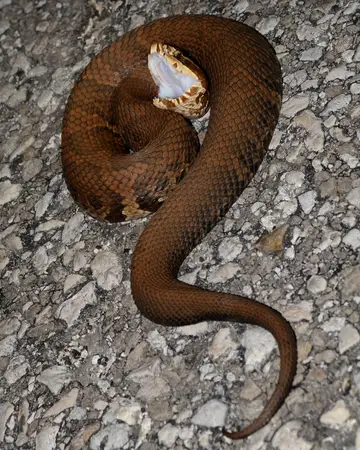

The cottonmouth, also called the water moccasin, is a venomous pit viper that lives in and around water in the southeastern United States. Official sources say its bite is dangerous and can be fatal without prompt medical care. Its range runs from the southeastern corner of Virginia across the coastal plain to central Texas, Oklahoma and Missouri. It does not live in Ohio or Pennsylvania. Many nonvenomous watersnakes look like it and are often mistaken for it. CDC/NIOSH
On this page
Is the cottonmouth dangerous?
The bite is dangerous and can be fatal if medical treatment is not sought immediately (Missouri Department of Conservation). Missouri Department of Conservation
“The bite of the northern cottonmouth is dangerous and can be fatal if medical treatment is not sought immediately.”
Bites and stings: Yes. A venomous bite that official sources call dangerous and potentially fatal.
If someone is bitten or stung, call 911 or Poison Help at 1-800-222-1222.
How to identify a cottonmouth
A photo or description can narrow it down, but cannot confirm what an animal is or that it is safe. Look from a distance and do not handle wild animals.
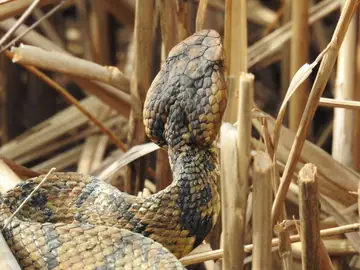
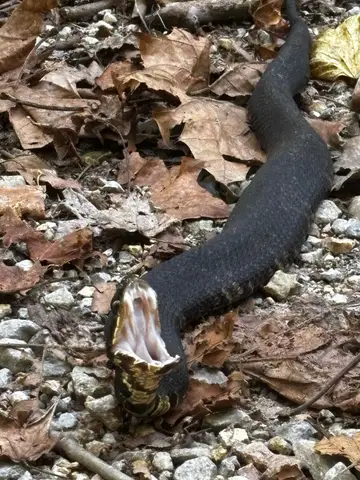
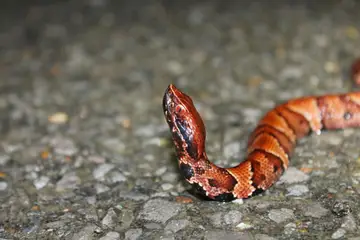
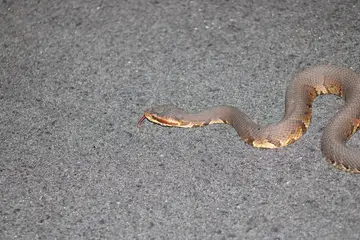

Size: Typically 30 to 48 inches (about 3 to 4 feet); recorded up to 75 inches. Missouri Department of Conservation
Colors: Adults dark tan, brown or nearly black; dark olive brown to nearly black; belly cream with heavy dark mottling. Pattern: Vague dark crossbands in adults; dark crossbands with lighter centers; older individuals are often completely dark and unpatterned.
Key features
- Heat-sensing pit between nostril and eye; no rattle North Carolina Wildlife Resources Commission
- Head much wider than the neck, with a dark bar from the eye to the jaw; vertical (cat-eye) pupils North Carolina Wildlife Resources Commission
- Gapes to show the white lining of its mouth when threatened North Carolina Wildlife Resources Commission
- Swims with its head above the surface and its back out of the water Missouri Department of Conservation
Young
Young snakes have a bold brown or orange crossbanded pattern and a yellow tail tip.
Animals mistaken for the cottonmouth
Cottonmouth or Watersnakes?
Cottonmouth
Watersnakes Nerodia spp.
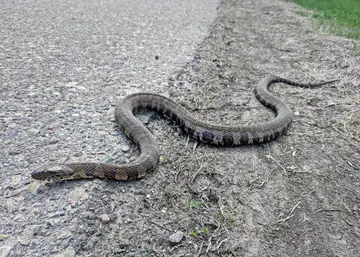

Seen from directly above, a watersnake's eyes are visible but a cottonmouth's are not. Watersnakes have round pupils and no facial pit, and they usually have thin dark vertical lines on the lips. Florida Museum of Natural History, University of Florida
Nonvenomous: the Florida Museum calls them 'non-venomous watersnakes'. CDC/NIOSH advice for any snake: 'Do not touch or handle any snake.'
Cottonmouth or Diamond-backed Watersnake?
Cottonmouth
Diamond-backed Watersnake Nerodia rhombifer
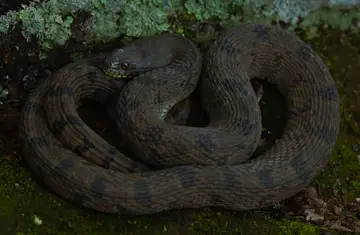

Alabama DCNR says this snake is often confused with the cottonmouth. TWRA: the diamond-backed watersnake is lighter, with a chain-like pattern; watersnakes in general lack the cottonmouth's facial pits (see the watersnake entry above).
Nonvenomous per Alabama DCNR.
Cottonmouth or Copperhead?
Cottonmouth
Copperhead Agkistrodon contortrix
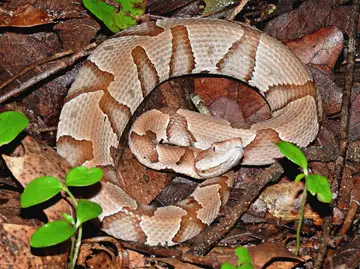

On young cottonmouths the dark crossbands have many dark spots and speckles; copperhead bands have none or one. Adult copperheads keep the banded pattern, while adult cottonmouths are usually plain and dark. A cottonmouth's eye is hidden in a dark facial band; a copperhead's is not. Florida Museum of Natural History, University of Florida
Venomous (CDC/NIOSH lists copperheads among venomous US snakes).
Where the cottonmouth lives
- Native or listed
- Nonnative or not established
- No official record in our data
- 1–9
- 10–99
- 100–999
- 1,000+
On our state guides
- Alabama snakes
- Arkansas snakes
- Georgia snakes
- Illinois snakes
- Indiana snakes
- Kansas snakes
- Kentucky snakes
- Louisiana snakes
- Mississippi snakes
- Missouri snakes
- North Carolina snakes
- Oklahoma snakes
- South Carolina snakes
- Tennessee snakes
- Texas snakes
- Virginia snakes
State boundaries: U.S. Census Bureau, cartographic boundary file cb_2024_us_state_20m.
When it is active
In Missouri: active from late April through October and mostly nocturnal, though it basks in spring and autumn. In Georgia: no well-defined activity period. Missouri Department of Conservation
US open-licence records peak in March to May and September to October.
Habitat and habits
Habitat: The most aquatic venomous snake in North America; found in most habitats tied to water: swamps, streams, ponds, marshes and ditches. North Carolina Wildlife Resources Commission
Behavior: When approached, some retreat and others stand their ground. A defensive snake coils, vibrates its tail and gapes. The Florida Museum says they are not aggressive and avoid contact with people and pets.
Diet: A very broad diet that includes fish, other snakes, small mammals, birds, lizards, amphibians, turtles, crayfish and insects.
Young: Gives birth to live young: 3 to 14 per litter, between August and October. Females often breed only every other year.
Legal status and reporting
Protection: Indiana: state endangered. Missouri: all snakes are protected by law. North Carolina: nongame species with no open season.
Questions about the cottonmouth
Which states have water moccasins
Georgia DNR gives the range as the southeastern corner of Virginia across the coastal plain to central Texas, Oklahoma and Missouri. State sources confirm cottonmouths in Alabama, Florida, Georgia, Louisiana, Mississippi, Missouri (southeast and the Ozarks), North Carolina (coastal plain and sandhills), South Carolina (sandhills and coastal plain), Tennessee (western third), Texas (eastern half), Virginia (southeast), and small areas of southern Indiana, Kentucky and Illinois.
Are there water moccasins in ohio?
No. Ohio DNR says water moccasins are not native to Ohio and that many people wrongly believe they occur there.
Are there water moccasins in pennsylvania?
No. The Pennsylvania Fish and Boat Commission says cottonmouths are not native to Pennsylvania and range only as far north as southern Virginia.
Are there water moccasins in indiana?
Yes, but only in one small area of southwestern Indiana, where the cottonmouth is state endangered (Indiana DNR).
Are there water moccasins in missouri?
Yes, mainly in the southeastern corner, with scattered populations in the Ozarks. Missouri Department of Conservation says none occur north of the Missouri River.
Are there water moccasins in texas?
Yes. Texas Parks and Wildlife says the cottonmouth is found across the eastern half of the state, in swamps, sluggish waterways, coastal marshes, rivers, ponds and streams.
Are there water moccasins in tennessee?
Yes, in the western third of Tennessee, including counties on the northern Highland Rim (TWRA).
Are there water moccasins in north carolina?
Yes, in the coastal plain and sandhills (NC State Extension).
Are there water moccasins in south carolina?
Yes, in the sandhills and coastal plain. SCDNR says they do not enter the piedmont or mountain regions.
Are there water moccasins in virginia?
Yes, mainly in southeastern Virginia (Virginia DWR).
Are there water moccasins in louisiana?
Yes. Louisiana Department of Wildlife and Fisheries says the northern cottonmouth is found throughout the state.
Are there water moccasins in florida?
Yes. The Florida Museum says cottonmouths are found throughout Florida and in every county.
Are there water moccasins in alabama?
Yes. Alabama DCNR lists the cottonmouth as common statewide.
Are there water moccasins in georgia?
Yes, mostly in the Coastal Plain and up the western side of the state. Georgia DNR lists both the Northern and the Florida Cottonmouth.
Cottonmouth vs water moccasin
They are the same snake: 'water moccasin' is another name for the cottonmouth. Missouri Department of Conservation notes that some people also use 'water moccasin' for nonvenomous watersnakes, which adds to the confusion.
Cottonmouth vs water snake
Seen from directly above, a cottonmouth's eyes are hidden but a watersnake's are visible. Cottonmouths have vertical pupils and a heat-sensing pit between the nostril and eye; watersnakes have round pupils and no pit, and they usually have thin dark lines on the lips. Cottonmouths often rest with the head tilted upward, and they swim with the head and back above the water.
Copperhead vs cottonmouth
Both are venomous. On young cottonmouths the crossbands are speckled with dark spots, while copperhead bands are not. Adult copperheads keep their banded pattern, but adult cottonmouths are usually plain and dark. A cottonmouth's eye sits inside a dark facial band; a copperhead's does not.
Sources
- Venomous Snakes at Work. CDC/NIOSH. archived copy, captured October 6, 2026; checked November 3, 2026.
Quoted passages (2)
“Venomous snakes found in the United States include rattlesnakes, copperheads, cottonmouths (also called water moccasins), and coral snakes.”
“Juveniles have a bold cross-banded pattern of brown or orange with a yellow tail.”
- Northern Cottonmouth (Field Guide). Missouri Department of Conservation. undated page; checked November 3, 2026.
Quoted passages (4)
“The bite of the northern cottonmouth is dangerous and can be fatal if medical treatment is not sought immediately.”
“Length: typically 30–48 inches (approx. 3–4 feet). They have been known to reach 75 inches (more than 6 feet) in length.”
“When swimming through the water, a cottonmouth will hold its head above the surface with its back out of the water.”
“Active from late April through October. … Individuals bask in the sun during the spring and autumn, but for the most part, this species is nocturnal.”
- Cottonmouth fact sheet. Georgia Department of Natural Resources, Wildlife Resources Division. PDF Last-Modified Fri, 02 Feb 2024 14:12:53 GMT; checked November 3, 2026.
- Reptiles of Ohio Field Guide (Publication 5354). Ohio Department of Natural Resources, Division of Wildlife. Publication date 2/18; checked November 3, 2026.
- Amphibians & Reptiles FAQs. Pennsylvania Fish and Boat Commission. undated page; checked November 3, 2026.
- Florida Cottonmouth (Florida Snake ID Guide). Florida Museum of Natural History, University of Florida. updated September 26, 2025; checked November 3, 2026.
Quoted passages (2)
“If the head is viewed from directly above, the eyes of cottonmouths cannot be seen, whereas the eyes of watersnakes are visible. … Cottonmouths have vertically elliptical pupils whereas watersnakes have round pupils. … Watersnakes usually have thin dark vertical lines on the sides of the face near the mouth, whereas the cottonmouths have no such dark lines.”
“The dark crossbands on the body of juvenile cottonmouths have numerous dark spots and speckles, whereas the dark crossbands on copperheads have no dark spots or at most only one. … Adult copperheads maintain their juvenile color pattern, whereas adult cottonmouths are typically uniformly dark with very little discernable pattern. … Each eye of the copperhead is not obscured by the dark facial band typical of the cottonmouth.”
- Cottonmouth. North Carolina Wildlife Resources Commission. undated page; checked November 3, 2026.
Quoted passages (7)
“The venomous cottonmouth, like all pit vipers, has a facial pit for sensing infrared radiation (heat), but unlike rattlesnakes, it lacks a rattle.”
“The head is distinctly wider than the neck, with a dark bar on both sides from the eye to the angle of the jaw. … the pupils of the eyes are vertically elliptical.”
“…the cottonmouth derives its common name from the white color of the inside of its mouth, which is revealed when the snake gapes to defend itself.”
“The cottonmouth is the most aquatic of North American venomous snakes and can be found in most habitats associated with water.”
“Cottonmouths have a very generalized diet; they eat fish, other snakes, small mammals, birds, lizards, amphibians, turtles, crayfish and insects.”
“If approached, some cottonmouths will retreat but others are defensive and will stand their ground. … They often coil, vibrate their tail and open their mouth to reveal the white inner lining.”
“Females give birth to a litter of 3–14 young between August and October. … many vipers, including cottonmouths, commonly reproduce in alternating years.”
- Cottonmouth. Alabama Department of Conservation and Natural Resources (Outdoor Alabama). undated page; checked November 3, 2026.
- Snakes. Indiana Department of Natural Resources, Division of Fish & Wildlife. article:modified_time 2026-03-09; checked November 3, 2026.
- Reptiles: Snakes (Tennessee Watchable Wildlife species accounts). Tennessee Wildlife Resources Agency. undated page; checked November 3, 2026.
- Snakes (TPWD Hunter Education). Texas Parks and Wildlife Department. undated page; checked November 3, 2026.
- Snakes on the Water. Virginia Department of Wildlife Resources. May 6, 2019; checked November 3, 2026.
- Upstate Snakes: Some Frequently Asked Questions. South Carolina Department of Natural Resources. page footer 2020; checked November 3, 2026.
- Snakes: Viperidae (NC State Extension). NC State Extension. Publication date: Aug. 21, 2019; checked November 3, 2026.
- Northern Cottonmouth (Snake Species Field Guide). Louisiana Department of Wildlife and Fisheries. undated page; checked November 3, 2026.
- Venomous Snakes of Georgia (brochure). Georgia Department of Natural Resources, Wildlife Resources Division. PDF Last-Modified 2024-02-02; checked November 3, 2026.
- GBIF.org occurrence records, human observations licensed CC0 1.0 or CC BY 4.0 only, accessed November 3, 2026. The datasets behind these counts are listed on our Sources page.
- State boundaries: U.S. Census Bureau, cartographic boundary file cb_2024_us_state_20m.