N.C. Wildlife Resources Commission: There are 38 species of snakes in North Carolina and most are harmless to people.
This page lists 41 snakes: all from N.C. Wildlife Resources Commission's 2025 SWAP Appendix 3 Table 3-7 REPTILES SGCN and Priority Species List.
6 are venomous by official accounts: Carolina Pygmy Rattlesnake, Copperhead, Eastern Coral Snake, Eastern Cottonmouth, Eastern Diamondback Rattlesnake and Timber Rattlesnake. N.C. Wildlife Resources Commission gives a total of 38; the 41 here are the snakes official sources name one by one.
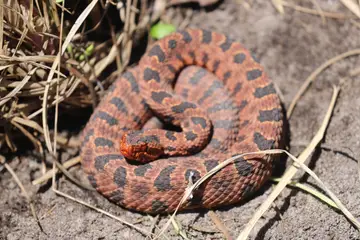
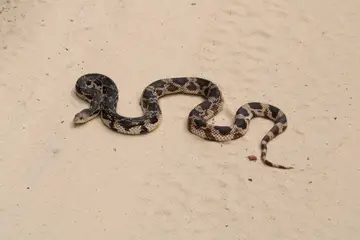
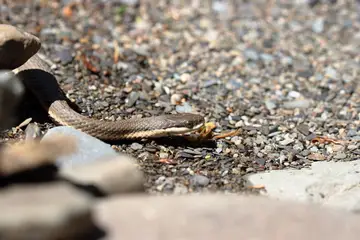
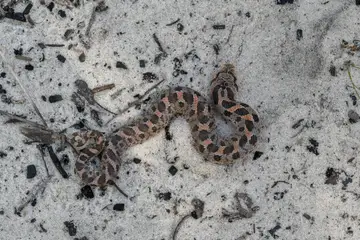
Pigmy rattlesnakes reach a length of 26 inches and occur primarily in the eastern and southeastern coastal plain and sandhills of North Carolina. NC State Extension
Conservation
NC State Protection Status: SC
What the sources say
Venom: “This venomous snake feeds on lizards, mice, and frogs.” (N.C. Wildlife Resources Commission)
These rare snakes are currently located only in the southeastern corner of North Carolina. NC State Extension
Conservation
NC State Protection Status: E
What the sources say
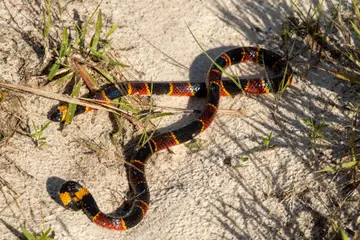
Venom: “The beautiful, highly venomous coral snake takes its name from its bright colors, reminiscent of those found in some species of coral.” (N.C. Wildlife Resources Commission)
Typically 30 to 48 inches (about 3 to 4 feet); recorded up to 75 inches.
How to recognize it
Heat-sensing pit between nostril and eye; no rattle
Head much wider than the neck, with a dark bar from the eye to the jaw; vertical (cat-eye) pupils
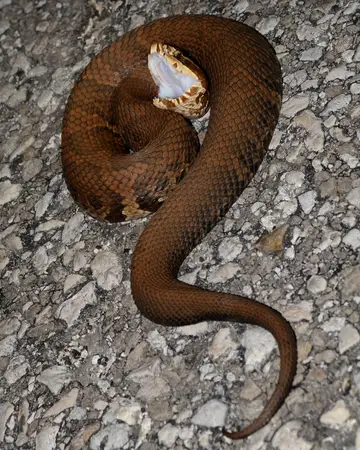
Gapes to show the white lining of its mouth when threatened
Where in North Carolina
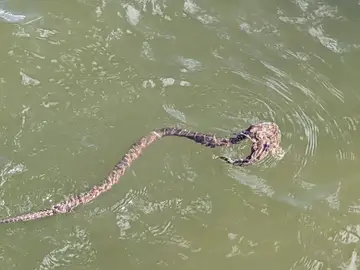
The cottonmouth (sometimes called water moccasin) can reach a length of 71 inches and occurs in the coastal plain and sandhills of North Carolina. NC State Extension
JFMAMJJASOND
105 records by month.What the sources say
Venom: “The venomous cottonmouth, like all pit vipers, has a facial pit for sensing infrared radiation (heat), but unlike rattlesnakes, it lacks a rattle.” (N.C. Wildlife Resources Commission)
Brown water snakes occur in the coastal plain, southern piedmont, and sandhills. NC State Extension
What the sources say
Venom: “They are often mistaken for cottonmouths because of brown skin with squarish blotches running down the center of their back, but they are non-venomous.” (N.C. Wildlife Resources Commission)
In populations on the Outer Banks and near brackish water, individuals have a dark-brown base color with black cross bands; these individuals are considered a subspecies … NC State Extension
Conservation
NC State Protection Status: SC
What the sources say
Venom: “This non-venomous watersnake is reddish brown and usually cross-banded.” (N.C. Wildlife Resources Commission)
Range: In populations on the Outer Banks and near brackish water, individuals have a dark-brown base color with black cross bands; these individuals are considered a subspecies known as the Carolina water snake (Nerodia sipedon williamengelsi), which is listed as a species of special concern in North Carolina.
They occur primarily in the sandhills, but small populations also persist in the extreme southeastern coastal plain and in the far southwestern mountains. NC State Extension
Conservation
NC State Protection Status: T
What the sources say
Venom: “The Northern pine snake is non-venomous” (N.C. Wildlife Resources Commission)
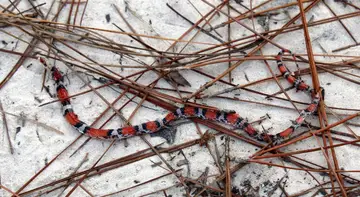
Scarlet snakes occur throughout much of the coastal plain and piedmont of North Carolina, but they are rare to absent in the mountains. NC State Extension
What the sources say
Venom: “Harmless (Cemophora coccinea)” (NC State Extension)
Northern water snakes can reach a length of 50 inches and occur throughout most of the mountains, piedmont, the northeastern coastal plain, and the Outer Banks. NC State Extension
What the sources say
Venom: “This non-venomous watersnake is reddish brown and usually cross-banded.” (N.C. Wildlife Resources Commission)
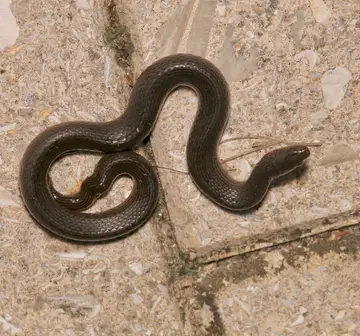
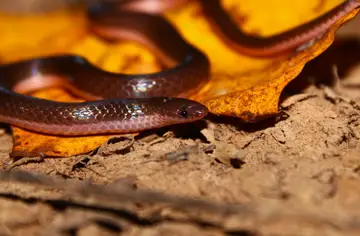
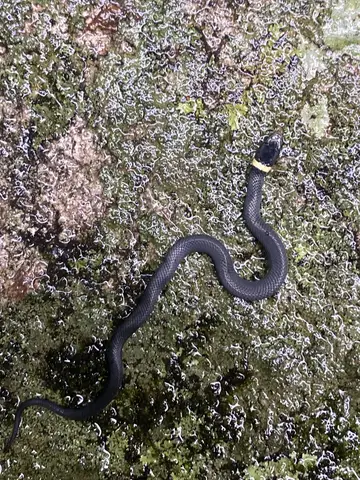
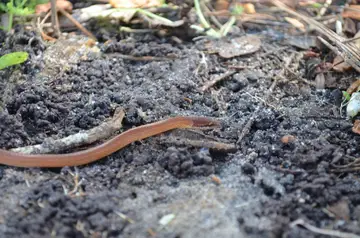
Pine woods snakes can reach 15 inches in length and occur in the southeastern coastal plain, with separate populations in the sandhills and on Roanoke and Bodie islands … NC State Extension
What the sources say
Venom: “This non-venomous snake feeds on lizards and frogs.” (N.C. Wildlife Resources Commission)
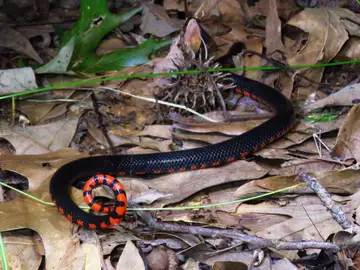
Range: Pine woods snakes can reach 15 inches in length and occur in the southeastern coastal plain, with separate populations in the sandhills and on Roanoke and Bodie islands on the Outer Banks.
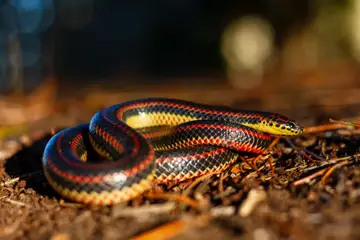
Most adults about 14-20 inches (36-51 cm); record 29.1 inches (Florida Museum). Louisiana gives 12 to 24 inches; NC State Extension says up to 27 inches.
How to recognize it
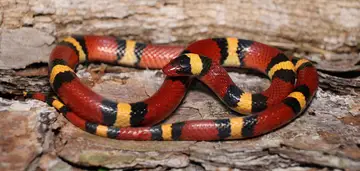
Red and yellow rings are separated by black rings, so red and yellow do not touch.
Small head with a red snout.
Rings continue across the belly (Louisiana).
Where in North Carolina
It occurs primarily in the coastal plain but also in small populations in the piedmont and mountains. NC State Extension
What the sources say
Venom: “Harmless (Lampropeltis elapsoides)” (NC State Extension)
They are most common in the southeastern coastal plain and sandhills, but they also occur over much of the piedmont and in portions of the southeastern mountains and … NC State Extension
What the sources say
Venom: “Harmless (Tantilla coronata)” (NC State Extension)
Range: They are most common in the southeastern coastal plain and sandhills, but they also occur over much of the piedmont and in portions of the southeastern mountains and foothills of North Carolina.
The copperhead's head is coppery with no marks; the milksnake's head is light with brownish marks (Pennsylvania). Tennessee: copperhead has a copper-colored, unmarked head and triangular shapes on the side of the body. Pennsylvania says the eastern milksnake is the snake most often killed by mistake for a copperhead. Belly colour is not used here: Pennsylvania's own pages describe the copperhead belly two different ways (uniform cream in one account, mottled white to gray in another).
Tennessee: the corn snake has a spear-point pattern between the eyes and a striped underside of the tail; milksnakes lack striping under the tail. Both have checkerboard bellies, so the belly alone does not separate them.
Scarlet kingsnake has a red snout and red, black and yellow bands in which red touches black but not yellow; its pattern continues onto the belly (Tennessee). Louisiana: the snout is always red and the rings continue across the belly. Tennessee still lists it as a milksnake subspecies (L. t. elapsoides); Louisiana lists it as Lampropeltis elapsoides.
Also venomous. Juvenile cottonmouths have many dark spots and speckles inside their dark crossbands (copperhead bands have none or at most one). The Florida Museum says adult Florida cottonmouths are typically uniformly dark, but SCDNR says cottonmouth color ranges from dark brown and black to olive drab and yellow-tan, so a pale snake is not ruled out. The copperhead's eye is not obscured by the dark facial band typical of the cottonmouth. Cottonmouths are almost always associated with wetlands.
Milk snake blotches are outlined in black and widest across the middle of the back; belly is a black-and-white checkerboard (copperhead belly is mottled white to gray).
Most copperhead bites can be prevented by leaving them alone; many bites happen when people try to capture, kill or handle them. N.C. Wildlife Resources Commission
Rarely. The Eastern Coral Snake is state-listed Endangered and one of NC's most rarely encountered vertebrates; found only in the southeastern corner of the state. N.C. Wildlife Resources Commission
“It is one of North Carolina’s most rarely encountered terrestrial vertebrates, and is state listed as Endangered.”
Are there water moccasins in North Carolina?
Yes. The cottonmouth (water moccasin) occurs in the coastal plain and sandhills. NC State Extension
“The cottonmouth (sometimes called water moccasin) can reach a length of 71 inches and occurs in the coastal plain and sandhills of North Carolina.”
Are there copperheads in North Carolina?
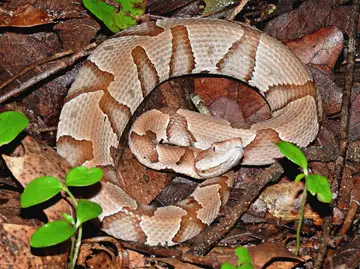
Yes. Copperheads occur across North Carolina except the Outer Banks (Extension); NCWRC lists abundance as statewide. NC State Extension
“They are the most common venomous snake in the state and occur across North Carolina, except for the Outer Banks.”
Copperhead (NCWRC species page). N.C. Wildlife Resources Commission. undated page; checked November 3, 2026.Quoted passages (5)
“There are 38 species of snakes in North Carolina and most are harmless to people.”
“The copperhead is the most common and widespread venomous snake in North Carolina.”
“The pupils are vertical and elliptical, and there is a heat sensory pit between the eye and nostril.”
“The great majority of bites can be prevented by exercising common sense: copperheads should be left alone.”
“Copperheads mate in the spring and fall. Females give birth to 3 to 14 (up to 20) live young during the late summer or early fall.”
Snakes: Family Colubridae (AG-472-02). NC State Extension (N.C. Cooperative Extension, NC State University). Publication date: Aug. 21, 2019; checked November 3, 2026.Quoted passages (7)
“They are often mistaken for cottonmouths because of brown skin with squarish blotches running down the center of their back, but they are non-venomous.”
“This venomous snake feeds on lizards, mice, and frogs.”
Snakes: Family Viperidae (AG-472-02). NC State Extension (N.C. Cooperative Extension, NC State University). Publication date: Aug. 21, 2019; checked November 3, 2026.Quoted passages (2)
“The cottonmouth (sometimes called water moccasin) can reach a length of 71 inches and occurs in the coastal plain and sandhills of North Carolina.”
“They are the most common venomous snake in the state and occur across North Carolina, except for the Outer Banks.”
“The beautiful, highly venomous coral snake takes its name from its bright colors, reminiscent of those found in some species of coral.”
“Still, these snakes should never be handled or in any way molested or harmed.”
“It is one of North Carolina’s most rarely encountered terrestrial vertebrates, and is state listed as Endangered.”
“Some nonvenomous snakes are often misidentified as coral snakes, especially the Scarlet Kingsnake”
Snakes: Family Elapidae (AG-472-02). NC State Extension (N.C. Cooperative Extension, NC State University). Publication date: Aug. 21, 2019; checked November 3, 2026.
Cottonmouth (NCWRC species page). N.C. Wildlife Resources Commission. undated page; checked November 3, 2026.Quoted passages (4)
“The venomous cottonmouth, like all pit vipers, has a facial pit for sensing infrared radiation (heat), but unlike rattlesnakes, it lacks a rattle.”
“The head is distinctly wider than the neck, with a dark bar on both sides from the eye to the angle of the jaw. … the pupils of the eyes are vertically elliptical.”
“…the cottonmouth derives its common name from the white color of the inside of its mouth, which is revealed when the snake gapes to defend itself.”
“Females give birth to a litter of 3–14 young between August and October.”