Eastern Diamondback Rattlesnake
Crotalus adamanteus · also called Eastern Diamond-backed Rattlesnake, Diamondback, Rattlesnake and Rattler · Last checked November 3, 2026.
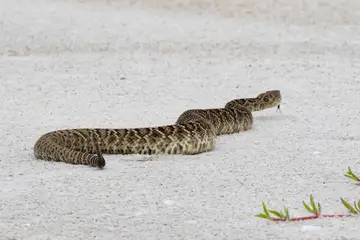
The eastern diamondback rattlesnake is a very large, heavy-bodied rattlesnake with a row of dark diamonds edged in cream or yellow down its brownish back and a rattle on the tail. It is venomous. The Florida Museum says its bites can be very dangerous to people and pets, but it is not aggressive and most bites happen when the snake is molested or stepped on. It lives in the Southeast: the coastal plain from southeastern North Carolina to eastern Louisiana, including all of Florida. Florida Museum of Natural History
On this page
Is the eastern diamondback rattlesnake dangerous?
Venomous. Bites can be very dangerous to people and pets. The snake is not aggressive, avoids contact and should be left alone. Florida Museum of Natural History
“The Eastern Diamond-backed Rattlesnake is a large and impressive snake, and bites can be very dangerous to people and pets.”
Bites and stings: Not aggressive. Florida Museum: most bites happen when the snake is intentionally molested or accidentally stepped on, and it can strike up to two-thirds of its body length. It does not need to rattle before striking (Florida Museum; CDC/NIOSH says rattlesnakes do not always rattle before biting).
If someone is bitten or stung, call 911 or Poison Help at 1-800-222-1222.
How to identify an eastern diamondback rattlesnake
A photo or description can narrow it down, but cannot confirm what an animal is or that it is safe. Look from a distance and do not handle wild animals.
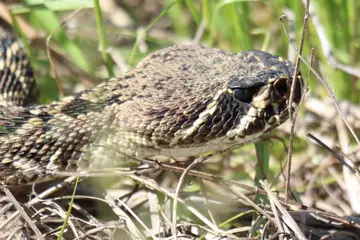
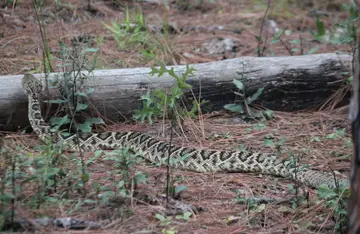
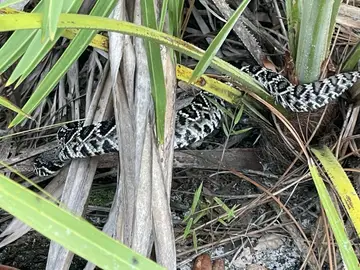
Size: Most adults 33 to 72 inches (about 3 to 6 feet); record 99 inches. Florida Museum of Natural History
Colors: Ground color brownish; background light brown to olive (South Carolina); gray back (North Carolina); belly yellowish to white. Pattern: A row of large dark diamonds with brown centers and cream borders down the back; toward the tail the diamonds fade or turn into dark bands; tail has pale and dark rings (Louisiana).
Key features
- Light-bordered dark stripe running diagonally through each eye Florida Museum of Natural History
- Tail ends in a rattle, often held above the ground Florida Museum of Natural History
- Cat-like vertical pupil and a deep heat-sensing pit between nostril and eye Florida Museum of Natural History
- Keeled (ridged) scales Florida Museum of Natural History
- Wide, blocky head, distinctly wider than the neck Georgia DNR Wildlife Resources Division
Young
Colored like adults but may be brighter; newborns have a single 'button' at the tail tip instead of a full rattle.
Animals mistaken for the eastern diamondback rattlesnake
Eastern Diamondback Rattlesnake or Timber Rattlesnake?
Eastern Diamondback Rattlesnake
Timber Rattlesnake Crotalus horridus
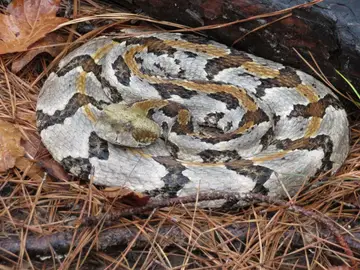

Timber rattlesnake has black chevron-like crossbands, a reddish stripe down the middle of the back and a black tail; Florida Museum says it is the only other rattlesnake likely to be confused with the diamondback in Florida. Florida Museum of Natural History
Venomous (Florida Museum).
Eastern Diamondback Rattlesnake or Western Diamondback Rattlesnake?
Eastern Diamondback Rattlesnake
Western Diamondback Rattlesnake Crotalus atrox
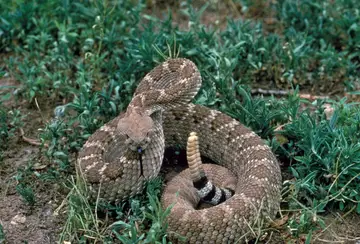

Arizona Game and Fish: the western diamondback's tail has alternating black and white bands of roughly equal width, and a thin light stripe runs back and down from the rear corner of the eye to the upper lip. Arizona Game and Fish Department
Venomous (Arizona Game and Fish Department).
Where the eastern diamondback rattlesnake lives
- Native or listed
- Nonnative or not established
- No official record in our data
- 1–9
- 10–99
- 100–999
- 1,000+
On our state guides
- Alabama snakes
- Florida snakes
- Georgia snakes
- Louisiana snakes
- Mississippi snakes
- North Carolina snakes
- South Carolina snakes
State boundaries: U.S. Census Bureau, cartographic boundary file cb_2024_us_state_20m.
When it is active
Mostly active by day (diurnal). Dormant underground in late fall and winter; may come out briefly on warm sunny days but is not seen regularly until spring. Georgia DNR Wildlife Resources Division
US open-licence records peak in March to April and September to December.
Habitat and habits
Habitat: Pine flatwoods, longleaf pine and turkey oak hammocks, sand pine scrub and coastal barrier islands, often with palmetto thickets and gopher tortoise burrows; sometimes suburban neighborhoods next to such habitat. Florida Museum of Natural History
Behavior: Usually lies quietly coiled when found; if provoked it coils, rattles loudly and may raise its head into an S-shaped strike position. Not aggressive; striking is a last-resort defense.
Diet: Mainly mammals (rabbits, cotton rats, mice, squirrels) and occasionally birds; usually a sit-and-wait ambush hunter.
Young: Gives birth to live young: in Florida about 8 to 29 young in August and September.
Legal status and reporting
Federal: Not listed under the Endangered Species Act; USFWS ECOS shows it as "Under Review". NCWRC's 2025 Wildlife Action Plan table gives its federal status as "At-Risk". US Fish and Wildlife Service
Protection: Protected in some states: State Endangered in North Carolina; in Louisiana, taking or possessing one from the wild is illegal. Alabama bans gassing wildlife burrows, a method used to collect these snakes. Georgia DNR calls it a Georgia Species of Concern, though SREL says it is not a protected species in Georgia; SREL says it is a species of concern in South Carolina. N.C. Wildlife Resources Commission
Report: North Carolina asks the public to report rattlesnake sightings (NCWRC "Rattlesnake Sightings Wanted" brochure). N.C. Wildlife Resources Commission
Questions about the eastern diamondback rattlesnake
Eastern diamondback rattlesnake bite
The eastern diamondback is venomous. The Florida Museum says bites can be very dangerous to people and pets and that a victim should get immediate medical care. Most bites happen when the snake is molested or stepped on. If bitten, call 911 or Poison Help at 1-800-222-1222.
Eastern diamondback rattlesnake venom
Alabama's wildlife agency says its venom attacks blood, tissue and the nervous system. Georgia calls it the largest venomous snake in North America.
Eastern diamondback rattlesnake size
Most adults are 33 to 72 inches long; the record is 99 inches (Florida Museum). Alabama gives an average of 4 to 5 feet. Georgia says they are known to reach 6.5 feet and that stories of snakes over 10 feet are not true.
Eastern diamondback rattlesnake range
Coastal plain from southeastern North Carolina to eastern Louisiana, including all of Florida (Alabama DCNR). State agencies confirm it in Florida, Georgia, Alabama, South Carolina, North Carolina and Louisiana, where it is now nearly gone.
Eastern diamondback rattlesnake florida
Yes. The Florida Museum says it is found throughout Florida and in every county, including many of the Keys. FWC lists it among Florida's six venomous snakes.
Eastern diamondback rattlesnake vs timber rattlesnake
Both are venomous. The diamondback has a row of dark diamonds with cream borders and a light-bordered dark stripe through each eye. The timber rattlesnake has black chevron-like crossbands, a reddish stripe down the back and a black tail.
Eastern diamondback rattlesnake vs western diamondback rattlesnake
Both are venomous rattlesnakes with diamond-shaped markings. The official sources here do not compare them, so this page gives no way to tell them apart. Alabama's wildlife agency gives the eastern diamondback's range as southeastern North Carolina to eastern Louisiana, including all of Florida; Arizona Game and Fish places the western diamondback across southern and most of western Arizona.
Are there eastern diamondback rattlesnakes in louisiana?
Barely. LDWF says there are no more than eight verifiable records, the last in 1995 near Franklinton, and no record of a stable population. It is ranked critically imperiled, and taking one from the wild is illegal.
Are there eastern diamondback rattlesnakes in new jersey?
No source here records them there. Their range ends in southeastern North Carolina (Alabama DCNR). New Jersey's Division of Fish and Wildlife names only two venomous snakes in the state: the timber rattlesnake and the northern copperhead.
Are there diamondback rattlesnakes in arizona?
Not the eastern diamondback, whose range runs from southeastern North Carolina to eastern Louisiana and Florida. Arizona does have the venomous western diamondback rattlesnake, found across southern and most of western Arizona.
Are there diamondback rattlesnakes in tennessee?
The Tennessee Poison Center says the eastern diamondback is not usually found in Tennessee; its range is along the coast from southeastern North Carolina to Florida and Louisiana.
Eastern diamondback rattlesnake nc
North Carolina lists it as State Endangered. It lives in sandy pine flatwoods of the southeastern Coastal Plain, and NCWRC asks people to report rattlesnake sightings.
Sources
- Florida Snake ID Guide species account: Eastern Diamond Backed Rattlesnake. Florida Museum of Natural History (University of Florida). updated September 23, 2022; checked November 3, 2026.
Quoted passages (12)
“The Eastern Diamond-backed Rattlesnake is a large and impressive snake, and bites can be very dangerous to people and pets.”
“Most adult Eastern Diamond-backed Rattlesnakes are about 33-72 inches (84-183 cm) in total length, with a record length recorded of 99 inches (251.5 cm).”
“The large and thick head is distinct from the neck and has a light bordered dark stripe running diagonally through each eye.”
“The tail ends in a rattle, which is often held above the ground.”
“The pupil is vertically elliptical, and there is a deep facial pit organ located between the nostril and the eye.”
“The dorsal scales of the body are keeled (each scale has a prominent raised ridge).”
“The coloration of juveniles is the same as described for adults, but it may be brighter with more contrast.”
“Eastern Diamond-backed Rattlesnakes are often found in pine flatwoods, longleaf pine and turkey oak hammocks, sand pine scrub areas, and coastal barrier islands.”
“Adults feed mostly on rabbits, cotton rats, mice, squirrels, and birds, whereas juveniles prefer mice and rats.”
“Most Eastern Diamond-backed Rattlesnakes lie quietly coiled when first discovered.”
“In Florida, females typically give birth to around 8-29 live young between August and September.”
“The Timber Rattlesnake has black chevron-like crossbands, a reddish stripe down the middle of its back, and a black tail.”
- Eastern Diamondback Rattlesnake. Alabama Department of Conservation and Natural Resources (Outdoor Alabama). undated page; checked November 3, 2026.
- Venomous Snakes Fact Sheet Series: Eastern Diamondback Rattlesnake. Georgia DNR Wildlife Resources Division. PDF Last-Modified Fri, 02 Feb 2024 14:12:53 GMT; checked November 3, 2026.
Quoted passages (2)
“…head is wide and blocky, and is distinctly wider than the neck.”
“Eastern diamondbacks are considered diurnal, which means they are most active during daylight hours.”
- ECOS species report query (Crotalus adamanteus, Storeria dekayi, Carcharhinus limbatus, Vespa crabro). U.S. Fish and Wildlife Service. live query 2026-11-03; checked November 3, 2026.
- Eastern Diamondback Rattlesnake (NCWRC species page). N.C. Wildlife Resources Commission. undated page; checked November 3, 2026.
Quoted passages (2)
“Classification: State Listed as Endangered”
“See a rattlesnake in the wild? We want to know!”
- Online Field Guide species account: Western Diamond-Backed Rattlesnake (Crotalus atrox). Arizona Game and Fish Department. 2023; checked November 3, 2026.
Quoted passages (1)
“The tail is marked with alternating black and white bands that are roughly equal in width. A thin, light colored stripe extends back and down from the posterior corner of the eye and touches the upper lip.”
- Checklist of Florida's Amphibians and Reptiles (Revised 2023). Florida Fish and Wildlife Conservation Commission (FWC). Revised 2023; checked November 3, 2026.
- Venomous Snakes of South Carolina (poster). SCDNR and South Carolina Wildlife Magazine. SCDNR 03CE4028 3/03; checked November 3, 2026.
- 2025 SWAP Appendix 3 Table 3-7 REPTILES SGCN and Priority Species List (2025 WAP Revision Taxa Team Evaluations). N.C. Wildlife Resources Commission. 2025 NC SWAP; checked November 3, 2026.
- Snake Species Field Guide: Eastern Diamond-backed Rattlesnake. Louisiana Department of Wildlife and Fisheries. undated page; checked November 3, 2026.
- Living with Snakes. Florida Fish and Wildlife Conservation Commission (FWC). archived copy, captured June 16, 2026; checked November 3, 2026. Archived copy.
- Snakes of New Jersey (brochure). New Jersey Division of Fish and Wildlife, Endangered and Nongame Species Program. PDF Last-Modified 2021-06-23; checked November 3, 2026.
- Bites & Stings | Tennessee Poison Center. Tennessee Poison Center (Vanderbilt University Medical Center), Tennessee's poison-control program. undated page; checked November 3, 2026.
- GBIF.org occurrence records, human observations licensed CC0 1.0 or CC BY 4.0 only, accessed November 3, 2026. The datasets behind these counts are listed on our Sources page.
- State boundaries: U.S. Census Bureau, cartographic boundary file cb_2024_us_state_20m.