Western Diamondback Rattlesnake
Crotalus atrox · also called western diamond-backed rattlesnake, western diamondback and diamondback · Last checked November 3, 2026.
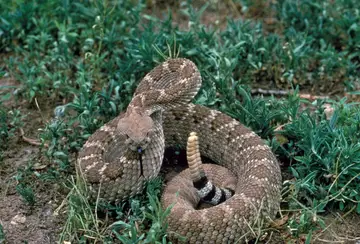

The western diamondback is a large rattlesnake of the Southwest: gray, tan, brown or pinkish, with dark-edged diamond-shaped blotches along the back and alternating black and white rings on the tail above the rattle. It is venomous and dangerous. Arizona Game and Fish says it can deliver large amounts of potent venom and is responsible for more bites and human deaths than any other US rattlesnake species. Leave it alone: a large share of bites happen when a snake is handled or abused. Official sources place it in Texas (all but the easternmost part), most of Oklahoma, southern and western Arizona, New Mexico, the far southeastern deserts of California, and Arkansas. If bitten, call 911 or Poison Help at 1-800-222-1222. Arizona Game and Fish Department
On this page
Is the western diamondback rattlesnake dangerous?
Dangerous to people and pets. Arizona Game and Fish: capable of delivering large amounts of potent venom; should be left alone. National Park Service: the venom can harm people and pets. Arizona Game and Fish Department
“This rattlesnake is capable of delivering large amounts of potent venom. If encountered it should be left alone.”
Bites and stings: Western diamondbacks often hold their ground instead of fleeing, and may raise the head into a striking pose, rattle and slowly retreat. A large percentage of bites happen when a snake is handled or abused. California warns that a startled rattlesnake may not rattle before striking and that dogs are at increased risk. Young snakes have fangs and venom from birth.
If someone is bitten or stung, call 911 or Poison Help at 1-800-222-1222.
How to identify a western diamondback rattlesnake
A photo or description can narrow it down, but cannot confirm what an animal is or that it is safe. Look from a distance and do not handle wild animals.
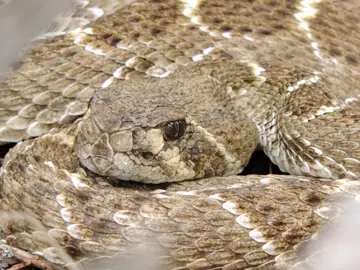
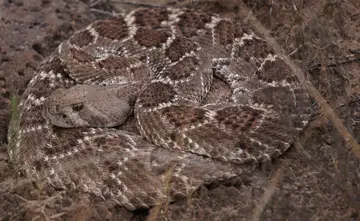
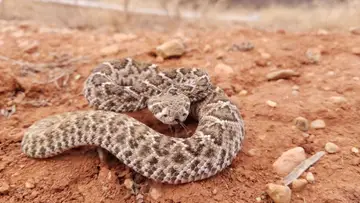
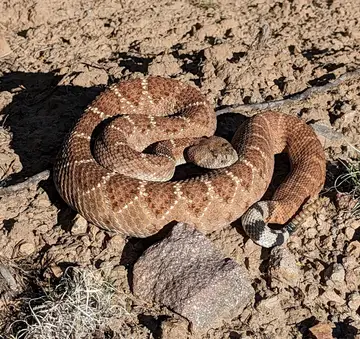
Size: Usually about 3.5 to 4.5 feet; Texas says it can reach seven feet. Arizona's maximum is 66 inches excluding the rattle; Saguaro National Park gives a range of 30 to 90 inches. Texas Parks and Wildlife Department
Colors: gray or tan, sometimes with a pinkish, rust or orange cast; brown to gray to pinkish, depending on habitat. Pattern: row of large brown to sandy-brown diamond-shaped blotches on the back, with dark edges, often outlined in cream or pale gray; alternating black and white tail bands of roughly equal width.
Key features
- rattle at the end of the tail Arizona Game and Fish Department
- broad triangular head on a slender neck; vertical pupils Arizona Game and Fish Department
- thin light stripe from behind the eye down to the upper lip Arizona Game and Fish Department
- heat-sensing pit on each side of the face Arizona Game and Fish Department
Young
Markings are very distinct in young snakes and fade in older ones. Young are born with fangs and venom.
Animals mistaken for the western diamondback rattlesnake
Western Diamondback Rattlesnake or Mojave (Mohave) rattlesnake?
Western Diamondback Rattlesnake
Mojave (Mohave) rattlesnake Crotalus scutulatus
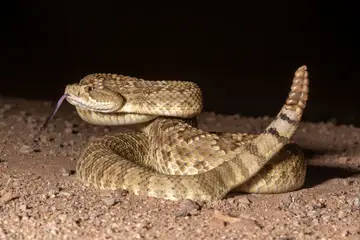
Hard to tell apart. Mojaves are often slightly greenish with thick white and narrower black tail bands; the western diamondback has more even bands. Texas adds that the Mojave is smaller and more slender. National Park Service
Also venomous: Arizona Game and Fish says it is widely considered the most toxic rattlesnake in the US.
Western Diamondback Rattlesnake or Eastern diamondback rattlesnake?
Western Diamondback Rattlesnake
Eastern diamondback rattlesnake Crotalus adamanteus
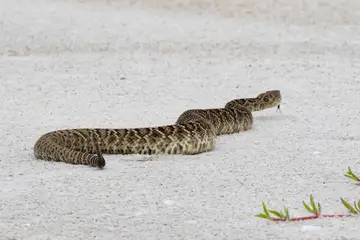
Location. Alabama gives the eastern diamondback range as coastal plain from southeastern North Carolina to eastern Louisiana and all of Florida. Outdoor Alabama
Also venomous.
Western Diamondback Rattlesnake or Bullsnake?
Western Diamondback Rattlesnake
Bullsnake Pituophis catenifer sayi
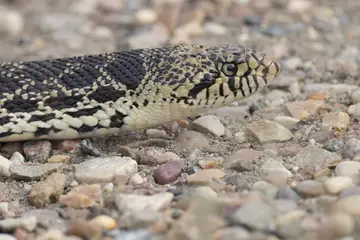

Bullsnakes lack a rattle but copy rattlesnake color and back pattern, and can hiss and shake the tail. In dry brush that can sound like a buzzing rattlesnake. National Park Service
NPS says bullsnakes are not venomous but should still be given a respectful amount of space.
Western Diamondback Rattlesnake or Gopher snake?
Western Diamondback Rattlesnake
Gopher snake Pituophis catenifer
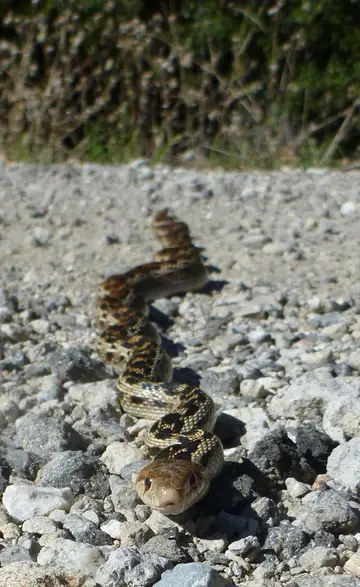

Can mimic a rattlesnake in appearance but has no rattle. California Department of Fish and Wildlife
California describes it as non-venomous.
Where the western diamondback rattlesnake lives
- Native or listed
- Nonnative or not established
- No official record in our data
- 1–9
- 10–99
- 100–999
- 1,000+
On our state guides
- Arizona snakes
- Arkansas snakes
- California snakes
- Kansas snakesNonnative
- Nevada snakes
- New Mexico snakes
- Oklahoma snakes
- Texas snakes
State boundaries: U.S. Census Bureau, cartographic boundary file cb_2024_us_state_20m.
When it is active
Can be active any time of day or night when conditions suit. Mostly daytime and dusk or dawn in spring and fall, and mostly night and dusk or dawn in hot summer months. Heads to winter dens in fall. In California, most rattlesnake bites happen April to October. Arizona Game and Fish Department
US open-licence records peak in May and July to September.
Habitat and habits
Habitat: Arid and semi-arid country: desert scrub and grassland, the lower reaches of chaparral and woodland, also river bottoms. In Arizona it seems most abundant on bajadas, hillsides and slopes; in Oklahoma it settles wherever small mammals are found. Arizona Game and Fish Department
Behavior: Often coils in partial shade and stays still to avoid detection; if that fails it may raise the head into a striking pose, rattle and slowly retreat. Hibernates alone or in communal dens.
Diet: Ambush hunter of mice, rats, ground squirrels, rabbits, lizards and birds, occasionally amphibians.
Young: Gives birth to live young. Sources differ on timing: Arizona says mating in spring and summer and a litter of up to 12 in early summer; Oklahoma says young are born in late summer. Oklahoma says the mother leaves them at birth.
Legal status and reporting
Protection: Protected inside national parks such as Big Bend, where all wildlife including snakes must not be harmed, handled or disturbed. No statewide protection statement for this species was found. National Park Service
Questions about the western diamondback rattlesnake
Western diamondback rattlesnake range
Official sources place it across southern and most of western Arizona, in New Mexico, most of Oklahoma, all but the easternmost part of Texas, the far southeastern deserts of California (rare there) and Arkansas.
Western diamondback rattlesnake size
Texas says it averages 3.5 to 4.5 feet and can reach seven feet. Arizona reports up to 66 inches excluding the rattle, and calls it the largest rattlesnake in the state.
Western diamondback rattlesnake bite
It is venomous and bites are a medical emergency: call 911 or Poison Help at 1-800-222-1222. Arizona Game and Fish says it is responsible for more bites and human deaths than any other US rattlesnake, and that many bites happen when a snake is handled or abused.
Western diamondback rattlesnake venom
Arizona Game and Fish says it can deliver large amounts of potent venom through long, hollow fangs. A Texas A&M publication describes the venom as a complex mix of tissue-destroying enzymes, hemotoxins and some neurotoxic peptides. Arizona also says a different species, the western rattlesnake (Crotalus oreganus), has venom twice as strong as the western diamondback's but produces less.
Western diamondback vs eastern diamondback
Both are venomous and share the diamond pattern. The main official difference is where they live: the eastern runs from coastal southeastern North Carolina to eastern Louisiana and all of Florida, while the western lives from Arkansas and Texas west to Arizona and far southeastern California. Eastern adults average four to five feet; western adults average 3.5 to 4.5 feet in Texas.
Are there western diamondback rattlesnakes in louisiana?
The Louisiana Department of Wildlife and Fisheries snake field guide lists three rattlesnakes (eastern diamond-backed, pygmy and timber) and does not list the western diamondback.
Are there diamondback rattlesnakes in arizona?
Yes. The western diamondback lives across all of southern and most of western Arizona.
Are there diamondback rattlesnakes in california?
Yes, but rarely seen: the western diamondback occurs in desert areas in the far southeastern part of the state.
Are there diamondback rattlesnakes in oklahoma?
Yes. Oklahoma says the western diamondback lives in most of the state.
Diamondback rattlesnakes in arkansas
Yes. The Arkansas Wildlife Action Plan lists the western diamond-backed rattlesnake as a Species of Greatest Conservation Need.
Sources
- Online Field Guide species account: Western Diamond-Backed Rattlesnake (Crotalus atrox). Arizona Game and Fish Department. 2023; checked November 3, 2026.
Quoted passages (11)
“This rattlesnake is capable of delivering large amounts of potent venom. If encountered it should be left alone.”
“Crotalus atrox Venomous”
“On the end of the tail is a rattle composed of a series of loosely interlocking keratinous sections.”
“The pupils are vertically elliptical and the dorsal scales are keeled. The neck is slender and the head is broad and triangular.”
“A thin, light colored stripe extends back and down from the posterior corner of the eye and touches the upper lip.”
“…heat sensing pits (one on each side of the face between the eye and nostril)”
“It inhabits a variety of communities including Sonoran, Chihuahuan, and Mohave desertscrubs, Semidesert Grassland, and the lower reaches of Interior Chaparral and Madrean Evergreen Woodland.”
“It eats mice, rats, ground squirrels, rabbits, lizards, birds and occasionally amphibians.”
“When a coiled snake is encountered it will often remain motionless, presumably to avoid detection. Failing that it may raise the head into a striking pose, rattle, and slowly retreat toward shelter. This snake hibernates alone or in communal dens.”
“It is primarily diurnal and crepuscular in spring and fall and becomes primarily nocturnal and crepuscular during the hot summer months.”
“Mating takes place in spring and summer. A litter of up to 12 young is born in early summer.”
- Living with Rattlesnakes. Arizona Game and Fish Department. archived copy, captured June 9, 2016; checked November 3, 2026.
- Venomous Snake Safety (Texas Junior Naturalists). Texas Parks and Wildlife Department. undated page; checked November 3, 2026.
Quoted passages (1)
“Averages 3 1/2 to 4-1/2 feet in length, and can reach seven feet.”
- Western Diamond-backed Rattlesnake (field guide). Oklahoma Department of Wildlife Conservation. undated page; checked November 3, 2026.
Quoted passages (1)
“These characteristics are very distinct in young snakes, but fade in older snakes.”
- Rattlesnakes. California Department of Fish and Wildlife. undated page; checked November 3, 2026.
Quoted passages (1)
“Some snakes can mimic the appearance of a rattlesnake, such as the gopher snake (Pituophis catenifer), but are non-venomous and lack a rattle.”
- Reptiles - El Malpais National Monument. National Park Service. updated May 6, 2025; checked November 3, 2026.
Quoted passages (1)
“Often confused with rattlesnakes, bullsnakes lack a rattle.”
- Arkansas Wildlife Action Plan, Section 8 Appendices (Appendix 2.1, List of Species of Greatest Conservation Need by Priority Score). Arkansas Game and Fish Commission. file path 2023/04; checked November 3, 2026.
- Snakes - Big Bend National Park. National Park Service. updated April 12, 2020; checked November 3, 2026.
Quoted passages (1)
“Keep in mind that all wildlife, including snakes, are protected in the park. Please don't harm, handle or otherwise disturb them.”
- Snakes - Saguaro National Park. National Park Service. updated May 6, 2025; checked November 3, 2026.
Quoted passages (1)
“Though somewhat difficult to tell apart from the western diamond-backed rattlesnake, mohaves are often slightly greenish in coloration, and their tail bands have thick white bands with narrower black bands; the diamond-backed has more uniform band widths.”
- Eastern Diamondback Rattlesnake. Alabama Department of Conservation and Natural Resources (Outdoor Alabama). undated page; checked November 3, 2026.
Quoted passages (1)
“Crotalus adamanteus ranges from coastal plain regions of southeastern North Carolina to eastern Louisiana, including all of Florida.”
- BISON-M (Biota Information System of New Mexico) species search export: taxonomic name "Serpentes". New Mexico Department of Wildlife (BISON-M, with Natural Heritage New Mexico). updated August 20, 2024; checked November 3, 2026.
- Venomous Snakes (NIOSH Outdoor Workers). CDC / NIOSH. archived copy, captured October 6, 2026; checked November 3, 2026.
- The Venomous Snakes of Texas Health Service Region 6/5S. Hosted by Texas A&M AgriLife Extension (Rangeland, Wildlife and Fisheries Management); authors at Texas A&M University Health Science Center and City of Pearland Animal Control. file path 2013/10; checked November 3, 2026.
- Nongame Wildlife FAQs. Alabama Department of Conservation and Natural Resources (Outdoor Alabama). undated page; checked November 3, 2026.
- Snake Species Field Guide. Louisiana Department of Wildlife and Fisheries. undated page; checked November 3, 2026.
- Pest Notes: Rattlesnakes. University of California Statewide IPM Program (UC ANR, Cooperative Extension). 2014-12; checked November 3, 2026.
- GBIF.org occurrence records, human observations licensed CC0 1.0 or CC BY 4.0 only, accessed November 3, 2026. The datasets behind these counts are listed on our Sources page.
- State boundaries: U.S. Census Bureau, cartographic boundary file cb_2024_us_state_20m.