Bullsnake
Pituophis catenifer sayi (bullsnake), a subspecies of the gophersnake Pituophis catenifer · also called Bull snake, Gopher snake and Gophersnake · Last checked November 3, 2026.
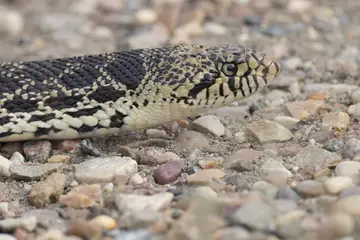

The bullsnake is a big, heavy-bodied, tan or yellowish snake with dark blotches, usually 3 to 6 feet long. It is non-venomous, but when threatened it hisses loudly, coils and vibrates its tail, so it is often mistaken for a rattlesnake. It has no rattle and will bite if captured. It lives in grasslands, prairies and farmland of the central and western US, from Texas and Missouri to Colorado, Iowa, Montana and Wyoming. Texas Parks and Wildlife Department
On this page
Is the bullsnake dangerous?
Texas Parks and Wildlife: bullsnakes can act defensively, hissing loudly and forming an S-shaped curve, but they are non-venomous and will not strike unless severely provoked. Texas Parks and Wildlife Department
“Despite their menacing attitude, they are non-venomous and they will not strike unless severely provoked.”
Bites and stings: Missouri Department of Conservation: if captured it will bite to defend itself. TPWD: it will not strike unless severely provoked.
If someone is bitten or stung, call 911 or Poison Help at 1-800-222-1222.
How to identify a bullsnake
A photo or description can narrow it down, but cannot confirm what an animal is or that it is safe. Look from a distance and do not handle wild animals.
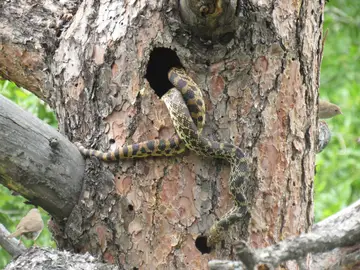
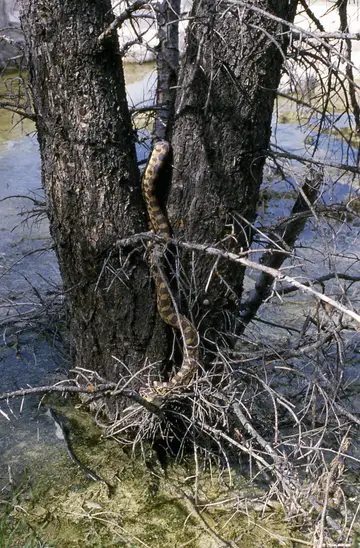

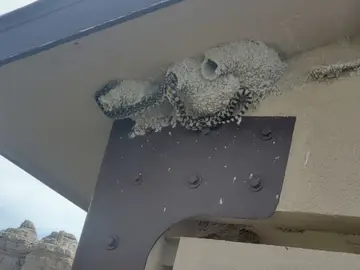
Size: Usually 37 to 72 inches; known to reach 105 inches (8 ft 9 in). Missouri's largest native snake. Missouri Department of Conservation
Colors: Tan, yellow, cream or white with about 40 large brown or black blotches; yellow or cream belly checkered with black; texas: beige to light brown with dark brown or black blotches; yellowish belly with black spots. Pattern: Blotches black on the neck and tail, brown at midbody; tail may have light and dark bands.
Key features
- Black line from the eye to the jaw and black bars along the upper lip Missouri Department of Conservation
- Keeled scales; round pupils; orange or brick-red eyes National Park Service
- No rattle on the tail National Park Service
- Heavy-bodied Texas Parks and Wildlife Department
- When threatened: coils, vibrates the tail and hisses loudly with the mouth partly open Missouri Department of Conservation
Animals mistaken for the bullsnake
Bullsnake or Prairie Rattlesnake?
Bullsnake
Prairie Rattlesnake Crotalus viridis
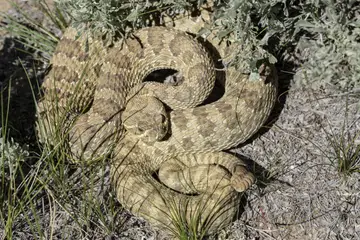
NPS (Bighorn Canyon): the bullsnake's color and scales are very similar to the prairie rattlesnake's; except for the shape of the head and eyes, they look very much alike. Bullsnake eyes have round pupils, and bullsnakes vibrate the tail in dry brush or leaves, making a sound like a rattle. NPS (Gila Cliff Dwellings): bull snakes do not have rattles on the end of the tail.
Venomous. Call 911 or Poison Help 1-800-222-1222 after any bite.
Bullsnake or Rattlesnakes (general)?
Bullsnake
Rattlesnakes (general) Crotalus spp.
California DFW: the gopher snake can mimic a rattlesnake's appearance but is non-venomous and has no rattle. California Department of Fish and Wildlife
Venomous. If unsure, keep away from the snake.
Where the bullsnake lives
- Native or listed
- Nonnative or not established
- No official record in our data
- 1–9
- 10–99
- 100–999
- 1,000+
On our state guides
- Arizona snakes
- California snakes
- Colorado snakes
- Idaho snakes
- Illinois snakes
- Iowa snakes
- Kansas snakes
- Minnesota snakes
- Montana snakes
- Nebraska snakes
- New Mexico snakes
- North Dakota snakes
- Oklahoma snakes
- Oregon snakes
- South Dakota snakes
- Texas snakes
- Utah snakes
- Washington snakes
- Wisconsin snakes
State boundaries: U.S. Census Bureau, cartographic boundary file cb_2024_us_state_20m.
When it is active
Missouri: active from late March to mid-November, seen most in May and June. It basks or hunts by day and shelters at night in burrows or under cover. Missouri Department of Conservation
US open-licence records peak in April to June and September.
Habitat and habits
Habitat: Native tallgrass prairies, other grasslands and savannas; also pastures, old fields and some river bluffs. TPWD: sandy soils in fields, brushlands and grasslands. Missouri Department of Conservation
Behavior: Varies in temperament: some are docile, others very defensive. It may hiss loudly or form an S-shaped curve.
Diet: Mainly small mammals, especially rodents: mice, rats, ground squirrels, pocket gophers and small rabbits, plus birds and eggs. It kills larger prey by constriction.
Young: Mating in April and May; 4 to 21 eggs laid in June or July in loose soil, burrows or under rocks and logs; hatching late August through September. Can live 20 years or more.
Legal status and reporting
Protection: Missouri lists it as a species of conservation concern and says rural Missourians should make every effort to protect it. Colorado requires a CPW license to collect or possess herpetofauna on its regulated list. Check your state agency. Missouri Department of Conservation
Questions about the bullsnake
Bull snake bite
Bullsnakes are non-venomous (TPWD, Colorado Parks and Wildlife, NPS). Missouri Department of Conservation says one will bite to defend itself if captured, and TPWD says it will not strike unless severely provoked. Because bullsnakes look like rattlesnakes, if you are not sure what bit you, call 911 or Poison Help at 1-800-222-1222.
Bull snake vs rattlesnake
NPS: bull snakes are not venomous and have no rattle on the tail, though they coil, hiss and vibrate the tail like a rattlesnake. At Bighorn Canyon, NPS says the bullsnake's colors and scales are very like the prairie rattlesnake's, but the head shape and eyes differ. Bullsnakes have round pupils.
Rattlesnake vs gopher snake
California DFW says the gopher snake can mimic a rattlesnake's appearance but is non-venomous and has no rattle. Arizona Game and Fish says that when threatened it raises its head, hisses, flattens the head and vibrates the tail, and is often mistaken for a rattlesnake.
Bull snake size
MDC: usually 37 to 72 inches, recorded to 105 inches. TPWD: 3 to 5 feet. Colorado: up to about 100 inches, rarely over 71. NPS: the largest snake in Montana and Wyoming, over 7 feet.
Bull snake texas
TPWD says bullsnakes are very common throughout Texas except the extreme east and the extreme western Trans-Pecos, in sandy fields, brushlands and grasslands.
Bull snake colorado
Yes. Colorado Parks and Wildlife says the bullsnake lives mostly on the eastern plains and the Great Basin gophersnake on the western slope. CPW calls both non-venomous and among the most effective rodent-control animals in Colorado.
Bull snake iowa
Yes. Iowa DNR has a bullsnake habitat sheet: it prefers open native grassland and sand prairies with loose sandy soil, and is active April through October.
Are there bull snakes in arizona?
Arizona Game and Fish lists the gophersnake (Pituophis catenifer), the species the bullsnake belongs to, in nearly every part of the state. It names the Sonoran and Great Basin subspecies, not the bullsnake subspecies.
Bull snake baby
MDC says bullsnake eggs usually hatch from late August through September, and TPWD says 15 to 20 hatchlings emerge in early autumn.
Gopher snake
The gophersnake (Pituophis catenifer) is the species the bullsnake belongs to. Arizona Game and Fish lists it as non-venomous and Arizona's longest snake, up to 92 inches. California DFW says it can mimic a rattlesnake but has no rattle.
Sources
- TPWD Wildlife Fact Sheet: Bullsnake (Pituophis catinefer sayi). Texas Parks and Wildlife Department. undated page; checked November 3, 2026.
Quoted passages (3)
“Despite their menacing attitude, they are non-venomous and they will not strike unless severely provoked.”
“The bullsnake is a heavy-bodied snake”
“Bullsnakes vary in temperament. Some are rather docile while others react very defensively toward anyone who attempts to handle them.”
- Bullsnake (Field Guide). Missouri Department of Conservation. undated page; checked November 3, 2026.
Quoted passages (8)
“Adult length: usually 37 to 72 inches; they have been known to reach 105 inches (8 feet 9 inches) in length.”
“There is usually a black line from the eye down to the jaw, and black bars along the upper lip.”
“If approached or cornered, a bullsnake will coil, vibrate its tail, and hiss loudly with the mouth partly open.”
“A species of native tallgrass prairies, other grasslands, and savannas; also occurs in pastures and old fields as well as along some river bluffs.”
“Bullsnakes kill larger prey by constriction, but small prey are simply grasped by the mouth and swallowed.”
“In Missouri, bullsnakes may be active from late March to the middle of November. Most bullsnakes are seen in May and June.”
“Eggs are laid during June or July, with 4–21 eggs per clutch.”
“A species of conservation concern in Missouri.”
- Reptiles - Gila Cliff Dwellings National Monument. National Park Service. updated April 24, 2025; checked November 3, 2026.
Quoted passages (1)
“Bull snakes are not venomous and do not have rattles on the end of their tail.”
- Gophersnake/Bullsnake (species profile). Colorado Parks and Wildlife. undated page; checked November 3, 2026.
- Bullsnake - Bighorn Canyon National Recreation Area. National Park Service. updated February 24, 2015; checked November 3, 2026.
Quoted passages (1)
“There are 27 to 37 rows of keeled dorsal scales. … The eyes are orange or brick red with round pupils.”
- Rattlesnake. California Department of Fish and Wildlife. undated page; checked November 3, 2026.
Quoted passages (1)
“Some snakes can mimic the appearance of a rattlesnake, such as the gopher snake (Pituophis catenifer), but are non-venomous and lack a rattle.”
- Online Field Guide species account: Gophersnake (Pituophis catenifer). Arizona Game and Fish Department. 2023; checked November 3, 2026.
- Bullsnake Pituophis catenifer sayi (Landowner Incentive Program habitat sheet). Iowa Department of Natural Resources (with US Fish and Wildlife Service). undated page; checked November 3, 2026.
- GBIF.org occurrence records, human observations licensed CC0 1.0 or CC BY 4.0 only, accessed November 3, 2026. The datasets behind these counts are listed on our Sources page.
- State boundaries: U.S. Census Bureau, cartographic boundary file cb_2024_us_state_20m.