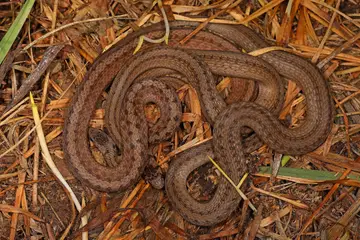
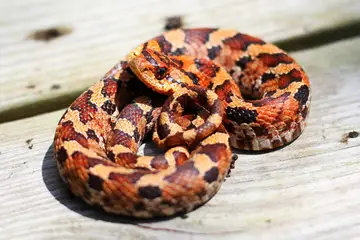
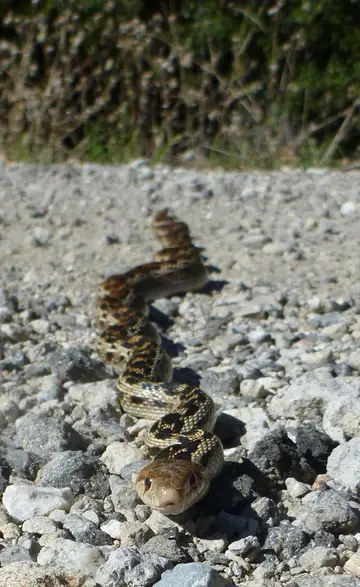
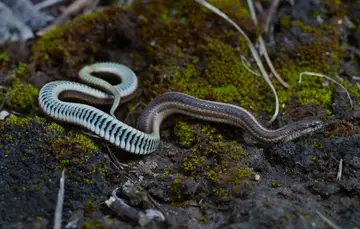
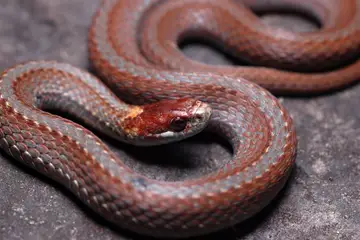
Minnesota Department of Natural Resources, Nongame Wildlife Program: Minnesota has seventeen snake species, two of which are rattle‑ snakes, and three lizard species
This page lists 17 snakes: all from Minnesota Department of Natural Resources, Nongame Wildlife Program's Snakes and Lizards of Minnesota.
2 are venomous by official accounts: Massasauga and Timber Rattlesnake.
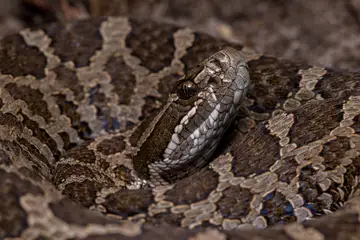
Venom: “MASSASAUGA (Sistrurus catenatus) Venomous” (Minnesota Department of Natural Resources, Nongame Wildlife Program)
Habitat: Prefers moist habitats such as marshes and other wetlands, backwater areas, and bottomland forests; often forages in more open, upland areas adjacent to water bodies (Minnesota Department of Natural Resources, Nongame Wildlife Program)
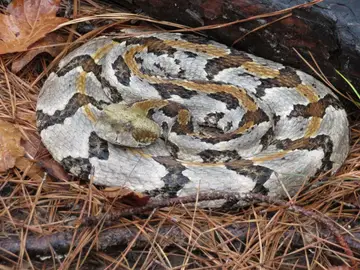
Venom: “Minnesota has two venomous snakes, both of which are rattlesnakes There are several characteristics that differentiate our rattlesnakes from our 15 nonvenomous snake species” (Minnesota Department of Natural Resources, Nongame Wildlife Program)
Habitat: This species is a habitat generalist, occurring in most Minnesota habitats It prefers forest and woodland edges, and has a strong affiliation for water and wet areas (Minnesota Department of Natural Resources, Nongame Wildlife Program)
Photo: U.S. Fish and Wildlife Service - Midwest Region · Public domain · Wikimedia Commons
Adults 22 to 42 inches long, occasionally to 59 inches (Missouri). Pennsylvania gives 24 to over 50 inches; females are usually bigger than males.
How to recognize it
Dark crossbands on the front part of the body break up into rows of blotches from the middle of the body to the tail.
Belly white, yellow or orange, usually with dark half-moon-shaped spots.
Keeled (ridged) scales, so it feels rough; round pupils like other nonvenomous snakes in Missouri.
What the sources say
Venom: “Minnesota has two venomous snakes, both of which are rattlesnakes There are several characteristics that differentiate our rattlesnakes from our 15 nonvenomous snake species” (Minnesota Department of Natural Resources, Nongame Wildlife Program)
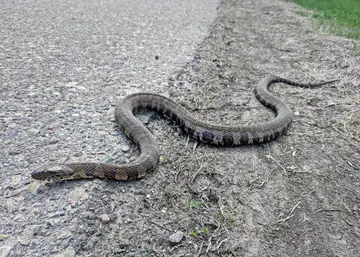
Habitat: Occurs in or around water including ponds, lakes, rivers, streams and wetlands Much time is spent basking on shore or on branches overhanging water (Minnesota Department of Natural Resources, Nongame Wildlife Program)
Most adults 9 to 13 inches; occasionally up to about 20 inches.
How to recognize it
Dark top of head; a dark spot under each eye and on each side of the neck
Keeled (ridged) scales in 17 rows; round pupil
Tennessee: a small dark downward streak on the side of the head
What the sources say
Venom: “Minnesota has two venomous snakes, both of which are rattlesnakes There are several characteristics that differentiate our rattlesnakes from our 15 nonvenomous snake species” (Minnesota Department of Natural Resources, Nongame Wildlife Program)
Habitat: Found under the surface litter in a variety of habitats, including moist areas of deciduous forests and woodland edges, oak savannas, prairies, old fields, and urban areas (Minnesota Department of Natural Resources, Nongame Wildlife Program)
Venom: “Minnesota has two venomous snakes, both of which are rattlesnakes There are several characteristics that differentiate our rattlesnakes from our 15 nonvenomous snake species” (Minnesota Department of Natural Resources, Nongame Wildlife Program)
Habitat: Prefer sandy areas in river floodplains, sand prairies, savannas and open woodlands Spend most of their time underground in self‑excavated burrows (Minnesota Department of Natural Resources, Nongame Wildlife Program)
Photo: National Park Service from USA · Public domain · Wikimedia Commons
Usually 3 to 6 feet; Arizona's longest snake, up to 92 inches (AZGFD); Missouri record 105 inches
How to recognize it
No rattle: tail tapers to a point
Round pupils; keeled back scales (separates it from the similar glossy snake)
Head somewhat triangular, more so when agitated (so head shape alone is not a safe test)
Conservation
Minnesota special concern species
What the sources say
Venom: “Minnesota has two venomous snakes, both of which are rattlesnakes There are several characteristics that differentiate our rattlesnakes from our 15 nonvenomous snake species” (Minnesota Department of Natural Resources, Nongame Wildlife Program)
Habitat: Occur in sand prairies, bluff prairies, oak savannas, oak barrens, and pastures (Minnesota Department of Natural Resources, Nongame Wildlife Program)
Venom: “Minnesota has two venomous snakes, both of which are rattlesnakes There are several characteristics that differentiate our rattlesnakes from our 15 nonvenomous snake species” (Minnesota Department of Natural Resources, Nongame Wildlife Program)
Habitat: Prefers prairies, savannas, and woodland edges, hiding under cover (Minnesota Department of Natural Resources, Nongame Wildlife Program)
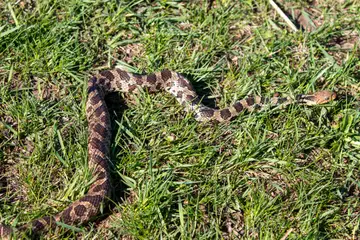
Eastern milksnake 24 to 52 inches (Alabama); TN gives 24 to 36 inches for eastern and 21 to 28 for red milksnake.
How to recognize it
Eastern milksnake: black-and-white checkerboard belly (Ohio). Western milksnake in Louisiana: underside dull white with scattered black marks.
Eastern milksnake: a light Y- or V-shaped mark is usually present on the nape
Smooth, shiny scales and round pupils
What the sources say
Venom: “Minnesota has two venomous snakes, both of which are rattlesnakes There are several characteristics that differentiate our rattlesnakes from our 15 nonvenomous snake species” (Minnesota Department of Natural Resources, Nongame Wildlife Program)
Habitat: Found in deciduous forests in association with rocky areas They are also found in woodlots, savannas, pastures and prairies They are often found near farm buildings and homes with stone foundations (Minnesota Department of Natural Resources, Nongame Wildlife Program)
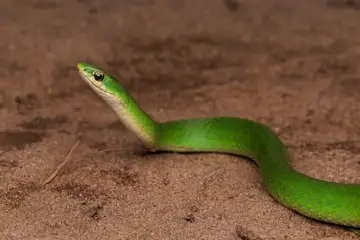
Most adults about 3 to 5 ft. Sources range from 20 to 56 inches (Florida Museum) to 34 to 77 inches (New Jersey); Alabama says some exceed 6 ft.
How to recognize it
Smooth scales
Long and slender with large eyes
White chin
Conservation
Minnesota special concern species
What the sources say
Venom: “Minnesota has two venomous snakes, both of which are rattlesnakes There are several characteristics that differentiate our rattlesnakes from our 15 nonvenomous snake species” (Minnesota Department of Natural Resources, Nongame Wildlife Program)
Habitat: Found in dry prairies, savannas, and woodland edges (Minnesota Department of Natural Resources, Nongame Wildlife Program)
Venom: “Minnesota has two venomous snakes, both of which are rattlesnakes There are several characteristics that differentiate our rattlesnakes from our 15 nonvenomous snake species” (Minnesota Department of Natural Resources, Nongame Wildlife Program)
Habitat: Prefer moist open grasslands and prairies, savannas, and open areas around ponds, marshes and streams in grassland areas (Minnesota Department of Natural Resources, Nongame Wildlife Program)
Venom: “Minnesota has two venomous snakes, both of which are rattlesnakes There are several characteristics that differentiate our rattlesnakes from our 15 nonvenomous snake species” (Minnesota Department of Natural Resources, Nongame Wildlife Program)
Habitat: Prefer open sandy or gravelly areas in river floodplains and sand prairies (Minnesota Department of Natural Resources, Nongame Wildlife Program)
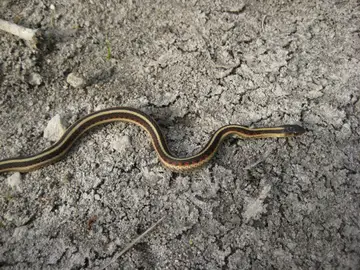
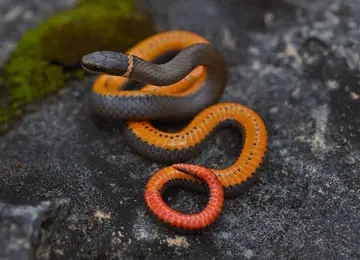
Usually 8 to 10 inches; state figures run from about 4 to 16 inches, with a Florida record of 16.6 inches.
How to recognize it
Plain, unmarked red or orange belly.
Three light spots just behind the head, which may fuse into a collar.
Keeled (ridged) scales in 15 rows at midbody and round pupils.
JFMAMJJASOND
101 records by month.What the sources say
Venom: “Minnesota has two venomous snakes, both of which are rattlesnakes There are several characteristics that differentiate our rattlesnakes from our 15 nonvenomous snake species” (Minnesota Department of Natural Resources, Nongame Wildlife Program)
Habitat: Prefer moist woodland habitats, but can be found in adjacent fields or wet areas (Minnesota Department of Natural Resources, Nongame Wildlife Program)
Venom: “Minnesota has two venomous snakes, both of which are rattlesnakes There are several characteristics that differentiate our rattlesnakes from our 15 nonvenomous snake species” (Minnesota Department of Natural Resources, Nongame Wildlife Program)
Habitat: Often found on south to west‑facing hillsides and bluffs in southeastern Minnesota, and under rocks, logs, or bark in damp deciduous forests in northern Minnesota These snakes are quite secretive, spending much of their time under flat rocks and in crevices They prefer areas with abundant ground cover (Minnesota Department of Natural Resources, Nongame Wildlife Program)
Venom: “Minnesota has two venomous snakes, both of which are rattlesnakes There are several characteristics that differentiate our rattlesnakes from our 15 nonvenomous snake species” (Minnesota Department of Natural Resources, Nongame Wildlife Program)
Habitat: Found in prairies, meadows, savannas, and in woodland and marsh edges (Minnesota Department of Natural Resources, Nongame Wildlife Program)
Venom: “Minnesota has two venomous snakes, both of which are rattlesnakes There are several characteristics that differentiate our rattlesnakes from our 15 nonvenomous snake species” (Minnesota Department of Natural Resources, Nongame Wildlife Program)
Habitat: Often found in riparian (river) areas, upland hardwood forests, pine barrens and prairies; typically near a river or stream (Minnesota Department of Natural Resources, Nongame Wildlife Program)
Adults 42 to 72 inches (3.5 to 6 feet), occasionally to 86 inches (MDC); Michigan adults frequently exceed 6 feet, record over 8 feet.
How to recognize it
Body shaped like a loaf of bread in cross section (flat belly meets the sides at an angle)
Weakly keeled scales, divided anal plate, squarish head
Freezes when approached; may kink its body like a crooked stick
Conservation
Minnesota threatened
What the sources say
Venom: “Minnesota has two venomous snakes, both of which are rattlesnakes There are several characteristics that differentiate our rattlesnakes from our 15 nonvenomous snake species” (Minnesota Department of Natural Resources, Nongame Wildlife Program)
Habitat: Occurs primarily in oak forests, but can occasionally be found on bluff prairies (Minnesota Department of Natural Resources, Nongame Wildlife Program)
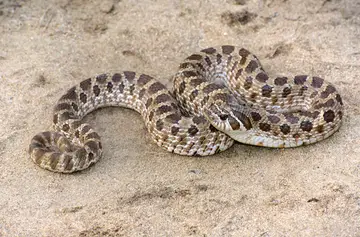
WDFW: gopher snakes lack a rattle and facial pits and have smaller, square back spots. NPS Cabrillo: the gopher snake's tail is long, skinny and pointed with no rattle, its head is about as slender as its neck (rattlesnakes have large spade- or triangle-shaped heads), and its back pattern is a rectangular chain rather than the circles or diamonds of a rattlesnake. Caution: a defensive gopher snake flattens its head into a triangle and vibrates its tail, so do not rely on head shape or sound alone.
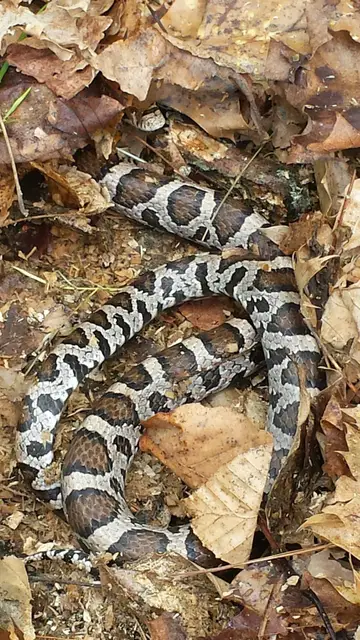
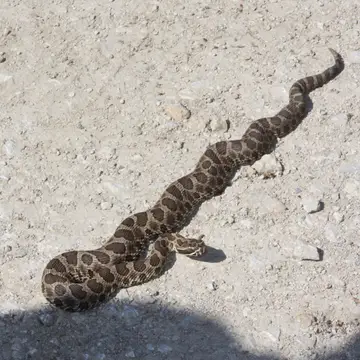
The timber rattlesnake has many small scales on top of the head (the massasauga has nine large plates), a uniformly black tail (the massasauga's tail has 4 to 7 black rings) and narrow, often chevron-shaped back bands rather than bow-tie-shaped blotches. INHS warns that head plates are hard to see on a live snake and says not to get close enough to check, because this is a venomous species.
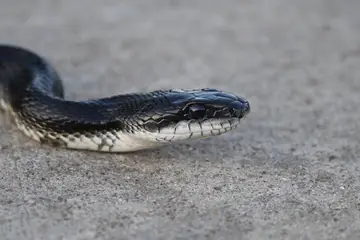
Massasauga rattlesnake or Common (northern) watersnake?
The two massasaugas look almost the same; Missouri identifies them mainly by where they are found.
Photos show typical adults; individuals vary. Never get close to compare.
When snakes are active in Minnesota
Records of snakes in Minnesota peak in May to June and September to October. They show when people record snakes, not how many there are (about month bars).
JanFebMarAprMayJunJulAugSepOctNovDec
547 records of snakes in Minnesota by month (GBIF, CC0 and CC BY records).
Do not try to capture or kill a rattlesnake or unidentified snake; most bites happen when people approach, handle or try to kill one. Minnesota Department of Natural Resources
Invasive insects (emerald ash borer, spongy moth, Asian long-horned beetle, brown marmorated stink bug): Minnesota Department of Agriculture "Report a Pest" line 1-888-545-6684. Invasive vertebrates (mute swans, Eurasian swine/wild pigs): the DNR Invasive Species Program and your local conservation officer or wildlife office. Aquatic invasives: your local DNR invasive species specialist. Cougar sightings: the nearest DNR area wildlife office or conservation officer. General DNR line: 888-646-6367. Minnesota Department of Natural Resources
What official sources say
Are there venomous snakes in Minnesota?
Yes. Two of Minnesota's 17 snake species are venomous, both rattlesnakes: the timber rattlesnake and the massasauga. Both are found only in the southeastern counties and are rarely encountered. Minnesota Department of Natural Resources
“Of the 17 snake species in the state, only two are venomous -- the Timber Rattlesnake and the Eastern Massasauga. Both are found only in the southeastern counties and are rarely encountered.”
Are there rattlesnakes in Minnesota?
Yes, but rare. Timber rattlesnakes live only in the blufflands of southeastern Minnesota (state threatened). The massasauga (state endangered) has not been documented since before 1960. Minnesota Department of Natural Resources
“Timber rattlesnakes live in the blufflands of southeastern Minnesota. They are not found anywhere else in the state.”
Are there copperheads or cottonmouths (water moccasins) in Minnesota?
“Minnesota has seventeen snake species, two of which are rattle‑ snakes, and three lizard species”
“Minnesota has two venomous snakes, both of which are rattlesnakes There are several characteristics that differentiate our rattlesnakes from our 15 nonvenomous snake species”
“MASSASAUGA (Sistrurus catenatus) Venomous”
“TIMBER RATTLESNAKE (Crotalus horridus) Venomous”
“Although timber rattlesnake bites are rarely life threatening, they should always be taken seriously”
“If you do not recognize a snake that you encounter, be safe Leave the snake alone, slowly back away, and if you need to pass the snake, stay at least 6 feet away”
“If you have a dog with you, it is important to get your dog on a leash or under your control until you are well past the snake”
“…they are typically only active in Minnesota from April through late October”
“May is the peak time for spring movements and September for fall movements, making them the peak months for most snake‑human encounters However, the peak encounter time for timber rattlesnakes in Minnesota is July through August”
“Water moccasins (cottonmouths) and copperheads do not occur in Minnesota”
“(Many people who encounter the common watersnake mistake it for a massasauga)”
Rare Species Guide: Massasauga. Minnesota Department of Natural Resources. archived copy, captured May 17, 2026; checked November 3, 2026.Quoted passages (1)
“The massasauga is one of Minnesota's two venomous snakes.”
“Report new locations to Minnesota Department of Agriculture or call the ‘Report a Pest’ phone number: 1-888-545-6684.”
Living with Wildlife: Snakes. Minnesota Department of Natural Resources. archived copy, captured October 25, 2026; checked November 3, 2026.Quoted passages (1)
“Of the 17 snake species in the state, only two are venomous -- the Timber Rattlesnake and the Eastern Massasauga. Both are found only in the southeastern counties and are rarely encountered.”