Black rat snake
Pantherophis obsoletus (broad sense; formerly Elaphe obsoleta obsoleta) · also called black ratsnake, black snake, pilot black snake and chicken snake · Last checked November 3, 2026.
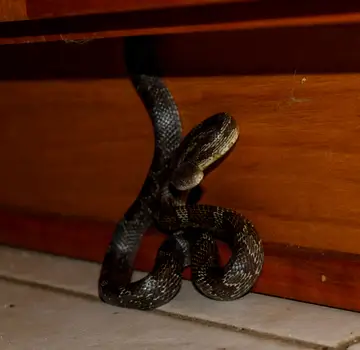
The black rat snake is a large, shiny black snake, usually 3.5 to 6 feet long and sometimes over 7 feet, with a white chin and throat. Ohio and Pennsylvania's wildlife agencies and Michigan State University Extension each call it their state's largest snake. It is not venomous: state wildlife agencies call it nonvenomous, though it will bite, vibrate its tail and release a foul musk if cornered or grabbed. Young ones are gray with dark blotches and look very different from adults, and Georgia DNR lists rat snakes among the nonvenomous snakes often confused with venomous copperheads. It climbs well and often turns up in barns, attics and trees, hunting rodents and birds. It lives across much of the eastern and central United States; official names now differ by state (western, gray, central or eastern ratsnake). Missouri Department of Conservation
On this page
Is the black rat snake dangerous?
Missouri Department of Conservation: harmless to people and nonvenomous, but it will bite in self-defense and release a foul musk when cornered or captured. Missouri Department of Conservation
“When cornered or captured, ratsnakes will bite in self-defense and release a pungent, unpleasant-smelling musk from glands at the base of the tail.”
Bites and stings: Bites in self-defense when cornered, grabbed or handled roughly. NCWRC says even a large one's bite is no more severe than a briar scratch.
If someone is bitten or stung, call 911 or Poison Help at 1-800-222-1222.
How to identify a black rat snake
A photo or description can narrow it down, but cannot confirm what an animal is or that it is safe. Look from a distance and do not handle wild animals.
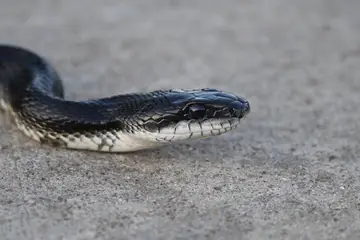
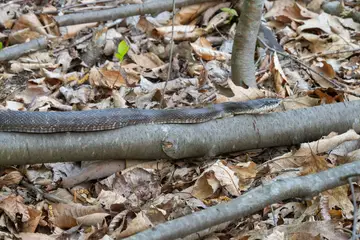

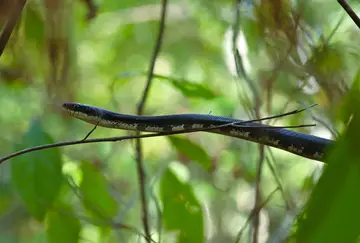

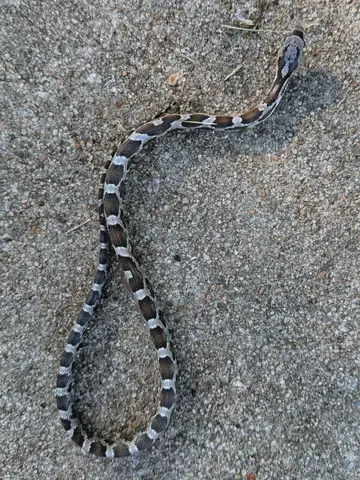
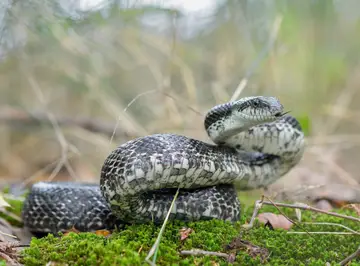

Size: Adults 42 to 72 inches (3.5 to 6 feet), occasionally to 86 inches (MDC); Michigan adults frequently exceed 6 feet, record over 8 feet. Missouri Department of Conservation
Colors: Shiny black with a white chin and throat; back generally shiny black; skin between scales may show red; white lip, chin and neck; belly white, checkered with black in front; skin between scales may be bluish white, yellow, red or orangish; belly white or yellow with gray or brown mottling. Pattern: Body mostly black or dark brown, some with a blotched pattern; adults may keep some blotching or lose it and look solid black. Light belly with dark square blotches in a checkered pattern.
Key features
- Body shaped like a loaf of bread in cross section (flat belly meets the sides at an angle) N.C. Wildlife Resources Commission
- Weakly keeled scales, divided anal plate, squarish head Pennsylvania Fish and Boat Commission
- Freezes when approached; may kink its body like a crooked stick N.C. Wildlife Resources Commission
- Vibrates its tail when cornered, which can be mistaken for a rattlesnake Indiana Department of Natural Resources
Young
Young are gray or tan with distinct dark brown or black blotches and a dark band between the eyes; they usually turn mostly black after a year or two.
Animals mistaken for the black rat snake
Black rat snake or Copperhead?
Black rat snake
Copperhead Agkistrodon contortrix
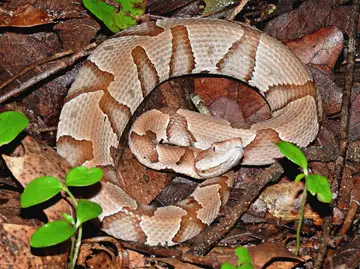

Georgia DNR lists the gray rat snake and the yellow phase of the eastern rat snake among nonvenomous snakes often confused with copperheads. Virginia DWR says baby eastern ratsnakes (black snakes) and northern black racers are the most commonly misidentified baby snakes, and that juvenile copperheads look much like adults but with a bright yellow tail. New Jersey DFW: copperheads have a unique hourglass pattern, wide on the sides and narrow across the back, and young copperheads have a greenish-yellow-tipped tail. Hatchling and yearling black rat snakes have irregularly shaped blotches, and the pattern runs through the tip of a pointed tail. Georgia Department of Natural Resources, Wildlife Resources Division
Venomous. New Jersey DFW lists the copperhead as one of the state's two venomous snakes.
Black rat snake or Timber rattlesnake (black phase)?
Black rat snake
Timber rattlesnake (black phase) Crotalus horridus
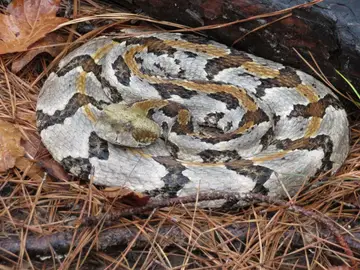

New Jersey DFW, for hatchling and yearling black rat snakes: the pattern runs down through the tip of a pointed tail, unlike the timber rattlesnake's 'velvet tail', where the last few inches before the rattle are solid black. New Jersey DFW also says timber rattlesnakes have yellow/light and black/dark color phases, and warns that many snakes shake their tails like a rattle, so the sound alone can mislead. New Jersey Division of Fish and Wildlife, Endangered and Nongame Species Program
Venomous (New Jersey DFW).
Black rat snake or North American racer (black racer)?
Black rat snake
North American racer (black racer) Coluber constrictor
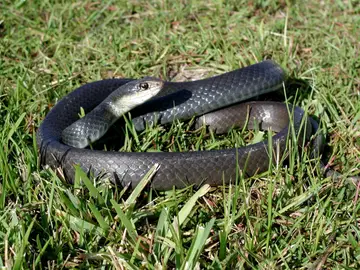

Ohio DNR: the adult black racer has no dorsal pattern at all, while most black (gray) ratsnakes show at least a trace of pattern. Indiana DNR adds that some adults lose the pattern and look solid black, so this does not separate every snake. NCWRC: racers are smaller and faster-moving. Ohio Department of Natural Resources, Division of Wildlife
Black rat snake or Cottonmouth?
Black rat snake
Cottonmouth Agkistrodon piscivorus / A. conanti
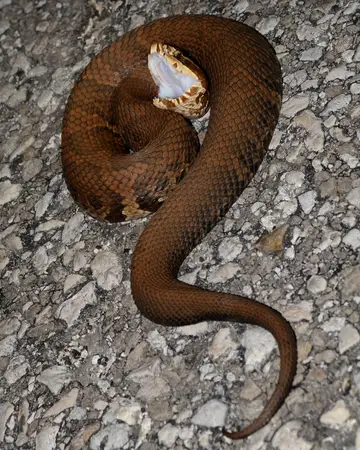

Georgia DNR: the dark stripe on the side of the jaw, the heat-sensing pit on the face and the gaping defensive display (opening the mouth wide) are distinctive to cottonmouths. Georgia Department of Natural Resources, Wildlife Resources Division
Venomous (Georgia DNR); see the cottonmouth page.
Where the black rat snake lives
- Native or listed
- Nonnative or not established
- No official record in our data
- 1–9
- 10–99
- 100–999
- 1,000+
On our state guides
- Delaware snakes
- Iowa snakes
- Kansas snakes
- Louisiana snakes
- Michigan snakes
- Minnesota snakes
- Missouri snakes
- New Jersey snakes
- North Carolina snakes
- Oklahoma snakes
- Texas snakes
State boundaries: U.S. Census Bureau, cartographic boundary file cb_2024_us_state_20m.
When it is active
Missouri: active early April through October; hunts by day in spring, early summer and autumn, at night in hot weather. Michigan: late April through October, peaking in May and June. Missouri Department of Conservation
US open-licence records peak in April to July.
Habitat and habits
Habitat: Mainly woodland and forest, especially rocky wooded hillsides and woods along streams; shelters in brush piles, hollow trees, barns and old houses, and may get into attics and walls. Missouri Department of Conservation
Behavior: Excellent climber that raids bird nests and boxes; enters buildings more often than any other North Carolina snake. Freezes when first approached.
Diet: Rodents, small rabbits, bats, bird eggs and small birds, occasionally lizards; kills larger prey by constriction. Young eat frogs, lizards and insects.
Young: Lays usually 4 to 40 eggs in June or early July in rotten logs, stumps, sawdust or mulch piles; eggs hatch in autumn after 42 to 84 days. Lifespan can exceed 20 years (MDC).
Legal status and reporting
Protection: Varies by state. Michigan: a state species of special concern (MNFI); MSU Extension's 1999 guide says it may not be captured or killed. North Carolina: nongame species with no open season. Virginia Cooperative Extension: it is illegal in Virginia to kill any species of snake. Savannah River Ecology Laboratory: not protected in most states, but protected in Georgia. Michigan State University Extension
Invasive status: Native where stated: Louisiana (LDWF, western ratsnake) and Virginia (DWR lists central ratsnake with no naturalized mark). Louisiana Department of Wildlife and Fisheries
Report: NCWRC does not send staff to remove snakes and advises leaving the snake alone and giving it space; it will usually move on. N.C. Wildlife Resources Commission
Questions about the black rat snake
Copperhead vs rat snake
Georgia DNR lists the gray rat snake and the yellow phase of the eastern rat snake among nonvenomous snakes often confused with copperheads. Virginia DWR says baby eastern ratsnakes are among the most commonly misidentified baby snakes, and that young copperheads look much like adults but with a bright yellow tail. New Jersey DFW says copperheads have an hourglass pattern, wide on the sides and narrow across the back, while young black rat snakes have irregular blotches running through the tip of a pointed tail. Copperheads are venomous. If unsure, leave the snake alone.
Rat snake baby
Baby black rat snakes do not look black: MDC says they are gray or tan with dark blotches and a dark band between the eyes, turning mostly black after a year or two. Eggs hatch in autumn.
Are there rat snakes in michigan?
Yes. MSU Extension's 1999 field guide says the black rat snake (now called the gray ratsnake) lives in the southern half of Michigan's Lower Peninsula, where it is locally common in the southwestern counties but rare and declining over most of its Michigan range. Michigan Natural Features Inventory lists it as state special concern.
Sources
- Western Ratsnake (Field Guide). Missouri Department of Conservation. undated page; checked November 3, 2026.
Quoted passages (7)
“When cornered or captured, ratsnakes will bite in self-defense and release a pungent, unpleasant-smelling musk from glands at the base of the tail.”
“Adult length: 42 to 72 inches (3½ to 6 feet); occasionally to 86 inches (more than 7 feet).”
“Young are gray or tan, with distinct dark brown or black blotches on the back and sides; a black band passes between the eyes and angles down toward the mouth. After a year or two of growth, the color normally changes to a more uniform black.”
“Western ratsnakes are principally a woodland and forest species, preferring rocky, wooded hillsides or sections of woods along streams and rivers.”
“Western ratsnakes eat a variety of rodents, small rabbits, bats, bird eggs, small birds, and occasionally lizards.”
“The active season is from early April through October. In spring, early summer, and autumn, they hunt in the daytime; in hot weather, they are nocturnal.”
“Eggs, usually 4–40, are laid in June or early July in rotten stumps or logs, tree holes, sawdust piles, or mulch piles, or under rocks.”
- Michigan Snakes: A Field Guide and Pocket Reference (MSU Extension Bulletin E-2000). Michigan State University Extension (MSU Library archive). Revised 1999; checked November 3, 2026.
Quoted passages (1)
“This is a species of "special concern" and may not be captured or killed.”
- Rat Snake (NCWRC species page). N.C. Wildlife Resources Commission. undated page; checked November 3, 2026.
Quoted passages (3)
“Their relatively slender bodies are shaped like a loaf of bread in a cross section”
“Because of their climbing abilities and shelter-seeking habits, rat snakes enter buildings more frequently than any other North Carolina snake.”
“The best plan is to leave the snake alone and give it plenty of space.”
- Reptiles of Ohio Field Guide (Publication 5354). Ohio Department of Natural Resources, Division of Wildlife. PUBLICATION 5354; checked November 3, 2026.
Quoted passages (1)
“The adult black racer has no dorsal pattern at all. Most gray ratsnakes have at least a semblance of a pattern”
- It’s Baby Snake Season! Virginia DWR (J.D. Kleopfer/DWR). September 18, 2019; checked November 3, 2026.
- Snakes (species accounts). Pennsylvania Fish and Boat Commission. undated page; checked November 3, 2026.
Quoted passages (1)
“A flattened snout seems to emphasize the head's squarish appearance. … It has a divided anal plate. The scales are only weakly keeled.”
- Venomous Snakes of Georgia (brochure). Georgia Department of Natural Resources, Wildlife Resources Division. PDF Last-Modified 2024-02-02; checked November 3, 2026.
Quoted passages (2)
“OFTEN CONFUSED WITH: Gray Rat Snake; Eastern Rat Snake (yellow phase)”
“…the dark stripe on the side of the jaw, heat-sensing pit on the face and the behavior of gaping – a defensive posture where the snake opens its mouth wide – are distinctive to Cottonmouths.”
- Rat Snake (Pantherophis obsoletus alleghaniensis). University of Georgia Savannah River Ecology Laboratory (linked by SCDNR as its species information). undated page; checked November 3, 2026.
- Rat Snake - North Carolina Wildlife Profiles. N.C. Wildlife Resources Commission. undated page; checked November 3, 2026.
Quoted passages (1)
“…will often lie still and kink its body so that it somewhat resembles a crooked stick.”
- Gray Ratsnake. Indiana Department of Natural Resources. undated page; checked November 3, 2026.
Quoted passages (1)
“The vibration of the tail is convincing, leading them to be mistaken for a rattlesnake.”
- Snake Species Field Guide: Western Ratsnake. Louisiana Department of Wildlife and Fisheries. undated page; checked November 3, 2026.
Quoted passages (1)
“Terrestrial Native Nonvenomous”
- Snake Identification: Avoid Being Confused! New Jersey Division of Fish and Wildlife, Endangered and Nongame Species Program. PDF Last-Modified 2019-04-03; checked November 3, 2026.
Quoted passages (1)
“Both of their patterns run down through the tip of their pointed tails as opposed to the rattlesnake’s ‘velvet tail.’”
- Special Animal Abstract: Gray Ratsnake (Pantherophis spiloides). Michigan Natural Features Inventory (Michigan State University Extension). Copyright 2008; checked November 3, 2026.
- GBIF.org occurrence records, human observations licensed CC0 1.0 or CC BY 4.0 only, accessed November 3, 2026. The datasets behind these counts are listed on our Sources page.
- State boundaries: U.S. Census Bureau, cartographic boundary file cb_2024_us_state_20m.