Northern watersnake
Nerodia sipedon · also called Northern water snake, Common watersnake, Midland watersnake (subspecies N. s. pleuralis) and Lake Erie watersnake (subspecies N. s. insularum) · Last checked November 3, 2026.
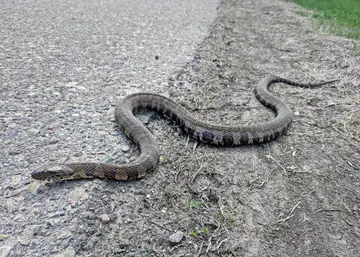

The northern watersnake (Nerodia sipedon) is a heavy-bodied snake of ponds, lakes, streams and marshes, usually brown to gray with dark crossbands toward the head that break into blotches farther back. State wildlife agencies say it is not venomous. It is often killed because people mistake it for a cottonmouth (water moccasin), but it will bite hard if grabbed and its bites may bleed a lot (Pennsylvania Fish and Boat Commission). It is native to much of the eastern and central US. California treats it as an invasive species: it is established near Roseville and should be reported to CDFW. Missouri Department of Conservation
On this page
Is the northern watersnake dangerous?
PFBC (Pennsylvania): the northern watersnake is not a water moccasin and is not venomous; its bite can be severe and bleed heavily, but it injects no venom. Pennsylvania Fish and Boat Commission
“Often killed by people out of fear, the northern watersnake is not a water moccasin and it is not venomous.”
Bites and stings: Bites hard if grabbed or cornered. PFBC: strong jaws can give a severe bite, and the bite may bleed a lot because of an anticoagulant in the saliva, but it injects no venom. Ohio DNR: large ones can cause painful, deep lacerations. Releases a foul-smelling musk when handled.
If someone is bitten or stung, call 911 or Poison Help at 1-800-222-1222.
How to identify a northern watersnake
A photo or description can narrow it down, but cannot confirm what an animal is or that it is safe. Look from a distance and do not handle wild animals.
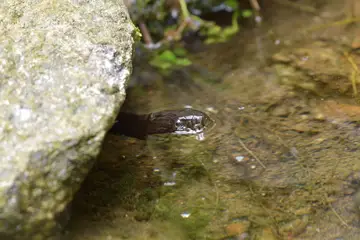

Size: Adults 22 to 42 inches long, occasionally to 59 inches (Missouri). Pennsylvania gives 24 to over 50 inches; females are usually bigger than males.
Colors: gray, tan, brown, reddish brown and black (older adults). Pattern: dark crossbands on front of body; blotches toward the tail; half-moon spots on belly.
Key features
- Dark crossbands on the front part of the body break up into rows of blotches from the middle of the body to the tail. California Department of Fish and Wildlife
- Belly white, yellow or orange, usually with dark half-moon-shaped spots. California Department of Fish and Wildlife
- Keeled (ridged) scales, so it feels rough; round pupils like other nonvenomous snakes in Missouri.
- Head is rounded but the snake often flattens it when threatened, so it can look diamond-shaped (Virginia DWR). Virginia DWR
- Swims with its body just below the surface (cottonmouths float on top), but Virginia DWR notes that some other nonvenomous snakes, such as the eastern hog-nosed snake, also float, so floating alone does not identify a cottonmouth. Virginia DWR
Young
Born live (see reproduction). MDC notes that coloration and shading vary with life stage, recent shedding and lighting.
Animals mistaken for the northern watersnake
Northern watersnake or Cottonmouth (water moccasin)?
Northern watersnake
Cottonmouth (water moccasin) Agkistrodon piscivorus
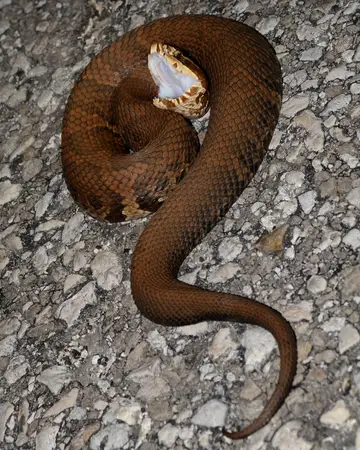

Cottonmouths are heavier-bodied with a larger, chunky head, a pit between nostril and eye, darker color, and a light line from the eye to the corner of the mouth (Missouri). Cottonmouths have cat-like pupils; watersnakes have round pupils and no facial pit, and seen from above a cottonmouth's eyes are hidden while a watersnake's are visible (Florida Museum). Georgia DNR: banded watersnakes have bands widest on top; banded cottonmouths have bands widest on the sides (hourglass-shaped from above). Cottonmouths float on the water; watersnakes swim with the body just below the surface (Virginia DWR). Cautions from the same agencies: Virginia DWR says some other nonvenomous snakes, such as the eastern hog-nosed snake, also float, and that watersnakes often flatten the head when threatened so it looks diamond-shaped; CDFW says older northern watersnakes can look almost entirely dark brown or black.
Venomous.
Northern watersnake or Copperhead?
Northern watersnake
Copperhead Agkistrodon contortrix
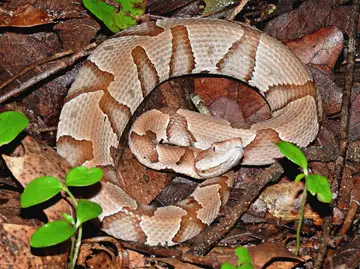

Florida Museum (midland watersnake): the watersnake's crossbands are darker, narrower and much more numerous than a copperhead's and turn into blotches halfway down the body. Watersnakes have round pupils and dark vertical lines near the mouth; copperheads have no such lines. Florida Museum of Natural History
Venomous (Florida Museum species account).
Northern watersnake or Other watersnakes (e.g., banded/southern, brown, plain-bellied watersnakes)?
Northern watersnake
Other watersnakes (e.g., banded/southern, brown, plain-bellied watersnakes) Nerodia spp.
Southern watersnakes have broad crossbands down the whole back and a dark stripe from the eye to the jaw; brown watersnakes have squarish blotches along the whole body (Florida Museum). In southeastern Missouri the broad-banded watersnake has no more than 20 bands or blotches; the midland watersnake has more than 20.
Also non-venomous (Florida Museum, Georgia DNR).
Where the northern watersnake lives
- Native or listed
- Nonnative or not established
- No official record in our data
- 1–9
- 10–99
- 100–999
- 1,000+
On our state guides
- Arkansas snakes
- California snakesNonnative
- Colorado snakes
- Connecticut snakes
- Florida snakes
- Georgia snakes
- Illinois snakes
- Iowa snakes
- Kansas snakes
- Kentucky snakes
- Louisiana snakes
- Maine snakes
- Maryland snakes
- Massachusetts snakes
- Minnesota snakes
- Missouri snakes
- Nebraska snakes
- New York snakes
- Oklahoma snakes
- Rhode Island snakes
- South Carolina snakes
- South Dakota snakes
- Tennessee snakes
- Texas snakes
- Vermont snakes
- Wisconsin snakes
State boundaries: U.S. Census Bureau, cartographic boundary file cb_2024_us_state_20m.
When it is active
Missouri: active early April into October; basks by day and becomes nocturnal in hot weather. Pennsylvania: active both day and night. Overwinters in rock dams, levees, burrows, logs and rock crevices.
US open-licence records peak in April to June.
Habitat and habits
Habitat: Almost any permanent fresh water: creeks, rivers, sloughs, ponds, lakes, swamps, ditches and wetlands; NCWRC also reports it in Outer Banks salt marshes. Often basks on overhanging branches, logs, rocks, docks or riprap.
Behavior: Wary; drops into the water when disturbed. If cornered it flattens its head and body and strikes repeatedly; if grabbed it bites and releases musk.
Diet: Mainly small fish and amphibians (frogs, tadpoles, toads, salamanders). MDC says game fish are usually too fast for it unless injured or diseased.
Young: Live-bearing. In Missouri, mating April into June and birth in August and September; litters of 6-99 young, usually about 27.
Legal status and reporting
Federal: Not federally listed as Endangered or Threatened in USFWS ECOS (query 2026-11-03): the Lake Erie water snake (N. s. insularum; Lake Erie offshore islands, OH, and Ontario) shows ESA listing status "Recovery" (listing date 08-30-1999), and the Upper Tidal Potomac River population of the northern water snake shows "Resolved Taxon".
Protection: California: all Nerodia are restricted species and cannot be imported, transported or possessed without a permit. North Carolina lists the Carolina saltmarsh watersnake subspecies as state Special Concern (SC) in its 2025 SWAP.
Invasive status: Invasive in California (non-native, established in Roseville, Placer County, since 2007). USGS NAS lists non-native occurrences in California and South Dakota.
Report: California: report sightings to the CDFW Invasive Species Program ([email protected]). If you catch or keep one, do not release it; call CDFW at (866) 440-9530. California Department of Fish and Wildlife
Questions about the northern watersnake
Is a water snake poisonous?
Northern watersnakes are not venomous, according to state wildlife agencies in Pennsylvania, Missouri, North Carolina, Virginia and California. They do bite hard if grabbed, and PFBC says the bite may bleed heavily, but no venom is injected. Venomous cottonmouths also live in water in parts of the South, so do not handle a snake you cannot identify. If someone is bitten, call 911 or Poison Help at 1-800-222-1222.
Is a water snake dangerous?
The Florida Museum says the closely related midland watersnake is not dangerous to people or pets but will readily bite to defend itself, and that nearly all bites happen when people deliberately bother the snake. Ohio DNR says watersnakes usually flee but large ones can cause painful, deep lacerations when grabbed.
Is a water snake the same as a water moccasin?
No. PFBC: the northern watersnake is not a water moccasin and it is not venomous. The water moccasin (cottonmouth) is a separate, venomous species. It does not occur naturally in Pennsylvania (PFBC) or in Ohio (Ohio DNR).
Cottonmouth vs water snake
Cottonmouths are heavier with a chunky head, a heat-sensing pit between nostril and eye, cat-like pupils and a light line from the eye to the mouth corner. Watersnakes have round pupils and no pit (Missouri, Florida Museum). Georgia DNR adds that banded watersnakes have bands widest on top, while banded cottonmouths have bands widest on the sides. Cottonmouths float on the surface, while watersnakes swim with the body just below it, but Virginia DWR notes some other nonvenomous snakes, such as the eastern hog-nosed snake, also float, and watersnakes may flatten the head so it looks diamond-shaped. Keep your distance from any snake you are unsure of.
Copperhead vs northern water snake
Florida Museum: a watersnake's crossbands are darker, narrower and more numerous than a copperhead's and break into blotches halfway down the body. Watersnakes also have round pupils and dark vertical lines near the mouth, which copperheads lack. Copperheads are venomous.
Are there northern water snakes in north carolina?
Yes. NCWRC says they live in Outer Banks salt marshes, the Coastal Plain, the Piedmont and the mountains of North Carolina. The Carolina saltmarsh subspecies is a state Special Concern species.
Are there water snakes in california?
Not natively. CDFW says northern watersnakes do not naturally occur west of the Rocky Mountains, but an invasive population has been established in Roseville (Placer County) since 2007. Report sightings to [email protected].
Are water snakes in california poisonous?
CDFW says the northern watersnakes found in California are not venomous, but they strike repeatedly when threatened and release a foul-smelling musk.
Are there water snakes in pennsylvania?
Yes. PFBC says the northern watersnake is the largest of Pennsylvania's three water snakes and is seen regularly. PFBC lists it as Abundant.
Are there water snakes in ohio?
Yes. Ohio DNR calls the northern watersnake one of the most widely distributed and abundant snakes in Ohio. The Lake Erie watersnake lives only on the Lake Erie islands. Cottonmouths do not occur in Ohio.
Are there water snakes in virginia?
Yes. Virginia DWR says watersnakes are found statewide in every county and city. The state has three species, and the northern watersnake is the most widely distributed.
Are there water snakes in missouri?
Yes. MDC says the northern and midland watersnakes together occur statewide and are Missouri's most commonly seen watersnakes.
Sources
- Field Guide: Northern Watersnake and Midland Watersnake. Missouri Department of Conservation. undated page; checked November 3, 2026.
Quoted passages (3)
“Northern watersnake coloration and shading can vary quite a bit, depending on the life stage, lighting outside, whether it has recently shed, and (if you're taking a picture) camera settings.”
“Watersnakes eat small fish; they also eat frogs, tadpoles, toads, and salamanders. Game fish are too agile for watersnakes to catch, unless the fish is injured or diseased.”
“Courtship and mating mainly occur April into June. Gestation may last about 2–4 months. Females give birth to live young in August and September. A litter can contain 6–99 young, usually averaging 27.”
- Snakes (species accounts). Pennsylvania Fish and Boat Commission. undated page; checked November 3, 2026.
Quoted passages (1)
“Often killed by people out of fear, the northern watersnake is not a water moccasin and it is not venomous.”
- California's Invaders: Northern Watersnake. California Department of Fish and Wildlife. undated page; checked November 3, 2026.
Quoted passages (3)
“All subspecies have black, dark brown, or reddish crossbands on the front section of the body that break up into rows of blotches from the middle to the end of the body.”
“Their bellies can be white, yellow, or orange, and commonly have dark half-mooned shaped spots.”
“If you observe this species in California, please report your sighting to the CDFW Invasive Species Program, by email to [email protected]. If you catch, or are currently in possession of a watersnake, do not release it. Immediately contact the CDFW Invasive Species Program at (866) 440-9530 for assistance.”
- Snakes on the Water: Cottonmouth or Watersnake? Virginia DWR (J.D. Kleopfer, DWR Herpetologist). May 6, 2019; checked November 3, 2026.
Quoted passages (2)
“Although the head is rounded in shape, they will often flatten their head as a defensive response giving it a more ‘diamond-shaped’ appearance.”
“Unlike watersnakes that swim with their body just below the surface, cottonmouths float on the water. However, other species of nonvenomous snake, such as the eastern hog-nosed snake, will also float on the water.”
- Florida Snake ID Guide species account: Eastern Copperhead. Florida Museum of Natural History (University of Florida). updated September 23, 2022; checked November 3, 2026.
Quoted passages (1)
“The alternating dark and light brown crossbands are darker, narrower, and much more numerous than those on the copperhead. The banding pattern transitions to alternating blotches about halfway down the body. The pupils are round. The sides of the face have dark vertical lines near the mouth, whereas the copperhead has no such lines on the face.”
- Northern Watersnake (NCWRC species page). N.C. Wildlife Resources Commission. undated page; checked November 3, 2026.
- Florida Snake ID Guide species account: Midland Watersnake. Florida Museum of Natural History (University of Florida). updated March 18, 2026; checked November 3, 2026.
- Reptiles of Ohio Field Guide (Publication 5354). Ohio Department of Natural Resources, Division of Wildlife. PUBLICATION 5354; checked November 3, 2026.
- Water Moccasin/Cottonmouth (Venomous) vs Water Snakes (Non-venomous) brochure. Georgia DNR Wildlife Resources Division. PDF Last-Modified Fri, 02 Feb 2024 14:12:52 GMT; checked November 3, 2026.
- 2025 SWAP Appendix 3 Table 3-7 REPTILES SGCN and Priority Species List (2025 WAP Revision Taxa Team Evaluations). N.C. Wildlife Resources Commission. 2025 NC SWAP; checked November 3, 2026.
- Pennsylvania Native Reptile and Amphibian Species (PA Species and Endangered Species Act listing status). Pennsylvania Fish and Boat Commission. undated page; checked November 3, 2026.
- GBIF.org occurrence records, human observations licensed CC0 1.0 or CC BY 4.0 only, accessed November 3, 2026. The datasets behind these counts are listed on our Sources page.
- State boundaries: U.S. Census Bureau, cartographic boundary file cb_2024_us_state_20m.