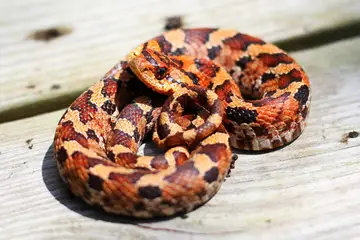
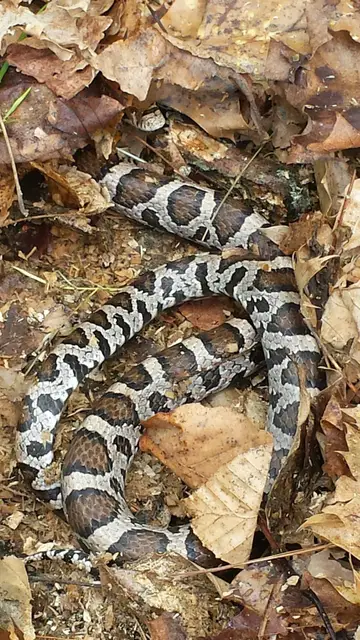
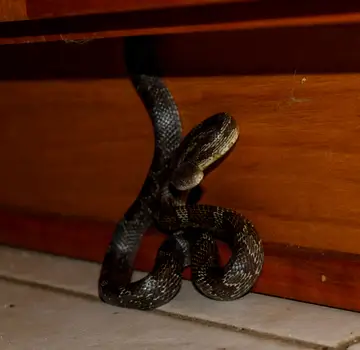
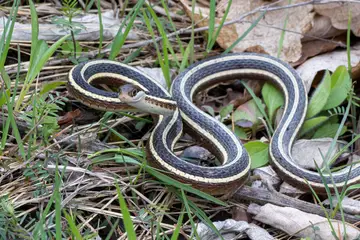
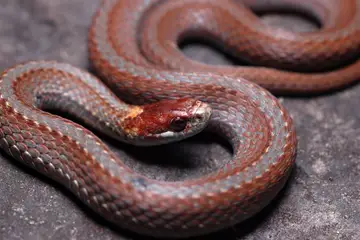
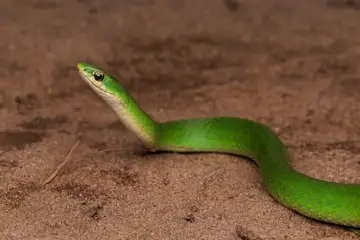
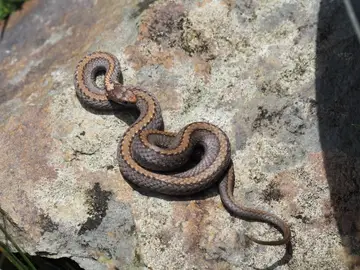
Vermont Fish & Wildlife Department: Vermont is home to 11 native snake species, representing a diversity of colors, patterns, sizes, distributions, and habitats.
This page lists 12 snakes: all from Vermont Fish & Wildlife Department's Reptiles and Amphibians of Vermont.
1 is venomous by official accounts: Timber Rattlesnake. Vermont Fish & Wildlife Department gives a total of 11; the 12 here are the snakes official sources name one by one.
Venomous snakes in Vermont
Official sources label these snakes venomous in Vermont. Venomous snakes in Vermont has more on each one.
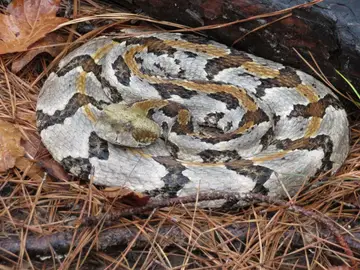
state endangered; SGCN (Vermont Wildlife Action Plan); state rank S1
What the sources say
Venom: “Vermont is home to one venomous snake species, the Timber Rattlesnake, which is state endangered, legally protected, and restricted to western Rutland County.” (Vermont Fish & Wildlife Department)
Habitat: In Vermont they inhabit rock slides, ledges, and nearby woodlands. (Vermont Fish & Wildlife Department)
From A to Z. "Not stated" means no official source we use gives a venom status, not that the snake is harmless. Some harmless snakes mimic venomous ones: leave every snake alone.
Venom: “Our other ten native species are harmless to humans, though some may produce mildly toxic saliva used to immobilize prey.” (Vermont Fish & Wildlife Department)
Habitat: Varies widely; often near water (Vermont Fish & Wildlife Department)
Photo: U.S. Fish and Wildlife Service - Midwest Region · Public domain · Wikimedia Commons
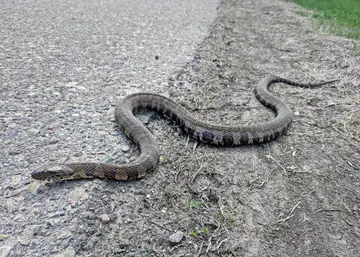
Adults 22 to 42 inches long, occasionally to 59 inches (Missouri). Pennsylvania gives 24 to over 50 inches; females are usually bigger than males.
How to recognize it
Dark crossbands on the front part of the body break up into rows of blotches from the middle of the body to the tail.
Belly white, yellow or orange, usually with dark half-moon-shaped spots.
Keeled (ridged) scales, so it feels rough; round pupils like other nonvenomous snakes in Missouri.
Conservation
SGCN (Vermont Wildlife Action Plan); state rank S3
What the sources say
Venom: “Our other ten native species are harmless to humans, though some may produce mildly toxic saliva used to immobilize prey.” (Vermont Fish & Wildlife Department)
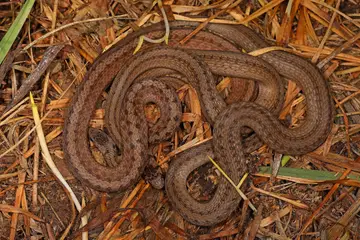
Most adults 9 to 13 inches; occasionally up to about 20 inches.
How to recognize it
Dark top of head; a dark spot under each eye and on each side of the neck
Keeled (ridged) scales in 17 rows; round pupil
Tennessee: a small dark downward streak on the side of the head
Conservation
SGCN (Vermont Wildlife Action Plan); state rank S4
What the sources say
Venom: “Our other ten native species are harmless to humans, though some may produce mildly toxic saliva used to immobilize prey.” (Vermont Fish & Wildlife Department)
Venom: “Our other ten native species are harmless to humans, though some may produce mildly toxic saliva used to immobilize prey.” (Vermont Fish & Wildlife Department)
Habitat: Old fields, old buildings, stone walls, and ledges (Vermont Fish & Wildlife Department)
state threatened; SGCN (Vermont Wildlife Action Plan); state rank S2
What the sources say
Venom: “Our other ten native species are harmless to humans, though some may produce mildly toxic saliva used to immobilize prey.” (Vermont Fish & Wildlife Department)
Habitat: A variety of forested and open habitats: forest and field edges, rocky outcrops, ledges, old buildings and barns (Vermont Fish & Wildlife Department)
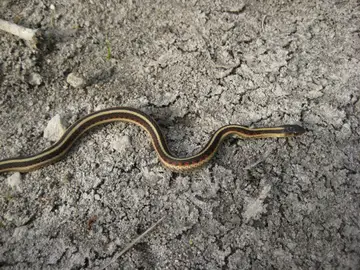
Eastern: most adults 18 to 26 inches (record 41 inches). Western: 16 to 42 inches in Louisiana; Oklahoma's orange-striped ribbonsnakes average 20 to 30 inches and can reach nearly 40.
How to recognize it
Very slender body; long tail, about one-third of total length.
Side stripes sit on the 3rd and 4th scale rows above the belly.
Upper lip scales white and unmarked; a distinct white spot in front of each eye; keeled (ridged) scales.
Conservation
state special concern; SGCN (Vermont Wildlife Action Plan); state rank S2
What the sources say
Venom: “Our other ten native species are harmless to humans, though some may produce mildly toxic saliva used to immobilize prey.” (Vermont Fish & Wildlife Department)
Habitat: Pastures, open woods, and rocky areas; almost always near water (Vermont Fish & Wildlife Department)
state threatened; SGCN (Vermont Wildlife Action Plan); state rank S1
What the sources say
Venom: “Our other ten native species are harmless to humans, though some may produce mildly toxic saliva used to immobilize prey.” (Vermont Fish & Wildlife Department)
Usually 8 to 10 inches; state figures run from about 4 to 16 inches, with a Florida record of 16.6 inches.
How to recognize it
Plain, unmarked red or orange belly.
Three light spots just behind the head, which may fuse into a collar.
Keeled (ridged) scales in 15 rows at midbody and round pupils.
Conservation
state rank S5
JFMAMJJASOND
42 records by month.What the sources say
Venom: “Our other ten native species are harmless to humans, though some may produce mildly toxic saliva used to immobilize prey.” (Vermont Fish & Wildlife Department)
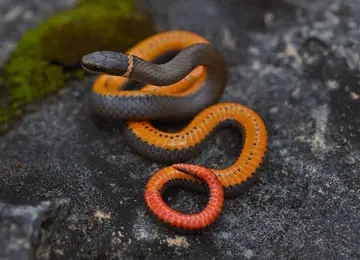
Usually 8 to 15 inches long; Alabama reports up to about 18 inches, rarely 24. AZGFD gives a maximum of 34 inches for Arizona animals.
How to recognize it
A yellow, cream or orange ring around the neck; it may be incomplete, and some Lower Florida Keys and western Arizona snakes lack it.
Bright yellow to orange or red belly, often with a row of black half-moon spots; the underside of the tail is often red.
Smooth, shiny scales and a small head only slightly wider than the neck.
Conservation
state rank S4
What the sources say
Venom: “Our other ten native species are harmless to humans, though some may produce mildly toxic saliva used to immobilize prey.” (Vermont Fish & Wildlife Department)
SGCN (Vermont Wildlife Action Plan); state rank S3
What the sources say
Venom: “Our other ten native species are harmless to humans, though some may produce mildly toxic saliva used to immobilize prey.” (Vermont Fish & Wildlife Department)
Snakes people confuse
Black Racer or Timber rattlesnake?
Photo: Everglades NPS from Homestead, Florida, United States · Public domain · Wikimedia Commons
Snakes found indoors in fall or during a winter warmup are probably looking for an overwintering site. Vermont Fish & Wildlife Department
If you are bitten or stung
Call 911 or Poison Help at 1-800-222-1222 right away. Poison Help connects you to your local poison center, any time of day.
Official advice from Vermont Fish & Wildlife Department:
If you find a rattlesnake on your property, do not handle or move it; call a Rattlesnake Response Program responder (free service). Vermont Fish & Wildlife Department
Identify a snake before approaching or handling it; head shape is not a reliable way to tell venomous snakes. Vermont Fish & Wildlife Department
If you suspect a Timber Rattlesnake in your home or property, photograph it from a safe distance and contact F&W (Luke Groff, 802-760-0089) or the Vermont Reptile and Amphibian Atlas. Vermont Fish & Wildlife Department
It is illegal to keep venomous snakes in Vermont; from January 1, 2027 Act 47 prohibits intentionally killing or harming any native reptile or amphibian. Vermont Fish & Wildlife Department
How to report
Reptiles and amphibians (including Timber Rattlesnake sightings): Vermont Reptile and Amphibian Atlas (vtherpatlas.org). Bear incidents and rare animals: F&W Citizen Reporting forms. Invasive insects and aquatic animals: vtinvasives.org Report It! pages. Wildlife conflicts: U.S. Department of Agriculture's Animal Damage Control Unit (name as given on the F&W page), Berlin VT, 802-223-8690. Vermont Fish & Wildlife Department
What official sources say
Are there venomous snakes in Vermont?
Yes. Vermont has one venomous snake, the Timber Rattlesnake. It is state endangered, legally protected, and restricted to western Rutland County. Vermont Fish & Wildlife Department
“Vermont is home to one venomous snake species, the Timber Rattlesnake, which is state endangered, legally protected, and restricted to western Rutland County.”
Are there rattlesnakes in Vermont?
Yes, but rare. Only two confirmed Timber Rattlesnake populations exist, both in Rutland County; they are most likely to be encountered June–September. Vermont Fish & Wildlife Department
“Currently, there are only two confirmed populations in the state, and both are in Rutland County.”
Reptiles and Amphibians of Vermont. Vermont Fish & Wildlife Department (Vermont Natural Heritage Inventory). document dated 13 March 2022; checked November 3, 2026.
Snake FAQs. Vermont Fish & Wildlife Department. undated page; checked November 3, 2026.Quoted passages (7)
“Vermont is home to 11 native snake species, representing a diversity of colors, patterns, sizes, distributions, and habitats.”
“Our other ten native species are harmless to humans, though some may produce mildly toxic saliva used to immobilize prey.”
“Vermont is home to one venomous snake species, the Timber Rattlesnake, which is state endangered, legally protected, and restricted to western Rutland County.”
“For safety reasons, it is wise to identify a snake before approaching or handling it.”
“If you suspect you have a Timber Rattlesnake in your home or on your property, please take a photograph from a safe distance and contact Luke Groff or the Vermont Reptile and Amphibian Atlas.”
“Additionally, Act 47 prohibits the intentional killing or harming of any native reptile or amphibian in Vermont, including snakes, starting on January 1, 2027.”
“Snakes found inside during the fall or a winter warmup were probably looking for an overwintering site or escaping cold temperatures.”
Rattlesnake Response Program. Vermont Fish & Wildlife Department. undated page; checked November 3, 2026.Quoted passages (3)
“If you find a rattlesnake on your property, do not attempt to handle or move it yourself.”
“In our state, rattlesnakes are most likely to be encountered during June–September as they migrate and forage miles from their overwintering den.”
“Currently, there are only two confirmed populations in the state, and both are in Rutland County.”
Citizen Reporting. Vermont Fish & Wildlife Department. undated page; checked November 3, 2026.Quoted passages (1)
“Report incidents of property damage by bears, visits to birdfeeders, compost bins or garbage, bears on porches or decks, damage to bee hives, corn or other crops, and any incident where you feel threatened by a bear.”