States Wildlife

Venomous Snakes in Vermont: 1 Species & How to Tell

Last checked November 3, 2026 against official sources.

On this page
  1. The venomous snake
  2. Lookalikes
  3. When they are active
  4. If you are bitten or stung
  5. How to report
  6. About this list
  7. Sources

Vermont has 1 venomous snake named by official sources: Timber Rattlesnake. It is labelled venomous by Vermont Fish & Wildlife Department.

The venomous snake of Vermont

Recognize them from a distance; a photo cannot confirm that a snake is safe. Identifying animals safely.

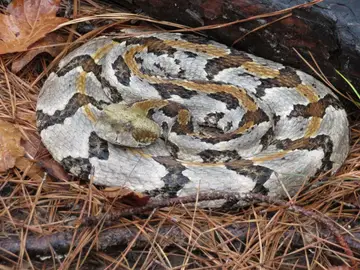
Timber Rattlesnake
Photo: NPS Photo · Public domain · Wikimedia Commons

Timber Rattlesnake

Crotalus horridus

Venomous per Vermont Fish & Wildlife Department

Size
Most adults 36 to 60 inches (3 to 5 feet); record 74.5 inches.
How to recognize it
  • Black tail ending in a rattle
  • Heat-sensing pit between nostril and eye
  • Large, thick head distinct from the neck; cat-like vertical pupil
Where in Vermont
Western Rutland County Vermont Fish & Wildlife Department
Conservation
state endangered; SGCN (Vermont Wildlife Action Plan); state rank S1
What the sources say

Venom: “Vermont is home to one venomous snake species, the Timber Rattlesnake, which is state endangered, legally protected, and restricted to western Rutland County.” (Vermont Fish & Wildlife Department)

Habitat: In Vermont they inhabit rock slides, ledges, and nearby woodlands. (Vermont Fish & Wildlife Department)

Full Timber Rattlesnake guide

For 1 other snake on Vermont's list, no official source we use states whether it is venomous: Eastern Hog-nosed Snake. That does not make them harmless. Leave every snake alone.

See all 12 snakes, venomous and not, on Vermont snakes. Vermont Fish & Wildlife Department gives Vermont 11 snake species in all; that page lists the 12 that official sources name one by one.

Snakes people confuse

Black Racer or Timber rattlesnake?

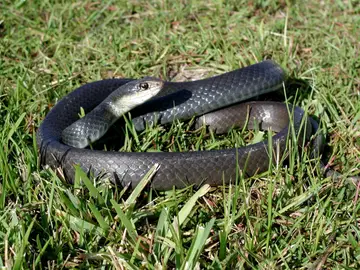
Black Racer
Photo: Everglades NPS from Homestead, Florida, United States · Public domain · Wikimedia Commons

Black Racer Non-venomous

Timber rattlesnake
Photo: NPS Photo · Public domain · Wikimedia Commons

Timber rattlesnake Venomous

NH Fish and Game: the rattlesnake has a blunt rattle, is thicker, and has keeled scales and a triangular head.

Black Racer or Northern water snake?

Black Racer
Photo: Everglades NPS from Homestead, Florida, United States · Public domain · Wikimedia Commons

Black Racer Non-venomous

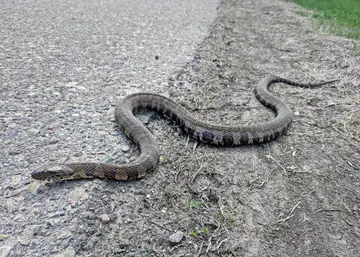
Northern water snake
Photo: U.S. Fish and Wildlife Service - Midwest Region · Public domain · Wikimedia Commons

Northern water snake Non-venomous

NH lists it as commonly confused; it gives no separating feature.

Ringneck snake or Brown snake (juvenile)?

Ringneck snake
Photo: Peter Paplanus from St. Louis, Missouri · CC BY 2.0 · Wikimedia Commons

Ringneck snake Non-venomous

Brown snake (juvenile)
Photo: Judy Gallagher · CC BY 2.0 · Wikimedia Commons

Brown snake (juvenile) Non-venomous

Young brown snakes also have a light collar, but their scales are keeled (ridged); the ringneck's scales are smooth.

Brown Snake (Dekay's Brownsnake) or Red-bellied Snake?

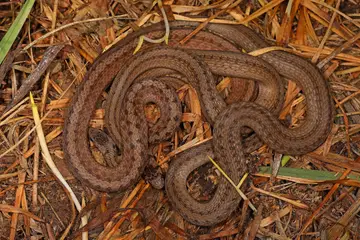
Brown Snake (Dekay's Brownsnake)
Photo: Judy Gallagher · CC BY 2.0 · Wikimedia Commons

Brown Snake (Dekay's Brownsnake) Non-venomous

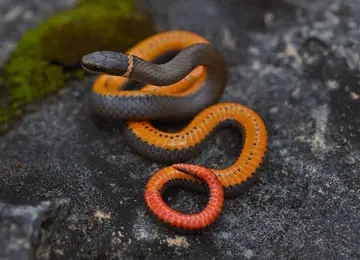
Red-bellied Snake
Photo: Rstanton13 · CC BY-SA 4.0 · Wikimedia Commons · resized

Red-bellied Snake Non-venomous

The red-bellied snake has a red underside; the brown snake's belly is cream, yellow or pink.

Brown Snake (Dekay's Brownsnake) or Ring-necked Snake?

Brown Snake (Dekay's Brownsnake)
Photo: Judy Gallagher · CC BY 2.0 · Wikimedia Commons

Brown Snake (Dekay's Brownsnake) Non-venomous

Ring-necked Snake
Photo: Peter Paplanus from St. Louis, Missouri · CC BY 2.0 · Wikimedia Commons

Ring-necked Snake Non-venomous

Ring-necked snakes have smooth scales and yellow bellies with paired dots down the center.

Red-bellied snake or Dekay's brownsnake?

Red-bellied snake
Photo: Clay Gibbons · CC BY 4.0 · iNaturalist

Red-bellied snake Non-venomous

Dekay's brownsnake
Photo: Judy Gallagher · CC BY 2.0 · Wikimedia Commons

Dekay's brownsnake Non-venomous

Tennessee: Dekay's brownsnake has a yellowish, tan or pinkish belly with very small black dots on the sides.

Photos show typical adults; individuals vary. Never get close to compare.

When venomous snakes are active in Vermont

Records of snakes in Vermont peak in May to July and September. They show when people record snakes, not how many there are (about month bars).

1,065 records of snakes in Vermont by month (GBIF, CC0 and CC BY records).

If you are bitten or stung

Call 911 or Poison Help at 1-800-222-1222 right away. Poison Help connects you to your local poison center, any time of day.

Official advice from Vermont Fish & Wildlife Department:

  • If you find a rattlesnake on your property, do not handle or move it; call a Rattlesnake Response Program responder (free service). Vermont Fish & Wildlife Department
  • Identify a snake before approaching or handling it; head shape is not a reliable way to tell venomous snakes. Vermont Fish & Wildlife Department
  • If you suspect a Timber Rattlesnake in your home or property, photograph it from a safe distance and contact F&W (Luke Groff, 802-760-0089) or the Vermont Reptile and Amphibian Atlas. Vermont Fish & Wildlife Department
  • It is illegal to keep venomous snakes in Vermont; from January 1, 2027 Act 47 prohibits intentionally killing or harming any native reptile or amphibian. Vermont Fish & Wildlife Department

How to report

Reptiles and amphibians (including Timber Rattlesnake sightings): Vermont Reptile and Amphibian Atlas (vtherpatlas.org). Bear incidents and rare animals: F&W Citizen Reporting forms. Invasive insects and aquatic animals: vtinvasives.org Report It! pages. Wildlife conflicts: U.S. Department of Agriculture's Animal Damage Control Unit (name as given on the F&W page), Berlin VT, 802-223-8690. Vermont Fish & Wildlife Department

About this list

The species list comes from Reptiles and Amphibians of Vermont (Vermont Natural Heritage Inventory, Vermont Fish & Wildlife Department) (Vermont Fish & Wildlife Department (Vermont Natural Heritage Inventory), 13 March 2022).

Venom labels come only from official sources and link to them; "Not stated" never means harmless. How labels work.

Sources

  1. Reptiles and Amphibians of Vermont. Vermont Fish & Wildlife Department (Vermont Natural Heritage Inventory). document dated 13 March 2022; checked November 3, 2026.
  2. Snake FAQs. Vermont Fish & Wildlife Department. undated page; checked November 3, 2026.
    Quoted passages (7)
    “Vermont is home to 11 native snake species, representing a diversity of colors, patterns, sizes, distributions, and habitats.”
    “Our other ten native species are harmless to humans, though some may produce mildly toxic saliva used to immobilize prey.”
    “Vermont is home to one venomous snake species, the Timber Rattlesnake, which is state endangered, legally protected, and restricted to western Rutland County.”
    “For safety reasons, it is wise to identify a snake before approaching or handling it.”
    “If you suspect you have a Timber Rattlesnake in your home or on your property, please take a photograph from a safe distance and contact Luke Groff or the Vermont Reptile and Amphibian Atlas.”
    “Additionally, Act 47 prohibits the intentional killing or harming of any native reptile or amphibian in Vermont, including snakes, starting on January 1, 2027.”
    “Snakes found inside during the fall or a winter warmup were probably looking for an overwintering site or escaping cold temperatures.”
  3. Milksnake (Vermont Critters: Reptiles). Vermont Fish & Wildlife Department. undated page; checked November 3, 2026.
  4. Eastern Ratsnake (Vermont Critters: Reptiles). Vermont Fish & Wildlife Department. undated page; checked November 3, 2026.
  5. Eastern Ribbonsnake (Vermont Critters: Reptiles). Vermont Fish & Wildlife Department. undated page; checked November 3, 2026.
  6. Common Garter Snake (Vermont Critters: Reptiles). Vermont Fish & Wildlife Department. undated page; checked November 3, 2026.
    Quoted passages (2)
    “The saliva of common garter snakes may be slightly toxic to some of their small prey”
    “They hibernate from late October through March or early April, but can be found basking on rocks during mild winter days.”
  7. Timber Rattlesnake (Vermont Critters: Reptiles). Vermont Fish & Wildlife Department. undated page; checked November 3, 2026.
  8. Rattlesnake Response Program. Vermont Fish & Wildlife Department. undated page; checked November 3, 2026.
    Quoted passages (3)
    “If you find a rattlesnake on your property, do not attempt to handle or move it yourself.”
    “In our state, rattlesnakes are most likely to be encountered during June–September as they migrate and forage miles from their overwintering den.”
    “Currently, there are only two confirmed populations in the state, and both are in Rutland County.”
  9. Citizen Reporting. Vermont Fish & Wildlife Department. undated page; checked November 3, 2026.
    Quoted passages (1)
    “Report incidents of property damage by bears, visits to birdfeeders, compost bins or garbage, bears on porches or decks, damage to bee hives, corn or other crops, and any incident where you feel threatened by a bear.”
  10. GBIF.org occurrence records, human observations licensed CC0 1.0 or CC BY 4.0 only, accessed November 3, 2026. The datasets behind these counts are listed on our Sources page.