Ribbon snake
Thamnophis saurita (eastern ribbonsnake) and Thamnophis proximus (western ribbonsnake); some sources spell the first Thamnophis sauritus · also called Ribbonsnake, Eastern ribbonsnake, Western ribbonsnake and Common ribbonsnake · Last checked November 3, 2026.
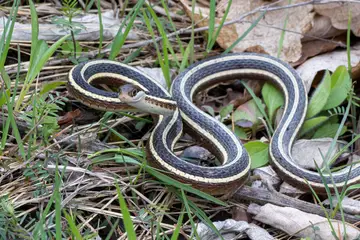

Ribbon snakes are very slender, fast-moving snakes, usually about 1.5 to 2.5 feet long, with three bright stripes running down a dark body and a long, thin tail. There are two US species: the eastern ribbonsnake in the eastern states and the western ribbonsnake from Tennessee and southwestern Wisconsin west to New Mexico and south to the Gulf Coast. They live near water and eat mostly frogs and other amphibians. Official sources say they are non-venomous: the Florida Museum says eastern ribbonsnakes are not dangerous to people or pets and rarely bite, and Louisiana Wildlife and Fisheries lists both species as nonvenomous. Florida Museum of Natural History
This page covers a group (Thamnophis saurita (eastern ribbonsnake) and Thamnophis proximus (western ribbonsnake); some sources spell the first Thamnophis sauritus), not a single species.
On this page
Is the ribbon snake dangerous?
Florida Museum: non-venomous; eastern ribbonsnakes are not dangerous to people or pets and rarely bite to defend themselves. Florida Museum of Natural History
“Non-venomous. Eastern Ribbonsnakes are not dangerous to people or pets, and they rarely bite to defend themselves.”
Bites and stings: Usually flees; if grabbed it thrashes and releases a foul-smelling musk, and rarely bites as a last resort (Florida Museum, eastern). The Illinois Natural History Survey says the western ribbonsnake bites when handled.
How to identify a ribbon snake
A photo or description can narrow it down, but cannot confirm what an animal is or that it is safe. Look from a distance and do not handle wild animals.
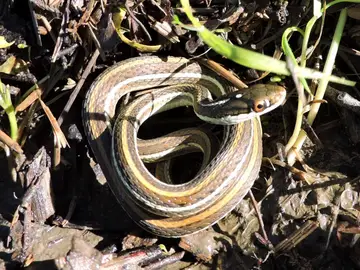
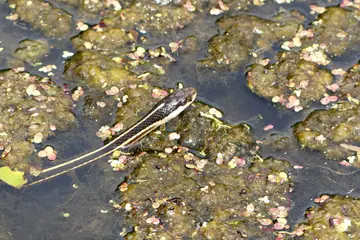
Size: Eastern: most adults 18 to 26 inches (record 41 inches). Western: 16 to 42 inches in Louisiana; Oklahoma's orange-striped ribbonsnakes average 20 to 30 inches and can reach nearly 40.
Colors: Eastern: brown, olive-black or bluish-black with three thin stripes that are usually yellow, tan, blue or whitish-green; belly plain yellowish-green; western: slender black snake with an orange stripe down the back and yellow or greenish side stripes. Pattern: Three light stripes, one down the middle of the back and one on each side; stripes are missing in some individuals.
Key features
- Very slender body; long tail, about one-third of total length.
- Side stripes sit on the 3rd and 4th scale rows above the belly.
- Upper lip scales white and unmarked; a distinct white spot in front of each eye; keeled (ridged) scales. Florida Museum of Natural History
- Eastern vs western (Louisiana): the western has a distinct white spot on top of the head and no brown edging on the belly scales. Louisiana Department of Wildlife and Fisheries
Young
Eastern: young look like adults. Western: newborns about 12 inches long in Oklahoma; juveniles might be confused with adult Texas brownsnakes.
Animals mistaken for the ribbon snake
Ribbon snake or Garter snake?
Ribbon snake
Garter snake Thamnophis sirtalis and other Thamnophis
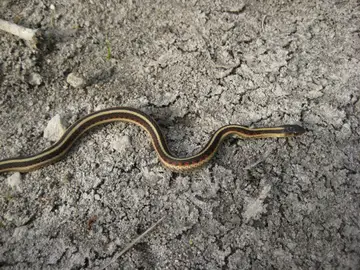
Ribbon snakes are more slender, have plain (unmarked) lip scales and a longer tail, and their side stripes are on scale rows 3 and 4; on garter snakes the side stripes are on rows 2 and 3.
The Florida Museum lists the common gartersnake (Thamnophis sirtalis) as non-venomous. That statement covers the common gartersnake only, not every garter snake species.
Ribbon snake or Texas gartersnake?
Ribbon snake
In Oklahoma the Texas gartersnake's side stripe is on scale rows 2 and 3, and its white lip scales have black vertical marks; the orange-striped ribbonsnake has unmarked white lip scales and a white bar in front of the eye. Oklahoma Department of Wildlife Conservation
Where the ribbon snake lives
- Native or listed
- Nonnative or not established
- No official record in our data
- 1–9
- 10–99
- 100–999
- 1,000+
On our state guides
- Delaware snakes
- Florida snakes
- Georgia snakes
- Louisiana snakes
- Maryland snakes
- Ohio snakes
- Pennsylvania snakes
- Vermont snakes
- Wisconsin snakes
State boundaries: U.S. Census Bureau, cartographic boundary file cb_2024_us_state_20m.
When it is active
Mainly active by day (often early morning and late evening), but at night in spring when frogs breed (Alabama). Active from early spring through late fall in Oklahoma; most active in spring in Alabama.
US open-licence records for both US ribbon snakes (Thamnophis saurita and T. proximus) peak in March to June and October.
Habitat and habits
Habitat: Near water: edges of ponds, lakes, streams, swamps, marshes, bogs and wet grassy areas; also pinelands and hammocks in Florida and sometimes suburban neighborhoods.
Behavior: Quick and wary; when approached, flees into cover or water. Swims and climbs readily.
Diet: Mostly frogs, tadpoles and salamanders, plus small fish; not constrictors, they swallow prey alive.
Young: Gives birth to live young (no eggs) in late summer: eastern 3 to 26 young between July and September in Florida; western 4 to 34 in Louisiana. Mating in April or May.
Legal status and reporting
Protection: Protected in some states: Georgia DNR says all non-venomous snakes are protected by state law; Wisconsin lists both ribbon snakes as endangered; Illinois lists the eastern ribbonsnake (state threatened per IDNR, endangered per INHS); Indiana lists the western ribbonsnake and Pennsylvania the eastern ribbonsnake as species of special concern.
Questions about the ribbon snake
Is a garter snake the same as a ribbon snake?
No. They are close relatives in the same genus and are easy to confuse, but ribbon snakes are more slender, have a longer tail (about a quarter to a third of their length), plain unmarked lip scales, and side stripes on scale rows 3 and 4; garter snakes have side stripes on rows 2 and 3. Official sources list ribbon snakes as non-venomous, and the Florida Museum lists the common gartersnake as non-venomous.
Sources
- Florida Snake ID Guide species account: Eastern Ribbonsnake. Florida Museum of Natural History (University of Florida). updated March 18, 2026; checked November 3, 2026.
Quoted passages (2)
“Non-venomous. Eastern Ribbonsnakes are not dangerous to people or pets, and they rarely bite to defend themselves.”
“The upper lip scales are white and unmarked. … There is a distinct white spot in front of each eye. … The body scales are keeled (each scale has a prominent raised ridge)”
- Snake Species Field Guide: Eastern Ribbonsnake. Louisiana Department of Wildlife and Fisheries. undated page; checked November 3, 2026.
- Snake Species Field Guide: Western Ribbonsnake. Louisiana Department of Wildlife and Fisheries. undated page; checked November 3, 2026.
Quoted passages (1)
“Unlike the eastern ribbon snake, the white parietal spot on top of the head is distinct, and there is no brown coloration on the outer edges of the ventral plates.”
- Orange-striped Ribbonsnake (ODWC Field Guide). Oklahoma Department of Wildlife Conservation. undated page; checked November 3, 2026.
Quoted passages (1)
“The lateral stripe in the Texas gartersnake is on the second and third scale rows. … The orange-striped ribbonsnake has white along scales of the upper jaw with no markings on them and a distinct vertical white bar in front of the eye preceded by a distinct black mark. … The Texas gartersnake has white upper labials with distinct vertical black marks between each scale”
- Eastern Ribbonsnake (Field Guide to Amphibians and Reptiles of Illinois). Illinois Natural History Survey (INHS), Prairie Research Institute, University of Illinois Urbana-Champaign. undated page; checked November 3, 2026.
- Eastern Ribbon Snake. Alabama Department of Conservation and Natural Resources (Outdoor Alabama). undated page; checked November 3, 2026.
- Eastern Ribbon Snake (Thamnophis sauritus). University of Georgia Savannah River Ecology Laboratory (linked by SCDNR as its species information). undated page; checked November 3, 2026.
- Reptiles of Ohio Field Guide (Publication 5354). Ohio Department of Natural Resources, Division of Wildlife. PUBLICATION 5354; checked November 3, 2026.
- GBIF.org occurrence records, human observations licensed CC0 1.0 or CC BY 4.0 only, accessed November 3, 2026. The datasets behind these counts are listed on our Sources page.
- State boundaries: U.S. Census Bureau, cartographic boundary file cb_2024_us_state_20m.