Garter snake
Thamnophis · also called Gartersnake, Common gartersnake, Eastern gartersnake and Garden snake (nickname) · Last checked November 3, 2026.
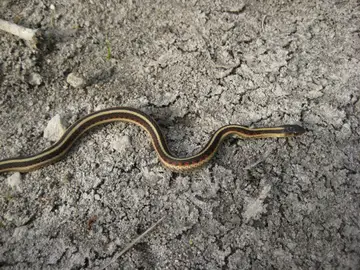
Garter snakes (genus Thamnophis) are slender snakes, usually with three light stripes running down the body. Outdoor Alabama says the eastern garter snake is, in many areas, the snake people meet most often. State wildlife agencies and university guides describe garter snakes as non-venomous. The Florida Museum says the common gartersnake is not dangerous to people or pets, though it will readily bite to defend itself and may release a foul-smelling musk. Outdoor Alabama calls the eastern garter snake the most widely distributed snake in North America. Four gartersnakes in California, Arizona and New Mexico are federally threatened or endangered. Florida Museum of Natural History
This page covers a genus (Thamnophis), not a single species.
On this page
Is the garter snake dangerous?
Florida Museum: non-venomous; common gartersnakes are not dangerous to people or pets, but will readily bite to defend themselves. Florida Museum of Natural History
“Non-venomous. Common Gartersnakes are not dangerous to people or pets, but they will readily bite to defend themselves.”
Bites and stings: Will bite if grabbed, pinned or handled roughly. NCWRC says even a large one's bite is no worse than a briar scratch. May release a foul-smelling musk.
How to identify a garter snake
A photo or description can narrow it down, but cannot confirm what an animal is or that it is safe. Look from a distance and do not handle wild animals.
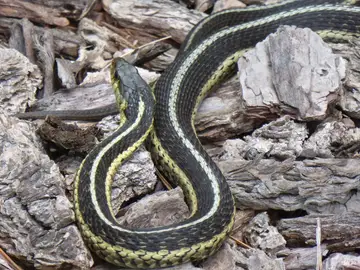

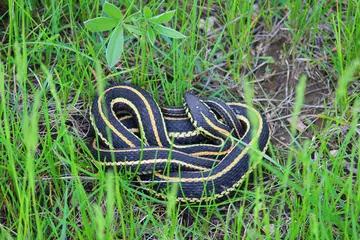

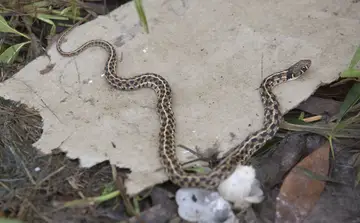

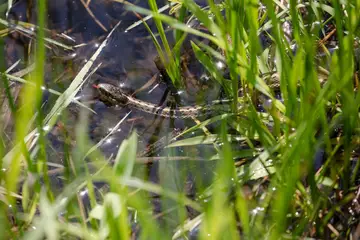

Size: Most adults about 18-26 inches (46-66 cm) long; record 54 inches (137.2 cm). Florida Museum, Common Gartersnake. Florida Museum of Natural History
Colors: black, greenish brown, tan, gray, brown, olive and reddish. Pattern: three light stripes, checkered sides and stripes sometimes absent.
Key features
- Three light stripes running the full length of the body: one down the back, one along each side. N.C. Wildlife Resources Commission
- Slender body; stripes typically yellow, green, brown, blue or white. Florida Museum of Natural History
- A dark checkerboard pattern may show on the sides between the stripes, and some individuals have no stripes. Florida Museum of Natural History
- Side stripes sit on scale rows 2 and 3 (on rows 3 and 4 in ribbon snakes). Vertical black lines on the lip scales. University of Georgia Savannah River Ecology Laboratory
- Keeled (ridged) scales in 19 rows; belly whitish to pale with a row of black dots on each side (Louisiana). Louisiana Department of Wildlife and Fisheries
Young
Born live, about 5-9 inches long, and look like small versions of the adults.
Animals mistaken for the garter snake
Garter snake or Ribbon snake?
Garter snake
Ribbon snake Thamnophis saurita / Thamnophis proximus
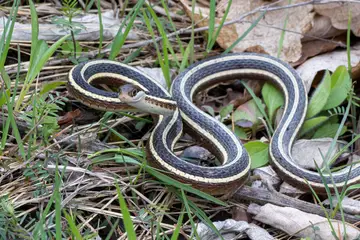

Ribbon snakes are generally more slender and have no dark bars on their lip scales; garter snakes have black lines or markings on the lip scales. On garter snakes the side stripes are lower on the body (scale rows 2 and 3); on ribbon snakes they are on rows 3 and 4.
Also non-venomous per official sources (e.g., Florida Museum on the Eastern Ribbonsnake).
Where the garter snake lives
- Native or listed
- Nonnative or not established
- No official record in our data
- 1–9
- 10–99
- 100–999
- 1,000+
State boundaries: U.S. Census Bureau, cartographic boundary file cb_2024_us_state_20m.
When it is active
Mostly active by day (Florida Museum), but may be active by day or night and even on warm winter days (SREL). In colder areas they spend winter in brumation, often in communal dens (Alabama). University of Georgia Savannah River Ecology Laboratory
US open-licence records for all garter snakes (genus Thamnophis) peak in April to August.
Habitat and habits
Habitat: Many habitats: woods, meadows, marshes, hillsides and backyards. They prefer moist, grassy places, often near ponds, lakes, ditches and streams, wherever there is cover.
Behavior: Usually flees. If cornered it may strike and vibrate its tail. If grabbed it bites and releases a foul-smelling musk.
Diet: Mostly frogs, salamanders, fish and earthworms; also slugs, snails, leeches, small mammals, young birds and eggs. Not constrictors: they grab prey and swallow it alive.
Young: Live-bearing. Mating is in spring (late March to early May in Alabama). In Florida, females give birth to 3-80 young between July and October; NCWRC gives 7 to 80 young.
Legal status and reporting
Federal: Federally listed (ESA): San Francisco garter snake (T. sirtalis tetrataenia) Endangered; Giant garter snake (T. gigas), Narrow-headed gartersnake (T. rufipunctatus) and Northern Mexican gartersnake (T. eques megalops) Threatened. ECOS
Protection: Federally listed gartersnakes are protected under the ESA. Some states protect gartersnakes: Georgia DNR says all non-venomous snakes are protected by state law; Arizona Game and Fish says the Mexican and Narrow-headed gartersnakes are protected in Arizona; New Mexico (BISON-M) lists the Northern Mexican and Narrow-headed gartersnakes as state endangered; Ohio lists the Plains Gartersnake as endangered; North Carolina classifies the eastern garter snake as a nongame species with no open season.
Questions about the garter snake
Is a garter snake poisonous?
No. Official sources describe garter snakes as non-venomous. The Florida Museum says common gartersnakes are not dangerous to people or pets, though they will bite to defend themselves.
Is a garter snake venomous?
No. The Florida Museum, the N.C. Wildlife Resources Commission, Louisiana Wildlife and Fisheries and Arizona Game and Fish all list gartersnakes as non-venomous.
Is a garter snake poisonous to dogs?
The Florida Museum says common gartersnakes are not dangerous to people or pets, but they will readily bite to defend themselves.
Is a garter snake dangerous?
The Florida Museum says they are not dangerous to people or pets and are not aggressive; almost all bites happen when the snake is being bothered.
Is a garter snake bite dangerous?
The N.C. Wildlife Resources Commission says most will bite if handled roughly, but even a large one's bite is no more severe than a briar scratch.
Is a garter snake a constrictor?
No. The Florida Museum says gartersnakes are not constrictors: they grab prey in their jaws and swallow it alive.
Is a garter snake the same as a garden snake?
Yes, "garden snake" is a nickname. Outdoor Alabama says it comes from how often garter snakes turn up in gardens. NCWRC notes the name is often used in error.
Is a garter snake the same as a ribbon snake?
No, but they are close relatives that look alike. The N.C. Wildlife Resources Commission says ribbon snakes are generally more slender and lack dark bars on their lip scales. Tennessee Wildlife Resources Agency says the eastern gartersnake has black markings on the lower jaw and its side stripes sit lower on the body (scale rows 2 and 3).
Garter snake size
Most adult common gartersnakes are 18-26 inches long, and the record is 54 inches (Florida Museum).
Garter snake baby
Garter snakes give birth to live young. Newborns are about 5-9 inches long (Outdoor Alabama) and look like small versions of the adults (NCWRC).
Garter snake diet
Mostly frogs, salamanders, fish and earthworms. They also eat slugs, snails, leeches, small mammals, young birds and eggs (Florida Museum).
Garter snake ohio
Ohio's Division of Wildlife reptile guide lists four gartersnakes: Eastern, Butler's, Short-headed and Plains. The Plains Gartersnake is state endangered.
Garter snake texas
Herps of Texas (University of Texas at Austin) lists four gartersnakes in Texas: Black-necked, Checkered, Plains and Common.
Sources
- Florida Snake ID Guide species account: Common Gartersnake. Florida Museum of Natural History (University of Florida). updated March 18, 2026; checked November 3, 2026.
Quoted passages (6)
“Non-venomous. Common Gartersnakes are not dangerous to people or pets, but they will readily bite to defend themselves.”
“Most adult Common Gartersnakes are about 18-26 inches (46-66 cm) in total length, with a record length of 54 inches (137.2 cm).”
“The stripes are typically yellow, green, brown, blue, or white.”
“However, stripes are absent in some individuals. A dark checkerboard pattern may be visible along the sides of the body between the back and side stripes.”
“Common Gartersnakes are typically diurnal (active during the day) and feed mostly on frogs, salamanders, freshwater fishes, and earthworms.”
“If grabbed or pinned, they will readily bite the attacker and release a foul-smelling musk from a pair of glands in the base of the tail.”
- Eastern Garter Snake (NCWRC species page). N.C. Wildlife Resources Commission. undated page; checked November 3, 2026.
Quoted passages (1)
“…the garter snake can be identified by three light stripes that run the entire length of its body on the back and sides.”
- Online Field Guide species account: Terrestrial Gartersnake (Thamnophis elegans). Arizona Game and Fish Department. 2023; checked November 3, 2026.
- ECOS species report export: Scientific Name like 'Thamnophis%'. U.S. Fish and Wildlife Service (ECOS). live ECOS database export retrieved 2026-11-03; checked November 3, 2026.
Quoted passages (1)
“Giant garter snake … Thamnophis gigas … Narrow-headed gartersnake … Thamnophis rufipunctatus … Northern Mexican gartersnake … Thamnophis eques megalops … San Francisco garter snake … Thamnophis sirtalis tetrataenia”
- Eastern Garter Snake. Alabama Department of Conservation and Natural Resources (Outdoor Alabama). undated page; checked November 3, 2026.
Quoted passages (1)
“Newborn garter snakes are typically between 5-9 inches long.”
- Eastern Garter Snake (Thamnophis sirtalis). University of Georgia Savannah River Ecology Laboratory (linked by SCDNR as its species information). undated page; checked November 3, 2026.
Quoted passages (2)
“…garter snakes have vertical black lines on their lip scales. Additionally, in garter snakes the lateral yellow lines are on scales 2 and 3 whereas they are on scale rows 3 and 4 in ribbon snakes.”
“Garter snakes may be active by day or night and are often found under boards or other debris.”
- Snake Species Field Guide: Common Gartersnake. Louisiana Department of Wildlife and Fisheries. undated page; checked November 3, 2026.
Quoted passages (1)
“Underside is dull white or pale tan to pale green with a row of black dots on each side. Scales are keeled (ridged) and in 19 rows.”
- Reptiles » Snakes (Tennessee Watchable Wildlife species accounts). Tennessee Wildlife Resources Agency (Tennessee Watchable Wildlife website). undated page; checked November 3, 2026.
- Reptiles of Ohio Field Guide (Publication 5354). Ohio Department of Natural Resources, Division of Wildlife. PUBLICATION 5354; checked November 3, 2026.
- Herps of Texas: Snakes of Texas. Herps of Texas, Biodiversity Collections, Dept. of Integrative Biology, The University of Texas at Austin. 2020-07-23 (archive capture date; checked November 3, 2026.
- GBIF.org occurrence records, human observations licensed CC0 1.0 or CC BY 4.0 only, accessed November 3, 2026. The datasets behind these counts are listed on our Sources page.
- State boundaries: U.S. Census Bureau, cartographic boundary file cb_2024_us_state_20m.