States Wildlife

Maryland Snakes: Identification Guide With Pictures

Last checked November 3, 2026 against official sources.

On this page
  1. Venomous snakes
  2. The other 24 snakes
  3. Lookalikes
  4. When they are active
  5. If you are bitten or stung
  6. How to report
  7. Common questions
  8. What official sources say
  9. About this list
  10. Sources

DNR: SNAKES – 25 native species and subspecies

This page lists 26 snakes: 25 from DNR's Reptiles and Amphibians of Maryland and 1 named in other official sources. 2 are venomous by official accounts: Eastern Copperhead and Timber Rattlesnake. DNR gives a total of 25; the 26 here are the snakes official sources name one by one.

Venomous snakes in Maryland

Official sources label these snakes venomous in Maryland. Venomous snakes in Maryland has more on each one.

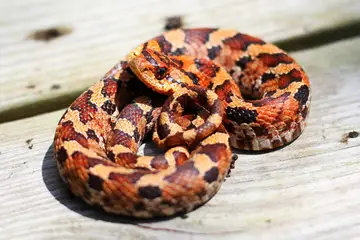
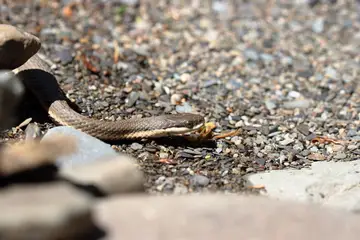
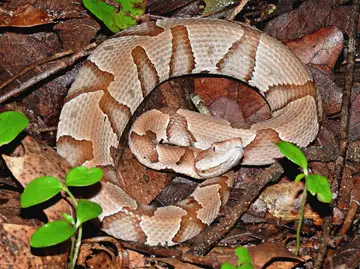
Eastern Copperhead
Photo: USFWSmidwest · Public domain · Wikimedia Commons

Eastern Copperhead

Agkistrodon contortrix

Venomous per DNR

Danger to people
“Both of these species are dangerously venomous and should be treated with caution. Do not approach or handle these snakes as a bite could be fatal.” DNR
Size
Adults usually about 2 to 3 feet (24-36 in); record about 53 inches.
How to recognize it
  • Vertical (cat-like) pupils and a heat-sensing pit between eye and nostril
  • Heavy-bodied; keeled scales
  • Head shape alone is not a reliable way to identify copperheads
Where in Maryland
Eastern Copperheads are found throughout Maryland with the exception of several counties on the Eastern Shore. DNR
52 records by month.
What the sources say

Venom: “Warning: this species is venomous!” (DNR)

Habitat: This is a snake of forests, old fields, swamps, dry sandy ridges adjacent to swamps, and agricultural fields adjacent to forests. (DNR)

Full Eastern Copperhead guide

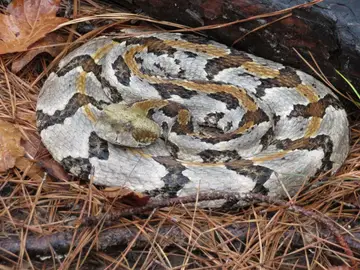
Timber Rattlesnake
Photo: NPS Photo · Public domain · Wikimedia Commons

Timber Rattlesnake

Crotalus horridus

Venomous per DNR

Danger to people
“Both of these species are dangerously venomous and should be treated with caution. Do not approach or handle these snakes as a bite could be fatal.” DNR
Size
Most adults 36 to 60 inches (3 to 5 feet); record 74.5 inches.
How to recognize it
  • Black tail ending in a rattle
  • Heat-sensing pit between nostril and eye
  • Large, thick head distinct from the neck; cat-like vertical pupil
Where in Maryland
Exclusively a western Maryland species, from Frederick to Garrett County, although historical records place these snakes east to the Susquehanna River. DNR
Conservation
State Watchlist (DNR herp checklist); RTE list Dec 2025: G4 S3
What the sources say

Venom: “Warning – this is a venomous snake.” (DNR)

Habitat: Prefer upland forested areas with rocky outcrops and talus slopes. (DNR)

Full Timber Rattlesnake guide

The other 24 snakes

From A to Z. "Not stated" means no official source we use gives a venom status, not that the snake is harmless. Some harmless snakes mimic venomous ones: leave every snake alone.

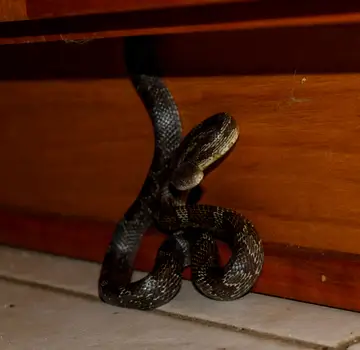
Central Ratsnake
Photo: Whitney Mattila · CC BY 4.0 · iNaturalist

Central Ratsnake

Pantherophis alleghaniensis

Non-venomous per DNR

Where in Maryland
One of our most common snakes, it is found statewide. DNR
454 records by month.
What the sources say

Venom: “Non-venomous, but readily give a painful bite when handled.” (DNR)

Habitat: Occur in a variety of habitats including farmlands, hardwood forests, forested wetlands, isolated urban woodlots and backyards. They do especially well in edge habitats. An arboreal species they are notorious for getting into human residences, where they may live in attics undetected. (DNR)

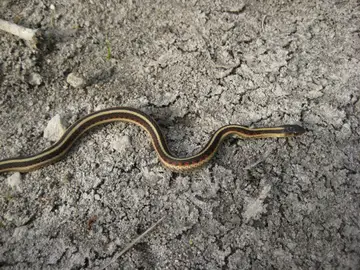
Common Gartersnake
Photo: kclarksdnhmorg · CC BY 4.0 · iNaturalist

Common Gartersnake

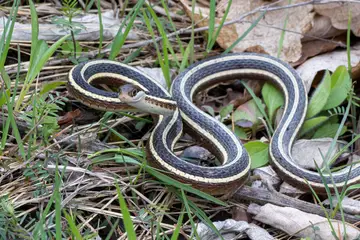
Thamnophis sirtalis

Non-venomous per DNR

Where in Maryland
Statewide. DNR
393 records by month.
What the sources say

Venom: “Non-venomous, though a few allergic reactions to bites have been reported.” (DNR)

Habitat: Common in a variety of habitats including forests, meadows, old fields, riparian areas, freshwater marshes, ditches and backyards. Some source of moisture is usually nearby. (DNR)

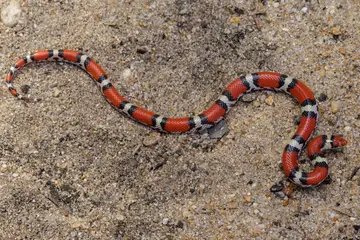
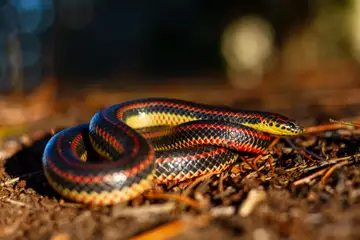
Common Scarletsnake
Photo: Stanton · CC BY-SA 4.0 · Wikimedia Commons · resized

Common Scarletsnake

Cemophora coccinea

Non-venomous per DNR

Where in Maryland
Found only on the Coastal Plain. DNR
Conservation
State Watchlist (DNR herp checklist); RTE list Dec 2025: G5 S1
What the sources say

Habitat: In or near loose well-drained sandy soils, typically in pine-dominated woods. (DNR)

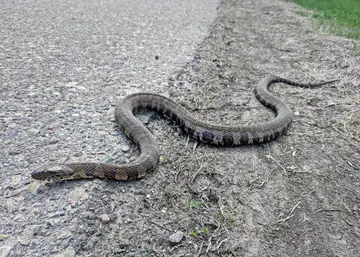
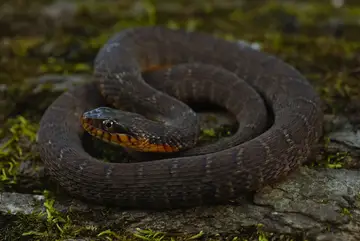
Common Watersnake
Photo: U.S. Fish and Wildlife Service - Midwest Region · Public domain · Wikimedia Commons

Common Watersnake

Nerodia sipedon

Non-venomous per DNR

Size
Adults 22 to 42 inches long, occasionally to 59 inches (Missouri). Pennsylvania gives 24 to over 50 inches; females are usually bigger than males.
How to recognize it
  • Dark crossbands on the front part of the body break up into rows of blotches from the middle of the body to the tail.
  • Belly white, yellow or orange, usually with dark half-moon-shaped spots.
  • Keeled (ridged) scales, so it feels rough; round pupils like other nonvenomous snakes in Missouri.
Where in Maryland
This snake is found commonly throughout Maryland. DNR
334 records by month.
What the sources say

Habitat: Can be found in or near every type of wetland habitat, from rivers to lakes, and bogs to ponds. Even lives in brackish marshes. (DNR)

Full Common Watersnake guide

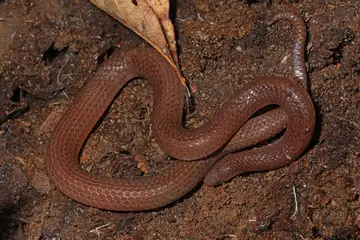
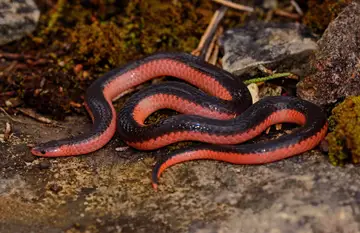
Common Wormsnake
Photo: Judy Gallagher · CC BY 2.0 · Wikimedia Commons

Common Wormsnake

Carphophis amoenus

Non-venomous per DNR

Where in Maryland
Found statewide except for the Allegheny Plateau of western Maryland. DNR
111 records by month.
What the sources say

Habitat: Any forested habitat with soil loose enough for burrowing. Also found in open fields and lawns. (DNR)

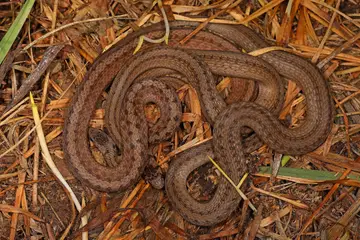
DeKay’s Brownsnake
Photo: Judy Gallagher · CC BY 2.0 · Wikimedia Commons

DeKay’s Brownsnake

Storeria dekayi

Non-venomous per DNR

Size
Most adults 9 to 13 inches; occasionally up to about 20 inches.
How to recognize it
  • Dark top of head; a dark spot under each eye and on each side of the neck
  • Keeled (ridged) scales in 17 rows; round pupil
  • Tennessee: a small dark downward streak on the side of the head
Where in Maryland
Found throughout Maryland including urban areas. DNR
215 records by month.
What the sources say

Venom: “This is a non-venomous species that is gentle when handled.” (DNR)

Habitat: Any type of moist (mesic) woods, grasslands, bogs, swamps, freshwater marshes, old fields, urban parks and backyards. (DNR)

Full DeKay’s Brownsnake guide

Eastern Hog-nosed Snake
Photo: Joshua Liverman · CC BY 4.0 · iNaturalist

Eastern Hog-nosed Snake

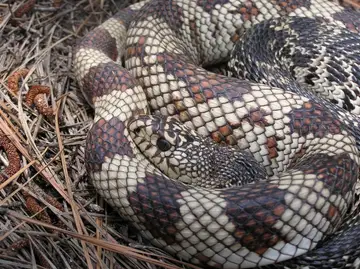
Heterodon platirhinos

Non-venomous per DNR

Where in Maryland
Can be found statewide but more abundant on the Coastal Plain. DNR
What the sources say

Venom: “Considered non-venomous, though it is a ‘rear-fanged’ snake with mildly toxic saliva.” (DNR)

Habitat: Anywhere there are sandy soils, including fields, any open woods, agricultural fields and pastures. Appear to prefer edge habitats. (DNR)

Eastern Kingsnake
Photo: Matthew Lumsden · CC BY 4.0 · iNaturalist

Eastern Kingsnake

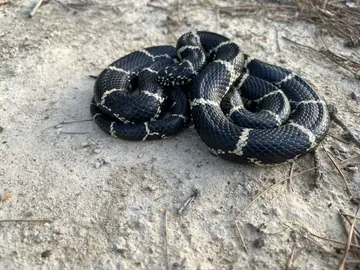
Lampropeltis getula

Non-venomous per DNR

Size
Most adults are about 36-48 inches. Maryland gives a record of 82 inches; Alabama gives up to 6.9 feet.
How to recognize it
  • Smooth, shiny scales and an indistinct neck.
  • Round pupil.
  • Florida Museum counts 19-32 crossbands in Florida; Alabama counts 23 to 52.
Where in Maryland
Primarily a Coastal Plain species but will follow river valleys onto the Piedmont. DNR
What the sources say

Habitat: Use a variety of habitats including most forest types, old fields, freshwater marshes, stream banks and borders of swamps. Can be found in agricultural and urban areas within riparian zones. (DNR)

Full Eastern Kingsnake guide

Eastern Milksnake
Photo: Tom Norton · CC BY 4.0 · iNaturalist

Eastern Milksnake

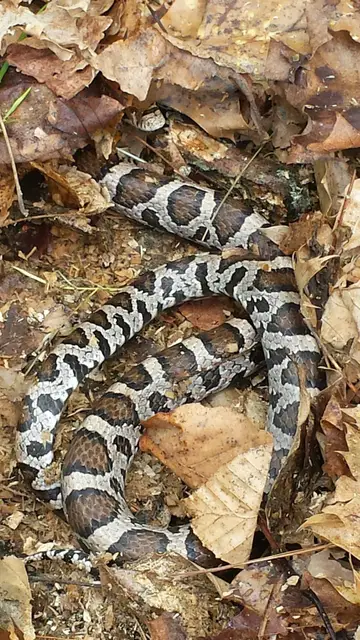
Lampropeltis triangulum

Non-venomous per DNR

Size
Eastern milksnake 24 to 52 inches (Alabama); TN gives 24 to 36 inches for eastern and 21 to 28 for red milksnake.
How to recognize it
  • Eastern milksnake: black-and-white checkerboard belly (Ohio). Western milksnake in Louisiana: underside dull white with scattered black marks.
  • Eastern milksnake: a light Y- or V-shaped mark is usually present on the nape
  • Smooth, shiny scales and round pupils
Where in Maryland
Found from the Fall Line (roughly I-95) west through the Piedmont and mountain regions. DNR
39 records by month.
What the sources say

Habitat: Will utilize a variety of habitats. In higher elevations may be found in deciduous and mixed forests, grassy hillsides, and rocky outcrops. In lower elevations, they prefer wooded areas, open fields, powerline rights-of-way, and around human habitation. (DNR)

Full Eastern Milksnake guide

Eastern Pinesnake
Photo: Alpha Wolf · CC BY 4.0 · iNaturalist

Eastern Pinesnake

Pituophis melanoleucus

Non-venomous per DNR

Size
Most adults are 48 to 66 inches long. The Florida Museum gives a record of 90 inches; Alabama gives a maximum of 83 inches for the northern and 74 inches for the black subspecies. New Jersey gives 48 to 100 inches.
How to recognize it
  • Pointed snout covered by a large, triangular, cone-shaped scale, used for pushing into soft earth.
  • Strongly keeled (ridged) body scales and round pupils.
  • Four prefrontal scales between and just in front of the eyes, where most similar snakes have two.
Where in Maryland
Possibly only found on the Coastal Plain of the Eastern Shore and Anne Arundel County. DNR
Conservation
Historic (DNR field guide); DNR species page: "Currently listed as Endangered Extirpated in Maryland"; RTE list Dec 2025: G4 SH
What the sources say

Habitat: Flat sandy pine barrens and sand ridges, usually in or near pine woods. (DNR)

Full Eastern Pinesnake guide

Eastern Ribbonsnake
Photo: Rstanton13 · CC BY-SA 4.0 · Wikimedia Commons · resized

Eastern Ribbonsnake

Thamnophis saurita

Non-venomous per DNR

Size
Eastern: most adults 18 to 26 inches (record 41 inches). Western: 16 to 42 inches in Louisiana; Oklahoma's orange-striped ribbonsnakes average 20 to 30 inches and can reach nearly 40.
How to recognize it
  • Very slender body; long tail, about one-third of total length.
  • Side stripes sit on the 3rd and 4th scale rows above the belly.
  • Upper lip scales white and unmarked; a distinct white spot in front of each eye; keeled (ridged) scales.
Where in Maryland
Found statewide but less common in western Maryland. DNR
What the sources say

Venom: “Non-venomous, but difficult to handle due to its nervous nature.” (DNR)

Habitat: This is a semi-aquatic species, typically found in or near streams, ponds, bogs, swamps, fresh and brackish marshes, and woodlands adjacent to wetlands. (DNR)

Full Eastern Ribbonsnake guide

Eastern Smooth Earthsnake
Photo: Stanton · CC BY-SA 4.0 · Wikimedia Commons · resized

Eastern Smooth Earthsnake

Virginia valeriae valeriae

Non-venomous per DNR

Where in Maryland
Found primarily on the Coastal Plain and the Piedmont regions. DNR
What the sources say

Habitat: Old fields adjacent to deciduous woodlands, trails and dirt roadways through woodlands, any forest type, pastures, urban and suburban woodlots. (DNR)

Mountain Earthsnake
Photo: Stanton · CC BY-SA 4.0 · Wikimedia Commons · resized

Mountain Earthsnake

Virginia valeriae pulchra

Non-venomous per DNR

Where in Maryland
Found only in western Garrett County. This snake is listed as state Endangered. If found, please report sightings to the Maryland Wildlife and Heritage Service. DNR
Conservation
State Endangered (DNR herp checklist); RTE list Dec 2025: G5T3T4 S1S2, State Endangered
What the sources say

Habitat: Prefers rich wooded areas with water nearby and loose, often sandy, soil. Grassy slopes with rock cover also used. (DNR)

North American Racer
Photo: Everglades NPS from Homestead, Florida, United States · Public domain · Wikimedia Commons

North American Racer

Coluber constrictor

Non-venomous per DNR

Size
Most adults about 3 to 5 ft. Sources range from 20 to 56 inches (Florida Museum) to 34 to 77 inches (New Jersey); Alabama says some exceed 6 ft.
How to recognize it
  • Smooth scales
  • Long and slender with large eyes
  • White chin
Where in Maryland
Statewide. DNR
128 records by month.
What the sources say

Venom: “Non-venomous, but the bite can be painful.” (DNR)

Habitat: Dry open grassy areas or open forest adjacent to grassy areas. They can also be found in urban, suburban and agricultural areas, and on barrier islands. (DNR)

Full North American Racer guide

Northern Mole Kingsnake
Photo: Marshall Cleveland · CC BY 4.0 · iNaturalist

Northern Mole Kingsnake

Lampropeltis rhombomaculata

Not stated

Venom
No official source we use states whether this animal is venomous. That does not mean it is harmless: do not handle it.
Where in Maryland
Found only on the western shore of the Coastal Plain and adjacent Piedmont counties. DNR
Conservation
RTE list Dec 2025: G4 S1
What the sources say

Habitat: This is a subterranean species, preferring to live in other animals' burrows. It may also burrow in sandy or loamy soils. (DNR)

Northern Ring-necked Snake
Photo: Sinéad Tuttle-Lerner · CC BY 4.0 · iNaturalist

Northern Ring-necked Snake

Diadophis punctatus edwardsii

Non-venomous per DNR

Where in Maryland
Ring-necked snakes can be found throughout Maryland. DNR
What the sources say

Habitat: Primarily found in hardwood and mixed pine-hardwood forests, but will also occur in agricultural lands next to woodlots and backyards. Usually found associated with moisture. (DNR)

Northern Rough Greensnake
Photo: Joshua Liverman · CC BY 4.0 · iNaturalist

Northern Rough Greensnake

Opheodrys aestivus

Non-venomous per DNR

Size
Most adults are 14 to 33 inches long (Florida Museum), with a record of 46 inches. Maryland, Missouri, Tennessee and Arkansas give 22 to 32 inches. The tail is long and thin, about a third or more of the total length.
How to recognize it
  • Keeled (ridged) scales in 17 rows, which feel rough; the smooth green snake has smooth scales.
  • Extremely long, thin tail and round pupils.
  • Large eyes.
Where in Maryland
Primarily a Coastal Plain species but has been known to follow river valleys west of the Fall Line into Montgomery County. DNR
75 records by month.
What the sources say

Venom: “Gentle when handled and non-venomous.” (DNR)

Habitat: An arboreal species, it is found in association with shrubs and vines in riparian areas, particularly in areas with sandy soils. They also occur in hardwood and mixed pine-hardwood forests, old fields, suburban lawns, coastal shrub thickets and the wrack zone of barrier islands. Found primarily on the coastal plain. (DNR)

Full Northern Rough Greensnake guide

Plain-bellied Watersnake
Photo: Peter Paplanus · CC BY 2.0 · Wikimedia Commons

Plain-bellied Watersnake

Nerodia erythrogaster

Non-venomous per DNR

Where in Maryland
Found only on the Lower Eastern Shore. DNR
Conservation
State Watchlist (DNR herp checklist); RTE list Dec 2025: G5 S2S3
What the sources say

Habitat: Forested riparian areas, particularly Atlantic White-cedar and Baldcypress Swamps, and shrub swamps, from brackish to tidal fresh waters of coastal plain rivers. May travel considerable distances from water during humid periods of mid-summer. All records are from the lower Eastern Shore where it may be locally common, though rarely seen. (DNR)

Queensnake
Photo: Rstanton13 · CC BY-SA 4.0 · Wikimedia Commons · resized

Queensnake

Regina septemvittata

Non-venomous per DNR

Where in Maryland
Most commonly found in the Piedmont and western Maryland, with a few historical sightings reported from the northern Coastal Plain. DNR
What the sources say

Habitat: Found in or near clear water, bogs and other freshwater shallow wetlands, small spring-fed streams, ponds or lakes. There will be crayfish. (DNR)

Rainbow Snake
Photo: Joshua Liverman · CC BY 4.0 · iNaturalist

Rainbow Snake

Farancia erytrogramma

Not stated

Venom
No official source we use states whether this animal is venomous. That does not mean it is harmless: do not handle it.
Where in Maryland
Found infrequently on the western portion of the Coastal Plain and possibly in the Potomac valley into Montgomery County. DNR
Conservation
State Endangered (DNR herp checklist); RTE list Dec 2025: G4 S1, State Endangered
What the sources say

Habitat: This is a highly aquatic species, preferring swamps, marshes, and slow-moving streams. They tolerate brackish water. They will also be found on dry land, burrowing in moist soil, muck or a sandy substrate. (DNR)

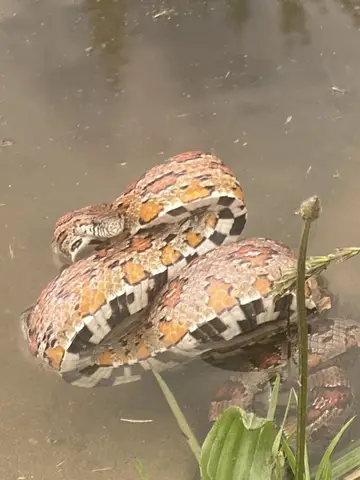
Red Cornsnake
Photo: Bea Leiderman · CC BY 4.0 · iNaturalist

Red Cornsnake

Pantherophis guttatus

Non-venomous per DNR

Size
Most adults 30-48 inches (76-122 cm); record 74 inches (188 cm)
How to recognize it
  • Spear-shaped head marking from the neck to a point between the eyes is a reliable identification feature
  • Weakly keeled scales and round pupil
Where in Maryland
Primarily found on the Coastal Plain but there are few records for the Ridge and Valley region of Washington and Allegany Counties. DNR
Conservation
RTE list Dec 2025: G5 S2
What the sources say

Habitat: Hardwood forests and pine-dominated agricultural and urban areas, and fields and open grassy areas next to woods. (DNR)

Full Red Cornsnake guide

Red-bellied Snake
Photo: Rstanton13 · CC BY-SA 4.0 · Wikimedia Commons · resized

Red-bellied Snake

Storeria occipitomaculata

Non-venomous per DNR

Size
Usually 8 to 10 inches; state figures run from about 4 to 16 inches, with a Florida record of 16.6 inches.
How to recognize it
  • Plain, unmarked red or orange belly.
  • Three light spots just behind the head, which may fuse into a collar.
  • Keeled (ridged) scales in 15 rows at midbody and round pupils.
Where in Maryland
Irregular distribution throughout the state; uncommon on the Coastal Plain. DNR
What the sources say

Venom: “This is a non-venomous species that is gentle when handled.” (DNR)

Habitat: Any open forests, old fields, the edges of freshwater wetlands and sphagnum bogs. Found in dry to wet habitats. (DNR)

Full Red-bellied Snake guide

Smooth Greensnake
Photo: User:Rstanton13 · CC BY-SA 4.0 · Wikimedia Commons · resized

Smooth Greensnake

Opheodrys vernalis

Non-venomous per DNR

Where in Maryland
Found in western Maryland, from Frederick County to Garrett County. DNR
Conservation
RTE list Dec 2025: G5 S3S4
What the sources say

Habitat: Prefers open areas like fields, meadows, marshes, stream edges, open woodlands and hillsides at higher elevations. (DNR)

Southern Ring-necked Snake
Photo: Peter Paplanus from St. Louis, Missouri · CC BY 2.0 · Wikimedia Commons

Southern Ring-necked Snake

Diadophis punctatus punctatus

Non-venomous per DNR

Where in Maryland
Ring-necked snakes can be found throughout Maryland. DNR
What the sources say

Habitat: Primarily found in hardwood and mixed pine-hardwood forests, but will also occur in agricultural lands next to woodlots and backyards. Usually found associated with moisture. (DNR)

Snakes people confuse

Northern watersnake or Copperhead?

Northern watersnake
Photo: U.S. Fish and Wildlife Service - Midwest Region · Public domain · Wikimedia Commons

Northern watersnake Non-venomous

Copperhead
Photo: USFWSmidwest · Public domain · Wikimedia Commons

Copperhead Venomous

Florida Museum (midland watersnake): the watersnake's crossbands are darker, narrower and much more numerous than a copperhead's and turn into blotches halfway down the body. Watersnakes have round pupils and dark vertical lines near the mouth; copperheads have no such lines.

Brown Snake (Dekay's Brownsnake) or Copperhead?

Brown Snake (Dekay's Brownsnake)
Photo: Judy Gallagher · CC BY 2.0 · Wikimedia Commons

Brown Snake (Dekay's Brownsnake) Non-venomous

Copperhead
Photo: USFWSmidwest · Public domain · Wikimedia Commons

Copperhead Venomous

Copperheads have bold hourglass-shaped bands, and young copperheads under about 12 inches have bright yellow tail tips. Brown snakes have small spots, not hourglass bands.

Brown Snake (Dekay's Brownsnake) or Red-bellied Snake?

Brown Snake (Dekay's Brownsnake)
Photo: Judy Gallagher · CC BY 2.0 · Wikimedia Commons

Brown Snake (Dekay's Brownsnake) Non-venomous

Red-bellied Snake
Photo: Rstanton13 · CC BY-SA 4.0 · Wikimedia Commons · resized

Red-bellied Snake Non-venomous

The red-bellied snake has a red underside; the brown snake's belly is cream, yellow or pink.

Red-bellied snake or Copperhead?

Red-bellied snake
Photo: Clay Gibbons · CC BY 4.0 · iNaturalist

Red-bellied snake Non-venomous

Copperhead
Photo: USFWSmidwest · Public domain · Wikimedia Commons

Copperhead Venomous

Missouri: red-bellied snakes are sometimes mistaken for young copperheads. Copperheads are stout-bodied with hourglass-shaped markings on the back, vertical pupils, a sensory pit between each nostril and eye and, sometimes, especially in young copperheads, a yellow tail tip.

Red-bellied snake or Dekay's brownsnake?

Red-bellied snake
Photo: Clay Gibbons · CC BY 4.0 · iNaturalist

Red-bellied snake Non-venomous

Dekay's brownsnake
Photo: Judy Gallagher · CC BY 2.0 · Wikimedia Commons

Dekay's brownsnake Non-venomous

Tennessee: Dekay's brownsnake has a yellowish, tan or pinkish belly with very small black dots on the sides.

Red-bellied snake or Eastern wormsnake?

Red-bellied snake
Photo: Clay Gibbons · CC BY 4.0 · iNaturalist

Red-bellied snake Non-venomous

Eastern wormsnake
Photo: Peter Paplanus · CC BY 2.0 · Wikimedia Commons

Eastern wormsnake Non-venomous

Massachusetts: look at the neck; the wormsnake has no constriction between the head and body. Connecticut also lists it as confused with the redbelly snake.

Photos show typical adults; individuals vary. Never get close to compare.

When snakes are active in Maryland

Records of snakes in Maryland peak in April to June and September. They show when people record snakes, not how many there are (about month bars).

2,041 records of snakes in Maryland by month (GBIF, CC0 and CC BY records).
  • Timber Rattlesnake: day-active in spring and fall, night-active in summer, most active in spring after hibernation. DNR
  • Eastern Hog-nosed Snake: look along edges in late spring and summer. DNR

If you are bitten or stung

Call 911 or Poison Help at 1-800-222-1222 right away. Poison Help connects you to your local poison center, any time of day.

Official advice from DNR:

  • If bitten by a venomous snake, immediately contact the Maryland Poison Center at 800-222-1222 (open 24 hours). DNR
  • Never handle venomous snakes, alive or dead. DNR
  • Leave snakes alone; many bites occur when people try to capture or kill venomous snakes. DNR
  • Copperhead and timber rattlesnake should not be approached or handled. DNR
  • Snake bites are serious and need expert evaluation; Maryland Poison Control receives about 100 snake bite cases a year. DNR

How to report

Nuisance, injured or sick wildlife: call toll-free in Maryland 1-877-463-6497 (USDA Wildlife Services, 8:00 am to 4:30 pm, Monday through Friday, except State holidays); from outside Maryland 410-349-8055. DNR

Common questions

What official sources say

Are there venomous snakes in Maryland?

Yes. DNR names two snakes with medically significant venom: the eastern copperhead and timber rattlesnake. DNR

“Several of Maryland’s snakes possess venom, but only the copperhead and the timber rattlesnake have medically significant venom known to cause adverse reactions in humans.”

Are there rattlesnakes in Maryland?

Yes. Timber Rattlesnake, in western Maryland from Frederick to Garrett County. DNR

“Exclusively a western Maryland species, from Frederick to Garrett County, although historical records place these snakes east to the Susquehanna River.”

Are there water moccasins or cottonmouths in Maryland?

No. DNR says water moccasins do not occur in Maryland; common watersnakes are often mistaken for them. DNR

“Often mistaken for ‘water moccasins’ which do not occur in Maryland.”

Are there coral snakes in Maryland?

Not on the official list. The Eastern Coral Snake is not on the DNR herp checklist. DNR notes that the non-venomous Scarletsnake mimics it. No DNR sentence directly says coral snakes are absent. DNR

“Mimics the color and pattern of the venomous Eastern Coral Snake, however this non-venomous species has black separating the narrow yellow (sometimes white) blotches and broad red blotches”

Are there snakeheads in Maryland?

Yes. DNR lists Northern Snakehead as invasive in Central, Southern and Eastern regions. DNR

“Northern Snakehead Channa argus Stream, River, Pond, and Lake; Bay and Ocean Central; Southern; Eastern”

About this list

The species list comes from The Reptiles and Amphibians of Maryland (Maryland Herp Checklist) (Maryland Department of Natural Resources (DNR), undated; "Taxonomy based on Nicholson 2025"; Internet Archive capture 2026-05-14). 1 more entry comes from other official sources named on each card.

Venom labels come only from official sources and link to them; "Not stated" never means harmless. How labels work.

Want a paper copy? Print the Maryland snakes ID chart.

Sources

  1. Maryland's Wildlife Species. Maryland Department of Natural Resources (DNR). archived copy, captured September 6, 2026; checked November 3, 2026. Archived copy.
  2. The Reptiles and Amphibians of Maryland (Maryland Herp Checklist). Maryland Department of Natural Resources (DNR). archived copy, captured May 14, 2026; checked November 3, 2026. Archived copy.
    Quoted passages (1)
    “SNAKES – 25 native species and subspecies”
  3. Common Watersnake (DNR field guide species page). Maryland Department of Natural Resources (DNR). archived copy, captured February 16, 2026; checked November 3, 2026. Archived copy.
    Quoted passages (1)
    “Often mistaken for ‘water moccasins’ which do not occur in Maryland.”
  4. Plain-bellied Watersnake (DNR field guide species page). Maryland Department of Natural Resources (DNR). archived copy, captured February 9, 2026; checked November 3, 2026. Archived copy.
  5. Queensnake (DNR field guide species page). Maryland Department of Natural Resources (DNR). archived copy, captured May 13, 2026; checked November 3, 2026. Archived copy.
  6. Smooth Earthsnake (DNR field guide species page). Maryland Department of Natural Resources (DNR). archived copy, captured February 16, 2026; checked November 3, 2026. Archived copy.
  7. Mountain Earthsnake (DNR field guide species page). Maryland Department of Natural Resources (DNR). archived copy, captured January 20, 2026; checked November 3, 2026. Archived copy.
  8. Dekay’s Brownsnake (DNR field guide species page). Maryland Department of Natural Resources (DNR). archived copy, captured February 12, 2026; checked November 3, 2026. Archived copy.
    Quoted passages (1)
    “This is a non-venomous species that is gentle when handled.”
  9. Red-bellied Snake (DNR field guide species page). Maryland Department of Natural Resources (DNR). archived copy, captured February 16, 2026; checked November 3, 2026. Archived copy.
    Quoted passages (1)
    “This is a non-venomous species that is gentle when handled.”
  10. Common Gartersnake (DNR field guide species page). Maryland Department of Natural Resources (DNR). archived copy, captured February 12, 2026; checked November 3, 2026. Archived copy.
    Quoted passages (1)
    “Non-venomous, though a few allergic reactions to bites have been reported.”
  11. Eastern Ribbonsnake (DNR field guide species page). Maryland Department of Natural Resources (DNR). archived copy, captured April 16, 2026; checked November 3, 2026. Archived copy.
    Quoted passages (1)
    “Non-venomous, but difficult to handle due to its nervous nature.”
  12. Ring-Necked Snake (DNR field guide species page). Maryland Department of Natural Resources (DNR). archived copy, captured February 9, 2026; checked November 3, 2026. Archived copy.
  13. Common Wormsnake (DNR field guide species page). Maryland Department of Natural Resources (DNR). archived copy, captured February 16, 2026; checked November 3, 2026. Archived copy.
  14. Smooth Greensnake (DNR field guide species page). Maryland Department of Natural Resources (DNR). archived copy, captured February 16, 2026; checked November 3, 2026. Archived copy.
  15. Rough Greensnake (DNR field guide species page). Maryland Department of Natural Resources (DNR). archived copy, captured March 8, 2026; checked November 3, 2026. Archived copy.
    Quoted passages (1)
    “Gentle when handled and non-venomous.”
  16. Eastern Hog-nosed Snake (DNR field guide species page). Maryland Department of Natural Resources (DNR). archived copy, captured February 12, 2026; checked November 3, 2026. Archived copy.
    Quoted passages (2)
    “Considered non-venomous, though it is a ‘rear-fanged’ snake with mildly toxic saliva.”
    “Walk field, forest and wetland edges in late Spring and Summer”
  17. North American Racer (DNR field guide species page). Maryland Department of Natural Resources (DNR). archived copy, captured February 12, 2026; checked November 3, 2026. Archived copy.
    Quoted passages (1)
    “Non-venomous, but the bite can be painful.”
  18. Red Cornsnake (DNR field guide species page). Maryland Department of Natural Resources (DNR). archived copy, captured January 19, 2026; checked November 3, 2026. Archived copy.
  19. Eastern Ratsnake (DNR field guide species page). Maryland Department of Natural Resources (DNR). archived copy, captured June 6, 2026; checked November 3, 2026. Archived copy.
    Quoted passages (1)
    “Non-venomous, but readily give a painful bite when handled.”
  20. Eastern Kingsnake (DNR field guide species page). Maryland Department of Natural Resources (DNR). archived copy, captured February 16, 2026; checked November 3, 2026. Archived copy.
  21. Eastern Milksnake (DNR field guide species page). Maryland Department of Natural Resources (DNR). archived copy, captured January 17, 2026; checked November 3, 2026. Archived copy.
  22. Scarletsnake (DNR field guide species page). Maryland Department of Natural Resources (DNR). archived copy, captured February 16, 2026; checked November 3, 2026. Archived copy.
    Quoted passages (1)
    “Mimics the color and pattern of the venomous Eastern Coral Snake, however this non-venomous species has black separating the narrow yellow (sometimes white) blotches and broad red blotches”
  23. Eastern Copperhead (DNR field guide species page). Maryland Department of Natural Resources (DNR). archived copy, captured February 12, 2026; checked November 3, 2026. Archived copy.
    Quoted passages (1)
    “Warning: this species is venomous!”
  24. Maryland Snakes (field guide). Maryland Department of Natural Resources (DNR). archived copy, captured July 16, 2026; checked November 3, 2026. Archived copy.
    Quoted passages (1)
    “Both of these species are dangerously venomous and should be treated with caution. Do not approach or handle these snakes as a bite could be fatal.”
  25. Timber Rattlesnake (DNR field guide species page). Maryland Department of Natural Resources (DNR). archived copy, captured January 24, 2026; checked November 3, 2026. Archived copy.
    Quoted passages (3)
    “Warning – this is a venomous snake.”
    “Diurnal during the spring and fall, nocturnal during summer to avoid the heat. Most active in the spring following hibernation.”
    “Exclusively a western Maryland species, from Frederick to Garrett County, although historical records place these snakes east to the Susquehanna River.”
  26. Eastern Pinesnake (DNR field guide species page). Maryland Department of Natural Resources (DNR). archived copy, captured February 16, 2026; checked November 3, 2026. Archived copy.
    Quoted passages (1)
    “Easily confused with a juvenile Eastern Ratsnake”
  27. Venomous Snakes of Maryland. Maryland Department of Natural Resources (DNR). archived copy, captured May 15, 2026; checked November 3, 2026. Archived copy.
    Quoted passages (6)
    “If bitten by a venomous snake, immediately contact the Maryland Poison Center at 800-222-1222. The Maryland Poison Center is open 24 hours a day”
    “Never handle venomous snakes, alive or dead.”
    “Leave snakes alone. Many bites occur when people attempt to capture or kill venomous snakes.”
    “Both of Maryland’s pit vipers should be treated with caution and should not be approached or handled.”
    “On average, Maryland Poison Control receives 100 snake bite cases each year, about half of which are due to bites from venomous snakes, mostly copperhead bites. Snake bites are serious and require expert evaluation and treatment.”
    “Several of Maryland’s snakes possess venom, but only the copperhead and the timber rattlesnake have medically significant venom known to cause adverse reactions in humans.”
  28. Wildlife Problems. Maryland Department of Natural Resources (DNR). archived copy, captured August 29, 2026; checked November 3, 2026. Archived copy.
    Quoted passages (1)
    “To report nuisance, injured or sick wildlife, call toll-free in Maryland 1-877-463-6497.”
  29. Invasive and Exotic Species in Maryland: Animals. Maryland Department of Natural Resources (DNR). archived copy, captured May 15, 2026; checked November 3, 2026. Archived copy.
    Quoted passages (1)
    “Northern Snakehead Channa argus Stream, River, Pond, and Lake; Bay and Ocean Central; Southern; Eastern”
  30. GBIF.org occurrence records, human observations licensed CC0 1.0 or CC BY 4.0 only, accessed November 3, 2026. The datasets behind these counts are listed on our Sources page.