Yes. DNR names two snakes with medically significant venom: the eastern copperhead and timber rattlesnake. DNR
Are there rattlesnakes in Maryland?
Yes. Timber Rattlesnake, in western Maryland from Frederick to Garrett County. DNR
Are there water moccasins or cottonmouths in Maryland?
No. DNR says water moccasins do not occur in Maryland; common watersnakes are often mistaken for them. DNR
Are there coral snakes in Maryland?
Not on the official list. The Eastern Coral Snake is not on the DNR herp checklist. DNR notes that the non-venomous Scarletsnake mimics it. No DNR sentence directly says coral snakes are absent. DNR
Are there snakeheads in Maryland?
Yes. DNR lists Northern Snakehead as invasive in Central, Southern and Eastern regions. DNR
“Both of these species are dangerously venomous and should be treated with caution. Do not approach or handle these snakes as a bite could be fatal.” DNR
Size
Adults usually about 2 to 3 feet (24-36 in); record about 53 inches.
How to recognize it
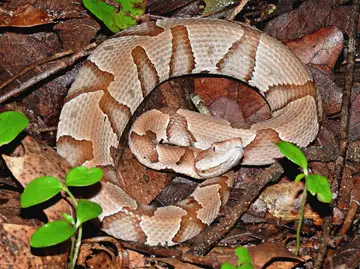
Vertical (cat-like) pupils and a heat-sensing pit between eye and nostril
Heavy-bodied; keeled scales
Head shape alone is not a reliable way to identify copperheads
Where in Maryland
Eastern Copperheads are found throughout Maryland with the exception of several counties on the Eastern Shore. DNR
JFMAMJJASOND
52 records by month.What the sources say
Venom: “Warning: this species is venomous!” (DNR)
Habitat: This is a snake of forests, old fields, swamps, dry sandy ridges adjacent to swamps, and agricultural fields adjacent to forests. (DNR)
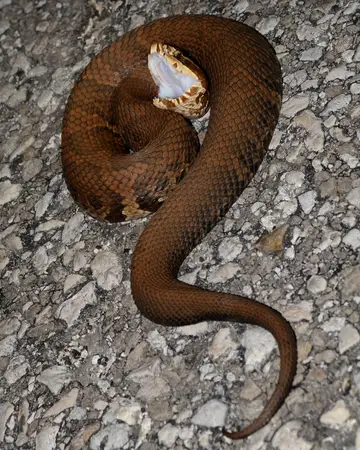
Also venomous. Juvenile cottonmouths have many dark spots and speckles inside their dark crossbands (copperhead bands have none or at most one). The Florida Museum says adult Florida cottonmouths are typically uniformly dark, but SCDNR says cottonmouth color ranges from dark brown and black to olive drab and yellow-tan, so a pale snake is not ruled out. The copperhead's eye is not obscured by the dark facial band typical of the cottonmouth. Cottonmouths are almost always associated with wetlands.
Photo: U.S. Fish and Wildlife Service - Midwest Region · Public domain · Wikimedia Commons
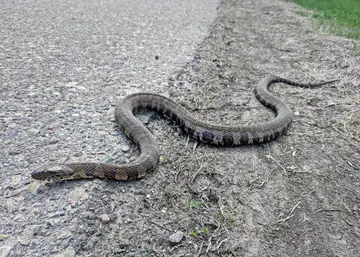
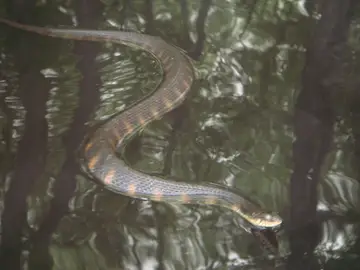
Northern water snake
Its dark bands form a 'reverse hourglass': wider across the back and narrower on the sides (the copperhead's are narrow on the back, wide on the sides). Older water snakes can look solid dark.
Florida Museum, for Florida: crossbands (in the Southern Watersnake, on juveniles) are darker, narrower and much more numerous than a copperhead's; pupils are round; dark vertical lines on the sides of the face near the mouth, which copperheads lack. Large adults are typically uniformly dark brown or black.
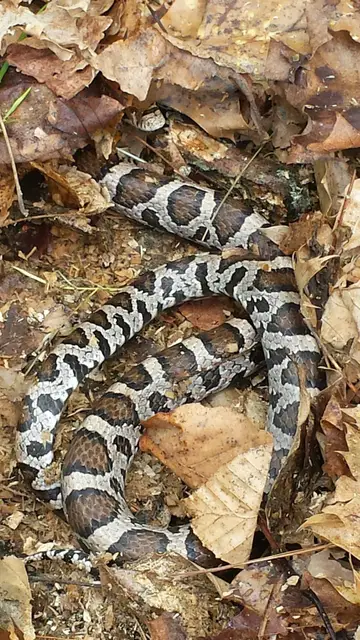
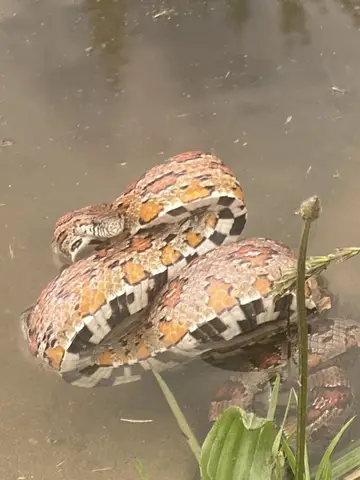
Milk snake blotches are outlined in black and widest across the middle of the back; belly is a black-and-white checkerboard (copperhead belly is mottled white to gray).
Maryland Snakes (field guide). Maryland Department of Natural Resources (DNR). archived copy, captured July 16, 2026; checked November 3, 2026.Archived copy. Quoted passages (1)
“Both of these species are dangerously venomous and should be treated with caution. Do not approach or handle these snakes as a bite could be fatal.”
Venomous Snakes of Maryland. Maryland Department of Natural Resources (DNR). archived copy, captured May 15, 2026; checked November 3, 2026.Archived copy. Quoted passages (2)
“Both of Maryland’s pit vipers should be treated with caution and should not be approached or handled.”
“Several of Maryland’s snakes possess venom, but only the copperhead and the timber rattlesnake have medically significant venom known to cause adverse reactions in humans.”
“Exclusively a western Maryland species, from Frederick to Garrett County, although historical records place these snakes east to the Susquehanna River.”
“Mimics the color and pattern of the venomous Eastern Coral Snake, however this non-venomous species has black separating the narrow yellow (sometimes white) blotches and broad red blotches”