Corn snake
Pantherophis guttatus · also called red cornsnake, cornsnake, red rat snake and chicken snake · Last checked November 3, 2026.
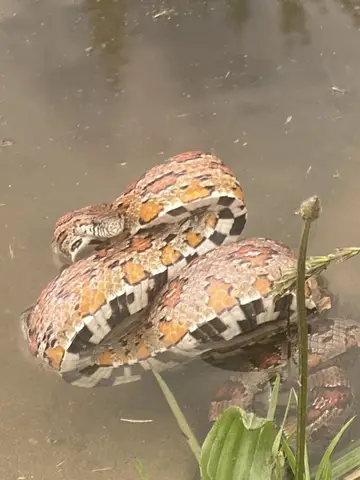
The corn snake (red cornsnake) is a medium-sized, orange to reddish-brown snake with black-bordered red or orange blotches and a black-and-white checkerboard belly. It is non-venomous. The Florida Museum says it is not dangerous to people or pets, though it will bite to defend itself. It lives in the southeastern United States, from southern New Jersey south through the Carolinas to the Florida Keys and west toward eastern Louisiana. Georgia DNR says it is occasionally confused with the venomous copperhead. Florida Museum of Natural History
On this page
Is the corn snake dangerous?
Non-venomous. The Florida Museum says cornsnakes are not dangerous to people or pets, but they will readily bite to defend themselves. Florida Museum of Natural History
“Non-venomous. Cornsnakes are not dangerous to people or pets, but they will readily bite to defend themselves.”
Bites and stings: May bite if cornered, grabbed or pinned. FLMNH says virtually all bites happen when the snake is deliberately molested.
How to identify a corn snake
A photo or description can narrow it down, but cannot confirm what an animal is or that it is safe. Look from a distance and do not handle wild animals.
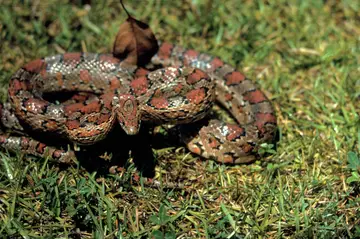

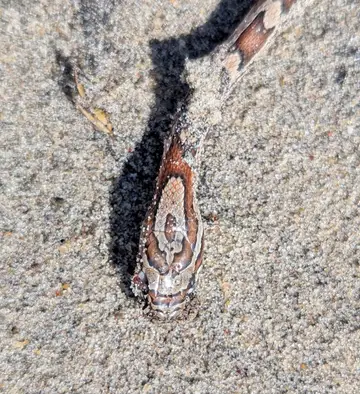
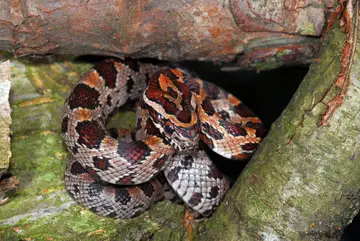
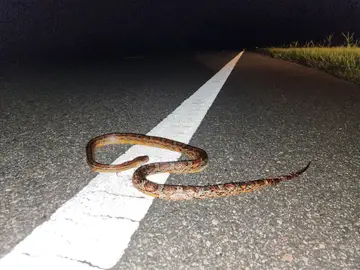
Size: Most adults 30-48 inches (76-122 cm); record 74 inches (188 cm) Florida Museum of Natural History
Colors: Orangish-brown with black-bordered orange, red or brownish blotches; coastal Plain snakes are usually bright orange; Piedmont and upland snakes darker and more subdued. Pattern: Black-and-white checkerboard belly; two black stripes under the tail; spear-shaped mark on the head and neck.
Key features
- Spear-shaped head marking from the neck to a point between the eyes is a reliable identification feature University of Georgia Savannah River Ecology Laboratory
- Weakly keeled scales and round pupil Florida Museum of Natural History
Young
Juveniles look like adults but may be browner; SREL says drabber, brown or gray
Animals mistaken for the corn snake
Corn snake or Copperhead?
Corn snake
Copperhead Agkistrodon contortrix
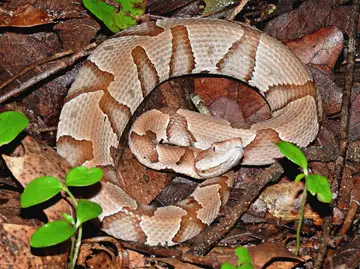

Georgia DNR says corn snakes are longer and slender, have an elongated head and square blotches with black outlines down the back, and tend to show more red, orange and yellow. (Georgia DNR also says corn snakes have smooth, shiny scales; the Florida Museum, UGA SREL and LDWF describe corn snake scales as weakly or slightly keeled, so scale texture is not offered here as a way to tell them apart.) Georgia Department of Natural Resources, Wildlife Resources Division
Venomous (Georgia DNR Venomous Snakes fact sheet). SCDNR: the corn snake 'may be confused with the copperhead.'
Corn snake or Eastern ratsnake?
Corn snake
Eastern ratsnake Pantherophis alleghaniensis
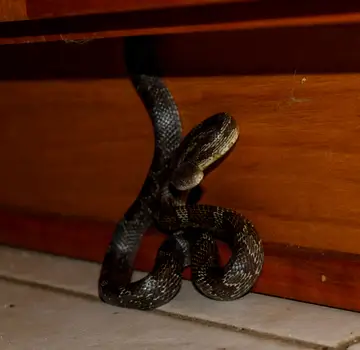
FLMNH: eastern ratsnakes lack the spear-shaped head pattern and the black-and-white checkerboard belly Florida Museum of Natural History
Non-venomous (FLMNH).
Corn snake or Milksnakes and mole kingsnake?
Corn snake
Milksnakes and mole kingsnake Lampropeltis spp.
TWRA: Scarlet, Red and Eastern Milksnakes and the Mole Kingsnake lack the striping under the tail. Tennessee Wildlife Resources Agency
Where the corn snake lives
- Native or listed
- Nonnative or not established
- No official record in our data
- 1–9
- 10–99
- 100–999
- 1,000+
On our state guides
- Alabama snakes
- Delaware snakes
- Florida snakes
- Georgia snakes
- Kentucky snakes
- Louisiana snakes
- Maryland snakes
- New Jersey snakes
- North Carolina snakes
- Tennessee snakes
- Texas snakes
- Virginia snakes
- West Virginia snakes
State boundaries: U.S. Census Bureau, cartographic boundary file cb_2024_us_state_20m.
When it is active
Mostly active at dawn and dusk, more nocturnal in hot weather. Surface activity peaks in late spring and early fall. University of Georgia Savannah River Ecology Laboratory
US open-licence records peak in March to June and October.
Habitat and habits
Habitat: Pinelands, hardwood hammocks, swamps and farm fields; often in suburbs next to good habitat Florida Museum of Natural History
Behavior: Flees or freezes when approached. If cornered it takes an S-shaped pose, strikes and vibrates its tail; not aggressive
Diet: Lizards, frogs, rodents, and birds and their eggs; constricts larger prey
Young: Lays about 3-40 eggs; in Florida they usually hatch August-September
Legal status and reporting
Protection: SREL says corn snakes are protected in Georgia and South Carolina. In North Carolina it is a nongame species with no open season (NCWRC). University of Georgia Savannah River Ecology Laboratory
Questions about the corn snake
Is a corn snake venomous?
No. The Florida Museum says cornsnakes are non-venomous and not dangerous to people or pets, though they will bite to defend themselves.
Coral snake vs corn snake
No official source checked compares these two snakes directly. The Florida Museum describes the venomous Harlequin Coralsnake as a thin-bodied snake with alternating red and black rings separated by narrower yellow rings, with a rounded black snout, and says that if you are not 100% positive of a snake's identification, it is best for everyone involved to leave it alone.
Are there corn snakes in new jersey?
The UGA Savannah River Ecology Lab says the corn snake's range starts in southern New Jersey.
Are there corn snakes in pennsylvania?
The Pennsylvania Fish and Boat Commission lists 21 native snakes, and the corn snake is not among them.
Are there corn snakes in ohio?
The Ohio DNR Reptiles of Ohio field guide has no corn snake account.
Copperhead vs corn snake
Georgia DNR says corn snakes are longer and slender, with an elongated head and square black-outlined blotches down the back, and more red, orange and yellow. Copperheads are venomous. NCWRC says the best plan when you meet a snake is to leave it alone and give it plenty of space.
Sources
- Florida Snake ID Guide: Red Cornsnake. Florida Museum of Natural History (University of Florida). updated March 18, 2026; checked November 3, 2026.
Quoted passages (9)
“Non-venomous. Cornsnakes are not dangerous to people or pets, but they will readily bite to defend themselves.”
“Most adult cornsnakes are about 30-48 inches (76-122 cm) in total length, with a record length recorded of 74 inches (188 cm).”
“The scales are weakly keeled, and there are 27-29 dorsal scale rows at midbody. The pupil is round.”
“Juveniles are similar in appearance to adults, but they may be more brownish in coloration.”
“Cornsnakes are commonly found in pinelands, hardwood hammocks, swamps, and agricultural fields. Adults and juveniles of this species are often found in suburban neighborhoods where development encroaches into favorable habitats.”
“Cornsnakes commonly feed on lizards, frogs, rodents, and birds and their eggs. Cornsnakes constrict larger prey with coils of their body, but they often swallow smaller prey alive.”
“When approached, cornsnakes may either flee for shelter or remain motionless to avoid detection. However, if they are cornered, both juveniles and adults will take an S-shaped posture and strike at the attacker while rapidly vibrating the tip of the tail, which produces a buzzing sound in leaf litter.”
“In Florida, females lay around 3-40 white elongate eggs, which typically hatch between August and September.”
“Eastern Ratsnakes lack a spear-shaped pattern on top of the head and lack a black and white checkerboard pattern on the belly.”
- Corn Snake (Elaphe [Pantherophis] guttatus). University of Georgia Savannah River Ecology Laboratory (linked by SCDNR). undated page; checked November 3, 2026.
Quoted passages (3)
“On the head, a spear-shaped marking extends from the neck forward to a point between the eyes, serving as a reliable identification feature.”
“Corn snakes are primarily crepuscular (active at dawn and dusk), though during the hot season, they become more nocturnal. … Surface activity peaks in warm months, particularly in late spring and early fall”
“Corn snakes are listed as stable and are protected in the states of Georgia and South Carolina.”
- Venomous Snakes Fact Sheet Series: Copperhead. Georgia Department of Natural Resources, Wildlife Resources Division. PDF Last-Modified Fri, 02 Feb 2024 14:12:53 GMT; checked November 3, 2026.
Quoted passages (1)
“However, corn snakes are longer and slender and have smooth, shiny scales. Corn snakes also have an elongated head, and square blotches with black outlines going down the back. Corn snakes also tend to feature more red, orange and yellow colors against a grayish or brownish background.”
- Red Cornsnake (Tennessee Watchable Wildlife species account). Tennessee Wildlife Resources Agency. undated page; checked November 3, 2026.
Quoted passages (1)
“Similar Species: Scarlet, Red, and Eastern Milksnake, and Mole Kingsnake lack striping under tails.”
- Florida Snake ID Guide: Harlequin Coralsnake. Florida Museum of Natural History (University of Florida). updated September 23, 2022; checked November 3, 2026.
- Pennsylvania Native Reptile and Amphibian Species. Pennsylvania Fish and Boat Commission. undated page; checked November 3, 2026.
- Reptiles of Ohio Field Guide (Publication 5354). Ohio Department of Natural Resources, Division of Wildlife. PUBLICATION 5354; checked November 3, 2026.
- Corn Snake (NCWRC species page). N.C. Wildlife Resources Commission. undated page; checked November 3, 2026.
- GBIF.org occurrence records, human observations licensed CC0 1.0 or CC BY 4.0 only, accessed November 3, 2026. The datasets behind these counts are listed on our Sources page.
- State boundaries: U.S. Census Bureau, cartographic boundary file cb_2024_us_state_20m.