Rat snake
Pantherophis (North American rat snakes) · also called ratsnake, black rat snake, black snake and chicken snake · Last checked November 3, 2026.
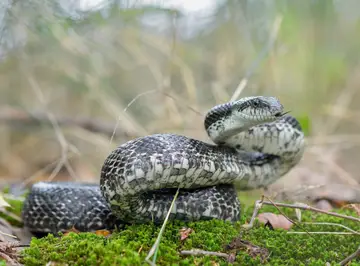

Rat snakes are large, non-venomous constricting snakes that climb well and eat rodents, birds and eggs. Adults are often shiny black, gray with dark blotches, or striped with four dark lines (yellow, orange, tan or gray in peninsular Florida; greenish in the southeastern Coastal Plain of North Carolina). Young ones are boldly blotched and look very different from adults. State agencies say rat snakes are not venomous, but they will bite if cornered or handled, and they vibrate their tails, which leads people to mistake them for rattlesnakes. Georgia DNR says copperheads are often confused with them. They live across the eastern and central United States. N.C. Wildlife Resources Commission
This page covers a genus (Pantherophis (North American rat snakes)), not a single species.
On this page
Is the rat snake dangerous?
Florida Museum: non-venomous and not dangerous to people or pets, but they readily bite to defend themselves. Florida Museum of Natural History
“Non-venomous. Eastern Ratsnakes are not dangerous to people or pets, but they will readily bite to defend themselves.”
Bites and stings: Will bite if cornered, grabbed or handled roughly. NCWRC says even a large one's bite is no more severe than a briar scratch.
If someone is bitten or stung, call 911 or Poison Help at 1-800-222-1222.
How to identify a rat snake
A photo or description can narrow it down, but cannot confirm what an animal is or that it is safe. Look from a distance and do not handle wild animals.
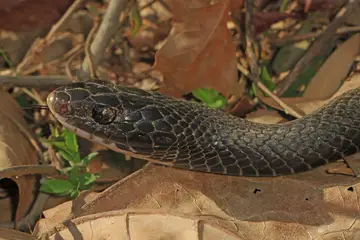

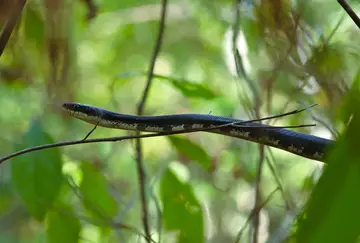

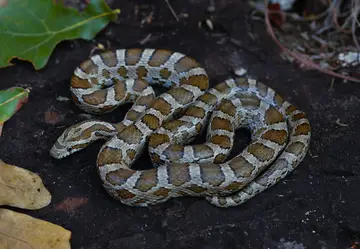

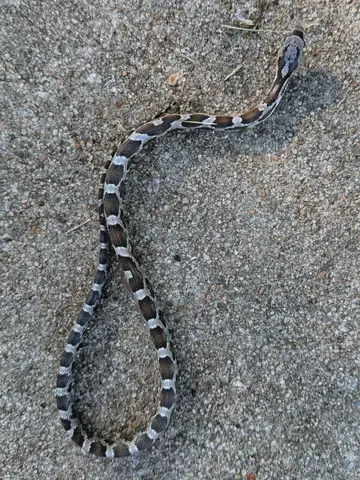
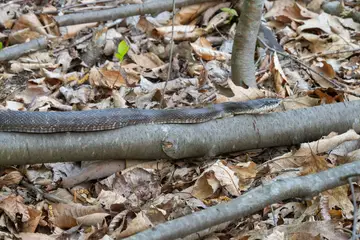

Size: Often about 3.5 to 6 feet: 42 to 72 inches in Florida, Missouri and Indiana accounts, with records to about 101 inches. Florida Museum of Natural History
Colors: Glossy black adults in much of the range, with a white chin and throat; light gray with darker gray blotches (gray ratsnake); yellow, orange, tan or gray with four dark stripes in peninsular Florida; tan or gray with dark blotches and a calico effect in southern Louisiana. Pattern: Dark square blotches on the belly, like a checkerboard.
Key features
- Body shaped like a loaf of bread in cross section, an aid to climbing N.C. Wildlife Resources Commission
- Weakly keeled scales and a round pupil Florida Museum of Natural History
- Kinked resting posture when approached N.C. Wildlife Resources Commission
- Vibrates the tail when cornered; the sound can suggest a rattlesnake Indiana Department of Natural Resources
Young
Bold blotches on gray or light brown, unlike adults; New Jersey says black rat snakes are not black until about 4 to 5 years old.
Animals mistaken for the rat snake
Rat snake or Copperhead?
Rat snake
Copperhead Agkistrodon contortrix
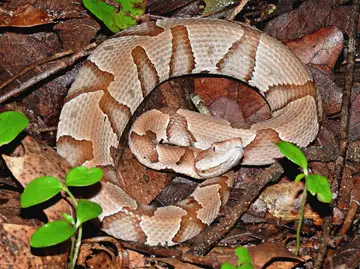

Georgia DNR lists the gray rat snake and the eastern rat snake (yellow phase) among non-venomous snakes often confused with copperheads. New Jersey DFW says copperheads have a unique hourglass-shaped pattern, wide on the sides and narrow across the back, and that no other snake species in New Jersey has this pattern; it describes young rat snakes as having irregularly shaped blotches down the body. (The New Jersey statement is written for New Jersey snakes. Both young copperheads and young rat snakes have pointed tail tips, so tail shape does not separate them.) New Jersey Division of Fish and Wildlife, Endangered and Nongame Species Program
Venomous (Florida Museum).
Rat snake or Timber rattlesnake?
Rat snake
Timber rattlesnake Crotalus horridus
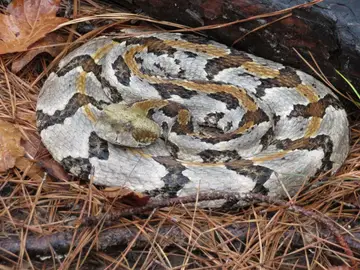

New Jersey DFW: young rat snake patterns run down through the tip of a pointed tail, unlike the timber rattlesnake's solid black "velvet tail"; young rattlesnakes have a small rattle that makes the tail end look blunt. (Written for New Jersey snakes.) New Jersey Division of Fish and Wildlife, Endangered and Nongame Species Program
Venomous (New Jersey DFW).
Rat snake or Eastern massasauga?
Rat snake
Eastern massasauga Sistrurus catenatus
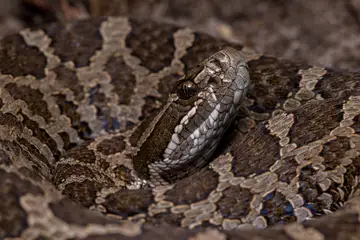

Michigan Natural Features Inventory lists the Eastern Massasauga among other snakes with dark blotches in Michigan and says it has a rattle at the end of its tail. Michigan Natural Features Inventory
Venomous (Michigan DNR).
Rat snake or Cottonmouth?
Rat snake
Cottonmouth Agkistrodon conanti / A. piscivorus
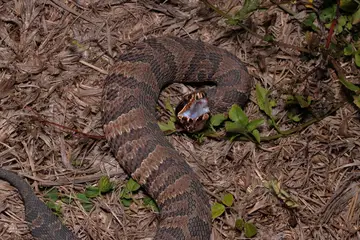

Florida Museum: in the cottonmouth the eye is hidden by a broad dark facial stripe, the top of the head has large plate-like scales, the pupil is vertically elliptical (cat-like) and there is a deep facial pit between the nostril and the eye. Florida Museum of Natural History, University of Florida
Venomous (Florida Museum).
Rat snake or North American racer (black racer)?
Rat snake
North American racer (black racer) Coluber constrictor
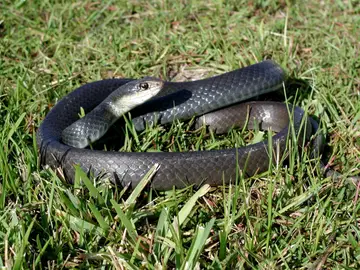

TWRA: North American racers have smooth scales and more rounded bodies; gray ratsnakes have keeled scales and a loaf-of-bread body shape, and young gray ratsnakes have distinct dark blotches on the tail. NCWRC: the racer is smaller and faster-moving. Tennessee Wildlife Resources Agency
Rat snake or Corn snake?
Rat snake
Corn snake Pantherophis guttatus
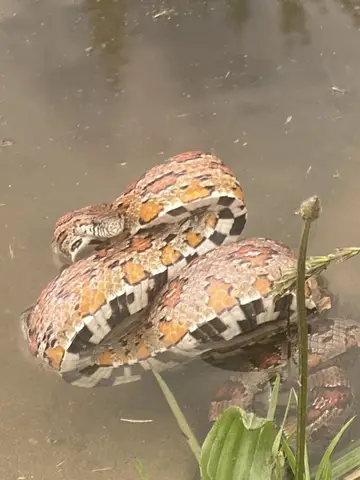
Florida Museum: eastern ratsnakes lack the corn snake's spear-shaped head pattern and black-and-white checkerboard belly. Florida Museum of Natural History
Non-venomous (Florida Museum).
Rat snake or Eastern foxsnake?
Rat snake
Eastern foxsnake Pantherophis gloydi
Michigan: told apart from young gray ratsnakes by belly scale count. Michigan Natural Features Inventory
Where the rat snake lives
- Native or listed
- Nonnative or not established
- No official record in our data
- 1–9
- 10–99
- 100–999
- 1,000+
State boundaries: U.S. Census Bureau, cartographic boundary file cb_2024_us_state_20m.
When it is active
Warm months: early April through October in Missouri, April to early October in Wisconsin. Daytime in spring and fall; often night in summer heat. The Florida Museum calls Florida's primarily nocturnal. Missouri Department of Conservation
US open-licence records for all North American rat snakes (genus Pantherophis) peak in April to July.
Habitat and habits
Habitat: Most land habitats, especially mixed forest and farmland; often in barns, buildings and forested suburbs. Outdoor Alabama
Behavior: Excellent climbers that enter buildings more than any other North Carolina snake. If approached they may freeze in a kinked pose, flee, or, if cornered, vibrate the tail and strike.
Diet: Rodents, birds and bird eggs as adults; juveniles eat small frogs and lizards. They constrict prey.
Young: Lay eggs; clutches reported from 4 to 44, in concealed, warm, moist sites (the Florida Museum names rotting vegetation and rotting logs), hatching after about 60 days.
Legal status and reporting
Protection: State rules vary. Michigan: state special concern, protected from take (MNFI abstract, 2008). Wisconsin: Special Concern and a Protected Wild Animal. North Carolina: nongame with no open season. New Jersey: illegal to kill, harm, harass, handle or collect any of the state's snakes. SREL says not protected in most states, though protected in Georgia. Wisconsin Department of Natural Resources
Questions about the rat snake
Copperhead vs rat snake
Copperheads are venomous; rat snakes are not. Georgia DNR lists the gray rat snake and the yellow phase of the eastern rat snake among snakes often confused with copperheads. New Jersey's guide says the copperhead's hourglass pattern, wide on the sides and narrow across the back, is unique among New Jersey snakes, while young rat snakes have irregular blotches. Adult rat snakes are often solid black. Pattern can vary, so leave any snake you cannot identify alone.
Rat snake vs copperhead
Copperheads are venomous; rat snakes are not. New Jersey's guide says copperheads have an hourglass pattern, wide on the sides and narrow across the back, that no other New Jersey snake has; young rat snakes have irregularly shaped blotches. If you are not sure, NCWRC says to leave the snake alone and give it plenty of space.
Cottonmouth vs rat snake
Cottonmouths are venomous and rat snakes are not.
Rattlesnake vs rat snake
Rat snakes vibrate their tails when cornered, and Indiana DNR says this leads people to mistake them for rattlesnakes. New Jersey's guide notes young rat snakes have a pattern running through a pointed tail tip, unlike a timber rattlesnake's velvet tail. Michigan notes the massasauga has a rattle at the tail tip.
Are there rat snakes in michigan?
Yes. The gray ratsnake lives in the southern half of the Lower Peninsula. Michigan Natural Features Inventory's 2008 abstract lists it as state special concern and calls it the largest snake in Michigan.
Are there rat snakes in wisconsin?
Yes. Wisconsin DNR says the central ratsnake lives in savanna and oak forest in southwestern Wisconsin and is a species of Special Concern and a Protected Wild Animal.
Is a corn snake a rat snake?
Official guides place both in the genus Pantherophis, and corn snakes are also called red rat snakes. Florida's checklist lists it as the Corn or Red Ratsnake.
Is a corn snake the same as a rat snake?
They are close relatives in the same genus, but separate species. The Florida Museum tells them apart by the corn snake's spear-shaped head pattern and black-and-white checkerboard belly, which eastern ratsnakes lack.
Is a king snake a rat snake?
Official guides name them in different genera: kingsnakes are Lampropeltis, and rat snakes are Pantherophis. No official source reviewed addresses the question directly.
Is a king snake the same as a rat snake?
No, official guides treat them as different species in different genera: Lampropeltis for kingsnakes and Pantherophis for rat snakes.
Is a milk snake a rat snake?
Official guides name them in different genera: milk snakes are Lampropeltis and rat snakes are Pantherophis. Michigan's abstract also separates eastern milk snakes from young gray ratsnakes by smooth scales and an undivided anal plate.
Rat snake alabama
Alabama's gray ratsnake is fairly common statewide. Alabama DCNR notes the black form is more common in the north and the gray form in the south.
Rat snake florida
The Florida Museum lists the eastern ratsnake in the Panhandle east of the Apalachicola River and down the peninsula to Key Largo, and the gray ratsnake west of the Apalachicola River. Both are non-venomous, and the two interbreed in the Panhandle.
Rat snake georgia
Georgia DNR lists the gray rat snake and eastern rat snake among Georgia's non-venomous snakes. SREL says the species is protected in Georgia.
Rat snake nc
NCWRC says the rat snake is non-venomous and common throughout North Carolina, and it enters buildings more often than any other snake in the state.
Rat snake tennessee
TWRA says the gray ratsnake occurs across all of Tennessee and is one of the state's most abundant snakes. It is often called the chicken snake.
Rat snake texas
Herps of Texas lists Baird's, Great Plains and eastern ratsnakes, plus the cornsnake and the Trans-Pecos ratsnake. This is a list only, and it makes no venom statement for each one.
Rat snake baby
Baby rat snakes look nothing like adults: they have bold dark blotches on a gray or light brown background. New Jersey says black rat snakes do not turn black until about 4 to 5 years old.
Sources
- Rat Snake (NCWRC species page). N.C. Wildlife Resources Commission. undated page; checked November 3, 2026.
Quoted passages (3)
“Their relatively slender bodies are shaped like a loaf of bread in a cross section”
“Juvenile rat snakes look nothing like adults, with bold, blotched pattern on a gray or light brown background.”
“Because of their climbing abilities and shelter-seeking habits, rat snakes enter buildings more frequently than any other North Carolina snake.”
- Florida Snake ID Guide species account: Eastern Ratsnake. Florida Museum of Natural History (University of Florida). updated March 18, 2026; checked November 3, 2026.
Quoted passages (2)
“Non-venomous. Eastern Ratsnakes are not dangerous to people or pets, but they will readily bite to defend themselves.”
“Most adult Eastern Ratsnakes are about 42-72 inches (106-183 cm) in total length, with a record length recorded of 101 inches (256.5 cm).”
- Western Ratsnake (Field Guide). Missouri Department of Conservation. undated page; checked November 3, 2026.
Quoted passages (1)
“The active season is from early April through October. In spring, early summer, and autumn, they hunt in the daytime; in hot weather, they are nocturnal.”
- Gray Ratsnake. Indiana Department of Natural Resources. undated page; checked November 3, 2026.
Quoted passages (1)
“The vibration of the tail is convincing, leading them to be mistaken for a rattlesnake.”
- Venomous Snakes of Georgia (brochure). Georgia Department of Natural Resources, Wildlife Resources Division. PDF Last-Modified 2024-02-02; checked November 3, 2026.
- Rat Snake (Pantherophis obsoletus alleghaniensis). University of Georgia Savannah River Ecology Laboratory (linked by SCDNR as its species information). undated page; checked November 3, 2026.
Quoted passages (2)
“Adults feed mostly on rodents, squirrels, birds, and bird eggs, while juveniles consume small frogs, lizards, and small mammals.”
“Clutches range from 4–44 eggs, deposited in concealed, warm, and moist sites, hatching after ~60 days.”
- Florida Snake ID Guide species account: Gray Ratsnake. Florida Museum of Natural History (University of Florida). updated March 18, 2026; checked November 3, 2026.
Quoted passages (1)
“The scales are weakly keeled, and there are 25-27 dorsal scale rows at midbody. The pupil is round.”
- Rat Snake - North Carolina Wildlife Profiles. N.C. Wildlife Resources Commission. undated page; checked November 3, 2026.
Quoted passages (1)
“…will often lie still and kink its body so that it somewhat resembles a crooked stick.”
- Gray Ratsnake. Alabama Department of Conservation and Natural Resources (Outdoor Alabama). undated page; checked November 3, 2026.
Quoted passages (1)
“Occurs in most kinds of terrestrial habitats but attains greatest densities in areas where forests and farmland are generally intermixed and small rodents are relatively abundant.”
- Central Ratsnake (Pantherophis alleghaniensis), Protecting Wisconsin's Biodiversity. Wisconsin Department of Natural Resources. undated page; checked November 3, 2026.
Quoted passages (1)
“…is a species of Special Concern and a Protected Wild Animal.”
- Snake Identification: Avoid Being Confused! New Jersey Division of Fish and Wildlife, Endangered and Nongame Species Program. PDF Last-Modified 2019-04-03; checked November 3, 2026.
Quoted passages (2)
“N. Copperheads have a unique hourglass-shaped pattern (the darker color); wide on the sides and narrow across the back. No other snake species in NJ has this pattern.”
“The pattern runs down through the tip of their pointed tails as opposed to the rattlesnake’s ‘velvet tail.’”
- Special Animal Abstract: Gray Ratsnake (Pantherophis spiloides). Michigan Natural Features Inventory (Michigan State University Extension). Copyright 2008; checked November 3, 2026.
Quoted passages (2)
“Other snakes with dark blotches in Michigan include the Eastern Hog-nosed Snake (Heterodon platyrhinos) which has an upturned snout, the Eastern Milk Snake (Lampropeltis triangulum triangulum) which has smooth scales and an undivided anal plate, the Eastern Massasauga (Sistrurus catenatus catenatus) which has a rattle at the end of its tail”
“Eastern Foxsnakes have 216 or fewer scales on the belly while Gray Ratsnakes have 221 or more ventral or belly scales”
- Florida Cottonmouth (Florida Snake ID Guide). Florida Museum of Natural History, University of Florida. updated September 26, 2025; checked November 3, 2026.
Quoted passages (1)
“The eye is camouflaged by a broad, dark, facial stripe. The top of the head between the eyes is covered with large plate-like scales. The pupil is vertically elliptical. There is a deep facial pit organ located between the nostril and the eye.”
- North American Racer (Tennessee Watchable Wildlife species account). Tennessee Wildlife Resources Agency. undated page; checked November 3, 2026.
- Florida Snake ID Guide: Red Cornsnake. Florida Museum of Natural History (University of Florida). updated March 18, 2026; checked November 3, 2026.
Quoted passages (1)
“Eastern Ratsnakes lack a spear-shaped pattern on top of the head and lack a black and white checkerboard pattern on the belly.”
- Florida Snake ID Guide species account: Eastern Copperhead. Florida Museum of Natural History (University of Florida). updated September 23, 2022; checked November 3, 2026.
- Checklist of Florida's Amphibians and Reptiles (Revised 2023). Florida Fish and Wildlife Conservation Commission (FWC). Revised 2023; checked November 3, 2026.
- Florida Snake ID Guide species account: Eastern Kingsnake. Florida Museum of Natural History (University of Florida). updated March 23, 2026; checked November 3, 2026.
- Snake Species Field Guide: Western Milksnake. Louisiana Department of Wildlife and Fisheries. undated page; checked November 3, 2026.
- Snake Information & Resources (Snakes of Georgia). Georgia DNR Wildlife Resources Division. undated page; checked November 3, 2026.
- Gray Ratsnake (Tennessee Watchable Wildlife species account). Tennessee Wildlife Resources Agency (Tennessee Watchable Wildlife website). undated page; checked November 3, 2026.
- Herps of Texas: Snakes of Texas. Herps of Texas, Biodiversity Collections, Dept. of Integrative Biology, The University of Texas at Austin. 2020-07-23 (archive capture date; checked November 3, 2026.
- GBIF.org occurrence records, human observations licensed CC0 1.0 or CC BY 4.0 only, accessed November 3, 2026. The datasets behind these counts are listed on our Sources page.
- State boundaries: U.S. Census Bureau, cartographic boundary file cb_2024_us_state_20m.