Pine snake
Pituophis melanoleucus · also called Eastern pinesnake, Pinesnake, Northern pine snake and Florida pine snake · Last checked November 3, 2026.
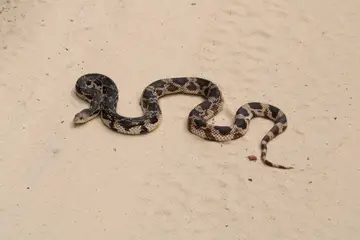
The pine snake (eastern pinesnake) is a large, thick-bodied, non-venomous constrictor, most often 4 to 5.5 feet long, with dark blotches on a white, cream, yellowish, tan or gray body and a pointed snout. Black pine snakes are almost uniformly black or dark brown. Official sources say it is not venomous and not aggressive, but if cornered it hisses loudly, vibrates its tail and strikes, and it can give a painful bite if handled. It lives in dry, sandy pine habitats in scattered parts of the East and Southeast, from the New Jersey Pine Barrens to Florida and west to Alabama and Mississippi, and it spends most of its time underground. It is rare in much of its range and has legal protection in several states; the black pine snake subspecies is federally threatened. Florida Museum of Natural History
On this page
Is the pine snake dangerous?
Florida Museum: Eastern Pinesnakes are non-venomous and not dangerous to people or pets, but they readily bite to defend themselves; they are not aggressive and avoid direct contact with people and pets. Florida Museum of Natural History
“Non-venomous Eastern Pinesnakes are not dangerous to people or pets, but they will readily bite to defend themselves. These snakes are not aggressive and avoid direct contact with people and pets.”
Bites and stings: Yes, in defense. Florida Museum: readily bites to defend itself, with virtually all bites occurring when the snake is intentionally bothered. New Jersey: can inflict a painful, non-venomous bite if handled. Alabama: if picked up it may bite, though many individuals refrain.
If someone is bitten or stung, call 911 or Poison Help at 1-800-222-1222.
How to identify a pine snake
A photo or description can narrow it down, but cannot confirm what an animal is or that it is safe. Look from a distance and do not handle wild animals.
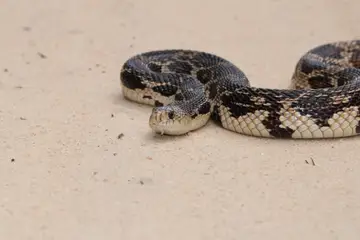
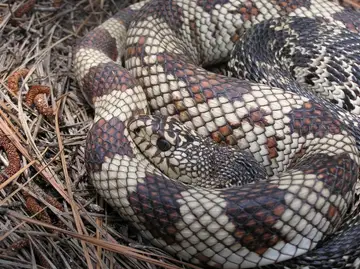
Size: Most adults are 48 to 66 inches long. The Florida Museum gives a record of 90 inches; Alabama gives a maximum of 83 inches for the northern and 74 inches for the black subspecies. New Jersey gives 48 to 100 inches. Florida Museum of Natural History
Colors: white, cream, yellow, tan, gray, reddish brown, dark brown and black. Pattern: blotched; solid (black pine snake).
Key features
- Pointed snout covered by a large, triangular, cone-shaped scale, used for pushing into soft earth. Florida Museum of Natural History
- Strongly keeled (ridged) body scales and round pupils. Florida Museum of Natural History
- Four prefrontal scales between and just in front of the eyes, where most similar snakes have two. University of Georgia Savannah River Ecology Laboratory
- Small head only slightly wider than the neck. Outdoor Alabama
- Very loud hiss when threatened, described by Maryland DNR as like air escaping from a truck tire. DNR
Young
Young look similar to adults but brighter; young of the black subspecies have black blotches on a brown background that darken with age. Hatchlings are large, about 12 to 18 inches.
Animals mistaken for the pine snake
Pine snake or Gray ratsnake?
Pine snake
Gray ratsnake Pantherophis spiloides
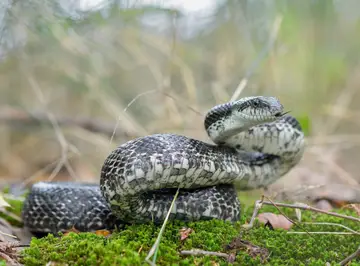

Alabama: a northern pine snake may be mistaken for the gray rat snake, but the pine snake has an enlarged snout scale and an undivided anal scale. Tennessee: juvenile gray ratsnakes have only 2 prefrontal scales and divided anal scales. Florida Museum: gray ratsnakes lack the enlarged triangular snout scale. Outdoor Alabama
Non-venomous
Pine snake or Eastern ratsnake?
Pine snake
Eastern ratsnake Pantherophis alleghaniensis
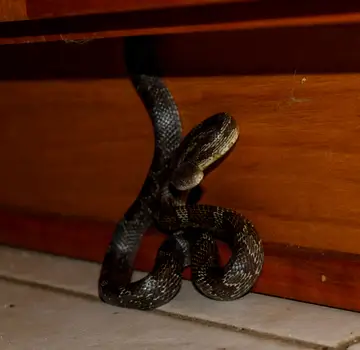
Maryland: the pine snake is easily confused with a juvenile eastern ratsnake. Florida Museum: eastern ratsnakes lack the enlarged triangular snout scale. DNR
Non-venomous
Pine snake or Eastern coachwhip?
Pine snake
Eastern coachwhip Masticophis flagellum
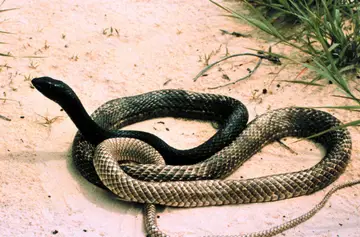

Florida Museum: coachwhips have a dark brown or black head and neck fading to a tan body and tail, no enlarged snout scale, and smooth scales. Florida Museum of Natural History
Non-venomous
Pine snake or Black racer and eastern indigo snake (for the black pine snake)?
Pine snake
Black racer and eastern indigo snake (for the black pine snake)


Alabama: two other black snakes in the black pine snake's range, the black racer and eastern indigo snake, have smooth body scales; pine snakes have keeled scales. Outdoor Alabama
Non-venomous
Pine snake or Louisiana pinesnake?
Pine snake
Louisiana pinesnake Pituophis ruthveni
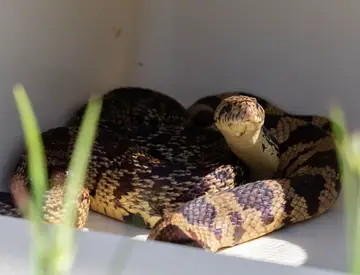
LDWF describes the Louisiana pinesnake as a separate species, dull yellow, pale tan or beige with 30 to 37 large brown or black blotches, and says it occurs only in eastern Texas and Louisiana west of the Mississippi River. USFWS lists it as federally threatened. Louisiana Department of Wildlife and Fisheries
Non-venomous (Louisiana Department of Wildlife and Fisheries)
Pine snake or Foxsnake, locally called "pine snake" in the upper Midwest?
Pine snake
Foxsnake, locally called "pine snake" in the upper Midwest
In Wisconsin the name "pine snake" is used for the foxsnake (Wisconsin DNR also names the gophersnake and gray ratsnake), and in Michigan's Upper Peninsula for the western fox snake (MSU Extension). Wisconsin DNR: foxsnakes vibrate their tails, sound like rattlesnakes and are often misidentified as them. Rattlesnakes have rattles; Wisconsin's non-venomous snakes have tails that come to a point. Wisconsin Department of Natural Resources, Bureau of Natural Heritage Conservation
Non-venomous, but rattlesnakes it is confused with are venomous
Where the pine snake lives
- Native or listed
- Nonnative or not established
- No official record in our data
- 1–9
- 10–99
- 100–999
- 1,000+
On our state guides
- Florida snakes
- Georgia snakes
- Kentucky snakes
- Louisiana snakes
- Maryland snakes
- South Carolina snakes
- Tennessee snakes
- Virginia snakes
State boundaries: U.S. Census Bureau, cartographic boundary file cb_2024_us_state_20m.
When it is active
Occasional surface activity from spring through fall, particularly May to October (SREL); surface activity usually in early morning or late afternoon (Alabama). University of Georgia Savannah River Ecology Laboratory
US open-licence records peak in April to June.
Habitat and habits
Habitat: Dry, sandy, well-drained soils for burrowing: open pine and pine-oak woods, longleaf pine, sandhills, scrub, pine barrens and old fields; also dry mountain ridges. Closed-canopy forest is avoided. Florida Museum of Natural History
Behavior: A burrower that spends most of its life underground and is seldom seen. When approached it usually flees. If cornered it may inflate its body, rear up, hiss loudly and strike while vibrating its tail, which buzzes in leaf litter, and it may release foul-smelling musk. It can climb trees.
Diet: Mostly pocket gophers and other small mammals; also ground-nesting birds and their eggs, reptile eggs and, especially in the young, lizards. It kills prey by constriction.
Young: Lays eggs, about 4 to 12 large eggs in summer, sometimes in communal nests in sandy soil. Hatching runs from late summer into fall. Tennessee says these are the largest eggs of any North American snake.
Legal status and reporting
Federal: The species as a whole is not federally listed, but the black pine snake subspecies (Pituophis melanoleucus lodingi) is listed as Threatened wherever found. The separate Louisiana pinesnake (Pituophis ruthveni) is also Threatened. US Fish and Wildlife Service
Protection: Alabama regulation makes it unlawful to take, capture, kill or possess pine snakes. Florida: Florida pine snake state Threatened. North Carolina: state Threatened; cannot be collected or taken without a special permit. New Jersey and Tennessee: state Threatened. Mississippi: black pine snake state Endangered. Maryland: Endangered Extirpated. Louisiana: Threatened; the Louisiana pinesnake cannot legally be possessed or harvested from the wild. Georgia: may not be held as a pet. Virginia: Wildlife Action Plan Tier I, not a legal status. Outdoor Alabama
Report: North Carolina: Wildlife Commission biologists ask for pine snake sightings to be submitted. Maryland: contact DNR's Wildlife and Heritage Service immediately. N.C. Wildlife Resources Commission
Questions about the pine snake
Pine snake
A pine snake is a large, non-venomous constrictor of dry, sandy pine habitats in the East and Southeast, with dark blotches on a pale body (black pine snakes are nearly solid black). It is not aggressive, but when cornered it hisses loudly, vibrates its tail and strikes, and it can bite. If you are not sure what bit you, call 911 or Poison Help at 1-800-222-1222.
Are there pine snakes in wisconsin?
No true pine snakes. Wisconsin DNR says true pinesnakes do not exist in the upper Midwest and that the name is often used for larger Wisconsin snakes such as the gophersnake (bullsnake), foxsnake and gray ratsnake.
Sources
- Florida Snake ID Guide species account: Eastern Pinesnake. Florida Museum of Natural History (University of Florida). updated September 8, 2021; checked November 3, 2026.
Quoted passages (10)
“Non-venomous Eastern Pinesnakes are not dangerous to people or pets, but they will readily bite to defend themselves. These snakes are not aggressive and avoid direct contact with people and pets.”
“Non-venomous Eastern Pinesnakes are not dangerous to people or pets, but they will readily bite to defend themselves.”
“Most adult Eastern Pinesnakes are 48-66 inches (122-168 cm) in total length, with a record length recorded of 90 inches (229 cm).”
“The snout is somewhat pointed and covered by a large triangular, cone-shaped scale.”
“The scales on the body are strongly keeled (each scale has a prominent raised ridge). The pupils are round.”
“The juvenile color pattern is similar to adults but brighter and less obscured towards the head.”
“Eastern Pinesnakes require dry sandy soils for burrowing. They are found most often in open pine-turkey oak woodlands and abandoned fields, but they also inhabit scrub, sandhills, and longleaf pine forest.”
“Eastern Pinesnakes feed primarily on pocket gophers, which they pursue by forcing their way into their underground tunnels and burrows. However, other small mammals, lizards, and reptile eggs are also eaten.”
“…if they are cornered, these snakes often inflate and rear the forebody off the ground, hiss loudly, and strike at the attacker while rapidly vibrating the tip of the tail, which produces a buzzing sound in leaf litter.”
“Eastern Coachwhips have a dark brown or black head and neck that transition into a tan body and tail. They lack the enlarged triangular rostral scale, and they have smooth scales.”
- Northern Pine Snake (NCWRC species page). N.C. Wildlife Resources Commission. undated page; checked November 3, 2026.
Quoted passages (1)
“If you see a pine snake in the wild, Wildlife Commission biologists want to know.”
- Snakes of New Jersey (brochure). NJDEP Division of Fish & Wildlife, Endangered and Nongame Species Program. PDF Last-Modified 2021-06-23; checked November 3, 2026.
- Reptiles: Snakes (Tennessee Watchable Wildlife). Tennessee Wildlife Resources Agency. footer 2026; checked November 3, 2026.
Quoted passages (1)
“Females lay 4-12 large eggs in the nest during the summer. The young hatch in late summer or fall and can be over 12 inches in length.”
- Black Pine Snake. Alabama Department of Conservation and Natural Resources (Outdoor Alabama). undated page; checked November 3, 2026.
Quoted passages (1)
“Two other black snakes occurring within distribution, the black racer and eastern indigo snake, have smooth body scales.”
- Pine Snake (Pituophis melanoleucus). University of Georgia Savannah River Ecology Laboratory (linked by SCDNR as its species information). undated page; checked November 3, 2026.
Quoted passages (2)
“They have four prefrontal scales, unlike most other colubrids, which have two.”
“Their occasional surface activity can be observed in the spring through the fall, particularly May to October.”
- 50 CFR 17.11 List of Endangered and Threatened Wildlife, pinesnake rows. U.S. Fish and Wildlife Service (eCFR). eCFR version for 2026-10-01; checked November 3, 2026.
- Northern Pine Snake. Alabama Department of Conservation and Natural Resources (Outdoor Alabama). undated page; checked November 3, 2026.
Quoted passages (2)
“Head only slightly wider than neck”
“…easily distinguished from the latter by the enlarged rostral scute and the undivided anal scale (divided in gray rat snake)”
- Eastern Pinesnake (DNR field guide species page). Maryland Department of Natural Resources (DNR). archived copy, captured February 16, 2026; checked November 3, 2026.
Quoted passages (2)
“It makes a distinctive loud ‘hiss’ when threatened, likened to air escaping from a truck tire”
“Easily confused with a juvenile Eastern Ratsnake”
- Nongame Reptiles Protected by Alabama Regulations. Alabama Department of Conservation and Natural Resources (Outdoor Alabama). undated page; checked November 3, 2026.
Quoted passages (1)
“It shall be unlawful to take, capture, kill, or attempt to take, capture or kill; possess”
- Snake Species Field Guide: Louisiana Pinesnake. Louisiana Department of Wildlife and Fisheries. undated page; checked November 3, 2026.
Quoted passages (1)
“Species is dull yellow, pale tan, or beige with 30 to 37 large brown/black blotches on the back”
- Avoiding and Treating Rattlesnake Bites in Wisconsin, PUB-ER-083. Wisconsin Department of Natural Resources, Bureau of Natural Heritage Conservation. PUB-ER-083 2023; checked November 3, 2026.
Quoted passages (1)
“…especially species such as the foxsnake (pine snake) and gophersnake (bullsnake) that mimic rattlesnakes by ‘rattling’ their tails”
- Amphibian and Reptile Frequently Asked Questions #4 - Snakes, PUB-ER-670. Wisconsin Department of Natural Resources, Bureau of Endangered Resources (Kapfer 2011). 2011; checked November 3, 2026.
- GBIF.org occurrence records, human observations licensed CC0 1.0 or CC BY 4.0 only, accessed November 3, 2026. The datasets behind these counts are listed on our Sources page.
- State boundaries: U.S. Census Bureau, cartographic boundary file cb_2024_us_state_20m.