Coachwhip
Masticophis flagellum · also called coachwhip snake, eastern coachwhip, western coachwhip and red racer · Last checked November 3, 2026.
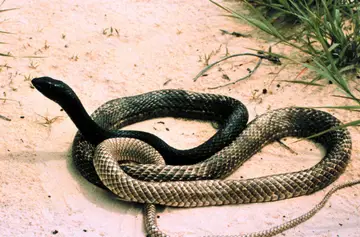

The coachwhip is one of the longest snakes in North America: very slender and very fast, with smooth scales and a long tail that looks like a braided whip. In the East it is usually black or dark brown at the front, fading to tan toward the tail; western forms such as the red racer are often red, pink or tan, and some are all black. It is not venomous. The Florida Museum says coachwhips are not dangerous to people or pets, but they will readily bite to defend themselves; a cornered coachwhip strikes repeatedly, sometimes at the face. It lives across the southern US from North Carolina and Florida west to California. A cornered coachwhip may buzz its tail in dry leaves, and New Mexico State University Extension says this can be mistaken for a rattlesnake. Florida Museum of Natural History
On this page
Is the coachwhip dangerous?
Non-venomous. The Florida Museum says coachwhips are not dangerous to people or pets, are not aggressive and avoid contact, but will readily bite to defend themselves. Missouri says it fights savagely to defend itself but is ultimately harmless to people; SREL and NPS (White Sands) also call it harmless to humans. Florida Museum of Natural History
“Non-Venomous. Coachwhips are not dangerous to people or pets, but they will readily bite to defend themselves.”
Bites and stings: Bites to defend itself. Usually flees; if cornered or grabbed it strikes repeatedly, may aim at the face, vibrates its tail and may release musk. The Florida Museum says virtually all bites happen when the snake is intentionally molested. The old story that a coachwhip chases people and whips them is a myth, per Alabama, Missouri and Illinois.
How to identify a coachwhip
A photo or description can narrow it down, but cannot confirm what an animal is or that it is safe. Look from a distance and do not handle wild animals.
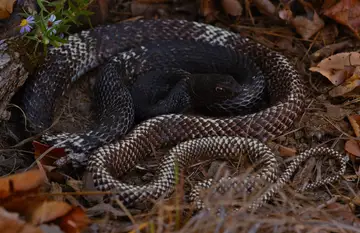

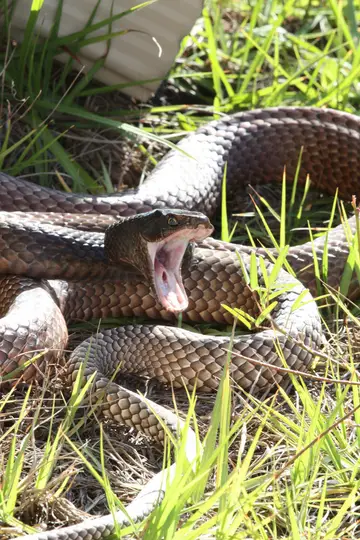

Size: Most adults about 42 to 60 inches (3.5 to 5 ft); record 102 inches (8.5 ft). Ranges given by agencies: 41 to 84 in (Louisiana), 36 to 82 in (Oklahoma), adults average 50 to 72 in (Alabama), up to 94 in (NC State Extension), up to 80 in in Colorado and up to 68 in in Arizona. Florida Museum of Natural History
Colors: Eastern coachwhip: dark brown or black head, neck and front of body, fading to light tan toward the tail. Some are all dark, all tan, or light with narrow dark crossbands; western forms (red racer and others): red, pink, orange, rusty brown, olive-brown or tan, often with dark bands on the neck; all-black individuals occur in south-central Arizona; belly dirty white, tan, yellow or pink; the Florida Museum says it matches the back. Some have two rows of dark spots on the belly. Pattern: Two-tone: darker front half, lighter rear half (eastern). Some have dark crossbands on the neck and front of the body.
Key features
- Long, slowly tapering tail whose scales look like a braided whip Florida Museum of Natural History
- Very long and slender, with smooth scales Florida Museum of Natural History
- Large eyes with round pupils Florida Museum of Natural History
- Often holds its head and neck raised to look around (periscoping) Florida Museum of Natural History
- Extremely fast; climbs into shrubs and trees Outdoor Alabama
- When cornered, vibrates its tail, making a buzz in dry leaves Florida Museum of Natural History
Young
Young look different from adults: lighter, brown or tan with dark crossbands on the neck and front of the body, and white markings on the head and chin. The pattern fades with age (about two years, Florida Museum). Hatchlings about 12 to 16 inches.
Animals mistaken for the coachwhip
Coachwhip or Rattlesnakes (by sound)?
Coachwhip
Rattlesnakes (by sound)
NMSU Extension says coachwhips may vibrate the tail and, in dry leaves or grass, be mistaken for rattlesnakes; Alabama and Oklahoma describe the same rattle-like sound. No official source here gives a safe way to tell them apart by sound, and none is offered. Leave any snake you cannot identify alone. College of ACES
VENOMOUS. See the rattlesnake records (e.g. western-diamondback-rattlesnake, timber-rattlesnake).
Coachwhip or North American racer (black racer)?
Coachwhip
North American racer (black racer) Coluber constrictor
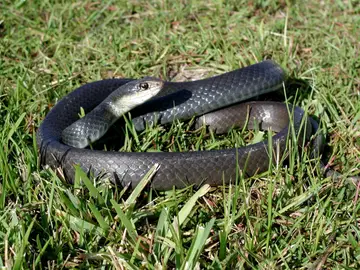

TWRA: the racer lacks the coachwhip's reddish tint along the sides of the tail; an all-black coachwhip is distinctly lighter or reddish toward the rear. Oklahoma: the coachwhip is much larger. Tennessee Wildlife Resources Agency
Non-venomous per the Florida Museum.
Coachwhip or Eastern indigo snake?
Coachwhip
Eastern indigo snake Drymarchon couperi
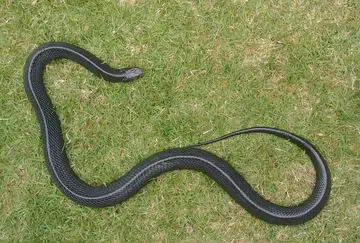
Florida Museum lists it as a comparison species: the coachwhip typically has a black head and neck and a tan body and tail. Florida Museum of Natural History
Non-venomous per the Florida Museum.
Coachwhip or Gray ratsnake?
Coachwhip
Gray ratsnake Pantherophis spiloides
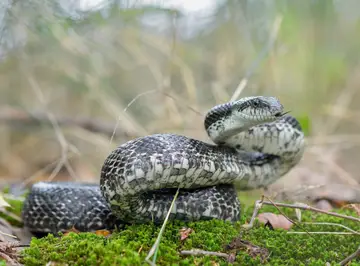

Illinois Natural History Survey: the coachwhip's tail scales are patterned like a braided whip and its back scales are smooth; it lists the gray ratsnake as a similar species. Illinois Natural History Survey (INHS), Prairie Research Institute, University of Illinois Urbana-Champaign
See the rat snake record.
Coachwhip or Sonoran whipsnake?
Coachwhip
Sonoran whipsnake Masticophis bilineatus
NPS Saguaro: the Sonoran whipsnake is smaller and greenish-gray with two or three light stripes on each side. National Park Service
Where the coachwhip lives
- Native or listed
- Nonnative or not established
- No official record in our data
- 1–9
- 10–99
- 100–999
- 1,000+
On our state guides
- Arizona snakes
- Arkansas snakes
- California snakes
- Colorado snakes
- Florida snakes
- Georgia snakes
- Illinois snakes
- Kansas snakes
- Louisiana snakes
- Missouri snakes
- Nebraska snakes
- New Mexico snakes
- Oklahoma snakes
- South Carolina snakes
- Tennessee snakes
- Texas snakes
- Utah snakes
State boundaries: U.S. Census Bureau, cartographic boundary file cb_2024_us_state_20m.
When it is active
Active by day, including on hot summer days when most snakes hide. Missouri: on sunny days from April until early November; Arkansas: April to October. Spends winter in burrows, rock crevices or under cover. MDC
US open-licence records peak in April to June and August.
Habitat and habits
Habitat: Hot, dry, open places: sandhills, longleaf pine and scrub, pine flatwoods, coastal dunes, old fields and glades in the East; shortgrass prairie, desert scrub, dune fields and rocky hillsides in the West. Shelters in burrows (including gopher tortoise burrows) and can turn up in suburban neighborhoods next to good habitat. Florida Museum of Natural History
Behavior: Alert, fast, day-active hunter that finds prey by sight with its head raised. Usually flees fast into cover or up a shrub; cornered, it coils, vibrates its tail, strikes repeatedly and bites, and may release musk or play dead when captured. Speed is described differently: Missouri says up to 3.6 mph and not as fast as a running person; Colorado says faster than a human in some cases.
Diet: Lizards (a main food in Florida), small mammals, birds and eggs, other snakes including venomous ones, frogs, small turtles and large insects. Not a constrictor: it grabs prey in its jaws and swallows it alive.
Young: Lays eggs. Mates in spring; females lay about 4 to 24 eggs in early to mid summer in loose soil, burrows, rotting logs or leaf litter; young hatch in late summer (August to September).
Legal status and reporting
Federal: Not listed under the Endangered Species Act at species level in a USFWS ECOS query run 2026-11-03. Two western subspecies appear in ECOS with the status "Species of Concern": the red coachwhip (M. f. piceus) and the San Joaquin whipsnake (M. f. ruddocki). ECOS
Protection: Varies by state. Protected by law in Alabama (species of concern), Georgia and South Carolina; state endangered in Illinois; NC State Protection Status "SC" in North Carolina's 2025 wildlife action plan table; regulated nongame species in Mississippi. Tennessee: uncommon but not protected. In national parks all wildlife, including snakes, is protected. University of Georgia Savannah River Ecology Laboratory
Questions about the coachwhip
Coachwhip snake
The coachwhip is a very long, slender, fast, non-venomous snake with smooth scales and a tail that looks like a braided whip. Eastern coachwhips are dark at the front and tan toward the tail; western ones are often red, pink or tan. The Florida Museum says it is not dangerous to people or pets, but it will readily bite to defend itself, and a cornered coachwhip may strike at the face and buzz its tail like a rattlesnake. Leave it alone. If you are not sure what kind of snake bit you, call 911 or Poison Help at 1-800-222-1222.
Sources
- Florida Snake ID Guide species account: Eastern Coachwhip. Florida Museum of Natural History (University of Florida). updated March 18, 2026; checked November 3, 2026.
Quoted passages (11)
“Non-Venomous. Coachwhips are not dangerous to people or pets, but they will readily bite to defend themselves.”
“Most adult coachwhips are about 42-60 inches (107-152 cm) in total length, with a record length recorded of 102 inches (259 cm).”
“The name ‘Coachwhip’ comes from the large tan scales on its long, slowly tapering tail, which give it the appearance of a braided bullwhip.”
“This is a long and slender snake with smooth scales in 17 dorsal rows at midbody.”
“The eyes are large and prominent with round pupils and yellow irises.”
“They often rest or crawl with their head and neck raised above the ground as they scan their environment, but they are also excellent climbers.”
“However, if they are cornered, both juveniles and adults will strike at the attacker and rapidly vibrate the tip of the tail, which produces a buzzing sound in leaf litter.”
“Juveniles are brown or tan with indistinct dark crossbands down the neck and back.”
“Coachwhips generally prefer hot and dry habitats with open canopies.”
“Coachwhips are diurnal (active during the day) predators and are known to feed on small mammals, birds and their eggs, lizards, turtles, snakes, frogs, and insects.”
“Nonetheless, these snakes are not aggressive, and striking is only used in defense as a last resort.”
- Eastern Coachwhip. Alabama Department of Conservation and Natural Resources (Outdoor Alabama). undated page; checked November 3, 2026.
Quoted passages (1)
“These snakes are extremely fast (believed to be the fastest in North America) and are good climbers as well.”
- Online Field Guide species account: Coachwhip (Coluber flagellum). Arizona Game and Fish Department. 2023; checked November 3, 2026.
- Coachwhip (Masticophis flagellum). University of Georgia Savannah River Ecology Laboratory (linked by SCDNR as its species information). undated page; checked November 3, 2026.
Quoted passages (1)
“They are protected by law in the states of Georgia and South Carolina.”
- New Mexico Snakes: Information for New Mexico Homeowners (Circular 541). New Mexico State University Cooperative Extension Service (College of ACES). Revised and electronically distributed July 1998; checked November 3, 2026.
Quoted passages (1)
“If the tail is in contact with dry leaves or grass, they may be mistaken for rattlesnakes.”
- Coachwhip (ODWC Field Guide). Oklahoma Department of Wildlife Conservation. undated page; checked November 3, 2026.
- MDC Field Guide: Reptiles and Amphibians > Snakes (species accounts). Missouri Department of Conservation (MDC). undated page; checked November 3, 2026.
Quoted passages (2)
“The eastern coachwhip is active on sunny days from April until early November.”
“In late June through July, the female lays 4–24 eggs in loose soil, animal burrows, rotting logs, or decaying leaf litter.”
- ECOS species report query (Masticophis / Coluber flagellum). U.S. Fish and Wildlife Service (ECOS). live query 2026-11-03; checked November 3, 2026.
- Reptiles » Snakes (Tennessee Watchable Wildlife species accounts). Tennessee Wildlife Resources Agency (Tennessee Watchable Wildlife website). undated page; checked November 3, 2026.
Quoted passages (1)
“North American Racer does not have reddish tint along the sides of the tail.”
- Florida Snake ID Guide species account: Eastern Indigo Snake. Florida Museum of Natural History (University of Florida). updated March 18, 2026; checked November 3, 2026.
Quoted passages (1)
“Eastern Coachwhip (Masticophis flagellum) Non-venomous Eastern Coachwhips typically have a black head and neck and a tan body and tail.”
- Coachwhip (Field Guide to Amphibians and Reptiles of Illinois). Illinois Natural History Survey (INHS), Prairie Research Institute, University of Illinois Urbana-Champaign. undated page; checked November 3, 2026.
Quoted passages (1)
“Key Characters: Tail scales patterned like a braided whip; back scales smooth; anal plate divided. Similar Species: North American Racer, Gray Ratsnake.”
- Snakes - Saguaro National Park. National Park Service. updated May 6, 2025; checked November 3, 2026.
Quoted passages (1)
“Extremely silimar to the coachwhip in behavior and form, the Sonoran whipsnake is smaller, and greenish-gray in color with two or three light colored stripes on each side of the body.”
- GBIF.org occurrence records, human observations licensed CC0 1.0 or CC BY 4.0 only, accessed November 3, 2026. The datasets behind these counts are listed on our Sources page.
- State boundaries: U.S. Census Bureau, cartographic boundary file cb_2024_us_state_20m.