Eastern Indigo Snake
Drymarchon couperi · also called Indigo Snake, Gulf Coast Indigo Snake and Blue Indigo Snake · Last checked November 3, 2026.
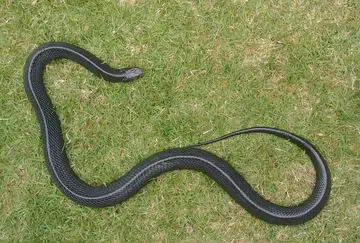
The eastern indigo snake is a large, glossy blue-black snake of the Southeast and the longest native snake in the US. It is officially non-venomous and, per Florida Museum, not dangerous to people or pets; it is not aggressive and seldom bites in defense. It is federally listed as threatened and lives in portions of Florida and southern Georgia, with a reintroduced population in south Alabama. U.S.
On this page
Is the eastern indigo snake dangerous?
Non-venomous and not dangerous to people or pets; not aggressive and avoids direct contact when possible. Florida Museum of Natural History
“Non-venomous. Eastern Indigo Snakes are not dangerous to people or pets. These snakes are not aggressive and avoid direct contact when possible.”
Bites and stings: Seldom bites in defense if cornered or captured (Florida Museum); instead it may flatten its neck, hiss, vibrate its tail and release musk.
How to identify an eastern indigo snake
A photo or description can narrow it down, but cannot confirm what an animal is or that it is safe. Look from a distance and do not handle wild animals.
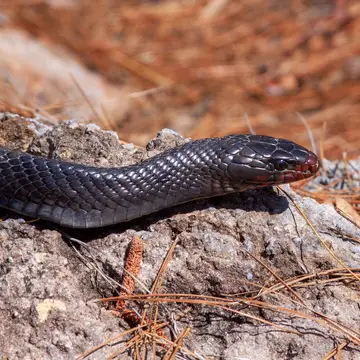
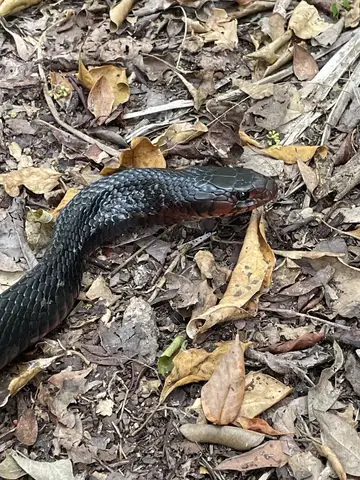
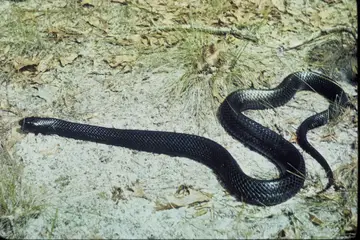

Size: Most adults about 60 to 82 inches (5 to 7 feet) long; record 8.6 feet. The longest native snake in the US. Florida Museum of Natural History
Colors: Glossy black with iridescent purple or blue highlights in sunlight; chin and throat may be solid black, red, orangish or cream. Pattern: Uniform glossy blue-black, sometimes with reddish-orange or cream on throat, cheeks and chin. Juveniles are banded (see juveniles).
Key features
- Large, thick-bodied, glossy black snake with smooth scales and round pupils Florida Museum of Natural History
- Anal plate single (entire), unlike the black racer whose anal plate is divided Outdoor Alabama
Young
Glossy black with narrow whitish-blue bands; hatchlings average 22 inches.
Animals mistaken for the eastern indigo snake
Eastern Indigo Snake or North American Racer (Black Racer)?
Eastern Indigo Snake
North American Racer (Black Racer) Coluber constrictor


Racers are smaller and thinner, usually have a white chin and throat, and duller black color (Florida Museum). Alabama adds that the racer is slender and fast, the indigo stout and slow, and the racer has a divided anal plate. Florida Museum of Natural History
Non-venomous (Florida Museum).
Eastern Indigo Snake or Eastern Coachwhip?
Eastern Indigo Snake
Eastern Coachwhip Masticophis flagellum
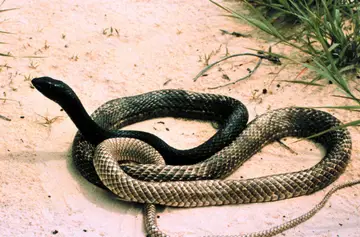

Eastern coachwhips typically have a black head and neck with a tan body and tail. Florida Museum of Natural History
Non-venomous (Florida Museum).
Eastern Indigo Snake or Black Pine Snake?
Eastern Indigo Snake
Black Pine Snake Pituophis melanoleucus lodingi
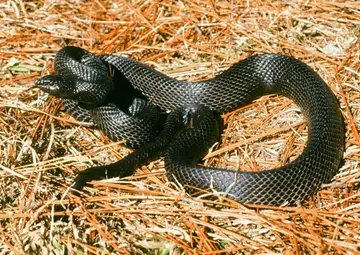
Black pine snakes share some of the same areas but have keeled scales; the indigo has smooth scales. Outdoor Alabama
Listed under Non Venomous Snakes by Alabama ADCNR.
Where the eastern indigo snake lives
- Native or listed
- Nonnative or not established
- No official record in our data
- 1–9
- 10–99
- 100–999
- 1,000+
On our state guides
State boundaries: U.S. Census Bureau, cartographic boundary file cb_2024_us_state_20m.
When it is active
USFWS: moves seasonally between upland and lowland habitats, especially in the north of its range, overwintering in gopher tortoise burrows. Breeding season October to January (peak). U.S.
Too few open-licence records to chart by month: GBIF has only 9 records CC0 or CC BY human observations of this species in the US.
Habitat and habits
Habitat: Scrub, tropical hardwood hammocks, pine flatwoods, longleaf pine sandhills, prairies, coastal dunes and the edges of freshwater marshes and cypress ponds, also farmland. Strongly tied to gopher tortoise burrows, especially in the north of its range. Florida Museum of Natural History
Behavior: Seldom bites; when cornered may flatten the neck, hiss loudly, vibrate the tail and release a foul-smelling musk. Adults move long distances and have large home ranges.
Diet: Generalist that likely eats any vertebrate small enough to overpower and swallow, and appears to prefer other reptiles including venomous snakes; not a constrictor.
Young: Mates mainly October to January (USFWS); Alabama gives October to February. Females lay one clutch of 4 to 14 eggs from late April to early June (USFWS); in Florida eggs typically hatch July to September.
Legal status and reporting
Federal: Threatened, wherever found; listed 1978-03-03. US Fish and Wildlife Service
Protection: Protected: federally threatened. Florida listed it as state threatened in 1975; Georgia lists it as state threatened (and protects all non-venomous snakes); Alabama protects it under its nongame regulation.
Report: Florida Museum asks people to email new or interesting observations, with photos, to its herpetology staff. Florida Museum of Natural History
Sources
- Eastern Indigo Snake (Drymarchon couperi). U.S. archived copy, captured July 20, 2026; checked November 3, 2026.
Quoted passages (2)
“Eastern indigo snakes move seasonally between upland and lowland habitats, especially in the northern portions of their range.”
“Females will lay a single clutch of 4 to 14 eggs from late April through early June.”
- Florida Snake ID Guide species account: Eastern Indigo Snake. Florida Museum of Natural History (University of Florida). updated March 18, 2026; checked November 3, 2026.
Quoted passages (11)
“Non-venomous. Eastern Indigo Snakes are not dangerous to people or pets. These snakes are not aggressive and avoid direct contact when possible.”
“Non-venomous. Eastern Indigo Snakes are not dangerous to people or pets.”
“Most adult Eastern Indigo Snakes are 60-82 inches (152-213 cm) in total length, with a record length recorded of 8.6 feet (2.63 m).”
“The scales on the back are smooth, and there are 17 scale rows at midbody. The pupil is round.”
“Juveniles are glossy black with narrow whitish-blue bands.”
“They are commonly associated with Gopher Tortoise (Gopherus polyphemus) burrows, which they often use as refuges.”
“These snakes appear to prefer to eat other reptiles (including venomous snakes), but they are known to also eat amphibians, mammals, and birds.”
“However, they may flatten their neck vertically, hiss loudly, rapidly vibrate the tip of the tail, which produces a buzzing sound in leaf litter, and release a foul-smelling musk from a pair of glands in the base of the tail.”
“If you have a new or interesting observation for this species, please email the herpetology staff at the Florida Museum.”
“North American Racers are smaller and they have thinner bodies. They also typically have a white chin and throat, and the black coloration of their bodies is duller.”
“Eastern Coachwhips typically have a black head and neck and a tan body and tail.”
- Eastern Indigo Snake. Alabama Department of Conservation and Natural Resources (Outdoor Alabama). undated page; checked November 3, 2026.
Quoted passages (2)
“A distinct difference between the indigo snake and the black racer is the anal plate which is entire on the indigo and divided on the black racer.”
“Black pine snakes have keeled scales. The indigo snake has smooth scales.”
- ECOS species report query (p32 taxa). U.S. Fish and Wildlife Service. live query 2026-11-03; checked November 3, 2026.
Quoted passages (1)
“Drymarchon couperi: Eastern indigo snake … {'value': 'Drymarchon couperi', 'url': 'https://ecos.fws.gov/ecp/species/646'} … Wherever found”
- GBIF.org occurrence records, human observations licensed CC0 1.0 or CC BY 4.0 only, accessed November 3, 2026. The datasets behind these counts are listed on our Sources page.
- State boundaries: U.S. Census Bureau, cartographic boundary file cb_2024_us_state_20m.