Eastern Kingsnake
Lampropeltis getula · also called chain kingsnake, common kingsnake, eastern king snake and chain snake · Last checked November 3, 2026.
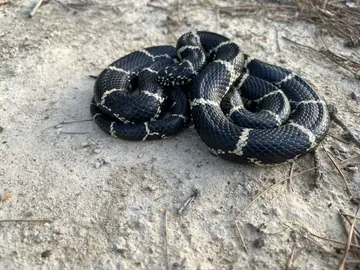
The eastern kingsnake is a large, glossy black to dark brown snake with narrow white or yellow crossbands that form a chain-like pattern. It is non-venomous. The Florida Museum says it is not dangerous to people or pets, though it may bite to defend itself. Official sources place it in the East and Southeast, from southern New Jersey through Virginia and the Carolinas to Georgia, Alabama and northern Florida. It eats other snakes, including venomous ones, and has declined in parts of its range. Florida Museum of Natural History
On this page
Is the eastern kingsnake dangerous?
Non-venomous and not dangerous to people or pets, according to the Florida Museum, though it occasionally bites to defend itself. Florida Museum of Natural History
“Non-venomous. Eastern Kingsnakes are not dangerous to people or pets, but they occasionally bite to defend themselves.”
Bites and stings: Can bite in defense. If grabbed or pinned it may bite and chew while releasing foul-smelling musk. The Florida Museum says virtually all bites occur when people intentionally bother the snakes.
How to identify an eastern kingsnake
A photo or description can narrow it down, but cannot confirm what an animal is or that it is safe. Look from a distance and do not handle wild animals.
Size: Most adults are about 36-48 inches. Maryland gives a record of 82 inches; Alabama gives up to 6.9 feet. Florida Museum of Natural History
Colors: Solid black to chocolate brown, with white to yellowish crossbands. Pattern: Narrow crossbands down the back and a chain-like pattern on the sides; belly checkered or solid black.
Key features
- Smooth, shiny scales and an indistinct neck. Florida Museum of Natural History
- Round pupil. Florida Museum of Natural History
- Florida Museum counts 19-32 crossbands in Florida; Alabama counts 23 to 52. Florida Museum of Natural History
- Small black head with white or yellow spots. DNR
Young
Look like adults in color and pattern.
Animals mistaken for the eastern kingsnake
Eastern Kingsnake or Black kingsnake?
Eastern Kingsnake
Black kingsnake Lampropeltis nigra
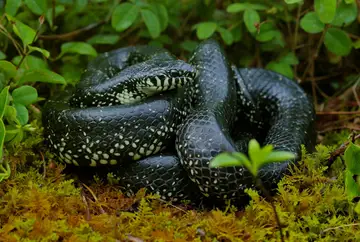

Reduced banding or none; typically speckled across the body, and some adults are plain black. Eastern kingsnakes have a highly contrasting banded or chain pattern. University of Georgia Savannah River Ecology Laboratory
SREL covers both species in its statement on kingsnakes and people.
Eastern Kingsnake or Florida kingsnake?
Eastern Kingsnake
Florida kingsnake Lampropeltis floridana
More than 34 light crossbands, lightened scales between the bands, a weaker chain pattern on the sides, and usually 23 scale rows at midbody. Florida Museum of Natural History
Non-venomous (Florida Museum).
Eastern Kingsnake or Apalachicola kingsnake?
Eastern Kingsnake
Apalachicola kingsnake Lampropeltis meansi
Fewer than 26 wide crossbands with much lighter scales between them, or no bands at all (striped or patternless). Florida Museum of Natural History
Non-venomous (Florida Museum).
Eastern Kingsnake or Scarlet kingsnake (often confused by name)?
Eastern Kingsnake
Scarlet kingsnake (often confused by name) Lampropeltis elapsoides
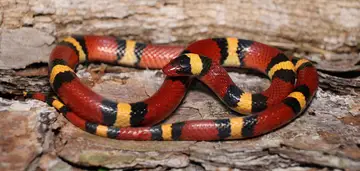

The kingsnake that official sources say is mistaken for the coral snake is the scarlet kingsnake, a red, black and yellow species, not the eastern kingsnake. N.C. Wildlife Resources Commission
Coral snakes are venomous. NCWRC says coral snakes should never be handled or in any way molested or harmed, and that left alone they pose no threat.
Where the eastern kingsnake lives
- Native or listed
- Nonnative or not established
- No official record in our data
- 1–9
- 10–99
- 100–999
- 1,000+
On our state guides
- Alabama snakes
- Arizona snakes
- Arkansas snakes
- Delaware snakes
- Florida snakes
- Georgia snakes
- Illinois snakes
- Maryland snakes
- New Jersey snakes
- North Carolina snakes
- Oklahoma snakes
- Oregon snakes
- South Carolina snakes
- Tennessee snakes
- Texas snakes
- Virginia snakes
State boundaries: U.S. Census Bureau, cartographic boundary file cb_2024_us_state_20m.
When it is active
Active mainly by day (North Carolina). Alabama reports peaks in mid-morning and late afternoon, with occasional individuals active after dark. In Georgia and South Carolina it is most active at the surface in April-June and may shift to night activity in the hottest months. University of Georgia Savannah River Ecology Laboratory
US open-licence records peak in April to June.
Habitat and habits
Habitat: Pinelands, hardwood hammocks, cypress strands, prairies, marshes, estuaries and the edges of streams and lakes; sometimes suburban neighborhoods. Maryland adds old fields, swamp borders and farmland along streams. Florida Museum of Natural History
Behavior: Usually flees. If cornered it may strike and vibrate its tail, which buzzes in leaf litter. Kills larger prey by constriction. Rarely climbs but swims well.
Diet: Small mammals, birds and their eggs, amphibians, lizards, turtles and their eggs, and other snakes, including venomous snakes.
Young: Lays eggs. Alabama: mates March to early May, lays 3-29 eggs in June-July, hatching after about 60 days. Florida: around 3-30 eggs, hatching June to September.
Legal status and reporting
Federal: No ECOS record for the eastern kingsnake under Lampropeltis getula: a live FWS ECOS query for the genus on 2026-11-03 returned no plain L. getula entry. ECOS lists the Apalachicola kingsnake (as Lampropeltis getula meansi) as "Under Review" and the short-tailed snake (Lampropeltis extenuata, a Florida species) as "Proposed Threatened"; neither is this snake. ECOS
Protection: Protected by law in Georgia and South Carolina, according to UGA SREL. Georgia law lists it among native species that may not be held as pets. Alabama lists all native kingsnakes as protected nongame reptiles. University of Georgia Savannah River Ecology Laboratory
Report: Not invasive, so no reporting program applies. The Florida Museum invites photos or videos of interesting observations by email to its herpetology staff, or posts on iNaturalist. Florida Museum of Natural History
Questions about the eastern kingsnake
Is a king snake dangerous?
The eastern kingsnake is non-venomous, and the Florida Museum says it is not dangerous to people or pets. It may bite if grabbed or pinned; the Florida Museum says virtually all bites occur when people intentionally bother the snakes.
Is a king snake poisonous?
No official source checked calls it poisonous or venomous. North Carolina, Maryland and the Florida Museum all describe the eastern kingsnake as non-venomous.
Is a king snake a constrictor?
Yes. Alabama calls it a powerful constrictor. The Florida Museum says larger prey are typically killed by constriction, while smaller prey and eggs are swallowed right away.
Is a king snake immune to rattlesnake venom?
Official sources describe strong resistance, not proven full immunity. The Florida Museum says it appears to be immune to the venom of the venomous snakes it eats. UGA SREL speaks of resistance to pit viper venom, and New Jersey says it will eat timber rattlesnakes.
Is a king snake the same as a rat snake?
No. Illinois lists kingsnakes (Lampropeltis) and ratsnakes such as the gray ratsnake (Pantherophis) as different species, and INHS names the gray ratsnake as a similar-looking snake.
Is a king snake a good pet?
Official sources checked give no pet-care advice. Georgia lists the eastern kingsnake among native species that may not be held as pets, and the Florida Museum names collecting for the pet trade among the reasons for its decline. Check your state wildlife agency.
King snake vs coral snake
The kingsnake usually confused with the coral snake is the scarlet kingsnake, not the eastern kingsnake. North Carolina says the scarlet kingsnake is often misidentified as a coral snake. The eastern kingsnake is black or brown with white or yellow bands, and the sources describe no red.
Are there king snakes in florida?
Yes. FWC lists the eastern kingsnake, and the Florida Museum places it north of a line from Pinellas to Flagler County and west into the Panhandle.
Are there king snakes in georgia?
Yes. UGA SREL says the eastern kingsnake is found across Georgia, with the black kingsnake in the northwest, and Georgia DNR lists both.
Are there king snakes in virginia?
Yes. Virginia DWR lists the eastern kingsnake among native and naturalized species.
King snake nc
The eastern kingsnake lives in North Carolina. The state wildlife commission describes it as a strong constrictor with a chain-like pattern of whitish-yellow bars on a black back, and says it is non-venomous and found around farms and suburbs.
Are there king snakes in tennessee?
Yes. Tennessee lists three forms: the eastern kingsnake in the extreme southeast, the eastern black kingsnake across most of the state, and the speckled kingsnake in the west and southwest.
Sources
- Florida Snake ID Guide species account: Eastern Kingsnake. Florida Museum of Natural History (University of Florida). updated March 23, 2026; checked November 3, 2026.
Quoted passages (12)
“Non-venomous. Eastern Kingsnakes are not dangerous to people or pets, but they occasionally bite to defend themselves.”
“Most adult Eastern Kingsnakes are about 36-48 inches (90-122 cm) in total length.”
“The neck is indistinct and the scales are smooth and shiny.”
“…the pupil is round”
“…with 19-32 white to yellowish, narrow (1.5-2.5 body scale rows) crossbands down the back”
“Juveniles resemble adults in color and pattern.”
“Eastern Kingsnakes are found in pinelands, hardwood hammocks, cypress strands, prairies, marshes, estuaries, and along the edges of streams and lakes.”
“Eastern Kingsnakes have a broad diet that includes small mammals, birds and their eggs, amphibians, lizards, turtles and their eggs, and other snakes, including venomous snakes and other kingsnakes.”
“When approached, Eastern Kingsnakes will typically flee for shelter.”
“Send photos or videos of interesting observations”
“Florida Kingsnakes have more than 34 light crossbands on the body, lightening of the black interband scales, a degenerate lateral chain-like pattern, and usually 23 scale rows at midbody.”
“Apalachicola Kingsnakes have either fewer than 26 wide crossbands with considerably lightened interbands or they are non-banded (striped or patternless).”
- Eastern Kingsnake (Lampropeltis getula). University of Georgia Savannah River Ecology Laboratory (linked by SCDNR as its species information). undated page; checked November 3, 2026.
Quoted passages (3)
“In Georgia and South Carolina, kingsnakes are most surface-active during spring and early summer (April-June)”
“They are protected by law in both Georgia and South Carolina, but not in many other states where they are found.”
“This species shows reduced banding, with some individuals lacking it altogether.”
- Snakes of New Jersey (brochure). NJDEP Division of Fish & Wildlife, Endangered and Nongame Species Program. PDF Last-Modified 2021-06-23; checked November 3, 2026.
- Eastern Kingsnake. Alabama Department of Conservation and Natural Resources (Outdoor Alabama). undated page; checked November 3, 2026.
Quoted passages (1)
“Courtship and mating take place in spring from March to early May, and three to 29 leathery shelled eggs are laid in early summer (June-July)”
- Eastern Kingsnake (DNR field guide species page). Maryland Department of Natural Resources (DNR). archived copy, captured February 16, 2026; checked November 3, 2026.
Quoted passages (1)
“The small head is black with varying numbers of white or yellow spots.”
- ECOS species report queries (genus-wide). U.S. Fish and Wildlife Service (ECOS). live query 2026-11-03; checked November 3, 2026.
- Eastern Coral Snake (NCWRC species page). N.C. Wildlife Resources Commission. undated page; checked November 3, 2026.
Quoted passages (1)
“Some nonvenomous snakes are often misidentified as coral snakes, especially the Scarlet Kingsnake”
- Eastern Kingsnake (NCWRC species page). N.C. Wildlife Resources Commission. undated page; checked November 3, 2026.
- Wild About Illinois Snakes! (species gallery by family). Illinois Department of Natural Resources (IDNR). undated page; checked November 3, 2026.
- Eastern Kingsnake (Field Guide to Amphibians and Reptiles of Illinois). Illinois Natural History Survey (INHS), Prairie Research Institute, University of Illinois Urbana-Champaign. undated page; checked November 3, 2026.
- Laws Related to Native Wildlife. Georgia DNR Wildlife Resources Division. undated page; checked November 3, 2026.
- Checklist of Florida's Amphibians and Reptiles (Revised 2023). Florida Fish and Wildlife Conservation Commission (FWC). Revised 2023; checked November 3, 2026.
- List of Native and Naturalized Fauna of Virginia. Virginia Department of Wildlife Resources (DWR). May, 2026; checked November 3, 2026.
- Reptiles » Snakes (Tennessee Watchable Wildlife species accounts). Tennessee Wildlife Resources Agency (Tennessee Watchable Wildlife website). undated page; checked November 3, 2026.
- GBIF.org occurrence records, human observations licensed CC0 1.0 or CC BY 4.0 only, accessed November 3, 2026. The datasets behind these counts are listed on our Sources page.
- State boundaries: U.S. Census Bureau, cartographic boundary file cb_2024_us_state_20m.