Gopher snake (gophersnake)
Pituophis catenifer · also called gophersnake, bullsnake, bull snake and blowsnake · Last checked November 3, 2026.
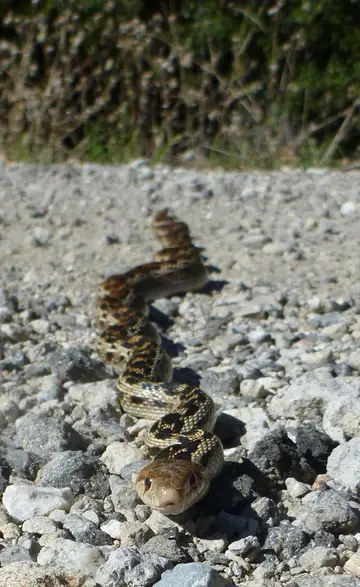

The gopher snake (called the bullsnake in the Great Plains and Texas) is a large, tan to yellowish snake with dark brown or black blotches down the back. It is non-venomous, but it is often mistaken for a rattlesnake because when threatened it coils, hisses loudly, flattens its head and vibrates its tail. It has no rattle. It will bite if threatened. Official sources confirm it in Arizona, California, Missouri, Minnesota, Nevada, New Mexico, Texas, Utah and Washington, and TPWD says bullsnakes occur in the western, southern and southeastern United States. Washington Department of Fish & Wildlife
On this page
Is the gopher snake dangerous?
Non-venomous. WDFW says gopher snakes will bite if threatened, but the bite is not venomous. Washington Department of Fish & Wildlife
“Gopher snakes will bite if threatened, but the bite is not venomous.”
Bites and stings: Will bite if threatened or captured; the bite is not venomous (WDFW). TPWD: will not strike unless severely provoked.
How to identify a gopher snake
A photo or description can narrow it down, but cannot confirm what an animal is or that it is safe. Look from a distance and do not handle wild animals.
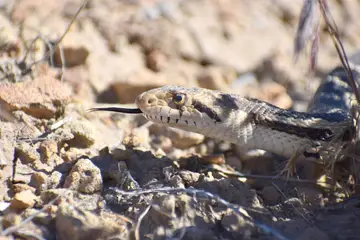

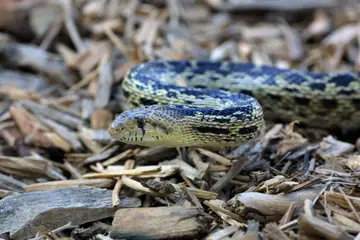

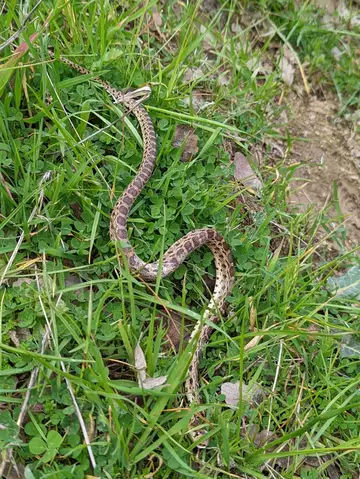
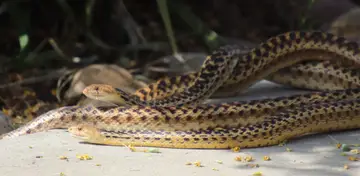
Size: Usually 3 to 6 feet; Arizona's longest snake, up to 92 inches (AZGFD); Missouri record 105 inches Arizona Game and Fish Department
Colors: Tan, cream, yellow, orange-brown or pale gray background with brown, reddish-brown, black or olive blotches; beige to light brown with dark brown or black blotches; yellowish belly with black spots (bullsnake, Texas). Pattern: About 40 large blotches down the back; light and dark bands on the tail; black line from the eye to the jaw (Missouri bullsnake); dark eye stripe through the eyes and across the snout; small dark tear-like mark below each eye; banded tail.
Key features
- No rattle: tail tapers to a point Washington Department of Fish & Wildlife
- Round pupils; keeled back scales (separates it from the similar glossy snake) Arizona Game and Fish Department
- Head somewhat triangular, more so when agitated (so head shape alone is not a safe test) Washington Department of Fish & Wildlife
Young
Juveniles resemble adults
Animals mistaken for the gopher snake
Gopher snake (gophersnake) or Rattlesnakes?
Gopher snake (gophersnake)
Rattlesnakes Crotalus spp.
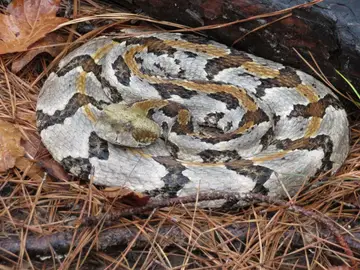

WDFW: gopher snakes lack a rattle and facial pits and have smaller, square back spots. NPS Cabrillo: the gopher snake's tail is long, skinny and pointed with no rattle, its head is about as slender as its neck (rattlesnakes have large spade- or triangle-shaped heads), and its back pattern is a rectangular chain rather than the circles or diamonds of a rattlesnake. Caution: a defensive gopher snake flattens its head into a triangle and vibrates its tail, so do not rely on head shape or sound alone. Washington Department of Fish & Wildlife
Venomous. NM Poison & Drug Information Center: rattlesnakes are the most common venomous snakes in New Mexico, rattlesnake venom is very toxic, and the rattle may or may not sound before a strike.
Gopher snake (gophersnake) or Glossy snake?
Gopher snake (gophersnake)
Glossy snake Arizona elegans
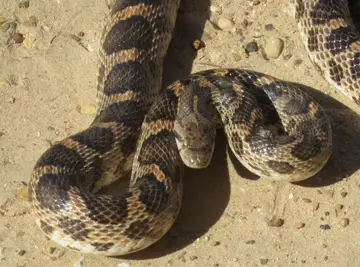
AZGFD: gopher snake back scales are keeled, which distinguishes it from the similar-looking glossy snake Arizona Game and Fish Department
Where the gopher snake lives
- Native or listed
- Nonnative or not established
- No official record in our data
- 1–9
- 10–99
- 100–999
- 1,000+
On our state guides
- Arizona snakes
- California snakes
- Colorado snakes
- Idaho snakes
- Illinois snakes
- Iowa snakes
- Kansas snakes
- Minnesota snakes
- Montana snakes
- Nebraska snakes
- New Mexico snakes
- North Dakota snakes
- Oklahoma snakes
- Oregon snakes
- South Dakota snakes
- Texas snakes
- Utah snakes
- Washington snakes
- Wisconsin snakes
State boundaries: U.S. Census Bureau, cartographic boundary file cb_2024_us_state_20m.
When it is active
Active day or night when conditions are right; hibernates in late fall and winter. Washington: out from late March or early April into late October. Missouri: late March to mid-November, mostly seen in May and June. Texas: usually hunts by day, more at night in hot summers. Arizona Game and Fish Department
US open-licence records peak in April to June and September.
Habitat and habits
Habitat: A habitat generalist: from low, hot, dry desert sand dunes to heavily wooded slopes (AZGFD); also grasslands, prairies, shrubsteppe, pastures and old fields, brushlands, and oak and pine forests. AZGFD: found in all of Arizona's biotic communities except alpine tundra. Arizona Game and Fish Department
Behavior: When threatened it raises its head into a striking pose, hisses loudly, flattens and broadens its head and vibrates its tail, and is often mistaken for a rattlesnake. Mostly a ground-dweller but can climb.
Diet: A constrictor that eats mainly rodents (mice, rats, gophers, ground squirrels), plus rabbits, birds and eggs, lizards, snakes and insects
Young: Lays eggs: mating in spring, up to 24 eggs laid in late spring or early summer; hatchlings appear in August (Arizona) or late August to September (Missouri)
Legal status and reporting
Protection: Minnesota: species of special concern (Minnesota Rules 6134.0200). Missouri: a species of conservation concern (MDC). Minnesota Office of the Revisor of Statutes
Report: Washington: WDFW asks people to share gopher snake sightings, especially from western Washington, outside the known range, or from Walla Walla County, using the WDFW wildlife reporting form. Washington Department of Fish & Wildlife
Questions about the gopher snake
Rattlesnake vs gopher snake
Gopher snakes have no rattle; the tail is long, skinny and pointed (NPS Cabrillo). WDFW says they also lack facial pits and have smaller, square back spots. NPS Cabrillo adds that the gopher snake's back pattern looks like a rectangular chain, not the circles or diamonds of a rattlesnake. A scared gopher snake coils, hisses, flattens its head and vibrates its tail to look like a rattlesnake, so keep your distance from any snake you are not sure about.
Baby rattlesnake vs gopher snake
WDFW says young gopher snakes resemble adults, and no gopher snake has a rattle or facial pits. No official source checked describes baby rattlesnakes alongside young gopher snakes, so treat any small blotched snake you cannot identify as possibly venomous and leave it alone.
Bull snake vs rattlesnake
The bullsnake is the Great Plains and Texas form of the gopher snake (Pituophis catenifer sayi). NPS Gila Cliff Dwellings: bull snakes are not venomous and have no rattles, but they imitate rattlesnakes by coiling, hissing, striking and vibrating the tail.
Bull snake bite
Bullsnakes and gopher snakes are non-venomous. They will bite if threatened or captured (WDFW, MDC); TPWD says they will not strike unless severely provoked.
Bull snake size
TPWD: three to five feet. MDC: usually 37 to 72 inches, with a record of 105 inches. AZGFD: up to 92 inches, Arizona's longest snake.
Bull snake texas
Yes. TPWD says bullsnakes are very common throughout Texas except the extreme east and the extreme western Trans-Pecos.
Bull snake mn
Yes. Minnesota Rules list the gopher snake (Pituophis catenifer) as a species of special concern.
Are there bull snakes in arizona?
Yes. The Arizona Game and Fish Department field guide says the gophersnake is found in nearly every part of the state, from near sea level to about 9,000 feet.
Bull snake colorado
Not confirmed from a Colorado agency source in this check (the CPW species profile URL tried returned only a search page).
Bull snake iowa
Not confirmed from an Iowa agency source in this check.
Sources
- Gopher snake (Pituophis catenifer). Washington Department of Fish & Wildlife. undated page; checked November 3, 2026.
Quoted passages (6)
“Gopher snakes will bite if threatened, but the bite is not venomous.”
“The gopher snake is a large snake with dark blotches, a distinct eye stripe and a tail that tapers to the tip.”
“The head is somewhat triangular in shape, becoming more pronounced when the snake is agitated.”
“No obvious external features distinguish males from females. Juveniles resemble adults.”
“If you see this species, please share your observation using the WDFW wildlife reporting form.”
“In comparison to rattlesnakes, gopher snakes differ in their physical appearance by lacking a rattle and facial pits. They also have smaller, square, dorsal spots;”
- Online Field Guide species account: Gophersnake (Pituophis catenifer). Arizona Game and Fish Department. 2023; checked November 3, 2026.
Quoted passages (8)
“Arizona's longest snake (up to 2,337 mm or 92″ in total length).”
“The pupils are round. The dorsal scales are keeled distinguishing this snake from the similar looking Glossy Snake.”
“A true generalist, this snake is found in all of Arizona's biotic communities with the exception of the small tract of treeless Alpine Tundra on the peaks of the San Francisco Mountains in Coconino County. It is most abundant in moderate terrain such as foothills, bajadas, and flatlands below about 6,000′ elevation but it inhabits a wide variety of habitats ranging from hot, dry, low elevation, sand dunes to heavily wooded slopes.”
“This is a powerful constrictor that preys on a wide variety of animals including rats, mice, rabbits, lizards, birds, snakes, eggs, and insects.”
“When threatened it often raises its head and neck into a striking posture, hisses loudly, flattens and broadens the head, and vibrates the tail. When exhibiting this behavior it is often mistaken for a rattlesnake.”
“The Gophersnake can be active around the clock when conditions are favorable. It h ibernates during the cold months of late fall and winter.”
“Mating takes place in spring and a clutch of up to 24 eggs is laid in late spring or early summer. Hatchlings begin to emerge in August.”
“The dorsal scales are keeled distinguishing this snake from the similar looking Glossy Snake.”
- TPWD Wildlife Fact Sheet: Bullsnake (Pituophis catinefer sayi). Texas Parks and Wildlife Department. undated page; checked November 3, 2026.
- We Brake for Snakes! - Cabrillo National Monument. National Park Service. updated June 18, 2019; checked November 3, 2026.
- Rattlesnake. California Department of Fish and Wildlife. undated page; checked November 3, 2026.
- Bullsnake (Pituophis catenifer sayi) - Field Guide. Missouri Department of Conservation. undated page; checked November 3, 2026.
- Minnesota Rules 6134.0200 Animal Species (endangered, threatened, special concern). Minnesota Office of the Revisor of Statutes (Minnesota DNR rule). Published Electronically: October 8, 2013; checked November 3, 2026.
Quoted passages (1)
“Of special concern:”
- Snakes and Lizards - Great Basin National Park. National Park Service. updated February 28, 2015; checked November 3, 2026.
- BISON-M (Biota Information System of New Mexico) species search export: taxonomic name "Serpentes". New Mexico Department of Wildlife (BISON-M, with Natural Heritage New Mexico). database queried November 3, 2026; checked November 3, 2026.
- Reptiles - Gila Cliff Dwellings National Monument. National Park Service. updated April 24, 2025; checked November 3, 2026.
- GBIF.org occurrence records, human observations licensed CC0 1.0 or CC BY 4.0 only, accessed November 3, 2026. The datasets behind these counts are listed on our Sources page.
- State boundaries: U.S. Census Bureau, cartographic boundary file cb_2024_us_state_20m.