Mojave Rattlesnake
Crotalus scutulatus · also called Mohave rattlesnake, Mojave green and Mohave green rattlesnake · Last checked November 3, 2026.
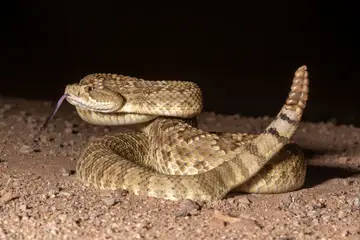
The Mojave (Mohave) rattlesnake is a venomous desert rattlesnake of the Southwest. It is tan, olive or gray-brown, sometimes with a greenish tinge, and has dark blotches down the back and a rattle on the tail. It is dangerous: the National Park Service calls its venom a potent blend of hemotoxins and neurotoxins that is extremely dangerous, and Arizona Game and Fish says it is widely considered the most toxic rattlesnake in the US. Leave it alone. Official sources place it in southern and western Arizona, the deserts of southeastern California, southwestern and south-central New Mexico, and extreme West Texas. New Mexico's wildlife database adds southern Nevada and the far southwest corner of Utah. It is easily confused with the western diamondback. If bitten, call 911 or Poison Help at 1-800-222-1222. Arizona Game and Fish Department
On this page
Is the mojave rattlesnake dangerous?
Dangerous to people and pets. Arizona Game and Fish: it can deliver large amounts of potent venom; in some parts of Arizona the venom contains dangerous neurotoxins; leave it alone. National Park Service (Saguaro): its venom is a potent blend of hemotoxins and neurotoxins and is extremely dangerous. Arizona Game and Fish Department
“This rattlesnake is capable of delivering large amounts of potent venom. In some parts of the state its venom contains dangerous neurotoxins. If encountered it should be left alone.”
Bites and stings: When threatened it may rattle constantly, raise its head into a high striking pose, strike often and slowly back toward shelter. A large share of bites happen when a snake is handled or abused. Rattlesnakes generally avoid people, but a startled rattlesnake may not rattle before it strikes, and dogs are at higher risk. Mojave National Preserve says it is not aggressive but is highly defensive: give it a wide berth. Newborn rattlesnakes can also deliver a dangerous bite.
If someone is bitten or stung, call 911 or Poison Help at 1-800-222-1222.
How to identify a mojave rattlesnake
A photo or description can narrow it down, but cannot confirm what an animal is or that it is safe. Look from a distance and do not handle wild animals.
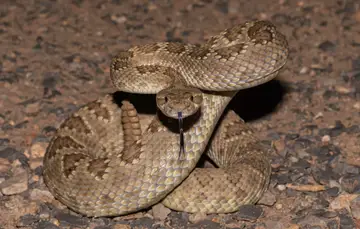
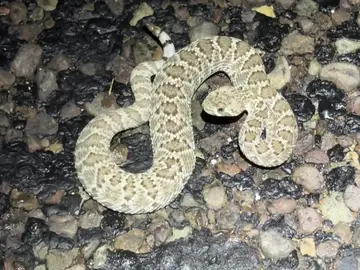
Size: Up to 50 inches excluding the rattle (Arizona). Grand Canyon-Parashant National Monument says it averages 2 to 4 feet. Texas calls it smaller and more slender than the western diamondback. Arizona Game and Fish Department
Colors: tan, olive or gray-brown; often slightly greenish (hence 'Mojave green'). Pattern: dark blotches down the back with dark edges and evenly colored centers, turning into crossbands toward the tail; pale gray tail with dark rings that are narrower than the pale spaces between them.
Key features
- rattle at the end of the tail Arizona Game and Fish Department
- broad triangular head on a slender neck; vertical pupils Arizona Game and Fish Department
- thin light stripe from the back corner of the eye running past the corner of the mouth Arizona Game and Fish Department
- heat-sensing pit on each side of the face Arizona Game and Fish Department
Young
Born live, 2 to 11 per brood on average (Parashant); newborns have a single silent button instead of a full rattle. Even newborn rattlesnakes can deliver a dangerous bite.
Animals mistaken for the mojave rattlesnake
Mojave Rattlesnake or Western diamondback rattlesnake?
Mojave Rattlesnake
Western diamondback rattlesnake Crotalus atrox
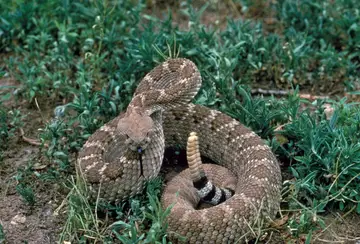

Hard to tell apart. Arizona: the Mojave's eye-stripe angle, its evenly colored blotches and its relatively thin tail rings set it apart. NPS Saguaro: Mojaves are often slightly greenish, with thick white and narrower black tail bands; the diamondback's bands are more even. Arizona Game and Fish Department
Also venomous and dangerous.
Mojave Rattlesnake or Western rattlesnake?
Mojave Rattlesnake
Western rattlesnake Crotalus oreganus
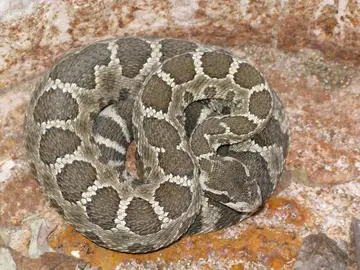

Grand Canyon-Parashant: the Mojave has a greenish tinge that the western rattlesnake lacks. National Park Service
Also a venomous rattlesnake.
Mojave Rattlesnake or Prairie rattlesnake?
Mojave Rattlesnake
Prairie rattlesnake Crotalus viridis
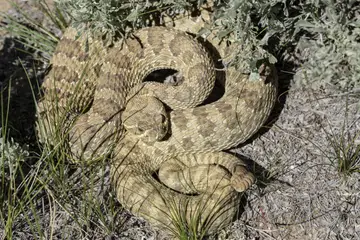
New Mexico's BISON-M notes that some southeastern Arizona grassland Mojaves look like prairie rattlesnakes. BISON-M
Also a venomous rattlesnake.
Where the mojave rattlesnake lives
- Native or listed
- Nonnative or not established
- No official record in our data
- 1–9
- 10–99
- 100–999
- 1,000+
On our state guides
State boundaries: U.S. Census Bureau, cartographic boundary file cb_2024_us_state_20m.
When it is active
Mostly nocturnal in Arizona, also active at dusk and dawn where days are milder. Most active at night and twilight from April through September (Parashant). Inactive (hibernating or brumating) in late fall and winter. Arizona Game and Fish Department
US open-licence records peak in July to August.
Habitat and habits
Habitat: Desert scrub (Sonoran, Mojave and Chihuahuan) and semidesert grassland, usually on fairly level ground such as creosote bush flats, low valleys, gentle bajadas and rolling foothills; Parashant adds cacti, mesquite and Joshua tree woodland. From near sea level to over 5,200 feet in Arizona. Arizona Game and Fish Department
Behavior: Uses heat-sensing pits to find warm-blooded prey and predators. Hibernates alone or in groups of two or three, unlike many rattlesnakes. Some males may become aggressive and chase threats in the spring mating season.
Diet: Rats, mice, lizards, birds and frogs, killed with venom.
Young: Mates in spring and summer; up to 17 young are born live in summer (Arizona). Parashant gives an average brood of 2 to 11.
Questions about the mojave rattlesnake
Mojave rattlesnake
A venomous desert rattlesnake of the Southwest, often with a greenish tinge (the 'Mojave green'). The National Park Service calls its venom a potent mix of hemotoxins and neurotoxins that is extremely dangerous, and Arizona Game and Fish says it is widely considered the most toxic rattlesnake in the US. Official sources place it in southern and western Arizona, southeastern California, southern New Mexico and extreme West Texas, and BISON-M adds southern Nevada and far southwestern Utah. Leave it alone; if bitten, call 911 or Poison Help at 1-800-222-1222.
Sources
- Online Field Guide species account: Mohave Rattlesnake (Crotalus scutulatus). Arizona Game and Fish Department. 2023; checked November 3, 2026.
Quoted passages (12)
“This rattlesnake is capable of delivering large amounts of potent venom. In some parts of the state its venom contains dangerous neurotoxins. If encountered it should be left alone.”
“Crotalus scutulatus Venomous”
“A large (up to 1,270 mm or 50″ in total length excluding rattle)”
“On the end of the tail is a rattle composed of a series of loosely interlocking keratinous sections.”
“The pupils are vertically elliptical … The neck is slender and the head is broad and triangular.”
“A thin, light colored stripe extends back from the posterior corner of the eye to beyond the corner of the mouth.”
“…heat sensing pits (one on each side of the face between the eye and nostril)”
“It occurs in Sonoran, Mohave, and Chihuahuan desertscrubs and Semidesert Grassland.”
“The Mohave Rattlesnake feeds on rats, mice, lizards, birds, and frogs.”
“It is primarily nocturnal across most of its range in Arizona.”
“Mating takes place in spring and summer. A litter of up to 17 young is born in summer.”
“The angle of this snakes eye-stripe, its uniformly-colored blotches, and its relatively thin tail rings distinguish it from the similar looking Western Diamond-backed Rattlesnake”
- Living with Rattlesnakes. Arizona Game and Fish Department. archived copy, captured June 9, 2016; checked November 3, 2026.
- Snakes - Saguaro National Park. National Park Service. updated May 6, 2025; checked November 3, 2026.
Quoted passages (1)
“…the Mohave hibernates alone or in groups of two or three individuals.”
- Rattlesnake. California Department of Fish and Wildlife. undated page; checked November 3, 2026.
- Venomous Snake Safety (Texas Junior Naturalists). Texas Parks and Wildlife Department. undated page; checked November 3, 2026.
- BISON-M Species Booklet 030165: Mojave Rattlesnake. New Mexico Department of Wildlife (BISON-M). updated August 28, 2024; checked November 3, 2026.
Quoted passages (1)
“Some SE Arizona grassland Mojaves look like prairie rattlers (C. v. viridis)”
- Mojave Green Rattlesnake - Grand Canyon-Parashant National Monument. National Park Service. updated October 26, 2022; checked November 3, 2026.
Quoted passages (2)
“The newborn snakes lack a full rattle at the end of the tail. Instead, they are born with a single silent button that will have an additional button added to it each time they shed their skin.”
“Not to be confused with the Western rattlesnake, the Mojave rattlesnake has a greenish tinge that the Western rattlesnake lacks.”
- GBIF.org occurrence records, human observations licensed CC0 1.0 or CC BY 4.0 only, accessed November 3, 2026. The datasets behind these counts are listed on our Sources page.
- State boundaries: U.S. Census Bureau, cartographic boundary file cb_2024_us_state_20m.