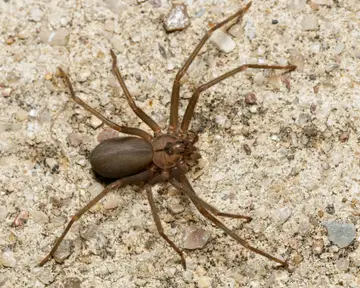
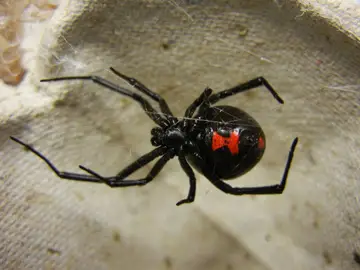
This page lists 3 spiders: all from NC State Extension's Spiders in and Around Homes.
2 are venomous by official accounts.
Not every species: no complete official list of North Carolina spiders exists, so this page covers the ones state and Extension sources name. How lists are built.
Which spiders can hurt you
Official sources single out these spiders in North Carolina, in their own words:
Venomous. “In North Carolina, there are few spiders that can inflect serious and painful injuries. The two best-known poisonous spiders found here are the black widow spider and the brown recluse.” NC State Extension
“In North Carolina, there are few spiders that can inflect serious and painful injuries. The two best-known poisonous spiders found here are the black widow spider and the brown recluse.” NC State Extension
JFMAMJJASOND
44 records by month.What the sources say
Venom: “Black widow spider venom affects the nervous system.” (NC State Extension)
Habitat: Black widow spiders are found in protected places, such as under rocks, wooden boards, and in dense plant growth. (NC State Extension)
“A necrotic lesion (i.e., an area of dead skin tissue) may develop and require surgery” NC State Extension
Size
Body about 7 to 12 mm (about 3/8 inch); females average about 9 mm and males about 8 mm. UC IPM says a recluse body is not more than 3/8 inch long.
How to recognize it
Six equal-sized eyes in three pairs. UC IPM calls this the most definitive feature, since most spiders have eight eyes.
The violin mark alone is not a reliable way to identify it
UC IPM's five-point check: six eyes in pairs, evenly colored finely haired abdomen, no spines on the legs, evenly colored legs, body no more than 3/8 inch
What the sources say
Venom: “Venomous spiders found in the United States include the black widow and the brown recluse.” (CDC / NIOSH)
Habitat: Outdoors, they are most common under rocks, debris, wood piles, etc. (NC State Extension)
Yes. The black widow is one of the two best-known poisonous spiders found in North Carolina. NC State Extension
“The two best-known poisonous spiders found here are the black widow spider and the brown recluse.”
About this list
The species list comes from Spiders in and Around Homes (NC State Extension (N.C. Cooperative Extension, NC State University), Publication date: Jan. 1, 2008; Reviewed/Revised: Oct. 24, 2022).
Venom labels come only from official sources and link to them; "Not stated" never means harmless. How labels work.
Spiders in and Around Homes. NC State Extension (N.C. Cooperative Extension, NC State University). Publication date: Jan. 1, 2008; checked November 3, 2026.Quoted passages (4)
“Black widow spider venom affects the nervous system.”
“In North Carolina, there are few spiders that can inflect serious and painful injuries. The two best-known poisonous spiders found here are the black widow spider and the brown recluse.”
“A necrotic lesion (i.e., an area of dead skin tissue) may develop and require surgery”
“The two best-known poisonous spiders found here are the black widow spider and the brown recluse.”
Venomous Spiders (Outdoor Workers). CDC / NIOSH. archived copy, captured September 29, 2026; checked November 3, 2026.Quoted passages (1)
“Venomous spiders found in the United States include the black widow and the brown recluse.”
Animals, Bites, and Stings (FAQ). U.S. Health Resources & Services Administration (HRSA), Poison Help. archived copy, captured July 13, 2026; checked November 3, 2026.Quoted passages (1)
“If you or someone you know has been bitten by a spider, call Poison Help (1-800-222-1222), which connects you to your local poison center, to find out more information.”
Have a Wildlife Problem? N.C. Wildlife Resources Commission. undated page; checked November 3, 2026.Quoted passages (1)
“The Wildlife Helpline is open Monday through Friday, 8 a.m. to 5 p.m. Call: 866-318-2401”