States Wildlife

Scorpions in North Carolina: Species, Stings & Lookalikes

Last checked November 3, 2026 against official sources.

On this page
  1. All 3 scorpions
  2. Lookalikes
  3. If you see one
  4. How to report
  5. Common questions
  6. About this list
  7. Sources

This page lists 3 scorpions: all from NC State Extension's Scorpions in North Carolina. 2 are nonnative.

Not every species: no complete official list of North Carolina scorpions exists, so this page covers the ones state and Extension sources name. How lists are built.

All 3 scorpions

From A to Z.

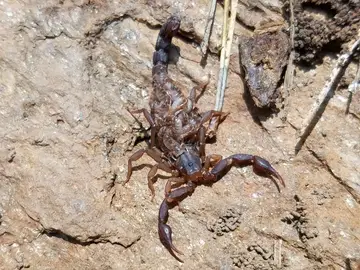
Hentz striped scorpion
Photo: Judy Gallagher · CC BY 2.0 · Wikimedia Commons

Hentz striped scorpion

Centruroides hentzi

Not stated Nonnative

Venom
No official source we use states whether this animal is venomous. That does not mean it is harmless: do not handle it.
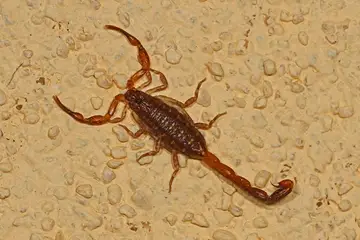
Southern unstriped scorpion (southern devil scorpion)
Photo: Leila Dasher · CC BY 4.0 · iNaturalist

Southern unstriped scorpion (southern devil scorpion)

Vaejovis carolinianus

Not stated

Venom
No official source we use states whether this animal is venomous. That does not mean it is harmless: do not handle it.
Where in North Carolina
In North Carolina, it has been found primarily in western areas from Cherokee County to Polk County. However, it has been reported in other areas of the state as well. NC State Extension
What the sources say

Habitat: Scorpions are normally found outdoors under the loose bark of trees and logs or under logs and stones on the ground. (NC State Extension)
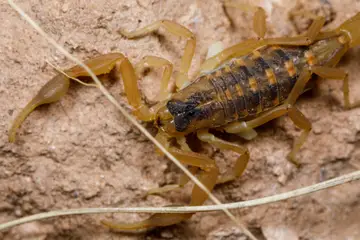
Striped bark scorpion
Photo: Meghan Cassidy · CC BY-SA 4.0 · iNaturalist · resized

Striped bark scorpion

Centruroides vittatus

Not stated Nonnative

Venom
No official source we use states whether this animal is venomous. That does not mean it is harmless: do not handle it.
Size
Usually about 2.5 inches. Sources range from 1 to 1.5 inches on average (Missouri Department of Conservation) to up to 3.5 inches (Oklahoma State).
How to recognize it
  • Slender pincers and a long, slender tail. The tail is longer on males than females.
  • Tail ends in a stinger, usually carried up and over the body.
  • Glows under ultraviolet light.

Full Striped bark scorpion guide

Scorpions people confuse

Striped Bark Scorpion or Southern devil scorpion (southern unstriped scorpion)?

Striped Bark Scorpion
Photo: Meghan Cassidy · CC BY-SA 4.0 · iNaturalist · resized

Striped Bark Scorpion Not stated

Southern devil scorpion (southern unstriped scorpion)
Photo: Leila Dasher · CC BY 4.0 · iNaturalist

Southern devil scorpion (southern unstriped scorpion) Not stated

More uniformly brown and about 1 inch long when grown, with no stripes. NC State Extension

Striped Bark Scorpion or Hentz striped scorpion?

Striped Bark Scorpion
Photo: Meghan Cassidy · CC BY-SA 4.0 · iNaturalist · resized

Striped Bark Scorpion Not stated

Hentz striped scorpion
Photo: Judy Gallagher · CC BY 2.0 · Wikimedia Commons

Hentz striped scorpion Not stated

Alabama Cooperative Extension: the Hentz striped scorpion is brown with three yellowish stripes along its back (sometimes a little obscure) and is typically 2 inches or less long.

Photos show typical adults; individuals vary. Never get close to compare.

If you see one

Official advice from NC State Extension:

How to report

NC Wildlife Helpline (NCWRC), Monday-Friday 8 a.m.-5 p.m.: 866-318-2401; email [email protected]. Aquatic invasive species: NCWRC Aquatic Nuisance Species Reporting Tool (https://survey123.arcgis.com/share/710337fbf02140599fd788ebfdd72744). Rattlesnake sightings: [email protected] or HerpMapper. Wildlife violations / alligator emergencies: 800-662-7137. Yellow-legged hornet: www.ncagr.gov/YLH (NCDA&CS). N.C. Wildlife Resources Commission

Common questions

About this list

The species list comes from Scorpions in North Carolina (NC State Extension (N.C. Cooperative Extension, NC State University), Publication date: Oct. 1, 1984; Reviewed/Revised: Oct. 24, 2022).

Venom labels come only from official sources and link to them; "Not stated" never means harmless. How labels work.

"Nonnative" and "Invasive" follow the wording of the source list. See invasive species in North Carolina.

Sources

  1. North Carolina's State Wildlife Action Plan (SWAP) page. N.C. Wildlife Resources Commission. 2025 SWAP approved by USFWS January 2026; checked November 3, 2026.
  2. Scorpions in North Carolina. NC State Extension (N.C. Cooperative Extension, NC State University). Publication date: Oct. 1, 1984; checked November 3, 2026.
    Quoted passages (3)
    “The easiest step to take is to vigorously shake clothing before wearing.”
    “Scorpions tend to be more active at night”
    “Its body is more uniformly brown and about one inch in length when fully grown.”
  3. Have a Wildlife Problem? N.C. Wildlife Resources Commission. undated page; checked November 3, 2026.
    Quoted passages (1)
    “The Wildlife Helpline is open Monday through Friday, 8 a.m. to 5 p.m. Call: 866-318-2401”