Striped Bark Scorpion
Centruroides vittatus · also called striped scorpion, common striped scorpion and common striped bark scorpion · Last checked November 3, 2026.
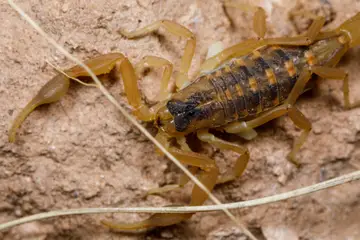
The striped bark scorpion is a yellowish-tan scorpion with two broad dark stripes down its back, and the most common scorpion in the US. It is venomous. Its sting is quite painful but is almost never life-threatening, according to Missouri Department of Conservation, and some people can have a serious allergic reaction. Official sources place it from Colorado and New Mexico through Texas, Kansas, Oklahoma, Arkansas, Missouri and Louisiana, with smaller populations farther east. It is a different species from the more dangerous Arizona bark scorpion. If stung, call 911 or Poison Help at 1-800-222-1222. Missouri Department of Conservation
On this page
Is the striped bark scorpion dangerous?
Venomous. The sting is quite painful but almost never life-threatening, and some people can have an allergic reaction that needs medical attention (Missouri Department of Conservation). Reactions vary: Kansas extension says some people have an intense reaction and should seek medical help immediately. This statement does not apply to the Arizona bark scorpion, which CDC says can be life-threatening. Missouri Department of Conservation
“…some people can respond with an allergic reaction that requires medical attention”
Bites and stings: Stings rather than bites, when disturbed or pinned against the skin. Stings often happen when people turn over wood or rocks with bare hands.
If someone is bitten or stung, call 911 or Poison Help at 1-800-222-1222.
How to identify a striped bark scorpion
A photo or description can narrow it down, but cannot confirm what an animal is or that it is safe. Look from a distance and do not handle wild animals.
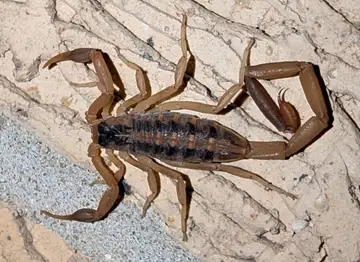
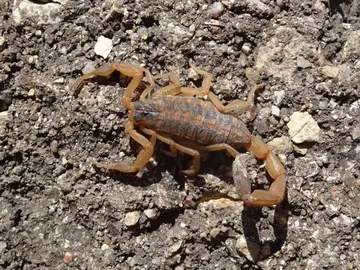
Size: Usually about 2.5 inches. Sources range from 1 to 1.5 inches on average (Missouri Department of Conservation) to up to 3.5 inches (Oklahoma State). Texas A&M AgriLife Extension Service
Colors: Yellowish tan to pale yellow; Illinois says color can vary somewhat. Big Bend populations may be faint or pale. Pattern: Two broad dark stripes running the length of the back; dark triangular mark on the front of the head.
Key features
- Slender pincers and a long, slender tail. The tail is longer on males than females. Texas A&M AgriLife Extension Service
- Tail ends in a stinger, usually carried up and over the body. IDNR
- Glows under ultraviolet light. University of Arkansas Arthropod Museum
Young
Immature scorpions may be lighter, with dark brown or black at the base of the pincers and the last tail segment. Newborns ride on the mother and can already sting.
Animals mistaken for the striped bark scorpion
Striped Bark Scorpion or Southern devil scorpion (southern unstriped scorpion)?
Striped Bark Scorpion
Southern devil scorpion (southern unstriped scorpion) Vaejovis carolinianus
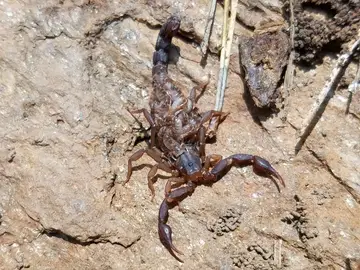
More uniformly brown and about 1 inch long when grown, with no stripes. NC State Extension
Can sting. NC State says it is not considered a public health threat except possibly for people allergic to other arthropod venoms or with other health issues.
Striped Bark Scorpion or Hentz striped scorpion?
Striped Bark Scorpion
Hentz striped scorpion Centruroides hentzi
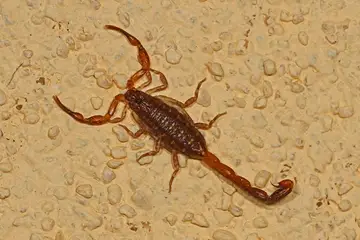

Alabama Cooperative Extension: the Hentz striped scorpion is brown with three yellowish stripes along its back (sometimes a little obscure) and is typically 2 inches or less long. Alabama Cooperative Extension System
Venomous sting; UF/IFAS says Florida scorpions are not known to cause significant medical issues.
Striped Bark Scorpion or Northern desert hairy scorpion?
Striped Bark Scorpion
Northern desert hairy scorpion Hadrurus spadix
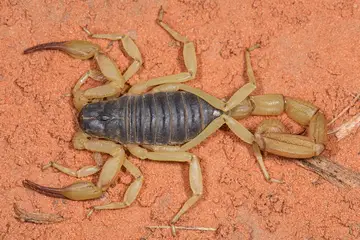

Much larger; CSU gives a body length of 5 inches for this species, with light appendages and a dark back. Colorado State University, Department of Agricultural Biology
See the desert hairy scorpion page.
Where the striped bark scorpion lives
- Native or listed
- Nonnative or not established
- No official record in our data
- 1–9
- 10–99
- 100–999
- 1,000+
On our state guides
- Arkansas scorpions
- Colorado scorpions
- Georgia scorpions
- Illinois scorpions
- Kansas scorpions
- Mississippi scorpions
- Missouri scorpions
- Nebraska scorpions
- North Carolina scorpionsNonnative
- Oklahoma scorpions
- Texas scorpions
State boundaries: U.S. Census Bureau, cartographic boundary file cb_2024_us_state_20m.
When it is active
Active at night. Timing indoors varies: Arkansas says April to early June is when they roam and commonly enter houses; Kansas says most often indoors from mid-August through October. K-State Research and Extension
US open-licence records peak in April to July and September.
Habitat and habits
Habitat: Wide range of habitats, including deserts, deciduous and pine forests and grasslands. Found under rocks, boards, debris and loose bark, on trees, fence posts and buildings, and indoors. In Missouri it prefers rocky glades. University of Arkansas Arthropod Museum
Behavior: Hides by day and hunts at night. Often climbs trees and other plants at night. Would rather flee from people than sting.
Diet: Mostly spiders and other small arthropods such as cockroaches, ants, crickets and beetles. A hungry scorpion may tackle small mice and lizards.
Young: Bears live young after about 8 months of gestation. Females usually have 13 to 47 young, which ride on the mother for days. Reaches maturity in 3 to 4 years (Arkansas, Oklahoma State digital diagnostics, Illinois; the Oklahoma State school IPM sheet says about one year); Texas gives a lifespan of about 4 years, Missouri 3 to 7.
Legal status and reporting
Federal: No ECOS record: live FWS ECOS queries returned no records for this name (2026-11-03), nor for any Centruroides name in a genus-wide re-check. ECOS
Protection: Listed as endangered in Illinois. IDNR
Questions about the striped bark scorpion
Striped bark scorpion
A yellowish-tan, venomous scorpion about 2.5 inches long with two broad dark stripes on its back. The sting is painful and almost never life-threatening, but some people react severely. If stung, call 911 or Poison Help at 1-800-222-1222.
Bark scorpion sting
For this species, Missouri Department of Conservation describes the sting as quite painful and almost never life-threatening, and K-State compares it to a wasp sting. Some people have a stronger reaction. The Arizona bark scorpion is a different species, and CDC says its sting can be life-threatening. If stung, call 911 or Poison Help at 1-800-222-1222.
Bark scorpion sting symptoms
K-State Research and Extension says swelling and burning at the site are usual, and that some people have an intense reaction with agitation, slurred speech, high temperature and tightening of the throat, and should seek medical help immediately. Call 911 or Poison Help at 1-800-222-1222.
Bark scorpion venom
The venom of the striped bark scorpion is low in toxicity to humans (K-State, Illinois DNR), and Missouri calls it a comparatively mild neurotoxin. This applies to this species only.
Bark scorpion size
Usually about 2.5 inches. Reported figures run from 1-1.5 inches on average in Missouri to 3.5 inches at most in Oklahoma.
Bark scorpion range
Official sources place it in Arkansas, Colorado, Illinois, Kansas, Louisiana, Mississippi, Missouri, New Mexico, Oklahoma and Texas, with Georgia, North Carolina and Tennessee also named. It also lives in northern Mexico.
Bark scorpion texas
Yes. It is the most common scorpion in Texas and the only one that occurs throughout the state. Texas has 18 species.
Bark scorpion oklahoma
Yes. Oklahoma State says the striped bark scorpion is the most common scorpion in Oklahoma, and that the state has only five species.
Are there bark scorpions in missouri?
Yes. The striped bark scorpion is the only scorpion species in Missouri, mainly in the Ozarks and other parts of the southern half of the state.
Are there bark scorpions in new mexico?
Yes, two kinds. The state BISON-M database lists the common striped scorpion, and the New Mexico Poison Center places the more dangerous Arizona bark scorpion in the southwestern corner of the state.
Are there bark scorpions in oklahoma?
Yes. The striped bark scorpion is the most common scorpion in Oklahoma, according to Oklahoma State.
Sources
- Striped Bark Scorpion. Missouri Department of Conservation. undated page; checked November 3, 2026.
Quoted passages (3)
“…some people can respond with an allergic reaction that requires medical attention”
“Scorpions are venomous, and although the sting of this species is quite painful, it is almost never life-threatening.”
“…striped bark scorpions prefer soft-bodied prey such as spiders, cockroaches, ants, crickets, beetles, and butterflies”
- Scorpions (ENTO-PU-032 05/22), Wizzie Brown. Texas A&M AgriLife Extension Service. 05/22 (publication code ENTO-PU-032 05/22; checked November 3, 2026.
Quoted passages (4)
“Adults are about 2½ inches long.”
“This species can be identified easily by its slender pedipalps (pincer-bearing arms) and long, slender tail.”
“Immature striped bark scorpions may be lighter in color.”
“Females usually give birth to 13 to 47 young, with an average of 31.”
- Scorpions of Colorado. Colorado State University Extension (Western Colorado Insects). file path 2017/03; checked November 3, 2026.
- IPM Action Plan for Bark Scorpions. Texas A&M AgriLife Extension Service (School IPM). undated page; checked November 3, 2026.
- Striped bark scorpion (Arkansas Arthropods). University of Arkansas Arthropod Museum (Department of Entomology and Plant Pathology). WordPress modified 2017-07-05; checked November 3, 2026.
Quoted passages (3)
“…glow phosphorescent yellow under ultraviolet light”
“It occurs in a wide variety of microhabitats in deserts, deciduous and pine forests, and grasslands.”
“They frequently climb trees and other plants at night”
- Household Pests of Kansas, MF3291 (Davis & Whitworth). K-State Research and Extension (Kansas State University Agricultural Experiment Station and Cooperative Extension Service). July 2018; checked November 3, 2026.
Quoted passages (1)
“The striped bark scorpion is most commonly found indoors in Kansas from mid-August through October.”
- Striped Bark Scorpion (Biodiversity of Illinois). Illinois Department of Natural Resources (IDNR). archived copy, captured March 3, 2023; checked November 3, 2026.
Quoted passages (2)
“The tail ends in a stinger that is usually carried up and over the body.”
“ILLINOIS STATUS endangered, native”
- ECOS species report query. U.S. Fish and Wildlife Service (ECOS). live query 2026-11-03; checked November 3, 2026.
- Scorpions in North Carolina. NC State Extension (N.C. Cooperative Extension, NC State University). Publication date: Oct. 1, 1984; checked November 3, 2026.
Quoted passages (1)
“Its body is more uniformly brown and about one inch in length when fully grown.”
- Scorpion Management in Residential Homes. Alabama Cooperative Extension System. published 2021-06-09; checked November 3, 2026.
Quoted passages (1)
“This scorpion is typically 2 inches (5 cm) or less in length. Large individuals may reach 2.5 inches (6.3 cm), although this is rare. It has a base color of brown with three yellowish stripes along its back, which at times may be a little obscure.”
- Scorpions (insect information fact sheet). Colorado State University, Department of Agricultural Biology (Extension entomology). undated page; checked November 3, 2026.
Quoted passages (1)
“Appendages are light colored but the back is dark.”
- Insects and Scorpions at Work. CDC / NIOSH. archived copy, captured October 4, 2026; checked November 3, 2026.
- Scorpions (Digital Diagnostics). Oklahoma State University Extension. archived copy, captured November 11, 2025; checked November 3, 2026.
- Leave It Be: Maintaining Leaf Litter in the Landscape. LSU AgCenter. article published 2024-09-27; checked November 3, 2026.
- Control Household Insect Pests (Publication 2443). Mississippi State University Extension Service. Publication 2443; checked November 3, 2026.
- BISON-M (Biota Information System of New Mexico) species search export: taxonomic name "Scorpiones". New Mexico Department of Wildlife (BISON-M, with Natural Heritage New Mexico). database queried November 3, 2026; checked November 3, 2026.
- Scorpions (OSU School IPM common pests sheet). Oklahoma State University Extension, School IPM program. undated page; checked November 3, 2026.
- Scorpions not as dangerous as they look. UGA College of Agricultural and Environmental Sciences (CAES Field Report/newswire). July 17, 2003; checked November 3, 2026.
- Bites and Stings. New Mexico Poison & Drug Information Center (UNM Health Sciences; New Mexico's poison-control program). undated page; checked November 3, 2026.
- GBIF.org occurrence records, human observations licensed CC0 1.0 or CC BY 4.0 only, accessed November 3, 2026. The datasets behind these counts are listed on our Sources page.
- State boundaries: U.S. Census Bureau, cartographic boundary file cb_2024_us_state_20m.