Desert hairy scorpion
Hadrurus arizonensis · also called Arizona giant hairy scorpion, giant desert hairy scorpion, Arizona hairy scorpion and giant hairy scorpion · Last checked November 3, 2026.
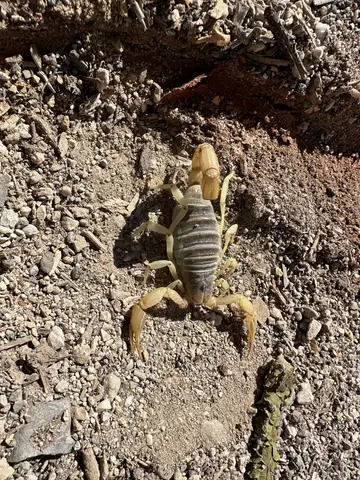
The desert hairy scorpion (Arizona giant hairy scorpion, Hadrurus arizonensis) is the largest scorpion in the US. It is a heavy-bodied scorpion, often more than 5 inches long, with a darker body and pale, buff-colored legs and pincers. It lives in the Sonoran and Mojave deserts of Arizona, California, Nevada and Utah. It is venomous, but University of Arizona Extension calls its venom mild. UC IPM says a sting is usually no more serious than an ant, bee or wasp sting unless the person has an allergic reaction. CDC warns that people allergic to venom can have a life-threatening reaction. Do not confuse it with the much smaller, slender Arizona bark scorpion, whose sting can be life-threatening. If stung, call 911 or Poison Help at 1-800-222-1222. University of Arizona Cooperative Extension
On this page
Is the desert hairy scorpion dangerous?
UC IPM: a Hadrurus sting is usually no more serious than an ant, bee or wasp sting unless the person has an allergic reaction. The usual reaction is an immediate, intense, burning pain at the site with little redness or swelling, which usually fades after about 30 minutes. University of California Statewide IPM Program
“The sting of scorpions in Vaejovis and Hadrurus genera is usually no more serious than stings of ants, bees, or wasps, unless a person has an allergic reaction.”
Bites and stings: It stings; it does not bite. Official sources describe its sting as painful and its venom as mild or of low toxicity.
If someone is bitten or stung, call 911 or Poison Help at 1-800-222-1222.
How to identify a desert hairy scorpion
A photo or description can narrow it down, but cannot confirm what an animal is or that it is safe. Look from a distance and do not handle wild animals.
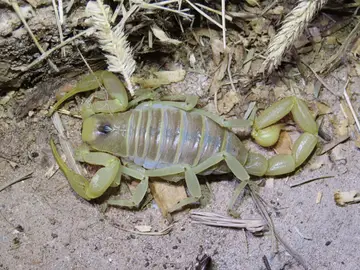
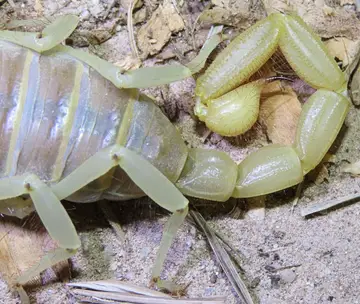
Size: Adults are often more than 5 inches long; UC IPM gives 5 to 7 inches at maturity. It is the largest scorpion in the US. (Northern desert hairy scorpion, H. spadix: up to about 5 inches.) University of Arizona Cooperative Extension
Colors: dark body; pale sides; pale buff legs and pincers. Pattern: dark back; pale or buff appendages.
Key features
- Heavy-bodied and very large. It is the biggest scorpion in the US. University of Arizona Cooperative Extension
- Strong, grasping pincers (pedipalps). It uses them to hold prey. University of Arizona Cooperative Extension
- H. spadix (Capitol Reef): many sensory hairs and a black front body section (cephalothorax), which sets it apart from other local scorpions. National Park Service
Young
No species-specific description of young was found. UA Extension says scorpions in general are born live and ride on the mother's back, and the pale young leave usually one to three weeks after birth.
Animals mistaken for the desert hairy scorpion
Desert hairy scorpion or Arizona bark scorpion?
Desert hairy scorpion
Arizona bark scorpion Centruroides sculpturatus
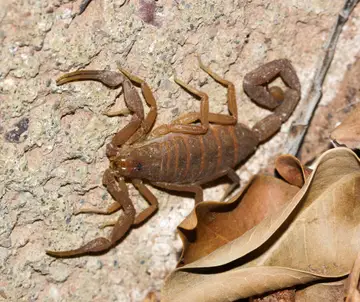
The bark scorpion is much smaller, about 1.5 to 3 inches, with slender pincers and a long, thin tail. The desert hairy scorpion is heavy-bodied, has strong pincers and is often more than 5 inches long. The bark scorpion climbs walls and is common around buildings; the hairy scorpion is a burrower, but UC IPM says it can also enter homes, so finding a scorpion indoors does not tell you which one it is. Utah State says the most venomous species have more delicate pincers. Size and build help, but no official source checked says they are proof, so treat any scorpion you cannot identify as possibly a bark scorpion. Arizona Poison and Drug Information Center
Dangerous: CDC says bark scorpion stings can be life-threatening. The Arizona Poison and Drug Information Center calls it the only one of Arizona's 30 scorpion species regarded as life-threatening.
Desert hairy scorpion or Arizona stripe-tailed scorpion (stripedtail scorpion)?
Desert hairy scorpion
Arizona stripe-tailed scorpion (stripedtail scorpion) Paravaejovis spinigerus (UC IPM: Vaejovis spinigerus)
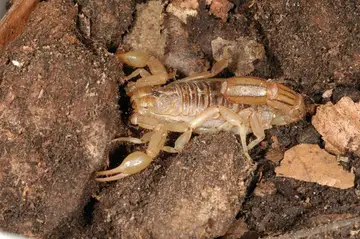

The stripe-tailed scorpion is much smaller, full-grown at under 3 inches, and UC IPM says its body is striped on top. University of Arizona Cooperative Extension
Venomous but not considered dangerous (UC IPM).
Where the desert hairy scorpion lives
- Native or listed
- Nonnative or not established
- No official record in our data
- 1–9
- 10–99
- 100–999
- 1,000+
On our state guides
State boundaries: U.S. Census Bureau, cartographic boundary file cb_2024_us_state_20m.
When it is active
Active at night. In Arizona, most stings reported to the poison center happen at night in the warm summer months (scorpions in general). University of California Statewide IPM Program
US open-licence records peak in April, June and August to September.
Habitat and habits
Habitat: Low sandy desert areas in the Sonoran and Mojave deserts. It burrows and spends most of its time under rocks and in shallow burrows. It is also found under logs, boards, woodpiles, decorative bark and tree bark, and often around homes and in garages. It may come indoors looking for water and hide in dark, cool places such as bathrooms, kitchens, crawl spaces, attics and closets. University of California Statewide IPM Program
Behavior: A night feeder drawn to water, swimming pools, irrigated areas and outdoor lights, where its insect prey gathers. H. spadix usually keeps a burrow and forages within a couple dozen feet of it. NPS calls H. spadix aggressive toward large insects, other scorpions, snakes and lizards.
Diet: A wide variety of insects, arachnids, small lizards and other animals, including Arizona bark scorpions. UC IPM names beetles, cockroaches, crickets and moths. CSU says the northern desert hairy scorpion is large enough to sometimes catch small rodents and other vertebrates.
Young: Scorpions bear live young, which ride on the mother's back (general scorpion biology; about 25 to 35 young per female on average, per UA). CSU says H. spadix may live 20 years or more.
Questions about the desert hairy scorpion
Desert hairy scorpion
The desert hairy scorpion (Arizona giant hairy scorpion, Hadrurus arizonensis) is the largest scorpion in the US, often over 5 inches long. It lives in the Sonoran and Mojave deserts of Arizona, California, Nevada and Utah. Its venom is mild, and a sting is usually no worse than a bee or wasp sting unless you are allergic. If stung, call 911 or Poison Help at 1-800-222-1222.
Are there scorpions in arizona that can kill you?
Only one: the Arizona Poison and Drug Information Center says the bark scorpion is the only one of Arizona's 30 scorpion species regarded as life-threatening. The desert hairy scorpion is much bigger, but its venom is mild. CDC adds that anyone allergic to venom can have a life-threatening reaction to a sting.
Are there deadly scorpions in nevada?
University of Arizona Extension places the desert hairy scorpion, which has mild venom, in Nevada. The Arizona Department of Agriculture lists Nevada in the range of the Arizona bark scorpion, whose sting CDC says can be life-threatening.
Are there poisonous scorpions in utah?
All scorpions have venom. Utah State University Extension says the only potentially harmful species in Utah is the Arizona bark scorpion, found only in southern Utah along the Colorado River. Hairy scorpions also live in Utah: the desert hairy scorpion in the southwest and the black hairy scorpion in the southeast. NPS says Capitol Reef's scorpions can deliver painful stings but their venom's toxicity is relatively low. Utah State says stings are no more serious than those of ants, bees or wasps unless a person has an allergic reaction.
Are there scorpions in moab utah?
Yes. NPS lists the giant hairy scorpion among the arachnids of Arches National Park, whose entrance NPS places north of the town of Moab, and Utah State places the black hairy scorpion in southeastern Utah.
Are there scorpions in the california desert?
Yes. UC IPM says the Arizona hairy scorpion is common in Southern California deserts and has been reported in Imperial, Inyo, Kern, Los Angeles, Riverside, San Bernardino and San Diego counties. UC IPM places the dangerous bark scorpion only in the far southeast of California, near Arizona, but the Arizona Department of Agriculture says small populations have also been found in northern California.
Are there scorpions in colorado?
Yes. CSU confirms three species in Colorado, including the northern desert (black) hairy scorpion on the West Slope, around places like Colorado National Monument.
Are there any scorpions in idaho?
Yes. Idaho Fish and Game lists the black-back scorpion (Hadrurus jedediah, also listed as Hadrurus spadix) as present and native in Idaho.
Sources
- Scorpions of the Desert Southwest United States (az1768). University of Arizona Cooperative Extension. 2018-05; checked November 3, 2026.
Quoted passages (7)
“They have a mild venom, but strong pedipalps that they use to grasp prey.”
“…they are heavy bodied scorpions, and adults often exceed 5 inches in length.”
“Arizona giant hairy scorpion Hadrurus arizonensis (Fig. 2) is the largest scorpion in the U.S.; they are heavy bodied scorpions”
“The pale colored young have been seen to climb down, molt then return to the mother’s back for several days before leaving for good, usually within one to three weeks after birth.”
“They feed on a wide variety of insects, arachnids, small lizards and other animals.”
“Scorpions give birth to live young, called scorplings, which ascend their mother’s back (Fig. 6).”
“…are burrowing species, and full-grown at less than 3 inches in length.”
- Pest Notes: Scorpions. University of California Statewide IPM Program. Updated 12/2011; checked November 3, 2026.
Quoted passages (4)
“The sting of scorpions in Vaejovis and Hadrurus genera is usually no more serious than stings of ants, bees, or wasps, unless a person has an allergic reaction.”
“Like many other desert scorpions, the Arizona hairy scorpion is a burrower but may also be found under rocks, logs, sleeping bags, and other surface objects. This scorpion can often be found around homes and in garages.”
“It is a night feeder attracted to water, swimming pools, irrigated areas, or outside lights where food prey such as beetles, cockroaches, crickets, moths, and other insects are attracted as well.”
“It is a night feeder”
- Insects and Scorpions at Work. CDC/NIOSH. archived copy, captured October 4, 2026; checked November 3, 2026.
- Scorpions. Arizona Poison and Drug Information Center. 2026 footer; checked November 3, 2026.
Quoted passages (1)
“The bark scorpion may be distinguished from other less toxic species by its more slender tail segments and pincers. Reaching only an inch and a half at maturity, it is a comparatively small scorpion.”
- Insects, Scorpions, and Other Invertebrates (Capitol Reef National Park). National Park Service. updated April 24, 2021; checked November 3, 2026.
Quoted passages (1)
“It is easily distinguished from other scorpions in the area by its black body (cephalothorax). Its many hairs help it sense vibrations that may indicate the presence of prey and predators.”
- Scorpions. Arizona Department of Agriculture. archived copy, captured May 21, 2025; checked November 3, 2026.
- Scorpions (fact sheet). Utah State University Extension. June 2008; checked November 3, 2026.
- Scorpions - School IPM. Utah State University Extension. undated page; checked November 3, 2026.
- Arachnids (Arches National Park kids quiz page). National Park Service. updated April 29, 2025; checked November 3, 2026.
- Directions - Arches National Park. National Park Service. updated April 18, 2025; checked November 3, 2026.
- Scorpions of Colorado. Colorado State University Extension (Western Colorado Insects). file path 2017/03; checked November 3, 2026.
- Hadrurus jedediah (Black-back Scorpion), Idaho Fish and Game Species Catalog. Idaho Department of Fish and Game. archived copy, captured November 15, 2025; checked November 3, 2026.
- GBIF.org occurrence records, human observations licensed CC0 1.0 or CC BY 4.0 only, accessed November 3, 2026. The datasets behind these counts are listed on our Sources page.
- State boundaries: U.S. Census Bureau, cartographic boundary file cb_2024_us_state_20m.