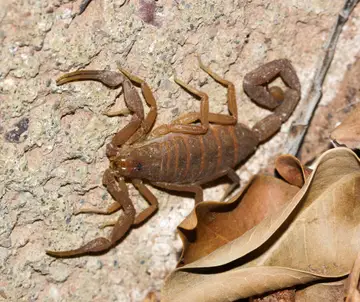
Arizona Poison and Drug Information Center: Only one of the 30 species of scorpions found in Arizona is regarded as life-threatening: the bark scorpion (Centruroides sculpturatus).
This page lists 4 scorpions.
1 is venomous by official accounts, and 3 mildly venomous. Arizona Poison and Drug Information Center gives a total of 30; the 4 here are the scorpions official sources name one by one.
Not every species: no complete official list of Arizona scorpions exists, so this page covers the ones state and Extension sources name. How lists are built.
Which scorpions can hurt you
Official sources single out these scorpions in Arizona, in their own words:
Venom: “The Arizona bark scorpion is the only scorpion of medical concern in the U.S. (Curry et al. 1983), and while all native scorpions can sting, only Arizona bark scorpion stings are hazardous to human health.” (University of Arizona Cooperative Extension)
Habitat: The Arizona bark scorpion is common around buildings of all kinds in low desert areas, and is often associated with homes and hollow-block perimeter walls. (University of Arizona Cooperative Extension)
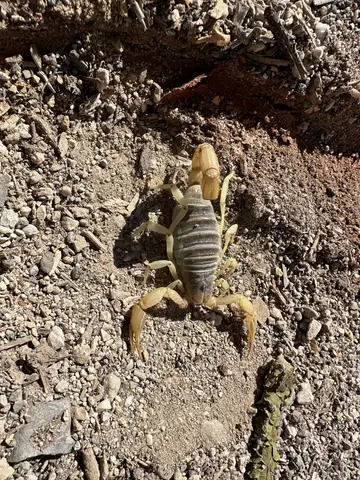
Adults are often more than 5 inches long; UC IPM gives 5 to 7 inches at maturity. It is the largest scorpion in the US. (Northern desert hairy scorpion, H. spadix: up to about 5 inches.)
How to recognize it
Heavy-bodied and very large. It is the biggest scorpion in the US.
Strong, grasping pincers (pedipalps). It uses them to hold prey.
H. spadix (Capitol Reef): many sensory hairs and a black front body section (cephalothorax), which sets it apart from other local scorpions.
Where in Arizona
This species can be found in the Sonoran and Mojave Desert areas of Arizona, California, Nevada and Utah, as well as the Sonoran and Baja California Norte areas of … University of Arizona Cooperative Extension
JFMAMJJASOND
96 records by month.What the sources say
Venom: “They have a mild venom, but strong pedipalps that they use to grasp prey.” (University of Arizona Cooperative Extension)
Range: This species can be found in the Sonoran and Mojave Desert areas of Arizona, California, Nevada and Utah, as well as the Sonoran and Baja California Norte areas of Mexico.
Habitat: These harmless giants spend most of their time under rocks and in shallow burrows (University of Arizona Cooperative Extension)
Venom: “The scorpions sting, but their venom is relatively mild, and does not usually require medical intervention.” (University of Arizona Cooperative Extension)
Habitat: Both scorpions are typically found on sandy soils in a variety of habitats, from desert floor to rocky hillsides, and under many surface objects (including sleeping bags, shoes, etc.) (University of Arizona Cooperative Extension)
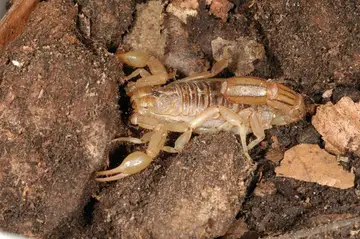
The less commonly found, but broadly present yellow ground scorpion is reported throughout much of Arizona, California, Idaho, Nevada, Utah and northern Mexico. University of Arizona Cooperative Extension
What the sources say
Venom: “The scorpions sting, but their venom is relatively mild, and does not usually require medical intervention.” (University of Arizona Cooperative Extension)
Habitat: Both scorpions are typically found on sandy soils in a variety of habitats, from desert floor to rocky hillsides (University of Arizona Cooperative Extension)
The bark scorpion is much smaller, about 1.5 to 3 inches, with slender pincers and a long, thin tail. The desert hairy scorpion is heavy-bodied, has strong pincers and is often more than 5 inches long. The bark scorpion climbs walls and is common around buildings; the hairy scorpion is a burrower, but UC IPM says it can also enter homes, so finding a scorpion indoors does not tell you which one it is. Utah State says the most venomous species have more delicate pincers. Size and build help, but no official source checked says they are proof, so treat any scorpion you cannot identify as possibly a bark scorpion. Arizona Poison and Drug Information Center
Desert hairy scorpion or Arizona stripe-tailed scorpion (stripedtail scorpion)?
Photos show typical adults; individuals vary. Never get close to compare.
When scorpions are active in Arizona
Records of scorpions in Arizona peak in April and July to September. They show when people record scorpions, not how many there are (about month bars).
JanFebMarAprMayJunJulAugSepOctNovDec
1,080 records of scorpions in Arizona by month (GBIF, CC0 and CC BY records).
Call 911 or Poison Help at 1-800-222-1222 right away. Poison Help connects you to your local poison center, any time of day.
Official advice from University of Arizona Cooperative Extension:
Scorpion sting: call Poison Help at 1-800-222-1222; for stung children 9 or under (or under 70 lb), call 911 or Poison Help immediately. University of Arizona Cooperative Extension
About this list
Venom labels come only from official sources and link to them; "Not stated" never means harmless. How labels work.
Scorpions. Arizona Poison and Drug Information Center (University of Arizona College of Pharmacy). 2026 (footer copyright; checked November 3, 2026.Quoted passages (3)
“Only one of the 30 species of scorpions found in Arizona is regarded as life-threatening: the bark scorpion (Centruroides sculpturatus).”
“The majority of stings reported to the poison center occur at night during the warm summer months.”
“The bark scorpion may be distinguished from other less toxic species by its more slender tail segments and pincers. Reaching only an inch and a half at maturity, it is a comparatively small scorpion.”
“The Arizona bark scorpion is the only scorpion of medical concern in the U.S. (Curry et al. 1983), and while all native scorpions can sting, only Arizona bark scorpion stings are hazardous to human health.”
“Scorpion stings are painful and can be deadly for small children in the absence of medical support. If children 9 years or under, or weighing less than 70lb (32 Kg) are stung, call 911 or the Poison Help Hotline 1 (800) 222-1222, or take them to the nearest hospital for treatment immediately.”
“They have a mild venom, but strong pedipalps that they use to grasp prey.”
“Arizona giant hairy scorpion Hadrurus arizonensis (Fig. 2) is the largest scorpion in the U.S.; they are heavy bodied scorpions”
“…they are heavy bodied scorpions, and adults often exceed 5 inches in length.”
“The scorpions sting, but their venom is relatively mild, and does not usually require medical intervention.”
“Most healthy adults can manage a sting without seeking the help of a doctor, but it is always advisable to call the Poison Help Hotline 1 (800) 222-1222 for advice, as each individual has a unique response. … If children 9 years or under, or weighing less than 70lb (32 Kg) are stung, call 911 or the Poison Help Hotline 1 (800) 222-1222, or take them to the nearest hospital for treatment immediately.”
“Arizona bark scorpions are active for most of the year in low-desert areas, and nighttime temperatures above 70° F are ideal. During the coolest months (November-March) they are less active”
“…are burrowing species, and full-grown at less than 3 inches in length.”