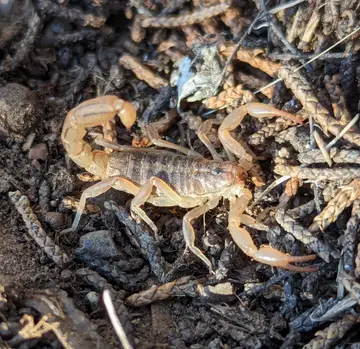
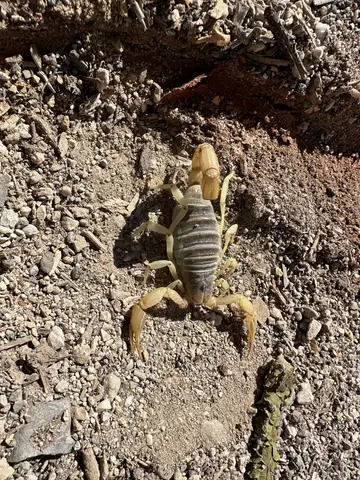
This page lists 3 scorpions.
1 is venomous by official accounts, and 1 mildly venomous.
Not every species: no complete official list of California scorpions exists, so this page covers the ones state and Extension sources name. How lists are built.
Which scorpions can hurt you
Official sources single out these scorpions in California, in their own words:
Bark Scorpion
Venomous. “Of the 70 or so species found in North America, only one, the bark scorpion, Centruroides exilicauda (formerly C. sculpturatus), is considered dangerous to people.” University of California Statewide IPM Program
All 3 scorpions
Venomous species first, then A to Z. Do not handle them.
“Of the 70 or so species found in North America, only one, the bark scorpion, Centruroides exilicauda (formerly C. sculpturatus), is considered dangerous to people.” University of California Statewide IPM Program
Venom: “Notable species of scorpions in the southwestern United States include the bark scorpion, which has venom that is dangerous to people; the Arizona hairy scorpion, the largest of the North American scorpions; and the stripedtail scorpion, one of the most common species.” (University of California Statewide IPM Program)
No official source we use states whether this animal is venomous. That does not mean it is harmless: do not handle it.
Size
Adults are often more than 5 inches long; UC IPM gives 5 to 7 inches at maturity. It is the largest scorpion in the US. (Northern desert hairy scorpion, H. spadix: up to about 5 inches.)
How to recognize it
Heavy-bodied and very large. It is the biggest scorpion in the US.
Strong, grasping pincers (pedipalps). It uses them to hold prey.
H. spadix (Capitol Reef): many sensory hairs and a black front body section (cephalothorax), which sets it apart from other local scorpions.
Records of scorpions in California peak in March to June, August and October. They show when people record scorpions, not how many there are (about month bars).
JanFebMarAprMayJunJulAugSepOctNovDec
1,977 records of scorpions in California by month (GBIF, CC0 and CC BY records).
If you are bitten or stung
Call 911 or Poison Help at 1-800-222-1222 right away. Poison Help connects you to your local poison center, any time of day.
Official advice from University of California Statewide IPM Program:
Wildlife conflicts: CDFW Wildlife Incident Reporting (WIR) system https://apps.wildlife.ca.gov/wir, emergencies 9-1-1. Invasive animal sightings: CDFW Invasive Species Program (866) 440-9530 or [email protected]; invasive insects/spiders/terrestrial invertebrates: California Department of Food and Agriculture 1-800-491-1899. California Department of Fish and Wildlife
Pest Notes: Scorpions. University of California Statewide IPM Program (UC ANR, Cooperative Extension). 2011-12; checked November 3, 2026.Quoted passages (5)
“Notable species of scorpions in the southwestern United States include the bark scorpion, which has venom that is dangerous to people; the Arizona hairy scorpion, the largest of the North American scorpions; and the stripedtail scorpion, one of the most common species.”
“Of the 70 or so species found in North America, only one, the bark scorpion, Centruroides exilicauda (formerly C. sculpturatus), is considered dangerous to people.”
“This scorpion is venomous but not considered dangerous.”
“These symptoms are signs for the need of immediate medical attention.”
“In California, the bark scorpion occurs only in the extreme southeastern part of the state, along the Arizona border.”
Report an Invasive Species Sighting. California Department of Fish and Wildlife (Invasive Species Program). undated page; checked November 3, 2026.Quoted passages (1)
“To report a sighting of a known, or suspected invasive species of an animal (mammal, bird, reptile, amphibian, fish, aquatic invertebrate) or marine plant, complete and submit the Suspect Invasive Species Sighting Report form below or contact us at (866) 440-9530. / For a known invasive plant, terrestrial invertebrate (worm, beetle, spider, bug, bee, fly, ant, snail, etc.) or plant/tree disease, or one that you suspect may be new to your area of California, contact the California Department of Food and Agriculture at 1-800-491-1899. / [ca-cdfw-hwc] Wildlife Incident Reporting (WIR) System For Emergencies, call 9-1-1”