Pickerel frog
Lithobates palustris (also written Rana palustris) · also called Rana palustris · Last checked November 3, 2026.
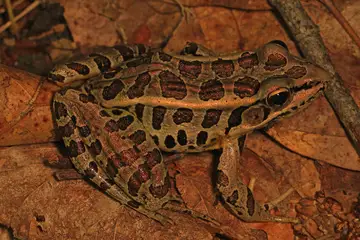

The pickerel frog is a medium-sized, tan or brown frog, about 1.75 to 3 inches long, with two rows of squarish dark spots down its back and bright yellow or orange on the inner hind legs. It lives near cool streams, springs, cave entrances, bogs and wet meadows across much of the eastern US. It is one of the few poisonous frogs in the US: its skin secretions can irritate people and can kill small animals, including other frogs kept in the same container. It is often mistaken for a leopard frog. Tennessee Wildlife Resources Agency
On this page
Is the pickerel frog dangerous?
Tennessee Wildlife Resources Agency: one of the few poisonous frogs in the US; its toxic skin secretions can irritate people and be deadly to small animals. Tennessee Wildlife Resources Agency
“One of the few poisonous frogs found in the U.S., Pickerel Frogs produce toxic skin secretions that can be irritating to humans and deadly to small animals”
No official source we use states whether this animal is venomous. That does not mean it is harmless: do not handle it.
If someone is bitten or stung, call 911 or Poison Help at 1-800-222-1222.
How to identify a pickerel frog
A photo or description can narrow it down, but cannot confirm what an animal is or that it is safe. Look from a distance and do not handle wild animals.
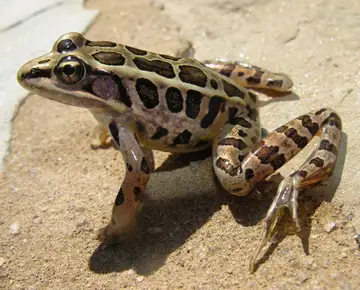
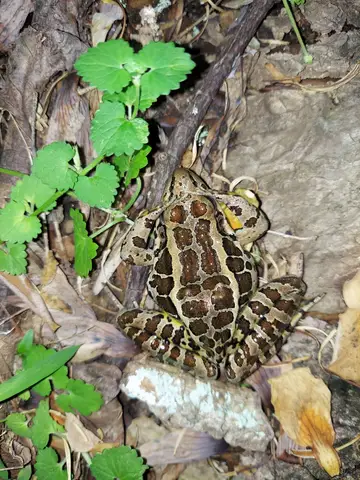
Size: About 1.75 to 3 inches long; large females reach about 3.5 inches. Males are smaller than females. Tennessee Wildlife Resources Agency
Colors: tan, brown, golden, gray, greenish-brown, copper and green. Pattern: two rows of square dark spots; light ridges along back.
Key features
- Two rows of square or rectangular dark spots down the back between two light ridges (dorsolateral folds); spots sometimes merge into bars Illinois Natural History Survey (INHS), Prairie Research Institute, University of Illinois Urbana-Champaign
- Bright yellow or orange on the hidden inner surfaces of the hind legs and groin DNR
- No white spot on the eardrum (tympanum), unlike the southern leopard frog Tennessee Wildlife Resources Agency
- Call: a low-pitched snore of 1 to 2 seconds, often given underwater N.C. Wildlife Resources Commission
Young
Tadpoles reach 2 to 2.5 inches, brown or greenish brown with fine darker mottling, and take about two to three months to become frogs.
Animals mistaken for the pickerel frog
Pickerel frog or Leopard frogs (southern and northern leopard frogs)?
Pickerel frog
Leopard frogs (southern and northern leopard frogs) Lithobates sphenocephalus / Lithobates pipiens
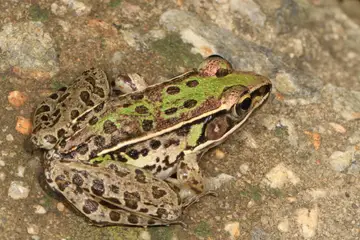
Leopard frogs have rounded spots that are not in two neat rows, and no bright yellow-orange on the hidden leg surfaces. The southern leopard frog has a white spot on the eardrum and can be bright green; NCWRC says the pickerel frog is virtually always brown, tan or golden, though TWRA and MSU also list green, so color alone does not settle it. N.C. Wildlife Resources Commission
Ohio DNR says the leopard frogs apparently do not share the pickerel frog's toxic skin secretions.
Where the pickerel frog lives
- Native or listed
- Nonnative or not established
- No official record in our data
- 1–9
- 10–99
- 100–999
- 1,000+
On our state guides
- Alabama frogs and toads
- Arkansas frogs and toads
- Connecticut frogs and toads
- Delaware frogs and toads
- Georgia frogs and toads
- Illinois frogs and toads
- Indiana frogs and toads
- Iowa frogs and toads
- Kansas frogs and toads
- Kentucky frogs and toads
- Louisiana frogs and toads
- Maine frogs and toads
- Maryland frogs and toads
- Massachusetts frogs and toads
- Michigan frogs and toads
- Minnesota frogs and toads
- Mississippi frogs and toads
- Missouri frogs and toads
- New Hampshire frogs and toads
- New Jersey frogs and toads
- New York frogs and toads
- North Carolina frogs and toads
- Ohio frogs and toads
- Oklahoma frogs and toads
- Pennsylvania frogs and toads
- Rhode Island frogs and toads
- South Carolina frogs and toads
- Tennessee frogs and toads
- Texas frogs and toads
- Vermont frogs and toads
- Virginia frogs and toads
- West Virginia frogs and toads
- Wisconsin frogs and toads
State boundaries: U.S. Census Bureau, cartographic boundary file cb_2024_us_state_20m.
When it is active
Breeds in late winter and early spring (North Carolina: February to early April; Oklahoma: February; Maryland calls heard in March and April). In the north it comes out of hibernation in late April or early May. It spends winter burrowed in mud under ponds or streams, and uses caves in hot or cold weather in Missouri. N.C. Wildlife Resources Commission
US open-licence records peak in June to September.
Habitat and habits
Habitat: Cool, clear water: shaded woodland streams, springs, seeps, cave entrances, fens and sphagnum bogs. In summer it wanders into grassy fields and weedy areas away from water. Farther south it also uses swamps and marshy pond edges. Tennessee Wildlife Resources Agency
Behavior: Secretive and wary; it hides most of the time and stops calling when approached. Alabama calls it nocturnal. Many frog-eating snakes avoid it.
Diet: Insects, spiders and other invertebrates such as beetles, caterpillars, ants, snails, crayfish and earthworms.
Young: Lays a globular egg mass of about 700 to 3,000 eggs attached to underwater plants or sticks. Eggs hatch in days to about two weeks, and tadpoles take about two to three months to become frogs. Frogs breed at about two years old.
Legal status and reporting
Federal: Not Listed in ECOS (Lithobates palustris) as of 2026-11-03. US Fish and Wildlife Service, ECOS
Protection: Some states list it as a concern: Wisconsin lists it as Special Concern, Michigan DNR lists it as special concern, and Illinois lists it as a Species in Greatest Need of Conservation. North Carolina classifies it as a nongame species with no open season. Minnesota DNR says it has no special status there, and SREL/UGA says it is not protected at the state or federal levels in Georgia. Illinois Natural History Survey (INHS), Prairie Research Institute, University of Illinois Urbana-Champaign
Report: Maine IFW asks the public to share photo-documented observations with the Maine Amphibian & Reptile Atlas Project (MARAP). Maine Department of Inland Fisheries and Wildlife
Sources
- Amphibians » Frogs and Toads (Tennessee Watchable Wildlife species accounts). Tennessee Wildlife Resources Agency (Tennessee Watchable Wildlife website). undated page; checked November 3, 2026.
Quoted passages (4)
“One of the few poisonous frogs found in the U.S., Pickerel Frogs produce toxic skin secretions that can be irritating to humans and deadly to small animals”
“Among the most attractive of Tennessee's frogs, Pickerel Frogs are typically 1.75 to 3 inches long.”
“Similar Species: Southern Leopard Frogs have a white spot in the tympanum (eardrum) that Pickerel Frogs lack.”
“Habitat: Pickerel Frogs typically inhabit cool wooded streams and can be found in creeks, springs, ponds and reservoirs. However, they often wander into grassy fields and weedy areas during the summer.”
- Pickerel Frog. Alabama Department of Conservation and Natural Resources (Outdoor Alabama). undated page; checked November 3, 2026.
- Pickerel frog. Minnesota Department of Natural Resources. archived copy, captured May 19, 2026; checked November 3, 2026.
Quoted passages (1)
“The female lays a blob of 700 to 3,000 eggs in the water. It takes about two weeks for the eggs to hatch and 8 to 11 weeks for tadpoles to develop into frogs.”
- Pickerel Frog (NCWRC species page). N.C. Wildlife Resources Commission. undated page; checked November 3, 2026.
Quoted passages (3)
“The call of the pickerel frog is a low snore often given underwater.”
“Pickerel frogs breed from Febuary to early April.”
“The pickerel frog is often mistaken for the closely related southern leopard frog but may be distinguished by more squarish spots that are roughly arranged in two parallel rows (and sometimes merging to form bars or stripes); orange or yellow pigment on the concealed surfaces of the legs; and the absence of a white spot on the tympanum (external eardrum).”
- Pickerel Frog (Field Guide to Amphibians and Reptiles of Illinois). Illinois Natural History Survey (INHS), Prairie Research Institute, University of Illinois Urbana-Champaign. undated page; checked November 3, 2026.
Quoted passages (2)
“Key Characters: Two rows of square to rectangular black spots on back between wide dorsolateral folds that extend from eyes to hips; undersides of thighs bright yellow in life.”
“Status: Listed as a Species in Greatest Need of Conservation in the Illinois Wildlife Action Plan.”
- Pickerel Frog (species page). Maine Department of Inland Fisheries and Wildlife. undated page; checked November 3, 2026.
Quoted passages (2)
“Eats a wide variety of terrestrial and aquatic invertebrates including beetles, caterpillars, spiders, pillbugs, snails, crayfish, and isopods”
“…we encourage members of the public to share their photo-documented observations as part of the Maine Amphibian & Reptile Atlas Project (MARAP).”
- Pickerel Frog (DNR field guide species page). Maryland Department of Natural Resources (DNR). archived copy, captured June 12, 2026; checked November 3, 2026. Archived copy.
Quoted passages (1)
“Diagnostic feature is the bright yellow or orange inner thigh.”
- Pickerel Frog (ODWC Field Guide). Oklahoma Department of Wildlife Conservation. undated page; checked November 3, 2026.
Quoted passages (2)
“Tadpoles of the pickerel frog can reach 2 to 2.5 inches in length before transforming into froglets.”
“Although they may be common in a swampy or marshy wetland, they are secretive and remain hidden most of the time.”
- ECOS species report queries: Lithobates palustris, Rana palustris. U.S. Fish and Wildlife Service, ECOS. live query 2026-11-03; checked November 3, 2026.
- GBIF.org occurrence records, human observations licensed CC0 1.0 or CC BY 4.0 only, accessed November 3, 2026. The datasets behind these counts are listed on our Sources page.
- State boundaries: U.S. Census Bureau, cartographic boundary file cb_2024_us_state_20m.