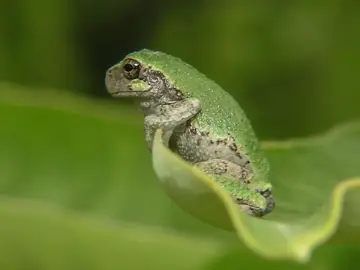
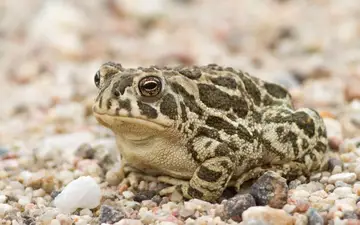
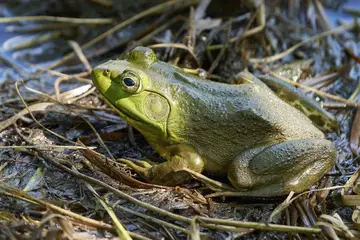
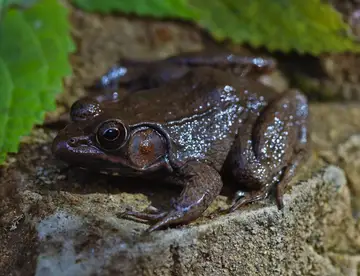
Kansas Herpetofaunal Atlas (Travis W. Taggart), Sternberg Museum of Natural History, Fort Hays State University: 22 frogs,
This page lists 22 species: all from Kansas Herpetofaunal Atlas (Travis W. Taggart), Sternberg Museum of Natural History, Fort Hays State University's Kansas Herpetofaunal Atlas species accounts: ANURA - Frogs, "ESTABLISHED TAXA"; cross-checked with GPNC 2017 amphibian/turtle/lizard pocket guide.
Which frogs and toads can hurt you
Official sources single out these frogs and toads in Kansas, in their own words:
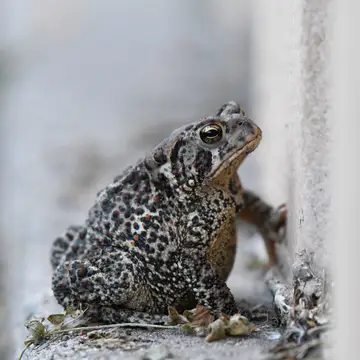
2 to 3.5 inches long (NCWRC: up to 4 inches); females are larger than males.
How to recognize it
Dark spots on the back hold only a few large warts; the similar Fowler's toad has three or more. Agencies give different counts for the American toad (TWRA: one or two; Ohio DNR: one, two or three; Georgia DNR: usually no more than one), so wart count alone does not settle it; check the head crests too (see lookalikes).
A large, kidney- or bean-shaped parotoid gland behind each eye that usually does not touch the bony ridge (cranial crest) above the eye, or touches it only by a short spur.
Venom: “No species are venomous.” (Great Plains Nature Center (cooperative project of the U.S. Fish and Wildlife Service, Kansas Department of Wildlife and Parks and City of Wichita); published by the Friends of the Great Plains Nature Center)
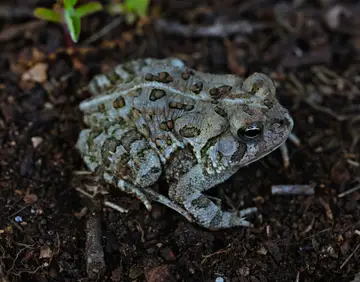
Range: Occurs throughout much of the eastern third of Kansas, primarily east of the Flint Hills. A specimen from Trego County (FHSM 5857) has been examined and exhibits diagnostic features of this species; however, it is not mapped due to its presumed introduction—likely associated with hatchery operations at Cedar Bluff Reservoir.
Venom: “No species are venomous.” (Great Plains Nature Center (cooperative project of the U.S. Fish and Wildlife Service, Kansas Department of Wildlife and Parks and City of Wichita); published by the Friends of the Great Plains Nature Center)
Range: Abundant throughout the eastern two-thirds of Kansas along the level muddy or gravel, sparsely vegetated, banks of streams, rivers, and impoundments. Historically, it was more widespread in the western two-thirds of Kansas, though largely confined to stream corridors.
Venom: “No species are venomous.” (Great Plains Nature Center (cooperative project of the U.S. Fish and Wildlife Service, Kansas Department of Wildlife and Parks and City of Wichita); published by the Friends of the Great Plains Nature Center)
Venom: “No species are venomous.” (Great Plains Nature Center (cooperative project of the U.S. Fish and Wildlife Service, Kansas Department of Wildlife and Parks and City of Wichita); published by the Friends of the Great Plains Nature Center)
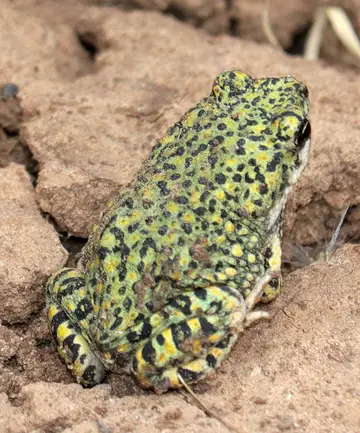
Range: The Chihuahuan Green Toad (Anaxyrus debilis) is currently restricted to rangeland and canyon systems above the Smoky Hill River and Ladder Creek drainages in Greeley, Logan, Wallace, and Wichita counties, Kansas.
Venom: “No species are venomous.” (Great Plains Nature Center (cooperative project of the U.S. Fish and Wildlife Service, Kansas Department of Wildlife and Parks and City of Wichita); published by the Friends of the Great Plains Nature Center)
Range: Found throughout the forested regions of the eastern third of Kansas. An isolated record exists at in Pratt County and may represent an accidental introduction at the state fish hatchery.
Kansas Species in Need of Conservation (SINC) (as labelled by KHA)
What the sources say
Venom: “No species are venomous.” (Great Plains Nature Center (cooperative project of the U.S. Fish and Wildlife Service, Kansas Department of Wildlife and Parks and City of Wichita); published by the Friends of the Great Plains Nature Center)
Range: This taxon is known from the Neosho, Marais des Cygnes, and northern Verdigris drainages, where they inhabit areas of perched water tables in upland grasslands with an abundance of crayfish. The northernmost records from Baker Wetlands/Wakarusa Bottoms (floodplain of the Wakarusa River: Kansas River drainage) in Douglas County may be extirpated (last observed in 1978).
Venom: “No species are venomous.” (Great Plains Nature Center (cooperative project of the U.S. Fish and Wildlife Service, Kansas Department of Wildlife and Parks and City of Wichita); published by the Friends of the Great Plains Nature Center)
Range: This small frog is known only from the extreme southeastern Cherokee County within the Spring River drainage basin. It's primary population is on the Ozark Plateau, however, it follows riparian corridors along Brush, Shawnee, and Cow creeks to the north and west into the Cherokee Plain.
Venom: “No species are venomous.” (Great Plains Nature Center (cooperative project of the U.S. Fish and Wildlife Service, Kansas Department of Wildlife and Parks and City of Wichita); published by the Friends of the Great Plains Nature Center)
Range: Specimens are known from Bourbon, Chautauqua, Cherokee, and Crawford counties in southeast Kansas. Potential specimens have been anecdotally reported south and east of Douglas County.
Venom: “No species are venomous.” (Great Plains Nature Center (cooperative project of the U.S. Fish and Wildlife Service, Kansas Department of Wildlife and Parks and City of Wichita); published by the Friends of the Great Plains Nature Center)
Range: Found throughout the forested regions of the eastern third of Kansas. An isolated record exists at in Pratt County and may represent an accidental introduction at the state fish hatchery.
Venom: “No species are venomous.” (Great Plains Nature Center (cooperative project of the U.S. Fish and Wildlife Service, Kansas Department of Wildlife and Parks and City of Wichita); published by the Friends of the Great Plains Nature Center)
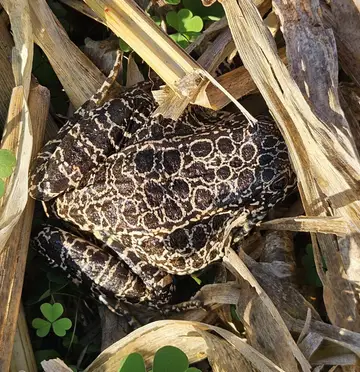
Range: Occurs throughout western Kansas, extending eastward to the edge of the Flint Hills. Additionally, it follows riparian corridors along the Kansas River and northward along the Missouri River.
Usually 6 to 8 inches long (NCWRC); can reach 8 inches or more and weigh over 2 pounds (CDFW). Missouri gives 3.5 to 6 inches snout to vent, occasionally to 8.75.
How to recognize it
No ridge (dorsolateral fold) down each side of the back
Large round eardrum: about twice the eye in males, about eye-sized in females
Fully webbed hind feet, longest toe extends past the webbing
Venom: “No species are venomous.” (Great Plains Nature Center (cooperative project of the U.S. Fish and Wildlife Service, Kansas Department of Wildlife and Parks and City of Wichita); published by the Friends of the Great Plains Nature Center)
Venom: “No species are venomous.” (Great Plains Nature Center (cooperative project of the U.S. Fish and Wildlife Service, Kansas Department of Wildlife and Parks and City of Wichita); published by the Friends of the Great Plains Nature Center)
Range: This frog is known from the Spring River and its tributaries in Cherokee County. An old record from Miami County (KU 9281, which is now lost) was taken near the Marais des Cygnes River at Osawatomie on 11 July 1911.
Venom: “No species are venomous.” (Great Plains Nature Center (cooperative project of the U.S. Fish and Wildlife Service, Kansas Department of Wildlife and Parks and City of Wichita); published by the Friends of the Great Plains Nature Center)
Range: Known from the Spring River drainage in Crawford and Cherokee counties. It has been collected 24.5 miles (39.5 km) west of the Kansas state line along the Spring River in adjacent Jasper County, Missouri (KU 18540, UIMNH 32888; both from 1934) approximately 8 miles east of Carthage.
Venom: “No species are venomous.” (Great Plains Nature Center (cooperative project of the U.S. Fish and Wildlife Service, Kansas Department of Wildlife and Parks and City of Wichita); published by the Friends of the Great Plains Nature Center)
Venom: “No species are venomous.” (Great Plains Nature Center (cooperative project of the U.S. Fish and Wildlife Service, Kansas Department of Wildlife and Parks and City of Wichita); published by the Friends of the Great Plains Nature Center)
Range: The Plains Spadefoot is found in western Kansas to the edge of the Flint Hills, and east along the floodplain of the Kansas and Missouri rivers. It is seldom encountered except when chorusing or moving (often across roads) The Plains Spadefoot inhabits prairies and open floodplains.
Kansas Species in Need of Conservation (SINC) (as labelled by KHA)
What the sources say
Venom: “No species are venomous.” (Great Plains Nature Center (cooperative project of the U.S. Fish and Wildlife Service, Kansas Department of Wildlife and Parks and City of Wichita); published by the Friends of the Great Plains Nature Center)
Range: The occurrence of this species has been documented in western Barber County and extreme southeastern Comanche County, with an isolated population in northern Clark County. An adult (51mm snout-vent length) specimen from Morton County (KU 9100, 12 mi N Elkhart, ca Walsh's Ranch [= Wood Walsh Ranch]: 25 June 1927: Burt and Parker) was reported by Hill (1931) from the material also reported on by Taylor (1929).
Venom: “No species are venomous.” (Great Plains Nature Center (cooperative project of the U.S. Fish and Wildlife Service, Kansas Department of Wildlife and Parks and City of Wichita); published by the Friends of the Great Plains Nature Center)
Venom: “No species are venomous.” (Great Plains Nature Center (cooperative project of the U.S. Fish and Wildlife Service, Kansas Department of Wildlife and Parks and City of Wichita); published by the Friends of the Great Plains Nature Center)
Kansas Species in Need of Conservation (SINC) (as labelled by KHA)
What the sources say
Venom: “No species are venomous.” (Great Plains Nature Center (cooperative project of the U.S. Fish and Wildlife Service, Kansas Department of Wildlife and Parks and City of Wichita); published by the Friends of the Great Plains Nature Center)
Range: In Kansas, this species is confined to the eastern border south of Johnson County. During spring chorusing it can be found calling from ditches, ponds, and vernal pools associated with riparian corridors.
Venom: “No species are venomous.” (Great Plains Nature Center (cooperative project of the U.S. Fish and Wildlife Service, Kansas Department of Wildlife and Parks and City of Wichita); published by the Friends of the Great Plains Nature Center)
Range: They can be found in south-central Kansas through Oklahoma and into eastern Texas, east into western Louisiana, and west-central Arkansas along the Arkansas River. Other disjunct populations occur in west-central and southwest Illinois, southeastern Missouri, and northeastern Arkansas.
Venom: “No species are venomous.” (Great Plains Nature Center (cooperative project of the U.S. Fish and Wildlife Service, Kansas Department of Wildlife and Parks and City of Wichita); published by the Friends of the Great Plains Nature Center)
Range: Known from the eastern three-fourths of the state, apparently avoiding much of the Western Plains. The record for Hamilton County (UIMNH 62332, from 1955) is in need of corroboration, although it is somewhat supported by specimens just to the west into Colorado.
Venom: “No species are venomous.” (Great Plains Nature Center (cooperative project of the U.S. Fish and Wildlife Service, Kansas Department of Wildlife and Parks and City of Wichita); published by the Friends of the Great Plains Nature Center)
Range: Common throughout all but extreme southeast Kansas where they are gradually replaced by Fowler's Toads (Bufo fowleri). Juveniles may be largely restricted to relatively mesic environments associated with breeding habitats of adults.
Frogs and Toads people confuse
American toad or Fowler's toad?
Photo: U.S. Fish and Wildlife Service - Midwest Region · Public domain · Wikimedia Commons
The difference official sources agree on is at the head: in the American toad the ridge (cranial crest) behind each eye is separate from the parotoid gland or joined to it only by a short spur; in Fowler's toad the two touch. Fowler's toad also has three or more warts in each of the larger dark spots, while the American toad has fewer (TWRA: one or two; Ohio DNR: one, two or three; Georgia DNR: usually no more than one). Fowler's toad has a whitish belly, often with a single dark spot on the chest; the American toad's belly is peppered with dark spots. The two can hybridize, so some toads cannot be told apart.
The difference official sources agree on is at the head: in the American toad the ridge (cranial crest) behind each eye is separate from the parotoid gland or joined to it only by a short spur; in Fowler's toad the two touch. Fowler's toad also has three or more warts in each of the larger dark spots, while the American toad has fewer (TWRA: one or two; Ohio DNR: one, two or three; Georgia DNR: usually no more than one). Fowler's toad has a whitish belly, often with a single dark spot on the chest; the American toad's belly is peppered with dark spots. The two can hybridize, and hybrids have intermediate features.
Cannot be told apart by sight. In the field they are told apart by the breeding call (Cope's trill is faster and harsher); in the lab by chromosomes. Location also helps: SREL says only Cope's occurs in Georgia and South Carolina.
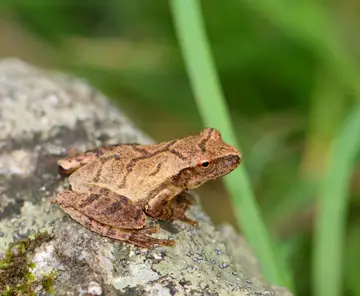
Maine IF&W lists the spring peeper's distinguishing characteristics: Maine's smallest frog (about 0.8 to 1.5 inches), grayish- or orangish-brown above with a distinct dark X on the back, and smooth skin; it notes it is commonly confused with the gray treefrog.
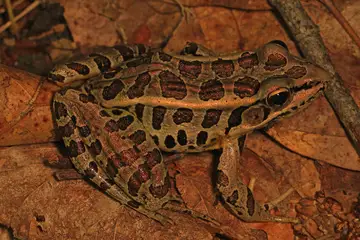
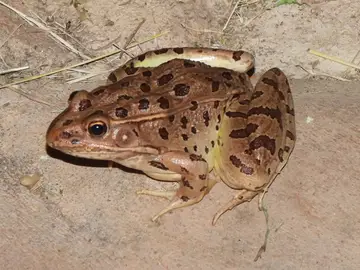
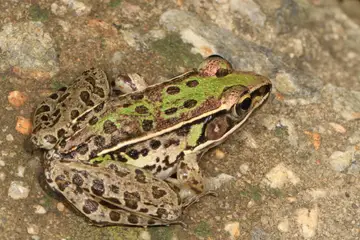
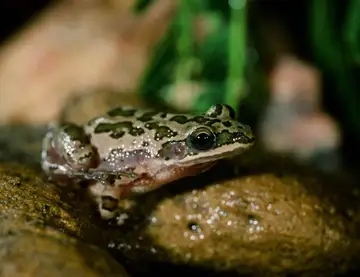
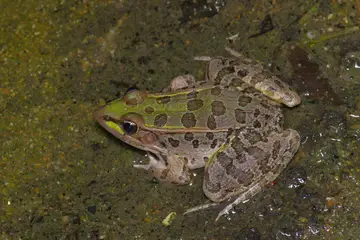
Leopard frogs have rounded spots that are not in two neat rows, and no bright yellow-orange on the hidden leg surfaces. The southern leopard frog has a white spot on the eardrum and can be bright green; NCWRC says the pickerel frog is virtually always brown, tan or golden, though TWRA and MSU also list green, so color alone does not settle it.
Photos show typical adults; individuals vary. Never get close to compare.
When frogs and toads are active in Kansas
Records of frogs and toads in Kansas peak in May to July and September. They show when people record frogs and toads, not how many there are (about month bars).
JanFebMarAprMayJunJulAugSepOctNovDec
751 records of frogs and toads in Kansas by month (GBIF, CC0 and CC BY records).
If you are bitten or stung
Call 911 or Poison Help at 1-800-222-1222 right away. Poison Help connects you to your local poison center, any time of day.
How to report
Report mountain lion, bear or wolf sightings and threatened, endangered, SINC or rare species to KDWP (Wildlife Sightings page; Pratt Operations Office, 512 SE 25th Avenue, Pratt, KS 67124, 620-672-5911). Nuisance wildlife: KDWP lists Nuisance Wildlife Damage Control permit holders. Kansas Department of Wildlife and Parks
ANURA - Frogs (KHA species accounts list). Kansas Herpetofaunal Atlas (Travis W. Taggart), Sternberg Museum of Natural History, Fort Hays State University. page footer 2026; checked November 3, 2026.
Kansas Herpetofaunal Atlas: home page. Kansas Herpetofaunal Atlas (Travis W. Taggart), Sternberg Museum of Natural History, Fort Hays State University. page footer 1999-2026; checked November 3, 2026.Quoted passages (1)
“22 frogs,”
A Pocket Guide to Kansas Amphibians, Turtles and Lizards (Taggart & Riedle). Great Plains Nature Center (cooperative project of the U.S. Fish and Wildlife Service, Kansas Department of Wildlife and Parks and City of Wichita); published by the Friends of the Great Plains Nature Center. First Edition; checked November 3, 2026.Quoted passages (1)
“No species are venomous.”
KHA species account: American Toad. Kansas Herpetofaunal Atlas (Travis W. Taggart), Sternberg Museum of Natural History, Fort Hays State University. updated July 13, 2025; checked November 3, 2026.
KHA species account: Great Plains Toad. Kansas Herpetofaunal Atlas (Travis W. Taggart), Sternberg Museum of Natural History, Fort Hays State University. updated January 10, 2026; checked November 3, 2026.
KHA species account: Chihuahuan Green Toad. Kansas Herpetofaunal Atlas (Travis W. Taggart), Sternberg Museum of Natural History, Fort Hays State University. updated July 13, 2025; checked November 3, 2026.
KHA species account: Fowler's Toad. Kansas Herpetofaunal Atlas (Travis W. Taggart), Sternberg Museum of Natural History, Fort Hays State University. updated August 14, 2026; checked November 3, 2026.
KHA species account: Red-spotted Toad. Kansas Herpetofaunal Atlas (Travis W. Taggart), Sternberg Museum of Natural History, Fort Hays State University. updated August 14, 2024; checked November 3, 2026.
KHA species account: Woodhouse's Toad. Kansas Herpetofaunal Atlas (Travis W. Taggart), Sternberg Museum of Natural History, Fort Hays State University. updated September 4, 2023; checked November 3, 2026.
KHA species account: Blanchard's Cricket Frog. Kansas Herpetofaunal Atlas (Travis W. Taggart), Sternberg Museum of Natural History, Fort Hays State University. updated January 28, 2025; checked November 3, 2026.
KHA species account: Cope's Gray Treefrog/Gray. Kansas Herpetofaunal Atlas (Travis W. Taggart), Sternberg Museum of Natural History, Fort Hays State University. updated June 26, 2025; checked November 3, 2026.
KHA species account: Spotted Chorus Frog. Kansas Herpetofaunal Atlas (Travis W. Taggart), Sternberg Museum of Natural History, Fort Hays State University. updated June 26, 2025; checked November 3, 2026.
KHA species account: Spring Peeper. Kansas Herpetofaunal Atlas (Travis W. Taggart), Sternberg Museum of Natural History, Fort Hays State University. updated April 5, 2024; checked November 3, 2026.
KHA species account: Boreal Chorus Frog. Kansas Herpetofaunal Atlas (Travis W. Taggart), Sternberg Museum of Natural History, Fort Hays State University. updated March 18, 2025; checked November 3, 2026.
KHA species account: Strecker's Chorus Frog. Kansas Herpetofaunal Atlas (Travis W. Taggart), Sternberg Museum of Natural History, Fort Hays State University. updated September 8, 2026; checked November 3, 2026.
KHA species account: Eastern Narrow-mouthed Toad. Kansas Herpetofaunal Atlas (Travis W. Taggart), Sternberg Museum of Natural History, Fort Hays State University. updated February 26, 2024; checked November 3, 2026.
KHA species account: Western Narrow-mouthed Toad. Kansas Herpetofaunal Atlas (Travis W. Taggart), Sternberg Museum of Natural History, Fort Hays State University. updated March 12, 2025; checked November 3, 2026.
KHA species account: Crawfish Frog. Kansas Herpetofaunal Atlas (Travis W. Taggart), Sternberg Museum of Natural History, Fort Hays State University. updated February 26, 2024; checked November 3, 2026.
KHA species account: Plains Leopard Frog. Kansas Herpetofaunal Atlas (Travis W. Taggart), Sternberg Museum of Natural History, Fort Hays State University. updated August 9, 2024; checked November 3, 2026.
KHA species account: North American Bullfrog. Kansas Herpetofaunal Atlas (Travis W. Taggart), Sternberg Museum of Natural History, Fort Hays State University. updated April 8, 2025; checked November 3, 2026.
KHA species account: North American Green Frog. Kansas Herpetofaunal Atlas (Travis W. Taggart), Sternberg Museum of Natural History, Fort Hays State University. updated April 8, 2025; checked November 3, 2026.
KHA species account: Pickerel Frog. Kansas Herpetofaunal Atlas (Travis W. Taggart), Sternberg Museum of Natural History, Fort Hays State University. updated February 26, 2024; checked November 3, 2026.
KHA species account: Southern Leopard Frog. Kansas Herpetofaunal Atlas (Travis W. Taggart), Sternberg Museum of Natural History, Fort Hays State University. updated February 26, 2024; checked November 3, 2026.
KHA species account: Plains Spadefoot. Kansas Herpetofaunal Atlas (Travis W. Taggart), Sternberg Museum of Natural History, Fort Hays State University. updated February 25, 2024; checked November 3, 2026.
“Examples of poisonous herps in Kansas include True Toads (Anaxyrus spp.), Cope's/Gray Treefrog (Hyla chrysoscelis/versicolor), and Pickerel Frog (Lithobates palustris).”
Wildlife Sightings (KDWP). Kansas Department of Wildlife and Parks. undated page; checked November 3, 2026.Quoted passages (1)
“If you observe a threatened or endangered species, a species in need of conservation, or a rare species in a new location, please report it to KDWP.”