Birds of Kansas: The Official State Checklist
Last checked November 3, 2026 against official sources.
Great Plains Nature Center (cooperative project of the U.S. Fish and Wildlife Service, Kansas Department of Wildlife and Parks and City of Wichita); published by the Friends of the Great Plains Nature Center: As of the publication of this guide, 475 species have been documented in Kansas.
This page lists 89 birds. Great Plains Nature Center (cooperative project of the U.S. Fish and Wildlife Service, Kansas Department of Wildlife and Parks and City of Wichita); published by the Friends of the Great Plains Nature Center gives a total of 475; the 89 here are the birds official sources name one by one.
Not every species: this page shows the birds named in the official sources below. How lists are built.
All 89 birds on the list
- American Crow Corvus brachyrhyncos
- American Goldfinch Spinus tristis
- American Kestrel Falco sparverius
- American Robin Turdus migratorius
- American Tree Sparrow Spizella arborea
- Bald Eagle Haliaeetus leucocephalus
- Baltimore Oriole Icterus galbula
- Barn Owl Tyto alba
- Barn Swallow Hirundo rustica
- Barred Owl Strix varia
- Black Vulture Coragyps atratus
- Black-capped Chickadee Poecile atricapilla
- Blue Jay Cyanocitta cristata
- Broad-winged Hawk Buteo platypterus
- Brown Thrasher Toxostoma rufum
- Brown-headed Cowbird Molothrus ater
- Burrowing Owl Athene cunicularia
- Carolina Chickadee Poecile carolinensis
- Carolina Wren Thryothorus ludovicianus
- Cedar Waxwing Bombycilla cedrorum
- Chimney Swift Chaetura pelagica
- Chipping Sparrow Spizella passerina
- Common Grackle Quiscalus quiscula
- Common Nighthawk Chordeiles minor
- Cooper’s Hawk Accipiter cooperii
- Dark-eyed Junco Junco hyemalis
- Downy Woodpecker Picoides pubescens
- Eastern Bluebird Sialia sialis
- Eastern Kingbird Tyrannus tyrannus
- Eastern Meadowlark Sturnella magna
- Eastern Phoebe Sayornis phoebe
- Eastern Screech-Owl Megascops asio
- Eastern Towhee Pipilo erythrophthalmus
- Eurasian Collared-Dove Streptopelia decaocto
- European Starling Sturnus vulgaris
- Ferruginous Hawk Buteo regalis
- Golden Eagle Aquila chrysaetos
- Gray Catbird Dumetella carolinensis
- Great Horned Owl Bubo virginianus
- Great-tailed Grackle Quiscalus mexicanus
- Gyrfalcon Falco rusticolus
- Hairy Woodpecker Picoides villosus
- Harris’s Sparrow Zonotrichia querula
- House Finch Haemorhous mexicanus
- House Sparrow Passer domesticus
- House Wren Troglodytes aedon
- Indigo Bunting Passerina cyanea
- Killdeer Charadrius vociferus
- Long-eared Owl Asio otus
- Merlin Falco columbarius
- Mississippi Kite Ictinia mississippiensis
- Mourning Dove Zenaida macroura
- Northern Cardinal Cardinalis cardinalis
- Northern Flicker Colaptes auratus
- Northern Goshawk Accipiter gentilis
- Northern Harrier Circus cyaneus
- Northern Mockingbird Mimus polyglottos
- Northern Saw-whet Owl Aegolius acadicus
- Orchard Oriole Icterus spurius
- Osprey Pandion haliaetus
- Peregrine Falcon Falco peregrinus
- Pine Siskin Spinus pinus
- Prairie Falcon Falco mexicanus
- Purple Martin Progne subis
- Red-bellied Woodpecker Melanerpes carolinus
- Red-eyed Vireo Vireo olivaceus
- Red-headed Woodpecker Melanerpes erythrocephalus
- Red-shouldered Hawk Buteo lineatus
- Red-tailed Hawk Buteo jamaicensis
- Red-winged Blackbird Agelaius phoeniceus
- Rock Pigeon Columba livia
- Rose-breasted Grosbeak Pheucticus ludovicianus
- Rough-legged Hawk Buteo lagopus
- Ruby-throated Hummingbird Archilochus colubris
- Sharp-shinned Hawk Accipiter striatus
- Short-eared Owl Asio flammeus
- Snowy Owl Bubo scandiacus
- Spotted Towhee Pipilo maculatus
- Swainson’s Hawk Buteo swainsoni
- Tufted Titmouse Baeolophus bicolor
- Turkey Vulture Cathartes aura
- Warbling Vireo Vireo gilvus
- Western Kingbird Tyrannus verticalis
- Western Meadowlark Sturnella neglecta
- White-breasted Nuthatch Sitta carolinensis
- White-crowned Sparrow Zonotrichia leucophrys
- Yellow Warbler Setophaga petechia
- Yellow-billed Cuckoo Coccyzus americanus
- Yellow-rumped Warbler Setophaga coronata
Birds people confuse
Turkey vulture or Black vulture?
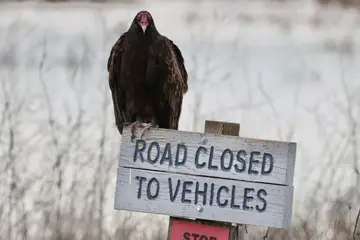
Turkey vulture Not stated
Black vulture Not stated
Black vulture: grayish-black head, shorter tail, a white patch near the wing tips (seen from below), and wings held nearly horizontal when soaring, with frequent flapping (Missouri). Tennessee and NPS Everglades say the same: black head, white patch at the wing tips, wings held flat. Turkey vulture: red head (adults), two-toned wings held in a V, rarely flaps. Note: juvenile turkey vultures also have dark heads.
Turkey vulture or Eagle?
Turkey vulture Not stated
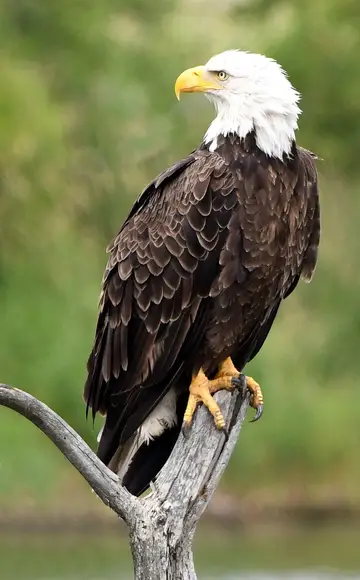

Eagle Not stated
An eagle holds its wings flat and they are uniformly black; a turkey vulture's are held in a slight V and are two-toned.
Red-tailed hawk or Red-shouldered hawk?
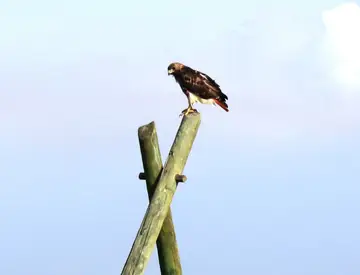

Red-tailed hawk Not stated
Red-shouldered hawk Not stated
A red-tail's rust-colored, broad, short tail distinguishes it from the smaller red-shouldered hawk (North Carolina). Tennessee: the red-shouldered hawk has a black and white banded tail and appears more uniformly colored.
Bald eagle or Golden eagle?
Bald eagle Not stated
Golden eagle Not stated
Young bald eagles lack the white head and tail and are often mistaken for golden eagles. Bald eagles have unfeathered lower legs and hold their wings flat when soaring; TWRA says golden eagles have feathered legs, limited white under the wing, and lift the outer wing in a slight V.
Photos show typical adults; individuals vary. Never get close to compare.
When birds are active in Kansas
Records of birds in Kansas peak in March to June and September to October. They show when people record birds, not how many there are (about month bars).
About this list
The species list comes from No complete official Kansas bird checklist found from a state agency, federal agency, extension or state survey. Entries: GPNC "A Pocket Guide to Common Kansas Backyard Birds" (2012) and "A Pocket Guide to Kansas Raptors" (3rd ed., 2013). Partial. (Great Plains Nature Center (cooperative project of the U.S. Fish and Wildlife Service, Kansas Department of Wildlife and Parks and City of Wichita); published by the Friends of the Great Plains Nature Center, 2012 (backyard birds); 2013 (raptors)). 23 more entries come from other official sources named on each card.
Venom does not apply to birds.
Sources
- Threatened, Endangered & Species in Need of Conservation (KDWP). Kansas Department of Wildlife and Parks. undated page; checked November 3, 2026.
- A Pocket Guide to Common Kansas Backyard Birds (Otte & Gress). Great Plains Nature Center (cooperative project of the U.S. Fish and Wildlife Service, Kansas Department of Wildlife and Parks and City of Wichita); published by the Friends of the Great Plains Nature Center. print file dated 8/27/12; checked November 3, 2026.
Quoted passages (1)
“As of the publication of this guide, 475 species have been documented in Kansas.”
- A Pocket Guide to Kansas Raptors, Third Edition (Gress). Great Plains Nature Center (cooperative project of the U.S. Fish and Wildlife Service, Kansas Department of Wildlife and Parks and City of Wichita); published by the Friends of the Great Plains Nature Center. Third Edition; checked November 3, 2026.
- GBIF.org occurrence records, human observations licensed CC0 1.0 or CC BY 4.0 only, accessed November 3, 2026. The datasets behind these counts are listed on our Sources page.