Red-tailed hawk
Buteo jamaicensis · also called red-tail and highway hawk · Last checked November 3, 2026.
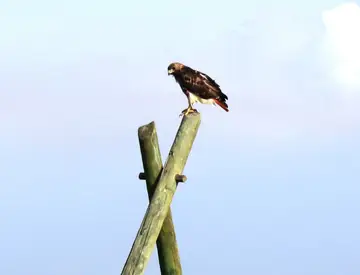

The red-tailed hawk is a large hawk with broad wings and a rust-red tail, and probably the most common hawk in North America, with permanent populations across the continental United States. It mainly eats rodents and other small mammals. Hawks are unlikely to carry off a pet, though on very rare occasions they may dive after small dogs or cats, and they are protected by federal and state law. Missouri Department of Conservation
On this page
Is the red-tailed hawk dangerous?
Hawks are unlikely to fly away with a pet but may very rarely dive after small dogs or cats. On rare occasions individuals swoop at people too close to a nest or young learning to fly. North Carolina Wildlife Resources Commission
“While a hawk is unlikely to fly away with a pet, on very rare occasion they may dive after small dogs or cats. … On rare occasion, individual hawks have been known to swoop at people passing too close to the nest or young that are still learning to fly.”
How to identify a red-tailed hawk
A photo or description can narrow it down, but cannot confirm what an animal is or that it is safe. Look from a distance and do not handle wild animals.
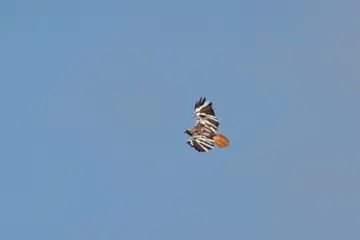

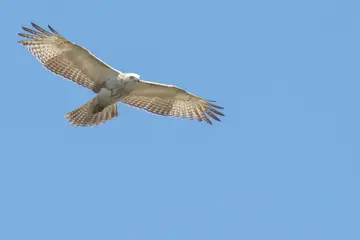
Size: About 18 to 25 inches long with a 48-inch wingspan; females about 3 inches larger (North Carolina). NCWRC adds that even the largest hawks in North Carolina weigh only about 3 pounds. North Carolina Wildlife Resources Commission
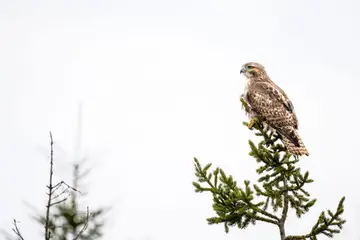
Colors: Brown above, white below; adults have a rust-red tail with a narrow black band near the end; other color morphs, almost entirely dark brown to very pale. Pattern: White breast with a brown belly band.
Key features
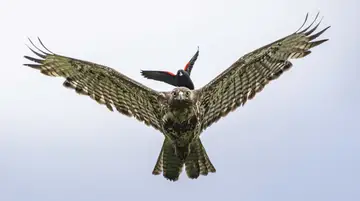
- Broad, rounded wings and short, wide tail in silhouette National Park Service
- Dark oblong patch on the front edge of the underwing in flight Missouri Department of Conservation
- Often perched on poles and fence posts along highways Missouri Department of Conservation
- Shrill, raspy scream Missouri Department of Conservation
Young
Immature birds resemble adults, but the tail is brown with narrow dark bars.
Animals mistaken for the red-tailed hawk
Red-tailed hawk or Red-shouldered hawk?
Red-tailed hawk
Red-shouldered hawk Buteo lineatus
A red-tail's rust-colored, broad, short tail distinguishes it from the smaller red-shouldered hawk (North Carolina). Tennessee: the red-shouldered hawk has a black and white banded tail and appears more uniformly colored. North Carolina Wildlife Resources Commission
Not stated.
Where the red-tailed hawk lives
- Native or listed
- Nonnative or not established
- No official record in our data
- 1–9
- 10–99
- 100–999
- 1,000+
On our state guides
- Alabama birds
- Alaska birds
- Arizona birds
- California birds
- Delaware birds
- Georgia birds
- Idaho birds
- Illinois birds
- Indiana birds
- Iowa birds
- Kansas birds
- Kentucky birds
- Maine birds
- Maryland birds
- Massachusetts birds
- Michigan birds
- Minnesota birds
- Missouri birds
- Montana birds
- Nevada birds
- New Jersey birds
- New Mexico birds
- New York birds
- North Carolina birds
- Ohio birds
- Pennsylvania birds
- Rhode Island birds
- South Dakota birds
- Tennessee birds
- Texas birds
- Vermont birds
- Virginia birds
- Washington birds
- West Virginia birds
- Wisconsin birds
- Wyoming birds
State boundaries: U.S. Census Bureau, cartographic boundary file cb_2024_us_state_20m.
When it is active
Active by day: at daybreak it moves to the woodland edge to perch and soar, and by evening returns to the woods to roost (North Carolina); migrating hawks move by day. Seen year-round where populations are permanent (NPS, Grand Canyon); hawks in Canada and Alaska migrate south for winter. National Park Service
US open-licence records peak in January to May and December.
Habitat and habits
Habitat: Open habitat; a mix of open country and deciduous forest, and it adapts to urban areas. North Carolina Wildlife Resources Commission
Behavior: Hunts by soaring and diving or by watching from a perch.
Diet: Mainly mammals: rabbits, squirrels, voles, mice, wood rats, also snakes, carrion and occasionally small birds.
Young: In Missouri nesting is in mid-March; nests usually in the crowns of tall trees, sometimes on cliff ledges, window ledges or billboards; usually 2-3 eggs (range 1-5); nestlings fledge about 42-45 days after hatching.
Legal status and reporting
Federal: Listed in 50 CFR 10.13, the list of birds protected by the Migratory Bird Treaty Act (alphabetical and taxonomic tables). US Fish and Wildlife Service regulation
Protection: Protected by federal and state law: illegal to injure, harass, kill or possess, including harming or removing a nest (North Carolina); protected by federal and state laws (Missouri); listed as a Protected Bird (PB) in New York. North Carolina Wildlife Resources Commission
Report: North Carolina: for an injured or orphaned hawk, contact a licensed raptor rehabilitator. For problem hawks, USDA Wildlife Services (866) 487-3297 advises on federal permits, which are issued under very limited circumstances. North Carolina Wildlife Resources Commission
Sources
- Red-Tailed Hawk (Field Guide). Missouri Department of Conservation. Reviewed On 2026-04-01; checked November 3, 2026.
Quoted passages (7)
“In flight, the front edges of the underwing have a dark oblong patch, contrasting with the lighter wing linings.”
“They are often observed along highways, perched on a fence post, telephone pole, tree, or hay bale, from which they watch for prey.”
“Red-tailed hawks have a shrill, raspy scream”
“Immature birds are similar to adults except that the tail is brown with narrow dark bars.”
“Red-tailed hawks mainly eat mammals. Common prey items include rabbits, squirrels, voles, mice, wood rats, and snakes. They also eat carrion and occasionally take small birds.”
“Red-tails hunt either by soaring and diving on prey or by watching from a perch and swooping down on the prey.”
“Nesting is in mid-March (the earliest nesting time of all Missouri hawks). Nests are typically built in the crowns of tall trees, but sometimes on cliff ledges, window ledges, or billboards. … Usually 2–3 eggs are laid, but the number can range from 1–5. Nestlings fledge about 42–45 days after hatching.”
- Red-Tailed Hawk - Grand Canyon National Park. National Park Service. updated May 18, 2016; checked November 3, 2026.
Quoted passages (2)
“Hawks have a distinctive silhouette: they have broad, rounded wings and a short, wide tail.”
“Hawks in Canada and Alaska migrate south to Mexico during the winter, and then return to their northern breeding grounds in the summer. … At the Grand Canyon, a permanent population means that red-tailed hawks can be seen year-round.”
- Red-Tailed Hawk. North Carolina Wildlife Resources Commission. undated page; checked November 3, 2026.
Quoted passages (6)
“While a hawk is unlikely to fly away with a pet, on very rare occasion they may dive after small dogs or cats. … On rare occasion, individual hawks have been known to swoop at people passing too close to the nest or young that are still learning to fly.”
“Red-tailed hawks grow to about 18 to 25 inches in length and have powerful legs and wings that span 48 inches as they soar. … The female’s plumage is identical to the male’s, but she grows about 3 inches larger. … the largest hawks in North Carolina only weigh about 3 pounds.”
“Red-tailed hawks like a mix of open country and deciduous forests, but they adapt to urban areas.”
“Under federal and state law, it is illegal for anyone to injure, harass, kill or possess a bird of prey or any parts of a bird of prey. This includes harming or removing a nest.”
“If you feel a hawk needs human help, or you need advice, contact a licensed raptor rehabilitator first. … Be aware, these permits are issued under very limited circumstances. … USDA Wildlife Services' toll free number is (866) 4USDA-WS (866-487-3297).”
“Its rust-colored tail, broad and short, distinguishes it from the smaller red-shouldered hawk.”
- 50 CFR 10.13 - List of Migratory Birds. U.S. Fish and Wildlife Service regulation (eCFR, Office of the Federal Register). Title 50 up to date as of 10/30/2026; checked November 3, 2026.
Quoted passages (1)
“Table 1 to Paragraph (c)(1)—Alphabetical Listing of Birds Protected by the Migratory Bird Treaty Act … Red-tailed Hawk Buteo jamaicensis.”
- GBIF.org occurrence records, human observations licensed CC0 1.0 or CC BY 4.0 only, accessed November 3, 2026. The datasets behind these counts are listed on our Sources page.
- State boundaries: U.S. Census Bureau, cartographic boundary file cb_2024_us_state_20m.