Turkey vulture
Cathartes aura · also called buzzard, turkey buzzard, John crow and carrion crow · Last checked November 3, 2026.
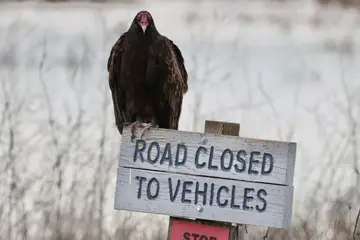
The turkey vulture is a large, dark scavenger with a bald red head and a wingspan of up to six feet (Missouri gives 70 inches), often seen soaring with its wings in a shallow V. It eats dead animals, and Missouri's conservation agency says it does not kill live animals and is no danger to livestock. If approached, especially at a nest, it may hiss and vomit in defense. It is federally protected. NPS says it lives year-round in the Southeast and across the contiguous US in summer. Missouri Department of Conservation
On this page
Is the turkey vulture dangerous?
Missouri Department of Conservation: does not kill live animals and presents no danger to livestock. No official source checked gives a direct statement on danger to people or pets. Missouri Department of Conservation
“Contrary to the beliefs of some, turkey vultures do not kill live animals and present no danger to livestock.”
How to identify a turkey vulture
A photo or description can narrow it down, but cannot confirm what an animal is or that it is safe. Look from a distance and do not handle wild animals.
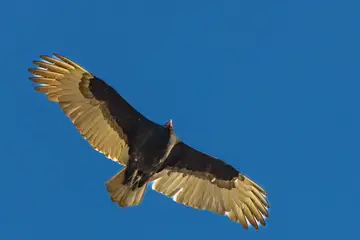
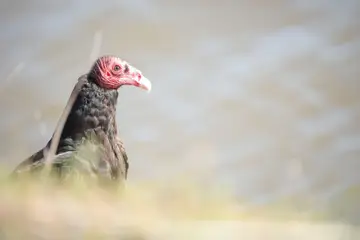

Size: 25 to 32 inches long with up to a six-foot wingspan, up to six pounds (Alabama). Missouri gives 27 inches long and a 70-inch wingspan; Tennessee gives 26 inches, a 67-inch wingspan and 4 pounds. Alabama Department of Conservation and Natural Resources
Colors: black, brown, red and gray. Pattern: two-toned wings.
Key features
- Small, red, featherless head (gray or black in juveniles). Missouri says the beak is short, hooked and whitish; Alabama says it is long and light red with a tan tip. Missouri Department of Conservation
- From below, wings are black with a gray or silvery trailing half. Missouri Department of Conservation
- Soars with wings in a V and tilts side to side. Missouri Department of Conservation
- Can only hiss and grunt. N.C. Wildlife Resources Commission
Young
Juveniles have a dark head: gray per the Missouri field guide; black per Alabama, Tennessee and a Missouri blog. Alabama and Missouri say they may be mistaken for black vultures. Tennessee: immatures (July to November) have black heads.
Animals mistaken for the turkey vulture
Turkey vulture or Black vulture?
Turkey vulture
Black vulture Coragyps atratus
Black vulture: grayish-black head, shorter tail, a white patch near the wing tips (seen from below), and wings held nearly horizontal when soaring, with frequent flapping (Missouri). Tennessee and NPS Everglades say the same: black head, white patch at the wing tips, wings held flat. Turkey vulture: red head (adults), two-toned wings held in a V, rarely flaps. Note: juvenile turkey vultures also have dark heads. Missouri Department of Conservation
Turkey vulture or Eagle?
Turkey vulture
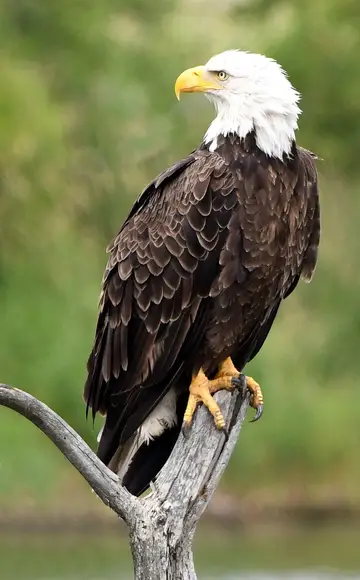

An eagle holds its wings flat and they are uniformly black; a turkey vulture's are held in a slight V and are two-toned. N.C. Wildlife Resources Commission
Turkey vulture or California condor (juvenile)?
Turkey vulture
California condor (juvenile) Gymnogyps californianus
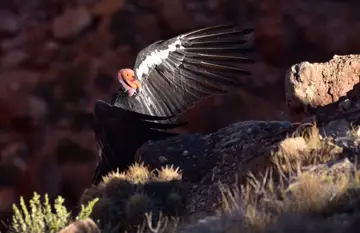
National Park Service (Grand Canyon-Parashant): turkey vultures are often mistaken for juvenile California condors; their two-toned wings, white along the back of the wings and solid black in front, make them easy to distinguish, and they hold their wings in a slight V when soaring. National Park Service, Grand Canyon-Parashant NM
Where the turkey vulture lives
- Native or listed
- Nonnative or not established
- No official record in our data
- 1–9
- 10–99
- 100–999
- 1,000+
On our state guides
- Alabama birds
- Alaska birds
- Arizona birds
- California birds
- Delaware birds
- Georgia birds
- Idaho birds
- Illinois birds
- Indiana birds
- Iowa birds
- Kansas birds
- Kentucky birds
- Maine birds
- Maryland birds
- Massachusetts birds
- Michigan birds
- Minnesota birds
- Missouri birds
- Montana birds
- Nevada birds
- New Jersey birds
- New Mexico birds
- New York birds
- North Carolina birds
- Ohio birds
- Pennsylvania birds
- Rhode Island birds
- South Dakota birds
- Tennessee birds
- Texas birds
- Vermont birds
- Virginia birds
- Washington birds
- West Virginia birds
- Wisconsin birds
- Wyoming birds
State boundaries: U.S. Census Bureau, cartographic boundary file cb_2024_us_state_20m.
When it is active
NPS: year-round in the southeastern US; across the contiguous US in summer when breeding. Active by day, moving from the roost as the sun warms the ground (Missouri). National Park Service, Big Thicket NP
US open-licence records peak in March to June and September to October.
Habitat and habits
Habitat: Variety of habitats, preferring open areas; also coastlines, rivers, lakes, deserts, plains and inland forests. Alabama Department of Conservation and Natural Resources
Behavior: Roosts in large groups, usually in large trees, but forages individually. Soars on warm rising air.
Diet: Highly specialized carrion feeder, mainly dead mammals, found by smell and sight. Alabama adds that it sometimes eats plant matter, small insects and rodents.
Young: Builds no real nest; lays usually two eggs in caves, crevices, hollow trees, thickets or abandoned buildings. Missouri gives 30 to 40 days to hatch; Alabama gives 38 to 41.
Legal status and reporting
Federal: Listed as a migratory bird under 50 CFR 10.13. eCFR / US Fish and Wildlife Service
Protection: Protected species. North Carolina: illegal to injure, harass, kill or possess, including harming or removing a nest; no open hunting season. New Mexico (BISON-M): "Provides full protection". New York lists it as a Protected Bird. N.C. Wildlife Resources Commission
Report: For damage or nuisance problems, North Carolina directs people to USDA Wildlife Services: (866) 487-3297. Federal depredation permits come from the US Fish and Wildlife Service and are limited. N.C. Wildlife Resources Commission
Questions about the turkey vulture
Turkey vulture
A large, dark scavenger with a bald red head that soars with its wings in a shallow V and eats dead animals. Missouri says it does not kill live animals. It is federally protected, and it may vomit in defense if approached.
Sources
- Turkey Vulture. Missouri Department of Conservation. undated page; checked November 3, 2026.
Quoted passages (8)
“Contrary to the beliefs of some, turkey vultures do not kill live animals and present no danger to livestock.”
“The turkey vulture is a large-bodied bird with blackish plumage and a small, red, featherless head (juveniles have gray heads).”
“From below, the wings appear black with the trailing half of the wing gray or silvery.”
“When soaring, turkey vultures hold their wings in a V position (not flattened horizontally).”
“Turkey vultures are highly specialized carrion feeders, locating their food by smell as well as by sight.”
“Turkey vultures roost in large colonies but forage individually.”
“There are usually 2 chicks per clutch.”
“Note their grayish-black head, shorter tail, and (seen from below) a white patch near the ends of the wings.”
- Turkey Vulture. N.C. Wildlife Resources Commission. undated page; checked November 3, 2026.
Quoted passages (4)
“…the only sounds they can make are hisses and grunts.”
“Under federal and state law, it is illegal for anyone to injure, harass, kill or possess a bird of prey or any parts of a bird of prey.”
“USDA Wildlife Services' toll free number is (866) 4USDA-WS (866-487-3297).”
“…its wings are held at a slight vee, or dihedral, and are distinctly two-toned, while an eagle’s wings are held flat and are uniformly black.”
- Turkey Vulture. National Park Service, Big Thicket NP. undated page; checked November 3, 2026.
Quoted passages (1)
“Turkey vultures are found in the southeastern United States year-round but can be found throughout the contiguous United States during the summer when they are breeding.”
- The Scavenger Life of Turkey Vultures. Missouri Department of Conservation. undated page; checked November 3, 2026.
- 50 CFR 10.13 List of Migratory Birds. eCFR / US Fish and Wildlife Service. Title 50 up to date as of 10/30/2026; checked November 3, 2026.
Quoted passages (1)
“Turkey Vulture Cathartes aura.”
- Turkey Vulture. Alabama Department of Conservation and Natural Resources. undated page; checked November 3, 2026.
Quoted passages (3)
“Healthy adults may be 25 to 32 inches long with up to six foot wingspans and weigh up to six pounds.”
“Juvenile turkey vultures usually have a black head and may be confused with black vultures from a distance.”
“They prefer open areas, but are found along coastlines, rivers, lakes, deserts, plains, and inland forests.”
- Turkey Vulture. National Park Service, Grand Canyon-Parashant NM. undated page; checked November 3, 2026.
Quoted passages (1)
“…often mistaken for juvenile California condors. The two-toned wings can make these birds easily distinguishable with white along the back of the wings and solid black in the front. The wings are held in a slight v-shapes as the bird soars on thermals.”
- GBIF.org occurrence records, human observations licensed CC0 1.0 or CC BY 4.0 only, accessed November 3, 2026. The datasets behind these counts are listed on our Sources page.
- State boundaries: U.S. Census Bureau, cartographic boundary file cb_2024_us_state_20m.