Bald eagle
Haliaeetus leucocephalus · also called American bald eagle · Last checked November 3, 2026.
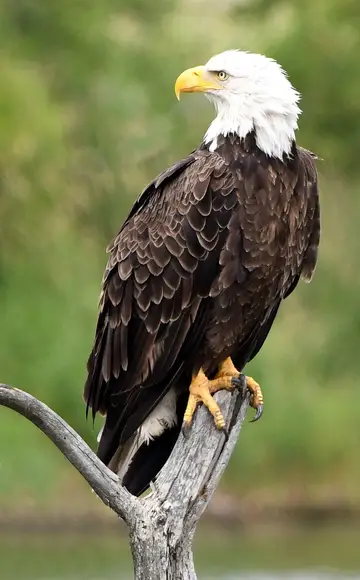

The bald eagle is a large bird of prey and the US national symbol. Adults have a dark brown body with a white head and tail and a yellow bill; young birds are mottled brown and white until about 5 years old. It eats mainly fish and carrion and lives near lakes, rivers, marshes and coasts across the US. It was removed from the endangered species list in 2007, but it is still protected by federal law: killing, selling or otherwise harming eagles, their nests or eggs is prohibited. No official source used here describes it as a danger to people. US Fish and Wildlife Service
On this page
Is the bald eagle dangerous?
How to identify a bald eagle
A photo or description can narrow it down, but cannot confirm what an animal is or that it is safe. Look from a distance and do not handle wild animals.
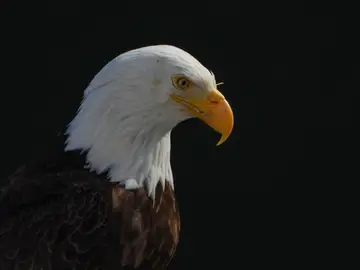
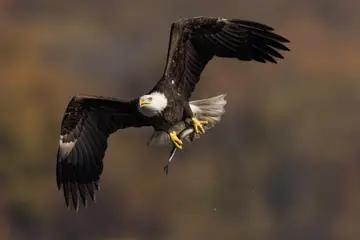
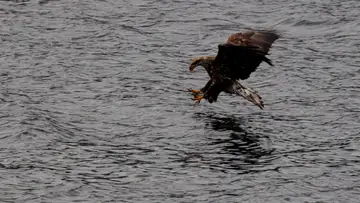
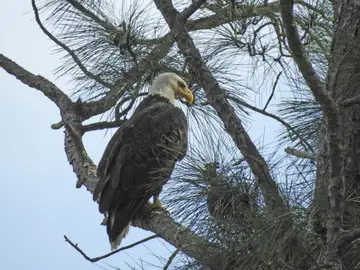
Size: 28 to 40 inches long with a 66 to 96 inch wingspan (MDC). Females are larger: wingspan up to 8 feet and weight up to 14 lb; males up to 6 feet and 10 lb (USFWS). Size varies: USFWS says northern birds are larger and Alaska birds have reached 16 lb.
Colors: Adults: dark brown body with white head and tail; bill, talons and eyes yellow.
Key features
- Soars on flat wings, not in a V like a turkey vulture. Missouri Department of Conservation
- Yellow legs, feathered only at the top. US Fish and Wildlife Service
- Call: weak, like a snickering laugh. US Fish and Wildlife Service
Young
Until 4 to 5 years old, mottled brown and white all over, with dark eyes and bill; adult plumage by about 5 years.
Animals mistaken for the bald eagle
Bald eagle or Golden eagle?
Bald eagle
Golden eagle Aquila chrysaetos
Young bald eagles lack the white head and tail and are often mistaken for golden eagles. Bald eagles have unfeathered lower legs and hold their wings flat when soaring; TWRA says golden eagles have feathered legs, limited white under the wing, and lift the outer wing in a slight V.
not stated
Bald eagle or Turkey vulture?
Bald eagle
Turkey vulture Cathartes aura
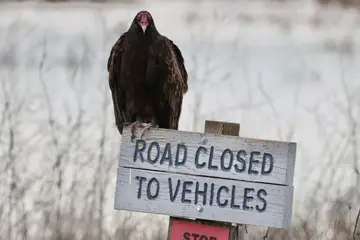
Turkey vultures hold their wings in a shallow V; bald eagles soar on flat wings. Missouri Department of Conservation
not stated
Bald eagle or Black vulture and large hawks (e.g. red-tailed hawk)?
Bald eagle
Black vulture and large hawks (e.g. red-tailed hawk)
Missouri Department of Conservation: in flight, a mature bald eagle is identified by its dark brown body with white head and tail. Missouri Department of Conservation
not stated
Where the bald eagle lives
- Native or listed
- Nonnative or not established
- No official record in our data
- 1–9
- 10–99
- 100–999
- 1,000+
On our state guides
- Alabama birds
- Alaska birds
- Arizona birds
- California birds
- Colorado birds
- Delaware birds
- Georgia birds
- Idaho birds
- Illinois birds
- Indiana birds
- Iowa birds
- Kansas birds
- Kentucky birds
- Louisiana birds
- Maine birds
- Maryland birds
- Massachusetts birds
- Michigan birds
- Minnesota birds
- Missouri birds
- Montana birds
- Nevada birds
- New Jersey birds
- New Mexico birds
- New York birds
- North Carolina birds
- Ohio birds
- Pennsylvania birds
- Rhode Island birds
- South Carolina birds
- South Dakota birds
- Tennessee birds
- Texas birds
- Vermont birds
- Virginia birds
- Washington birds
- West Virginia birds
- Wisconsin birds
- Wyoming birds
State boundaries: U.S. Census Bureau, cartographic boundary file cb_2024_us_state_20m.
When it is active
Northern birds migrate south in winter and return in late winter and early spring; in winter they gather near open water. In Missouri they are seen statewide, especially in winter.
US open-licence records peak in January to May and December.
Habitat and habits
Habitat: Near rivers, lakes, marshes, estuaries, reservoirs and some seacoasts; increasingly also farmland and suburban and urban areas. Winters near open water. US Fish and Wildlife Service
Behavior: Outside the breeding season, often roosts communally with other bald eagles.
Diet: Mainly fish; also waterfowl, shorebirds, turtles, rabbits, snakes, small animals and carrion; known to steal prey from other birds.
Young: Mate for life; usually nest at the top of large trees; lay 1 to 3 eggs a year that hatch after about 35 days. Most breed in early spring, but in hot climates such as Louisiana and Florida they nest in winter.
Legal status and reporting
Federal: Removed from the Endangered Species Act list in 2007 after recovery; still protected under the Migratory Bird Treaty Act and the Bald and Golden Eagle Protection Act. US Fish and Wildlife Service
Protection: Protected species: federal law prohibits killing, selling or otherwise harming eagles, their nests or eggs; import or export of bald eagles or their parts, nests or eggs is prohibited. US Fish and Wildlife Service
Sources
- Bald Eagle (Haliaeetus leucocephalus). U.S. Fish and Wildlife Service. archived copy, captured October 26, 2026; checked November 3, 2026.
Quoted passages (9)
“Bald eagles have yellow legs and only the tops of their legs have feathers.”
“Bald eagle calls have been described as weak in volume and like a snickering laugh.”
“Until bald eagles reach 4 to 5 years of age, they have mottled brown and white feathers all over their bodies, and slowly develop their distinctive white head and tail as they age. … juvenile eagles initially have dark eyes and bills, that lighten as they reach adulthood.”
“Their habitat can include estuaries, large lakes, reservoirs, rivers and some seacoasts. They're also increasingly found in drier areas that are farther from water sources such as farmland and urban and suburban habitat.”
“Bald eagles are opportunistic feeders, with fish being a staple food. They will also feed on waterfowl, shorebirds, waterbirds, turtles, rabbits, snakes, small animals and carrion.”
“Although bald eagles maintain breeding territories, it is common to see them roosting with other bald eagles when they are not breeding.”
“Bald eagles mate for life … Breeding bald eagles typically lay one to three eggs once a year, with the eggs hatching after about 35 days. … However, in hot climates, like Louisiana and Florida, bald eagles nest during the winter.”
“Even though bald eagles were delisted from the Endangered Species Act in August 2007, because their populations recovered sufficiently, bald eagles are still protected under the Migratory Bird Treaty Act and the Bald and Golden Eagle Protection Act.”
“Both laws prohibit killing, selling, or otherwise harming eagles, their nests or eggs. … The import, and or, export of bald eagles, or their parts, nests, or eggs is prohibited by law.”
- Bald Eagle (Field Guide). Missouri Department of Conservation. undated page; checked November 3, 2026.
Quoted passages (3)
“Bald eagles soar on wings held flat.This helps distinguish them from turkey vultures, which form a shallow V with their wings.”
“This helps distinguish them from turkey vultures, which form a shallow V with their wings.”
“In flight, a mature bald eagle is identified by its dark brown body with white head and tail.”
- GBIF.org occurrence records, human observations licensed CC0 1.0 or CC BY 4.0 only, accessed November 3, 2026. The datasets behind these counts are listed on our Sources page.
- State boundaries: U.S. Census Bureau, cartographic boundary file cb_2024_us_state_20m.