Kansas Herpetofaunal Atlas (Travis W. Taggart), Sternberg Museum of Natural History, Fort Hays State University: 14 turtles.
This page lists 14 turtles: all from Kansas Herpetofaunal Atlas (Travis W. Taggart), Sternberg Museum of Natural History, Fort Hays State University's Kansas Herpetofaunal Atlas species accounts: TESTUDINES - Turtles, "ESTABLISHED TAXA"; cross-checked with GPNC 2017 pocket guide.
Which turtles can hurt you
Official sources single out these turtles in Kansas, in their own words:
Venom: “No species are venomous.” (Great Plains Nature Center (cooperative project of the U.S. Fish and Wildlife Service, Kansas Department of Wildlife and Parks and City of Wichita); published by the Friends of the Great Plains Nature Center)
Range: A record from Wallace County (KU 3028) exists and is undoubtedly an error. Grant (1937) states that "numbers of these turtles were observed in the turtle traps" at the State Fish Hatchery in Pratt on 29 August 1929.
Venom: “No species are venomous.” (Great Plains Nature Center (cooperative project of the U.S. Fish and Wildlife Service, Kansas Department of Wildlife and Parks and City of Wichita); published by the Friends of the Great Plains Nature Center)
Range: The False Map Turtle (G. pseudogeographica) is known from the following river basins in Kansas: Kansas (Kansas [including the Solomon to Glen Elder Lake and Saline to Wilson Lake], the entire lengths of the Walnut, Caney, Verdigris, Fall, Neosho, and Spring rivers, and the upper Marais des Cygnes River). They have not been reported from much of the Marais des Cygnes River basin in Kansas.
Venom: “No species are venomous.” (Great Plains Nature Center (cooperative project of the U.S. Fish and Wildlife Service, Kansas Department of Wildlife and Parks and City of Wichita); published by the Friends of the Great Plains Nature Center)
Range: Records mapped in Collins (1994) for Cloud, Butler, Geary, and Jackson counties are unknown and therefore not plotted. Records mapped in Collins (1994) for Sumner County (KU 20519) are too imprecise to plot (county only).
Venom: “No species are venomous.” (Great Plains Nature Center (cooperative project of the U.S. Fish and Wildlife Service, Kansas Department of Wildlife and Parks and City of Wichita); published by the Friends of the Great Plains Nature Center)
Range: The Northern Map turtle is known from the Marais des Cygnes, Verdigris, and Caney drainage systems in eastern Kansas. This species inhabits slow-moving stretches and backwaters of rivers, streams, and lakes.
Venom: “No species are venomous.” (Great Plains Nature Center (cooperative project of the U.S. Fish and Wildlife Service, Kansas Department of Wildlife and Parks and City of Wichita); published by the Friends of the Great Plains Nature Center)
Range: A specimen exists for Scott County (CAS-SUA 19241) but is only given to the county, and therefore cannot be mapped precisely. The source of the records mapped by Collins (1993) from Jewell and Neosho counties cannot be determined and are not mapped.
Venom: “No species are venomous.” (Great Plains Nature Center (cooperative project of the U.S. Fish and Wildlife Service, Kansas Department of Wildlife and Parks and City of Wichita); published by the Friends of the Great Plains Nature Center)
Range: The Ouachita Map Turtle (G. ouachitensis) is known from the following river basins in Kansas; Marais des Cygnes, Spring, Neosho, Verdigris, Fall, Walnut, and Arkansas/Pawnee [to Pawnee County]. There are localized populations along the Kansas River to Geary County.
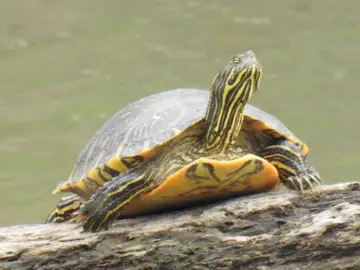
Photo: U. S. Fish and Wildlife Service - Northeast Region · Public domain · Wikimedia Commons
Venom: “No species are venomous.” (Great Plains Nature Center (cooperative project of the U.S. Fish and Wildlife Service, Kansas Department of Wildlife and Parks and City of Wichita); published by the Friends of the Great Plains Nature Center)
Venom: “No species are venomous.” (Great Plains Nature Center (cooperative project of the U.S. Fish and Wildlife Service, Kansas Department of Wildlife and Parks and City of Wichita); published by the Friends of the Great Plains Nature Center)
Range: The Pond Slider is a semi-aquatic turtle and found throughout much of Kansas (in all major river drainages). It is absent from the northwestern portion of the state and along the northern and western borders (except for four questionable records from Wallace County [AMNH 2670, KU 3258, and KU 3259 from 1911 and w/o specific locality and FHSM 13688 from 2007 which is mapped).
Venom: “No species are venomous.” (Great Plains Nature Center (cooperative project of the U.S. Fish and Wildlife Service, Kansas Department of Wildlife and Parks and City of Wichita); published by the Friends of the Great Plains Nature Center)
Range: The River Cooter inhabits rivers, streams, watershed lakes, ponds, and lagoons in southeastern Kansas. It is known from the Marais des Cygnes, Neosho/Spring, Verdigris/Fall, Walnut, and lower Arkansas drainages.
Venom: “No species are venomous.” (Great Plains Nature Center (cooperative project of the U.S. Fish and Wildlife Service, Kansas Department of Wildlife and Parks and City of Wichita); published by the Friends of the Great Plains Nature Center)
Venom: “No species are venomous.” (Great Plains Nature Center (cooperative project of the U.S. Fish and Wildlife Service, Kansas Department of Wildlife and Parks and City of Wichita); published by the Friends of the Great Plains Nature Center)
Venom: “No species are venomous.” (Great Plains Nature Center (cooperative project of the U.S. Fish and Wildlife Service, Kansas Department of Wildlife and Parks and City of Wichita); published by the Friends of the Great Plains Nature Center)
Range: Older records in Collins (1993) from Coffey County (KU 3017-20) are too imprecise to map, however, recent photographs turned in by Don Eccles lend support that this turtle may still exist there. Collins (1993) did not plot a 1912 record (USNM 55588) from Marion County and a 1925 record (KU 1918) from Stafford County.
Usually 15 to 26 inches of shell and 35 to 150 pounds; males can reach 29 inches and 249 pounds, females about 22 inches and 62 pounds. Missouri records over 250 pounds.
How to recognize it
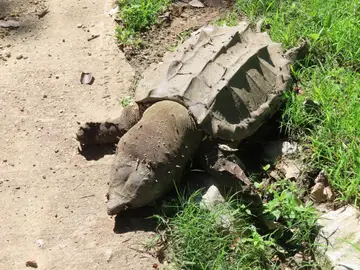
Three prominent ridges on the upper shell
Very large head with a sharp, strongly hooked beak
Kansas Species in Need of Conservation (SINC) (as labelled by KHA)
What the sources say
Venom: “No species are venomous.” (Great Plains Nature Center (cooperative project of the U.S. Fish and Wildlife Service, Kansas Department of Wildlife and Parks and City of Wichita); published by the Friends of the Great Plains Nature Center)
Range: The Alligator Snapping Turtle has been recorded from the Neosho, Verdigris, Walnut, and Arkansas River Basins in Kansas between 1885 and 1986. Records from Woods and Kay counties in Oklahoma indicate that this species may also be present in the Cimarron River and Arkansas River drainages, respectively (though Glass, 1949 felt that these wide sandy streams would not provide suitable habitat).
Venom: “No species are venomous.” (Great Plains Nature Center (cooperative project of the U.S. Fish and Wildlife Service, Kansas Department of Wildlife and Parks and City of Wichita); published by the Friends of the Great Plains Nature Center)
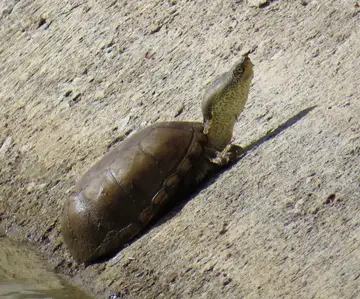
Range: Yellow Mud Turtles inhabit still to slow-moving aquatic situations with muddy bottoms, such as ponds, cattle tanks, lakes, and ditches. Well represented throughout the Arkansas River drainage and the western reaches of the Kansas River drainages.
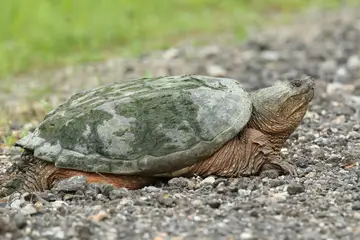
Tennessee (TWRA): the alligator snapping turtle has a longer snout with a hooked beak, extra marginal scutes (shell-edge plates) and more conspicuous ridges on the shell. Missouri (MDC): its upper shell has 3 prominent ridges, one along the center line and one on either side, and its large head ends in a sharp, strongly hooked beak. Texas (TPWD): the common snapping turtle has an oval-shaped head and a comparatively smooth, rounded shell; the alligator snapper has three distinct ridges, a triangular head and a fleshy lure in its mouth. Caution: young common snapping turtles also have three keels on the shell (MDC, NCWRC, CT DEEP), so ridges alone do not separate small turtles.
Photos show typical adults; individuals vary. Never get close to compare.
When turtles are active in Kansas
Records of turtles in Kansas peak in May to July. They show when people record turtles, not how many there are (about month bars).
JanFebMarAprMayJunJulAugSepOctNovDec
411 records of turtles in Kansas by month (GBIF, CC0 and CC BY records).
If you are bitten or stung
Call 911 or Poison Help at 1-800-222-1222 right away. Poison Help connects you to your local poison center, any time of day.
TESTUDINES - Turtles (KHA species accounts list). Kansas Herpetofaunal Atlas (Travis W. Taggart), Sternberg Museum of Natural History, Fort Hays State University. page footer 2026; checked November 3, 2026.
Kansas Herpetofaunal Atlas: home page. Kansas Herpetofaunal Atlas (Travis W. Taggart), Sternberg Museum of Natural History, Fort Hays State University. page footer 1999-2026; checked November 3, 2026.Quoted passages (1)
“14 turtles.”
A Pocket Guide to Kansas Amphibians, Turtles and Lizards (Taggart & Riedle). Great Plains Nature Center (cooperative project of the U.S. Fish and Wildlife Service, Kansas Department of Wildlife and Parks and City of Wichita); published by the Friends of the Great Plains Nature Center. First Edition; checked November 3, 2026.Quoted passages (2)
“No species are venomous.”
“…several large lizards and all turtles are capable of giving painful bites when handled.”
KHA species account: North American Snapping Turtle. Kansas Herpetofaunal Atlas (Travis W. Taggart), Sternberg Museum of Natural History, Fort Hays State University. updated April 8, 2025; checked November 3, 2026.
KHA species account: Western Alligator Snapping Turtle. Kansas Herpetofaunal Atlas (Travis W. Taggart), Sternberg Museum of Natural History, Fort Hays State University. updated April 8, 2025; checked November 3, 2026.
KHA species account: Painted Turtle. Kansas Herpetofaunal Atlas (Travis W. Taggart), Sternberg Museum of Natural History, Fort Hays State University. updated August 9, 2024; checked November 3, 2026.
KHA species account: Northern Map Turtle. Kansas Herpetofaunal Atlas (Travis W. Taggart), Sternberg Museum of Natural History, Fort Hays State University. updated August 13, 2026; checked November 3, 2026.
KHA species account: Ouachita Map Turtle. Kansas Herpetofaunal Atlas (Travis W. Taggart), Sternberg Museum of Natural History, Fort Hays State University. updated April 29, 2025; checked November 3, 2026.
KHA species account: False Map Turtle. Kansas Herpetofaunal Atlas (Travis W. Taggart), Sternberg Museum of Natural History, Fort Hays State University. updated July 5, 2023; checked November 3, 2026.
KHA species account: River Cooter. Kansas Herpetofaunal Atlas (Travis W. Taggart), Sternberg Museum of Natural History, Fort Hays State University. updated February 27, 2024; checked November 3, 2026.
KHA species account: Ornate Box Turtle. Kansas Herpetofaunal Atlas (Travis W. Taggart), Sternberg Museum of Natural History, Fort Hays State University. updated July 8, 2024; checked November 3, 2026.
KHA species account: Three-toed Box Turtle. Kansas Herpetofaunal Atlas (Travis W. Taggart), Sternberg Museum of Natural History, Fort Hays State University. updated July 8, 2024; checked November 3, 2026.
KHA species account: Pond Slider. Kansas Herpetofaunal Atlas (Travis W. Taggart), Sternberg Museum of Natural History, Fort Hays State University. updated September 15, 2025; checked November 3, 2026.
KHA species account: Yellow Mud Turtle. Kansas Herpetofaunal Atlas (Travis W. Taggart), Sternberg Museum of Natural History, Fort Hays State University. updated June 21, 2023; checked November 3, 2026.
KHA species account: Eastern Musk Turtle. Kansas Herpetofaunal Atlas (Travis W. Taggart), Sternberg Museum of Natural History, Fort Hays State University. updated February 27, 2024; checked November 3, 2026.
KHA species account: Smooth Softshell. Kansas Herpetofaunal Atlas (Travis W. Taggart), Sternberg Museum of Natural History, Fort Hays State University. updated August 2, 2023; checked November 3, 2026.
KHA species account: Spiny Softshell. Kansas Herpetofaunal Atlas (Travis W. Taggart), Sternberg Museum of Natural History, Fort Hays State University. updated February 26, 2024; checked November 3, 2026.