Northern cardinal
Cardinalis cardinalis · also called Redbird and Virginia nightingale (old-fashioned name) · Last checked November 3, 2026.
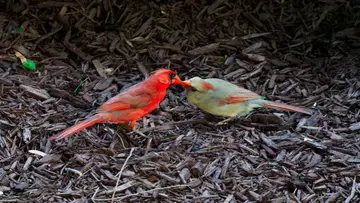
The northern cardinal is a medium-sized, crested songbird about 8 to 9 inches long. Males are bright red with a black area around a red, cone-shaped bill; females are buffy tan and grayish brown with reddish tinges. It is a year-round resident that does not migrate, found throughout the eastern and central United States and into the Southwest, and it is the official state bird of seven states. It is protected under the federal Migratory Bird Treaty Act. None of the official sources we checked say whether cardinals are any danger to people. Missouri Department of Conservation
On this page
Is the northern cardinal dangerous?
How to identify a northern cardinal
A photo or description can narrow it down, but cannot confirm what an animal is or that it is safe. Look from a distance and do not handle wild animals.
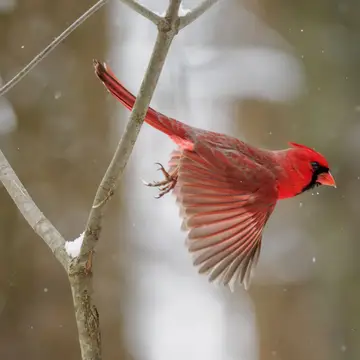
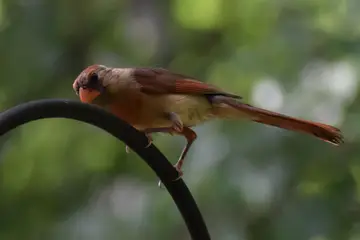
Size: About 8 to 9 inches long (MDC: 8 3/4 inches, bill tip to tail tip); adults weigh about 1 to 2 ounces.
Colors: Adult male: bright red, with darker wings and tail; female: buffy tan below and grayish brown above, with reddish tinges in wings, tail and crest; bill red (coral red) in adults. Pattern: Black mask around the bill (both sexes).
Key features
- Crested head Missouri Department of Conservation
- Large, cone-shaped red bill with black around it Missouri Department of Conservation
- Long tail and short, rounded wings Outdoor Alabama
- Song: clear whistles, sung by both males and females; call is a sharp 'chip' Missouri Department of Conservation
Young
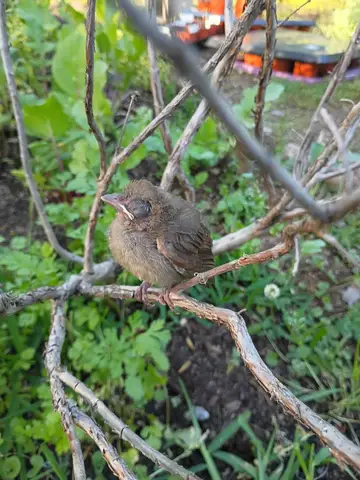
Immature birds look like the female but have a dark (gray-black) bill; immature females lack the reddish tint.
Animals mistaken for the northern cardinal
Northern cardinal or Summer tanager?
Northern cardinal
Summer tanager Piranga rubra
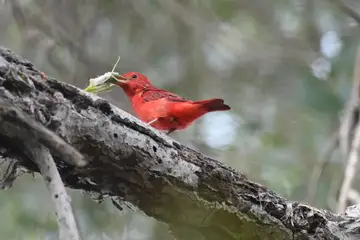
MDC: the adult male summer tanager is entirely rosy red, slightly darker on wings and tail, and is a summer resident; the adult male northern cardinal has a crest and a black area around its large red bill and is present year-round. TWRA says the summer tanager is the only other all-red songbird in Tennessee.
Northern cardinal or Pyrrhuloxia?
Northern cardinal
Pyrrhuloxia Cardinalis sinuatus
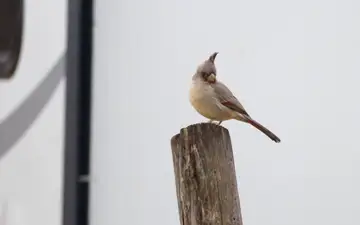
The pyrrhuloxia is a grayish bird with red highlights that lives in the desert Southwest. Missouri Department of Conservation
Where the northern cardinal lives
- Native or listed
- Nonnative or not established
- No official record in our data
- 1–9
- 10–99
- 100–999
- 1,000+
On our state guides
- Alabama birds
- Arizona birds
- California birds
- Delaware birds
- Georgia birds
- Hawaii birdsNonnative
- Illinois birds
- Indiana birds
- Iowa birds
- Kansas birds
- Kentucky birds
- Maine birds
- Maryland birds
- Massachusetts birds
- Michigan birds
- Minnesota birds
- Missouri birds
- Montana birds
- New Jersey birds
- New Mexico birds
- New York birds
- North Carolina birds
- Ohio birds
- Pennsylvania birds
- Rhode Island birds
- South Dakota birds
- Tennessee birds
- Texas birds
- Vermont birds
- Virginia birds
- West Virginia birds
- Wisconsin birds
- Wyoming birds
State boundaries: U.S. Census Bureau, cartographic boundary file cb_2024_us_state_20m.
When it is active
Present year-round (non-migratory). In Missouri, cardinals sing from early February through August.
US open-licence records peak in January to June.
Habitat and habits
Habitat: Woodland edges and clearings, brushy areas, thickets, streamside woods, hedgerows, parks, suburban gardens and yards; needs open ground for feeding, trees for singing perches and dense low growth for nesting.
Behavior: Territorial. Males sometimes fly at windows, attacking their own reflection as if it were a rival; Penn State Extension says male cardinals often keep this up all year because they hold territories year-round. A cardinal often spends its whole life within a mile of where it hatched.
Diet: Seeds, grains, insects, spiders, leaf buds, berries and fruit, foraged on the ground or in shrubs; up to a third of the summer diet can be insects, the winter diet is mostly large seeds, and young are fed mostly insects. Frequent visitor to feeders for sunflower and safflower seed.
Young: Breeding season March to September. The female builds the nest in thickets or dense shrubs (often landscaping shrubs in yards) and lays 1 to 5 eggs; incubation lasts 11 to 13 days and young leave the nest 7 to 13 days after hatching. Usually two broods a year, up to four.
Legal status and reporting
Federal: Protected under the Migratory Bird Treaty Act (listed in 50 CFR 10.13). Not listed under the Endangered Species Act: the USFWS ECOS species query returned no record for Cardinalis cardinalis on 2026-11-03. US Fish and Wildlife Service
Protection: Protected migratory bird: federal MBTA regulations cover the taking, possession, transportation, sale and purchase of listed birds. New York also lists it as a Protected Bird; New Mexico (BISON-M) lists 'State NM: Provides full protection'.
Sources
- Northern Cardinal (Field Guide). Missouri Department of Conservation. undated page; checked November 3, 2026.
Quoted passages (4)
“The head is crested.”
“The area around the bill is black, and the large conical bill is red.”
“Both males and females sing in clear, up- or down-slurred whistles.”
“There are two other species in genus Cardinalis: the pyrrhuloxia (peer-oo-LOX-ee-uh), a grayish bird with red highlights, which lives in the desert Southwest”
- Northern Cardinal. Alabama Department of Conservation and Natural Resources (Outdoor Alabama). undated page; checked November 3, 2026.
Quoted passages (1)
“Legs and feet of the cardinal are reddish black and their wings are short and rounded. Cardinals also have a long tail and a distinctive crest of feathers that adorns the top of their heads.”
- 50 CFR 10.13 List of Birds Protected by the Migratory Bird Treaty Act. U.S. Fish and Wildlife Service (regulation published in the eCFR, Office of the Federal Register). current eCFR text as of 2026-11-03; checked November 3, 2026.
Quoted passages (1)
“Cardinalis cardinalis.”
- GBIF.org occurrence records, human observations licensed CC0 1.0 or CC BY 4.0 only, accessed November 3, 2026. The datasets behind these counts are listed on our Sources page.
- State boundaries: U.S. Census Bureau, cartographic boundary file cb_2024_us_state_20m.