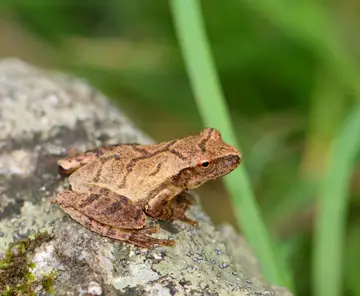
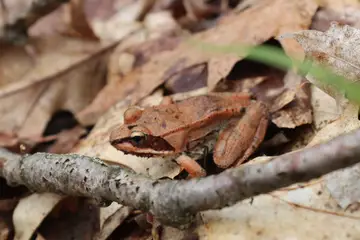
No official source we use states whether this animal is venomous. That does not mean it is harmless: do not handle it.
Size
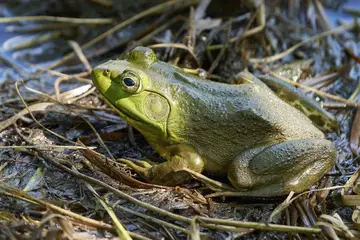
Usually 6 to 8 inches long (NCWRC); can reach 8 inches or more and weigh over 2 pounds (CDFW). Missouri gives 3.5 to 6 inches snout to vent, occasionally to 8.75.
How to recognize it
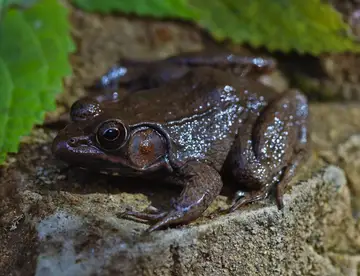
No ridge (dorsolateral fold) down each side of the back
Large round eardrum: about twice the eye in males, about eye-sized in females
Fully webbed hind feet, longest toe extends past the webbing
JFMAMJJASOND
283 records by month.What the sources say
Habitat: Permanent bodies of water (lakes, ponds, rivers, sluggish portions of streams) in forests, prairies, and disturbed habitats (including urban areas). (Illinois Natural History Survey (INHS), Prairie Research Institute, University of Illinois Urbana-Champaign)
No official source we use states whether this animal is venomous. That does not mean it is harmless: do not handle it.
Size
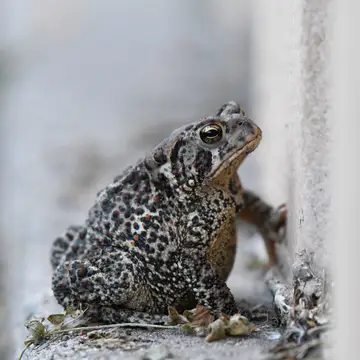
2 to 3.5 inches long (NCWRC: up to 4 inches); females are larger than males.
How to recognize it
Dark spots on the back hold only a few large warts; the similar Fowler's toad has three or more. Agencies give different counts for the American toad (TWRA: one or two; Ohio DNR: one, two or three; Georgia DNR: usually no more than one), so wart count alone does not settle it; check the head crests too (see lookalikes).
A large, kidney- or bean-shaped parotoid gland behind each eye that usually does not touch the bony ridge (cranial crest) above the eye, or touches it only by a short spur.
Enlarged warts on the lower leg.
JFMAMJJASOND
391 records by month.What the sources say
Habitat: Virtually all forest and prairie habitats in Illinois, including urban and agricultural areas, where flooded fields, ditches, and other bodies of water are available for reproduction. (Illinois Natural History Survey (INHS), Prairie Research Institute, University of Illinois Urbana-Champaign)
Habitat: Bald cypress-tupelo swamps and nearby wet hardwood forests. (Illinois Natural History Survey (INHS), Prairie Research Institute, University of Illinois Urbana-Champaign)
No confirmed photo of Blanchard's Cricket Frog
Blanchard's Cricket Frog
Acris blanchardi
Not stated
Venom
No official source we use states whether this animal is venomous. That does not mean it is harmless: do not handle it.
What the sources say
Habitat: Shallow margins of lakes, ponds, marshes, and streams, where they are active even in very cold weather. (Illinois Natural History Survey (INHS), Prairie Research Institute, University of Illinois Urbana-Champaign)
No confirmed photo of Boreal Chorus Frog
Boreal Chorus Frog
Pseudacris maculata
Not stated
Venom
No official source we use states whether this animal is venomous. That does not mean it is harmless: do not handle it.
What the sources say
Habitat: Forests, forest edges, and nearby open marshy fields. Breeds in nearly any shallow, temporary body of water, even a considerable distance from forest. (Illinois Natural History Survey (INHS), Prairie Research Institute, University of Illinois Urbana-Champaign)
No confirmed photo of Cope’s Gray Treefrog
Cope’s Gray Treefrog
Hyla chrysoscelis
Not stated
Venom
No official source we use states whether this animal is venomous. That does not mean it is harmless: do not handle it.
What the sources say
Habitat: Trunks and branches of trees. Adults mate in woodland pools, roadside ditches, and other temporary bodies of water. (Illinois Natural History Survey (INHS), Prairie Research Institute, University of Illinois Urbana-Champaign)
Habitat: Open, moist areas with abundant ground cover. Breeds in temporary or permanent waters such as ponds, lakes, swamp edges, marshy fields, and roadside ditches. (Illinois Natural History Survey (INHS), Prairie Research Institute, University of Illinois Urbana-Champaign)
No official source we use states whether this animal is venomous. That does not mean it is harmless: do not handle it.
What the sources say
Habitat: Forested and open areas, in sandy or loose soils. Breeds, often in large numbers, in temporary pools and flooded fields. (Illinois Natural History Survey (INHS), Prairie Research Institute, University of Illinois Urbana-Champaign)
No official source we use states whether this animal is venomous. That does not mean it is harmless: do not handle it.
Size
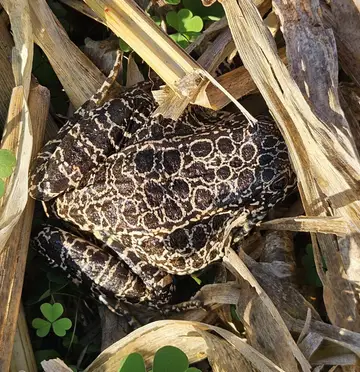
2 to 3 inches long (Alabama: 2 to 4 inches).
How to recognize it
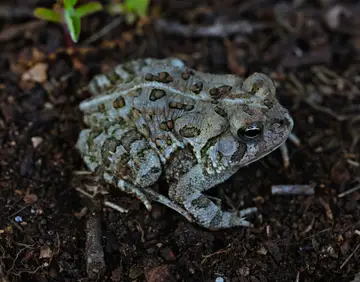
Three or more warts in each of the large dark spots on the back (the American toad has fewer)
The ridge behind each eye (cranial crest) touches the parotoid gland, with no gap
A pale stripe usually runs down the middle of the back
JFMAMJJASOND
81 records by month.What the sources say
Habitat: A wide variety of habitats where flooded fields, ditches, and other bodies of water are available for reproduction. (Illinois Natural History Survey (INHS), Prairie Research Institute, University of Illinois Urbana-Champaign)
No official source we use states whether this animal is venomous. That does not mean it is harmless: do not handle it.
Size
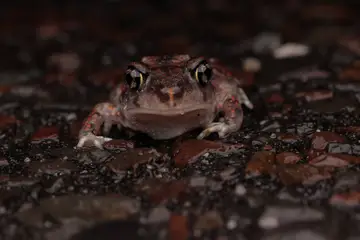
Small: body usually 1¼ to 2½ inches long (snout to vent); Tennessee gives 1.25 to 2 inches.
How to recognize it
Large white or gray spot below each eye
Warty (granular) skin and sticky pads on fingers and toes
Bright orange or golden yellow on the underside of each hind leg, shown as a flash color
What the sources say
Habitat: Trunks and branches of trees. Adults mate in woodland pools, roadside ditches, and other temporary bodies of water. (Illinois Natural History Survey (INHS), Prairie Research Institute, University of Illinois Urbana-Champaign)
No official source we use states whether this animal is venomous. That does not mean it is harmless: do not handle it.
JFMAMJJASOND
168 records by month.What the sources say
Habitat: A variety of shallow, weedy, aquatic habitats around lakes, ponds, and streams in wooded areas. In southern counties, where rock outcrops are abundant, it often is associated with small spring-fed streams. (Illinois Natural History Survey (INHS), Prairie Research Institute, University of Illinois Urbana-Champaign)
No official source we use states whether this animal is venomous. That does not mean it is harmless: do not handle it.
Size
Adults reach about 2.5 inches: USGS gives 1.25 to 2.5 inches snout to vent. Virginia DWR says up to 2 inches.
How to recognize it
Smooth skin
Prominent toe pads
Loud nasal call, like cowbells from a distance
JFMAMJJASOND
50 records by month.What the sources say
Habitat: Open brushy borders of cypress swamps, floodplain sloughs, cattail marshes, lakes, and farm ponds. (Illinois Natural History Survey (INHS), Prairie Research Institute, University of Illinois Urbana-Champaign)
Habitat: Sand prairies and remnants such as sandy agricultural fields and waste areas. Burrows in sand and emerges after heavy, early spring rains to breed in nearby flooded fields, ditches, and other vernal ponds. (Illinois Natural History Survey (INHS), Prairie Research Institute, University of Illinois Urbana-Champaign)
No official source we use states whether this animal is venomous. That does not mean it is harmless: do not handle it.
JFMAMJJASOND
133 records by month.What the sources say
Habitat: Streams, ponds, lakes, wet prairies, and other bodies of water, frequently moving into grassy, herbaceous fields or forest borders some distance from permanent water. (Illinois Natural History Survey (INHS), Prairie Research Institute, University of Illinois Urbana-Champaign)
No official source we use states whether this animal is venomous. That does not mean it is harmless: do not handle it.
Size
About 1.75 to 3 inches long; large females reach about 3.5 inches. Males are smaller than females.
How to recognize it
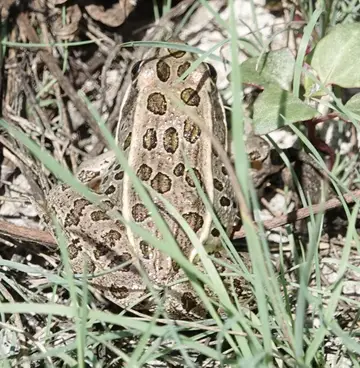
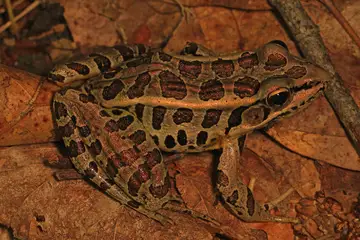
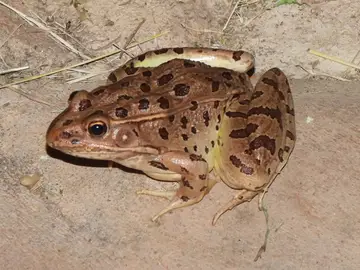
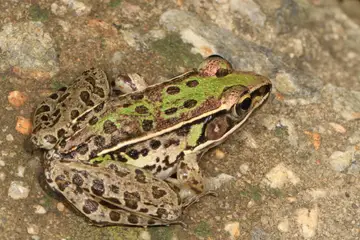
Two rows of square or rectangular dark spots down the back between two light ridges (dorsolateral folds); spots sometimes merge into bars
Bright yellow or orange on the hidden inner surfaces of the hind legs and groin
No white spot on the eardrum (tympanum), unlike the southern leopard frog
What the sources say
Habitat: Dense herbaceous vegetation along streams and within fens, often near forests. Rocky, spring-fed streams and seeps along Middle Mississippi Border Division. Characteristic animal of cave entranceways. (Illinois Natural History Survey (INHS), Prairie Research Institute, University of Illinois Urbana-Champaign)
No official source we use states whether this animal is venomous. That does not mean it is harmless: do not handle it.
What the sources say
Habitat: Uncultivated former prairies, marshlands, along creeks, in open bottomlands, and in old fields (former prairie) not far from water. Breeds in still waters of pools, roadside and drainage ditches, marshes, and ponds. (Illinois Natural History Survey (INHS), Prairie Research Institute, University of Illinois Urbana-Champaign)
No official source we use states whether this animal is venomous. That does not mean it is harmless: do not handle it.
JFMAMJJASOND
97 records by month.What the sources say
Habitat: This is a species of broad ecological tolerance and is found in all sorts of shallow water habitats. In summer, individuals venture away from shorelines and into nearby weed-and-grass-covered fields where they feed. (Illinois Natural History Survey (INHS), Prairie Research Institute, University of Illinois Urbana-Champaign)
No official source we use states whether this animal is venomous. That does not mean it is harmless: do not handle it.
Size
Adults 3/4 to 1 1/4 inches snout to vent, occasionally to 1 1/2 inches; males are smaller than females.
How to recognize it
Clear, high-pitched peep about once per second; a chorus can sound like small jingle bells
Adhesive pads on the tips of fingers and toes
Some individuals have little to no markings
JFMAMJJASOND
53 records by month.What the sources say
Habitat: Mesic forests, on trees, shrubs, and herbaceous plants. Most often seen around woodland pools in spring; seldom seen outside breeding season. Breeds in ponds and water-filled depressions in upland forest. (Illinois Natural History Survey (INHS), Prairie Research Institute, University of Illinois Urbana-Champaign)
No official source we use states whether this animal is venomous. That does not mean it is harmless: do not handle it.
What the sources say
Habitat: Forests, forest edges, and nearby open marshy fields. Breeds in nearly any shallow, temporary body of water, even a considerable distance from forest. (Illinois Natural History Survey (INHS), Prairie Research Institute, University of Illinois Urbana-Champaign)
No confirmed photo of Western Chorus Frog
Western Chorus Frog
Pseudacris triseriata
Not stated
Venom
No official source we use states whether this animal is venomous. That does not mean it is harmless: do not handle it.
What the sources say
Habitat: Forests, forest edges, and nearby open marshy fields. Breeds in nearly any shallow, temporary body of water, even a considerable distance from forest. (Illinois Natural History Survey (INHS), Prairie Research Institute, University of Illinois Urbana-Champaign)
No official source we use states whether this animal is venomous. That does not mean it is harmless: do not handle it.
Size
Adults 1.5 to 2.75 inches snout to vent, occasionally to 3.5 inches; females are larger than males.
How to recognize it
Dark eye mask: SREL calls it the only frog in the Southeast with such a facial pattern
Distinct ridge of skin (dorsolateral fold) down each side of the back to the groin
Call: a rapid, hoarse 'waaaduck' like a quacking duck, repeated three or four times
What the sources say
Habitat: Solitary inhabitant of mature, moist forests. May wander far from breeding habitats of shallow vernal pools and forest ponds. (Illinois Natural History Survey (INHS), Prairie Research Institute, University of Illinois Urbana-Champaign)
The difference official sources agree on is at the head: in the American toad the ridge (cranial crest) behind each eye is separate from the parotoid gland or joined to it only by a short spur; in Fowler's toad the two touch. Fowler's toad also has three or more warts in each of the larger dark spots, while the American toad has fewer (TWRA: one or two; Ohio DNR: one, two or three; Georgia DNR: usually no more than one). Fowler's toad has a whitish belly, often with a single dark spot on the chest; the American toad's belly is peppered with dark spots. The two can hybridize, so some toads cannot be told apart.
The difference official sources agree on is at the head: in the American toad the ridge (cranial crest) behind each eye is separate from the parotoid gland or joined to it only by a short spur; in Fowler's toad the two touch. Fowler's toad also has three or more warts in each of the larger dark spots, while the American toad has fewer (TWRA: one or two; Ohio DNR: one, two or three; Georgia DNR: usually no more than one). Fowler's toad has a whitish belly, often with a single dark spot on the chest; the American toad's belly is peppered with dark spots. The two can hybridize, and hybrids have intermediate features.
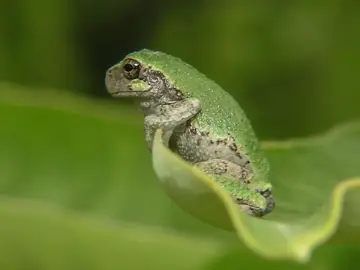
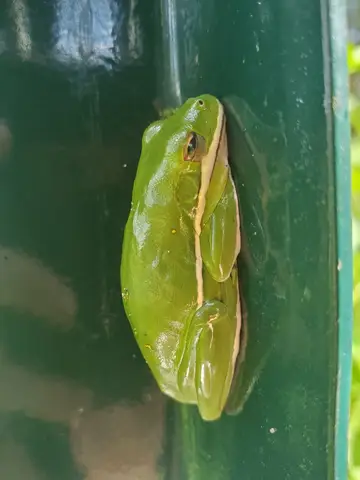
Missouri Department of Conservation calls both gray treefrogs gray, unlike the green treefrog, but its gray treefrog account says their color may be green to light greenish gray, gray, brown or dark brown, so color alone does not settle it. MDC: gray treefrogs have warty (granular) skin; the green treefrog's back is smooth and a light stripe runs from its upper lip down the side of the body.
Ohio: the call sounds like a finger rubbed over a comb's teeth, not a birdlike whistle.
Photos show typical adults; individuals vary. Never get close to compare.
When frogs and toads are active in Illinois
Records of frogs and toads in Illinois peak in April to June and August to September. They show when people record frogs and toads, not how many there are (about month bars).
JanFebMarAprMayJunJulAugSepOctNovDec
1,670 records of frogs and toads in Illinois by month (GBIF, CC0 and CC BY records).
Frog and toad breeding choruses may start as early as February. IDNR
How to report
Report mountain lion, black bear, gray wolf, feral swine, armadillo (north-central/northern counties) and nutria sightings to IDNR through Wildlife Illinois (wildlifeillinois.org/report-sightings/). Report spotted lanternfly with photos to [email protected]. Wildlife Illinois, website authorized by IDNR
“Key Characters: Two rows of square to rectangular black spots on back between wide dorsolateral folds that extend from eyes to hips; undersides of thighs bright yellow in life.”
“If you have recently seen a mountain lion, black bear, or gray wolf in Illinois, please report the sighting below to the Illinois Department of Natural Resources.”