No official source we use states whether this animal is venomous. That does not mean it is harmless: do not handle it.
Size
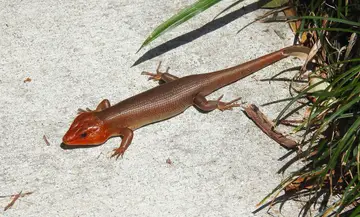
About 6.5 to 12.75 inches in total length. Oklahoma gives about 12 inches for large adults and SREL up to 13 inches. Males are larger than females.
How to recognize it
Large, wide head; breeding males have swollen orange-red jowls.
Smooth, glass-like scales, short legs and a stocky body.
Upper-lip scales separate it from five-lined skinks: Maryland, Tennessee and North Carolina count five labial scales between the nostril and the eye rather than four. Oklahoma and Missouri count differently, around 8 or 9 in the full lip row.
What the sources say
Habitat: Open forests and around barns and outbuildings near forest edge. (Illinois Natural History Survey (INHS), Prairie Research Institute, University of Illinois Urbana-Champaign)
No official source we use states whether this animal is venomous. That does not mean it is harmless: do not handle it.
Size
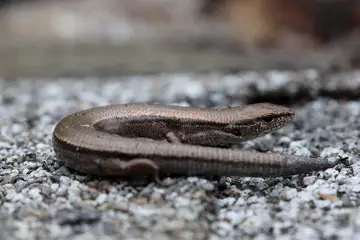
5 to 8.5 inches
How to recognize it
Smooth, shiny scales
Enlarged middle row of scales under the tail (separates it from the southeastern five-lined skink)
Tail breaks off easily and twitches to distract predators; it grows back shorter
JFMAMJJASOND
39 records by month.What the sources say
Habitat: Wooded habitats including dry uplands, floodplains, and hardwood swamps. Also found on abandoned buildings and around trash piles. (Illinois Natural History Survey (INHS), Prairie Research Institute, University of Illinois Urbana-Champaign)
No official source we use states whether this animal is venomous. That does not mean it is harmless: do not handle it.
Size
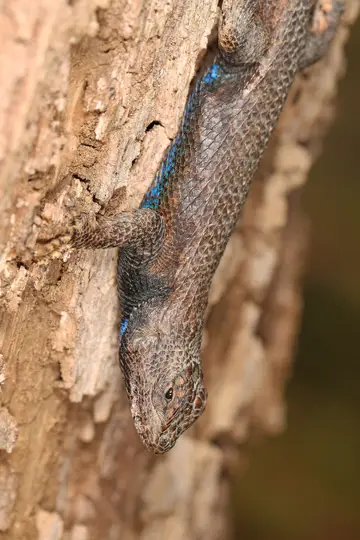
About 4 to 7.25 inches total length (SREL, Ohio DNR); Illinois gives up to about 19 cm (7.5 in).
How to recognize it
Rough, spiny, keeled scales: the only native lizard in North Carolina (and in Georgia and South Carolina) that looks rough or spiny
Often on fences, trees, logs, stumps, rocks and buildings; dashes up a tree and keeps to the far side when approached
What the sources say
Habitat: Rocky, wooded areas, dry hillsides, and sunny, open woodlots. (Illinois Natural History Survey (INHS), Prairie Research Institute, University of Illinois Urbana-Champaign)
No official source we use states whether this animal is venomous. That does not mean it is harmless: do not handle it.
What the sources say
Habitat: Sand prairies, hill prairies, and rocky open habitats. (Illinois Natural History Survey (INHS), Prairie Research Institute, University of Illinois Urbana-Champaign)
No official source we use states whether this animal is venomous. That does not mean it is harmless: do not handle it.
What the sources say
Habitat: Prairies, sand prairies, old fields, and dry open woodlands. (Illinois Natural History Survey (INHS), Prairie Research Institute, University of Illinois Urbana-Champaign)
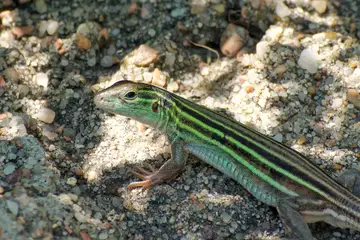
NCWRC: broadhead skinks reach a much larger size. ODWC: juveniles can be told apart by counting the upper lip scales (five-lined: seven, with two post-labials; broad-headed: nine, with no post-labials).
Photos show typical adults; individuals vary. Never get close to compare.
When lizards are active in Illinois
Records of lizards in Illinois peak in April to July. They show when people record lizards, not how many there are (about month bars).
JanFebMarAprMayJunJulAugSepOctNovDec
128 records of lizards in Illinois by month (GBIF, CC0 and CC BY records).
How to report
Report mountain lion, black bear, gray wolf, feral swine, armadillo (north-central/northern counties) and nutria sightings to IDNR through Wildlife Illinois (wildlifeillinois.org/report-sightings/). Report spotted lanternfly with photos to [email protected]. Wildlife Illinois, website authorized by IDNR
“If you have recently seen a mountain lion, black bear, or gray wolf in Illinois, please report the sighting below to the Illinois Department of Natural Resources.”