States Wildlife

Illinois Turtles: Identification Guide With Pictures

Last checked November 3, 2026 against official sources.

On this page
  1. Which turtles can hurt you
  2. All 17 turtles
  3. Lookalikes
  4. When they are active
  5. If you are bitten or stung
  6. About this list
  7. Sources

IDNR: Seventeen of these species inhabit Illinois

This page lists 17 turtles: all from IDNR's Wild About Illinois Turtles! - Gallery by Family and Species.

Which turtles can hurt you

Official sources single out these turtles in Illinois, in their own words:

All 17 turtles

From A to Z. Do not handle them.

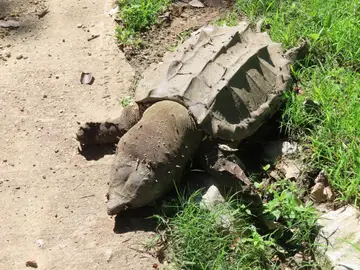
Alligator Snapping Turtle
Photo: Eric Schmidt · CC BY 4.0 · iNaturalist

Alligator Snapping Turtle

Macrochelys temminckii

Size
Usually 15 to 26 inches of shell and 35 to 150 pounds; males can reach 29 inches and 249 pounds, females about 22 inches and 62 pounds. Missouri records over 250 pounds.
How to recognize it
  • Three prominent ridges on the upper shell
  • Very large head with a sharp, strongly hooked beak
  • Extra row of scutes on each side of the shell
Conservation
Illinois endangered (Illinois E&T checklist, effective Oct 31, 2025: "Alligator Snapping Turtle Macrochelys temminckii")
What the sources say

Habitat: Chiefly riverine, but also oxbow lakes, cypress swamps, and canals. (Illinois Natural History Survey (INHS), Prairie Research Institute, University of Illinois Urbana-Champaign)

Full Alligator Snapping Turtle guide

No confirmed photo of Blanding’s Turtle

Blanding’s Turtle

Emydoidea blandingii

Conservation
Illinois endangered (Illinois E&T checklist, effective Oct 31, 2025: "Blanding's Turtle Emydoidea blandingii")
What the sources say

Habitat: Quiet waters in marshes, prairie wetlands, wet sedge meadows, and shallow, vegetated portions of lakes. (Illinois Natural History Survey (INHS), Prairie Research Institute, University of Illinois Urbana-Champaign)

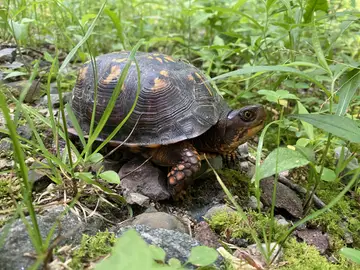
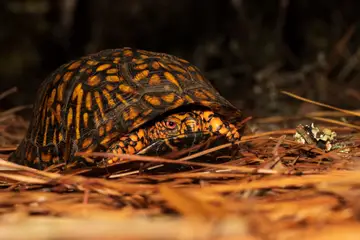
Eastern Box Turtle
Photo: Joshua Liverman · CC BY 4.0 · iNaturalist

Eastern Box Turtle

Terrapene carolina

Danger to people
“The flesh of eastern box turtles may be poisonous at times because their tissues store toxins of poisonous mushrooms that the turtle may eat.” IDNR
Size
Small: adult shell usually 4.5 to 6 inches; up to about 7 to 8 inches (Alabama, Virginia).
How to recognize it
  • High, domed upper shell
  • Hinged lower shell that closes the turtle in completely
  • Ridge (keel) down the center of the shell, more obvious in young
103 records by month.
What the sources say

Habitat: Forests and forest edges. (Illinois Natural History Survey (INHS), Prairie Research Institute, University of Illinois Urbana-Champaign)

Full Eastern Box Turtle guide

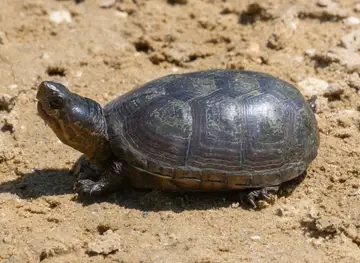
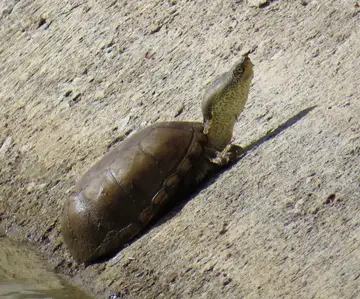
Eastern Mud Turtle
Photo: Jim Moore (Maryland) · CC BY 4.0 · iNaturalist

Eastern Mud Turtle

Kinosternon subrubrum

What the sources say

Habitat: Shallow stagnant or slow-moving temporary aquatic habitats: flatwoods, backwaters, oxbows, cypress swamps. (Illinois Natural History Survey (INHS), Prairie Research Institute, University of Illinois Urbana-Champaign)

Eastern Musk Turtle
Photo: Curtis Meyers · CC BY-SA 4.0 · iNaturalist · resized

Eastern Musk Turtle

Sternotherus odoratus

What the sources say

Habitat: Mud-bottomed habitats preferred (lakes, ponds, swamps, and slow-moving streams and rivers). (Illinois Natural History Survey (INHS), Prairie Research Institute, University of Illinois Urbana-Champaign)

No confirmed photo of False Map Turtle

False Map Turtle

Graptemys pseudogeographica

What the sources say

Habitat: Rivers and backwaters with mud bottoms and abundant basking sites. (Illinois Natural History Survey (INHS), Prairie Research Institute, University of Illinois Urbana-Champaign)

No confirmed photo of Northern Map Turtle

Northern Map Turtle

Graptemys geographica

What the sources say

Habitat: Slow-moving stretches and backwaters of rivers as well as large lakes. (Illinois Natural History Survey (INHS), Prairie Research Institute, University of Illinois Urbana-Champaign)

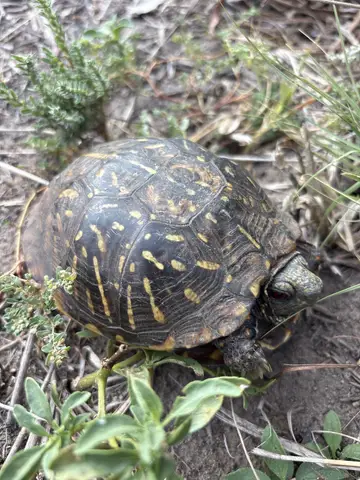
Ornate Box Turtle
Photo: Archer Silverman · CC BY 4.0 · iNaturalist

Ornate Box Turtle

Terrapene ornata

Conservation
Illinois threatened (Illinois E&T checklist, effective Oct 31, 2025: "Ornate Box Turtle Terrapene ornata")
What the sources say

Habitat: Sand prairies of central and northern Illinois, Southern Tillplain prairies (clay soil outlier prairies) and open fields in former prairie. (Illinois Natural History Survey (INHS), Prairie Research Institute, University of Illinois Urbana-Champaign)

No confirmed photo of Ouachita Map Turtle

Ouachita Map Turtle

Graptemys ouachitensis

What the sources say

Habitat: Rivers with sand or gravel bottoms. (Illinois Natural History Survey (INHS), Prairie Research Institute, University of Illinois Urbana-Champaign)

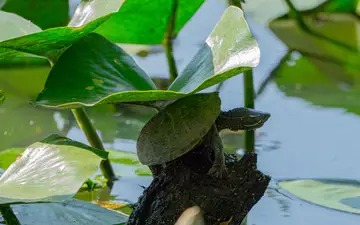
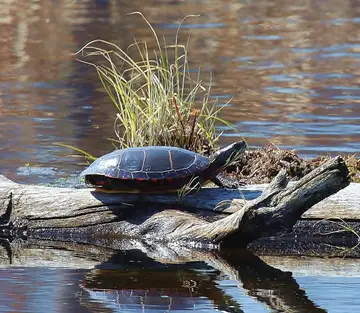
Painted Turtle
Photo: U. S. Fish and Wildlife Service - Northeast Region · Public domain · Wikimedia Commons

Painted Turtle

Chrysemys picta

Size
Small: adult shell usually 4 to 7 inches, up to about 10 inches; females are larger than males.
How to recognize it
  • Smooth, fairly flat shell with no keel and a smooth (not saw-toothed) rear edge
  • Red markings on the marginal shell plates
  • Yellow spot behind each eye and yellow stripes on the chin
306 records by month.
What the sources say

Habitat: Frequents most aquatic habitats but most common in shallow, quiet, weedy parts of lakes, ponds, marshes, and river backwaters. (Illinois Natural History Survey (INHS), Prairie Research Institute, University of Illinois Urbana-Champaign)

Full Painted Turtle guide

No confirmed photo of Pond Slider

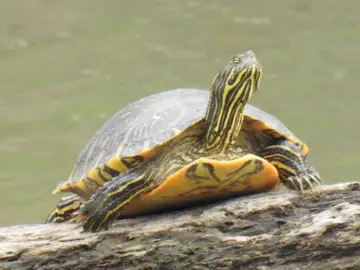
Pond Slider

Trachemys scripta

312 records by month.
What the sources say

Habitat: Most permanent bodies of water. Common in mud-bottomed sites rich in vegetation and basking structures. (Illinois Natural History Survey (INHS), Prairie Research Institute, University of Illinois Urbana-Champaign)

River Cooter
Photo: Sam Kieschnick · CC BY 4.0 · iNaturalist

River Cooter

Pseudemys concinna

Conservation
Illinois endangered (Illinois E&T checklist, effective Oct 31, 2025: "River Cooter Pseudemys concinna")
What the sources say

Habitat: Backwaters and oxbow lakes of large rivers and reservoirs. (Illinois Natural History Survey (INHS), Prairie Research Institute, University of Illinois Urbana-Champaign)

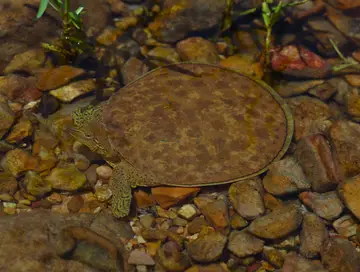
Smooth Softshell
Photo: Chrissy McClarren and Andy Reago · CC0 1.0 · iNaturalist

Smooth Softshell

Apalone mutica

Conservation
Illinois threatened (Illinois E&T checklist, effective Oct 31, 2025: "Smooth Softshell Apalone mutica")
What the sources say

Habitat: Rivers and large streams having sand substrate, bars, and banks. Unusual in lakes. (Illinois Natural History Survey (INHS), Prairie Research Institute, University of Illinois Urbana-Champaign)

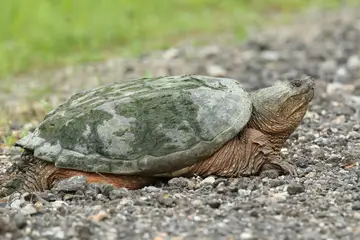
Snapping Turtle
Photo: Cephas · CC BY-SA 4.0 · Wikimedia Commons · resized

Snapping Turtle

Chelydra serpentina

Danger to people
“The animal is very aggressive out of water and will attempt to bite.” IDNR
Size
Upper shell usually 8 to 14 inches, occasionally to nearly 20; usually 10 to 35 lb, occasionally to 75 lb in the wild.
How to recognize it
  • Large head, long tail
  • Saw-toothed scales on the long tail
  • Small, cross-shaped lower shell
172 records by month.
What the sources say

Habitat: Almost any body of water. Shallow, mud-bottomed backwaters and ponds with lush aquatic vegetation are especially favorable. (Illinois Natural History Survey (INHS), Prairie Research Institute, University of Illinois Urbana-Champaign)

Full Snapping Turtle guide

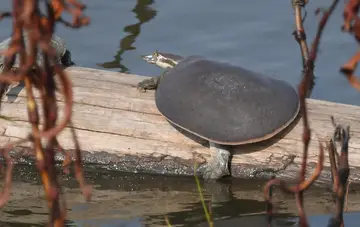
Spiny Softshell
Photo: Peter Paplanus · CC BY 2.0 · Wikimedia Commons

Spiny Softshell

Apalone spinifera

38 records by month.
What the sources say

Habitat: Rivers, backwaters, lakes, and ponds. (Illinois Natural History Survey (INHS), Prairie Research Institute, University of Illinois Urbana-Champaign)

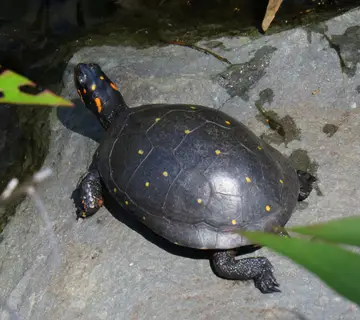
Spotted Turtle
Photo: Nick Block · CC BY 4.0 · iNaturalist

Spotted Turtle

Clemmys guttata

Conservation
Illinois endangered (Illinois E&T checklist, effective Oct 31, 2025: "Spotted Turtle Clemmys guttata")
What the sources say

Habitat: Shallow wetlands including sedge meadows adjoining cattail marshes, and wet dolomite prairies. (Illinois Natural History Survey (INHS), Prairie Research Institute, University of Illinois Urbana-Champaign)

Yellow Mud Turtle
Photo: Nick Block · CC BY 4.0 · iNaturalist

Yellow Mud Turtle

Kinosternon flavescens

Conservation
Illinois endangered (Illinois E&T checklist, effective Oct 31, 2025: "Yellow Mud Turtle Kinosternon flavescens")
What the sources say

Habitat: Temporary to permanent ponds and backwaters of rivers in sand prairies and deep sand soils. (Illinois Natural History Survey (INHS), Prairie Research Institute, University of Illinois Urbana-Champaign)

Turtles people confuse

Snapping Turtle or Alligator Snapping Turtle?

Snapping Turtle
Photo: Cephas · CC BY-SA 4.0 · Wikimedia Commons · resized

Snapping Turtle Not stated

Alligator Snapping Turtle
Photo: Eric Schmidt · CC BY 4.0 · iNaturalist

Alligator Snapping Turtle Not stated

Tennessee (TWRA): the alligator snapping turtle has a longer snout with a hooked beak, extra marginal scutes (shell-edge plates) and more conspicuous ridges on the shell. Missouri (MDC): its upper shell has 3 prominent ridges, one along the center line and one on either side, and its large head ends in a sharp, strongly hooked beak. Texas (TPWD): the common snapping turtle has an oval-shaped head and a comparatively smooth, rounded shell; the alligator snapper has three distinct ridges, a triangular head and a fleshy lure in its mouth. Caution: young common snapping turtles also have three keels on the shell (MDC, NCWRC, CT DEEP), so ridges alone do not separate small turtles.

Eastern box turtle or Ornate box turtle?

Eastern box turtle
Photo: Summit Metro Parks · CC BY-SA 4.0 · iNaturalist · resized

Eastern box turtle Not stated

Ornate box turtle
Photo: Archer Silverman · CC BY 4.0 · iNaturalist

Ornate box turtle Not stated

The ornate box turtle usually has no ridge down the shell and has many yellow lines radiating from the center of each shell plate; it is more of a grassland species.

Photos show typical adults; individuals vary. Never get close to compare.

When turtles are active in Illinois

Records of turtles in Illinois peak in April to July. They show when people record turtles, not how many there are (about month bars).

992 records of turtles in Illinois by month (GBIF, CC0 and CC BY records).
  • Turtles nest from mid-May to early July (often seen crossing roads in spring). IDNR

If you are bitten or stung

Call 911 or Poison Help at 1-800-222-1222 right away. Poison Help connects you to your local poison center, any time of day.
About this list

The species list comes from Wild About Illinois Turtles! - Gallery by Family and Species (IDNR) (Illinois Department of Natural Resources (IDNR), undated page; as retrieved 2026-11-03).

Venom labels come only from official sources and link to them; "Not stated" never means harmless. How labels work.

Sources

  1. IDNR Mission Statement. Illinois Department of Natural Resources (IDNR). undated page; checked November 3, 2026.
  2. Wild About Illinois Turtles! (gallery by family and species). Illinois Department of Natural Resources (IDNR). undated page; checked November 3, 2026.
    Quoted passages (3)
    “Seventeen of these species inhabit Illinois”
    “The flesh of eastern box turtles may be poisonous at times because their tissues store toxins of poisonous mushrooms that the turtle may eat.”
    “Egg-laying typically occurs between mid-May and early July.”
  3. Snapping Turtle (Wild About Illinois Turtles). Illinois Department of Natural Resources (IDNR). undated page; checked November 3, 2026.
    Quoted passages (1)
    “The animal is very aggressive out of water and will attempt to bite.”
  4. Snapping Turtle (Field Guide to Amphibians and Reptiles of Illinois). Illinois Natural History Survey (INHS), Prairie Research Institute, University of Illinois Urbana-Champaign. undated page; checked November 3, 2026.
  5. Alligator Snapping Turtle (Field Guide to Amphibians and Reptiles of Illinois). Illinois Natural History Survey (INHS), Prairie Research Institute, University of Illinois Urbana-Champaign. undated page; checked November 3, 2026.
  6. Painted Turtle (Field Guide to Amphibians and Reptiles of Illinois). Illinois Natural History Survey (INHS), Prairie Research Institute, University of Illinois Urbana-Champaign. undated page; checked November 3, 2026.
  7. Spotted Turtle (Field Guide to Amphibians and Reptiles of Illinois). Illinois Natural History Survey (INHS), Prairie Research Institute, University of Illinois Urbana-Champaign. undated page; checked November 3, 2026.
  8. Blanding's Turtle (Field Guide to Amphibians and Reptiles of Illinois). Illinois Natural History Survey (INHS), Prairie Research Institute, University of Illinois Urbana-Champaign. undated page; checked November 3, 2026.
  9. Northern Map Turtle (Field Guide to Amphibians and Reptiles of Illinois). Illinois Natural History Survey (INHS), Prairie Research Institute, University of Illinois Urbana-Champaign. undated page; checked November 3, 2026.
  10. Ouachita Map Turtle (Field Guide to Amphibians and Reptiles of Illinois). Illinois Natural History Survey (INHS), Prairie Research Institute, University of Illinois Urbana-Champaign. undated page; checked November 3, 2026.
  11. False Map Turtle (Field Guide to Amphibians and Reptiles of Illinois). Illinois Natural History Survey (INHS), Prairie Research Institute, University of Illinois Urbana-Champaign. undated page; checked November 3, 2026.
  12. River Cooter (Field Guide to Amphibians and Reptiles of Illinois). Illinois Natural History Survey (INHS), Prairie Research Institute, University of Illinois Urbana-Champaign. undated page; checked November 3, 2026.
  13. Eastern Box Turtle (Field Guide to Amphibians and Reptiles of Illinois). Illinois Natural History Survey (INHS), Prairie Research Institute, University of Illinois Urbana-Champaign. undated page; checked November 3, 2026.
  14. Ornate Box Turtle (Field Guide to Amphibians and Reptiles of Illinois). Illinois Natural History Survey (INHS), Prairie Research Institute, University of Illinois Urbana-Champaign. undated page; checked November 3, 2026.
  15. Pond Slider (Field Guide to Amphibians and Reptiles of Illinois). Illinois Natural History Survey (INHS), Prairie Research Institute, University of Illinois Urbana-Champaign. undated page; checked November 3, 2026.
  16. Yellow Mud Turtle (Field Guide to Amphibians and Reptiles of Illinois). Illinois Natural History Survey (INHS), Prairie Research Institute, University of Illinois Urbana-Champaign. undated page; checked November 3, 2026.
  17. Eastern Mud Turtle (Field Guide to Amphibians and Reptiles of Illinois). Illinois Natural History Survey (INHS), Prairie Research Institute, University of Illinois Urbana-Champaign. undated page; checked November 3, 2026.
  18. Eastern Musk Turtle (Field Guide to Amphibians and Reptiles of Illinois). Illinois Natural History Survey (INHS), Prairie Research Institute, University of Illinois Urbana-Champaign. undated page; checked November 3, 2026.
  19. Smooth Softshell Turtle (Field Guide to Amphibians and Reptiles of Illinois). Illinois Natural History Survey (INHS), Prairie Research Institute, University of Illinois Urbana-Champaign. undated page; checked November 3, 2026.
  20. Spiny Softshell Turtle (Field Guide to Amphibians and Reptiles of Illinois). Illinois Natural History Survey (INHS), Prairie Research Institute, University of Illinois Urbana-Champaign. undated page; checked November 3, 2026.
  21. GBIF.org occurrence records, human observations licensed CC0 1.0 or CC BY 4.0 only, accessed November 3, 2026. The datasets behind these counts are listed on our Sources page.