Eastern box turtle
Terrapene carolina · also called box turtle, woodland box turtle, three-toed box turtle and Gulf Coast box turtle · Last checked November 3, 2026.
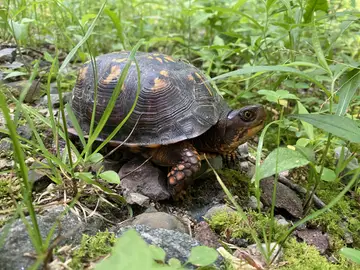
The eastern box turtle is a small land turtle with a high, domed shell marked with yellow or orange on brown or black. A hinge on the lower shell lets it close up completely. It lives in woods, fields and neighborhoods, and is most often seen in the morning or after summer rain. No official source checked addresses venom. CDC says even turtles without teeth can give painful bites that may spread germs, and that reptiles often carry Salmonella. It is native across the eastern US, west to Texas and Missouri, and is protected from collection or sale in many states. Virginia says it is illegal to possess one, and NCWRC says never relocate a box turtle or take one home as a pet. N.C. Wildlife Resources Commission
On this page
Is the eastern box turtle dangerous?
CDC: reptiles, including turtles, often carry Salmonella even when healthy. Wash your hands after handling reptiles or anything in their environment. Centers for Disease Control and Prevention
“Reptiles and amphibians often carry Salmonella bacteria in their digestive tracts. Even healthy reptiles and amphibians can carry the bacteria.”
Bites and stings: No official source checked describes box turtle bites specifically. CDC: even reptiles without teeth, like most turtles, can still give painful bites, and bites can spread germs.
How to identify an eastern box turtle
A photo or description can narrow it down, but cannot confirm what an animal is or that it is safe. Look from a distance and do not handle wild animals.
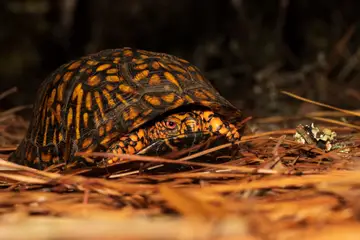

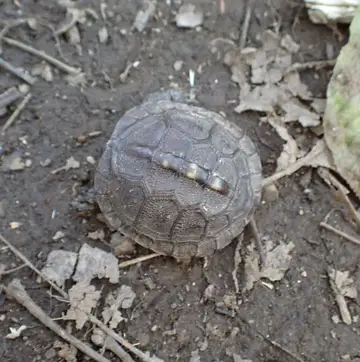
Size: Small: adult shell usually 4.5 to 6 inches; up to about 7 to 8 inches (Alabama, Virginia). Tennessee Wildlife Resources Agency
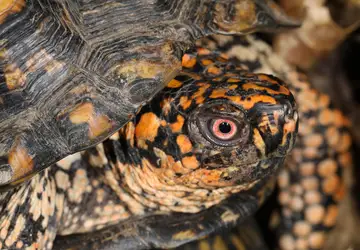
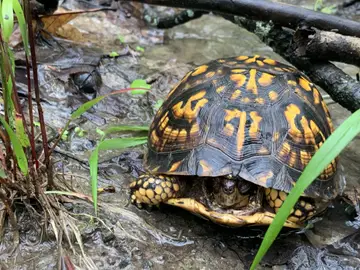
Colors: yellow to orange spots or blotches on a dark brown or black shell and skin; very variable; lower shell usually dark brown with yellow or orange blotches. Pattern: smudges, streaks, blotches or mottling on the shell.
Key features
- high, domed upper shell Pennsylvania Fish and Boat Commission
- hinged lower shell that closes the turtle in completely N.C. Wildlife Resources Commission
- ridge (keel) down the center of the shell, more obvious in young Tennessee Wildlife Resources Agency
- four toes on each hind foot (three-toed form usually three, sometimes four) N.C. Wildlife Resources Commission
- males usually have red or orange eyes, females brown N.C. Wildlife Resources Commission
Young
Hatchlings are about 1.5 inches long (Alabama), only slightly larger than a U.S. quarter (North Carolina), with a light yellow spot on each shell plate. They are secretive and seldom seen.
Animals mistaken for the eastern box turtle
Eastern box turtle or Ornate box turtle?
Eastern box turtle
Ornate box turtle Terrapene ornata
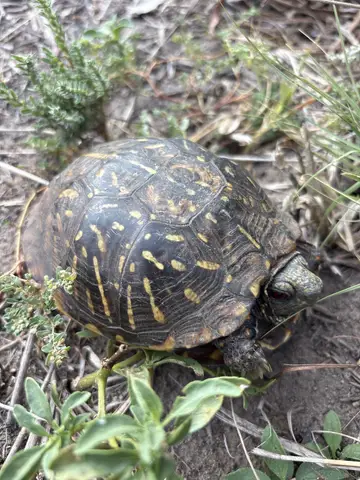
The ornate box turtle usually has no ridge down the shell and has many yellow lines radiating from the center of each shell plate; it is more of a grassland species. Missouri Department of Conservation
Not described as dangerous in the sources checked.
Eastern box turtle or Wood turtle?
Eastern box turtle
Wood turtle Glyptemys insculpta
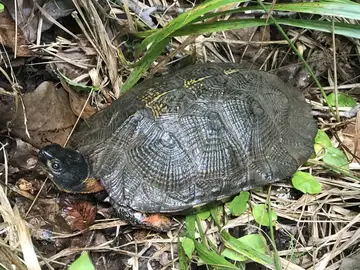
The wood turtle lacks the high-domed shell and the hinged lower shell. Virginia Department of Wildlife Resources
Not described as dangerous in the sources checked.
Eastern box turtle or Blanding's turtle?
Eastern box turtle
Blanding's turtle Emydoidea blandingii
Blanding's turtle has a bright yellow chin and throat and a hinged lower shell that cannot close as tightly as a box turtle's. Pennsylvania Fish and Boat Commission
Not described as dangerous in the sources checked.
Where the eastern box turtle lives
- Native or listed
- Nonnative or not established
- No official record in our data
- 1–9
- 10–99
- 100–999
- 1,000+
On our state guides
- Arkansas turtles
- Delaware turtles
- Florida turtles
- Georgia turtles
- Illinois turtles
- Indiana turtles
- Kentucky turtles
- Maine turtles
- Maryland turtles
- Massachusetts turtles
- Michigan turtles
- New Mexico turtles
- New York turtles
- Oklahoma turtles
- Rhode Island turtles
- South Carolina turtles
- Tennessee turtles
- Texas turtles
- Vermont turtles
State boundaries: U.S. Census Bureau, cartographic boundary file cb_2024_us_state_20m.
When it is active
Active from early spring to late fall (Missouri: early April to late October), in the morning or after summer rain; it spends the winter dug into soil under leaf litter. Pennsylvania Fish and Boat Commission
US open-licence records peak in May to August.
Habitat and habits
Habitat: Many kinds of woodland, including hardwood and mixed oak-pine forests, pine flatwoods, hardwood swamps and edges near farm fields; also fields and neighborhoods. In hot, dry weather it soaks in pools, mud or damp shade. Virginia Department of Wildlife Resources
Behavior: Our most land-dwelling turtle. Each turtle lives its whole life in a small home area (usually under 2 acres in North Carolina) and has a strong homing instinct. In summer heat it hides by day under rotting logs and leaves (Ohio). Many are killed crossing roads.
Diet: Omnivore: mushrooms, berries and other fruit, flowers, roots, snails, slugs, earthworms, insects, salamanders and carrion. Young turtles eat mostly animal food; adults eat more plants.
Young: Slow to reproduce: matures at about 6 to 20 years depending on the source and region and lays only a few eggs (about 2 to 8 per clutch) in a shallow nest in late spring or summer. Eggs take up to about 90 days to hatch; late nests may hatch the next spring.
Legal status and reporting
Federal: Not listed under the Endangered Species Act (USFWS ECOS: Eastern Box Turtle and Three-toed Box Turtle 'Not Listed'). ECOS
Protection: Protected from collection, possession or sale in many states. Virginia: illegal to possess. Georgia: may not be held as a pet. North Carolina: no open season, and possessing, buying or selling 5 or more is unlawful. Alabama: possessing more than one, or selling any, is unlawful without a permit. Missouri protects box turtles from being collected and sold as pets. Michigan lists it as state-threatened; New York and Pennsylvania as special concern; Ohio as a species of concern; Florida as a regulated species. Virginia Department of Wildlife Resources
Report: North Carolina asks the public to log box turtle sightings on HerpMapper, and says to contact a licensed reptile rehabilitator about an injured turtle. NCWRC: never relocate a box turtle or take it home; if you must move one off a road, carry it across in the direction it was heading. N.C. Wildlife Resources Commission
Questions about the eastern box turtle
Box turtle lifespan
Box turtles are long-lived. Virginia gives an average of 25 to 35 years; SREL says they certainly reach 50 years or more; Missouri says three-toed box turtles can live 50 to 80 years, with records of over 100.
Box turtle diet
Box turtles are omnivores. They eat mushrooms, berries and other fruit, flowers, roots, snails, slugs, earthworms, insects, salamanders and even carrion. Young turtles eat mostly animal food, and adults eat more plants.
Box turtle food
In the wild, box turtles eat fungi, berries, fruit, plants, earthworms, snails, slugs and insects (Alabama, Tennessee, Missouri). A Missouri study found mostly dogwood berries in fall and blackberries in summer.
Box turtle eggs
Females dig a shallow nest with their back legs and lay about 2 to 8 eggs (North Carolina: 3 to 6), sometimes in more than one clutch a year. The eggs take up to about 90 days to hatch, and late nests may not hatch until the next spring. NCWRC says no action is needed to protect a nest.
Box turtle habitat
Box turtles live in many kinds of woodland, forest edges and fields, and often in neighborhoods. In hot, dry weather they soak in puddles, mud or damp shade.
Box turtle enclosure
State agencies advise against keeping wild box turtles. Virginia says possessing one is illegal; Missouri says box turtles are hard to keep, may slowly starve or grow abnormally, and should not be kept in captivity; North Carolina says never take one home as a pet.
Sources
- Eastern Box Turtle (NCWRC species page). N.C. Wildlife Resources Commission. undated page; checked November 3, 2026.
Quoted passages (6)
“The single hinge on their plastron, or lower shell, allows complete closure and is located just behind their front legs.”
“They have four toes, without webbing, located on each hind foot.”
“Usually, but not always, males have orange or red eyes while females have brown eyes.”
“Box turtles spend their entire lives within a small territory (usually under 2 acres) and have very strong homing instincts.”
“Each spring, female box turtles lay 3-6 eggs in a shallow hole they’ve dug with their back legs.”
“If you find a turtle that has a cracked shell, is bleeding, or has other injuries, contact a licensed reptile rehabilitator for advice.”
- Eastern Box Turtle (Terrapene carolina). University of Georgia Savannah River Ecology Laboratory (linked by SCDNR as its species information). undated page; checked November 3, 2026.
- Reptiles » Turtles (Tennessee Watchable Wildlife species accounts). Tennessee Wildlife Resources Agency (Tennessee Watchable Wildlife website). undated page; checked November 3, 2026.
Quoted passages (3)
“A small, high-domed turtle (4.5 to 6.0 inches in length) with highly variable colors and patterns.”
“The carapace (upper shell) has a keel running down the center and is more pronounced in juveniles.”
“Young have a light yellow spot on each scute (plate).”
- Turtles (species accounts). Pennsylvania Fish and Boat Commission. undated page; checked November 3, 2026.
Quoted passages (3)
“The sharply rising dome-shaped upper shell is a good identifying characteristic.”
“It usually moves about in the early part of the day or soon after a summer rain.”
“The plastron is hinged so that it can be closed toward the carapace, but not to the extent the box turtle is able to close up.”
- Reptiles and Amphibians (Healthy Pets, Healthy People). Centers for Disease Control and Prevention. archived copy, captured October 10, 2026; checked November 3, 2026.
Quoted passages (1)
“Reptiles and amphibians often carry Salmonella bacteria in their digestive tracts. Even healthy reptiles and amphibians can carry the bacteria.”
- Woodland Box Turtle (Virginia DWR species profile). Virginia Department of Wildlife Resources. updated June 18, 2026; checked November 3, 2026.
Quoted passages (3)
“The Woodland Box Turtle occupies a variety of wooded habitats in Virginia, such as hardwood forests, mixed oak-pine forests, pine flatwoods, maritime oak forests, hardwood swamps, and edge habitat near agricultural areas.”
“The Woodland Box Turtle is illegal to possess in Virginia.”
“The Woodland Box Turtle is seldom confused with other Virginia species, with the exception of the Wood Turtle Glyptemys insculpta, which lacks the high-domed shell and the hinged plastron.”
- Three-Toed Box Turtle (MDC Field Guide). Missouri Department of Conservation. undated page; checked November 3, 2026.
Quoted passages (1)
“The ornate box turtle (T. ornata) usually has 4 toes on each hind leg, lacks a ridge along the center of the top shell, and the top shell is usually brown with numerous yellow lines radiating from the center of each plate.”
- Herps of Texas: Turtles of Texas. Herps of Texas, Biodiversity Collections, Dept. of Integrative Biology, The University of Texas at Austin. 2020-04-23 (archive capture date; checked November 3, 2026.
- Eastern Box Turtle. Alabama Department of Conservation and Natural Resources (Outdoor Alabama). undated page; checked November 3, 2026.
Quoted passages (1)
“Flowers, roots, fungi, berries, snails, slugs, insects, fish, frogs, salamanders, snakes, and eggs are all possible meals for box turtles.”
- USFWS ECOS species report: Scientific Name like 'Terrapene%' (ESA listing status). U.S. Fish and Wildlife Service (ECOS). database queried November 3, 2026; checked November 3, 2026.
Quoted passages (1)
“Terrapene carolina carolina”
- GBIF.org occurrence records, human observations licensed CC0 1.0 or CC BY 4.0 only, accessed November 3, 2026. The datasets behind these counts are listed on our Sources page.
- State boundaries: U.S. Census Bureau, cartographic boundary file cb_2024_us_state_20m.