States Wildlife

Texas Turtles: Identification Guide With Pictures

Last checked November 3, 2026 against official sources.

On this page
  1. All 29 turtles
  2. Lookalikes
  3. When they are active
  4. How to report
  5. About this list
  6. Sources

This page lists 29 turtles: all from Herps of Texas, Biodiversity Collections, Dept. of Integrative Biology, The University of Texas at Austin's Turtles of Texas.

All 29 turtles

From A to Z.

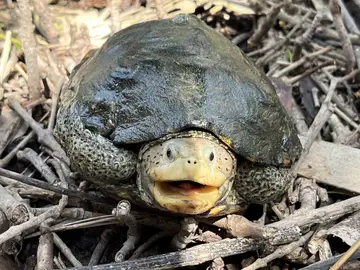
Alligator Snapping Turtle
Photo: Eric Schmidt · CC BY 4.0 · iNaturalist

Alligator Snapping Turtle

Macrochelys temminckii

Size
Usually 15 to 26 inches of shell and 35 to 150 pounds; males can reach 29 inches and 249 pounds, females about 22 inches and 62 pounds. Missouri records over 250 pounds.
How to recognize it
  • Three prominent ridges on the upper shell
  • Very large head with a sharp, strongly hooked beak
  • Extra row of scutes on each side of the shell

Full Alligator Snapping Turtle guide

No confirmed photo of Big Bend Slider

Big Bend Slider

Trachemys gaigae

No confirmed photo of Cagle's Map Turtle

Cagle's Map Turtle

Graptemys caglei

No confirmed photo of Chicken Turtle

Chicken Turtle

Deirochelys reticularia

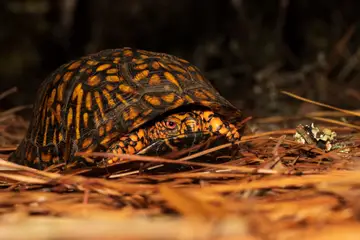
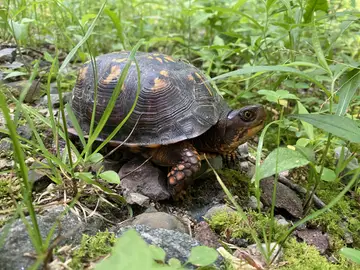
Eastern Box Turtle
Photo: Joshua Liverman · CC BY 4.0 · iNaturalist

Eastern Box Turtle

Terrapene carolina

Size
Small: adult shell usually 4.5 to 6 inches; up to about 7 to 8 inches (Alabama, Virginia).
How to recognize it
  • High, domed upper shell
  • Hinged lower shell that closes the turtle in completely
  • Ridge (keel) down the center of the shell, more obvious in young

Full Eastern Box Turtle guide

No confirmed photo of Green Sea Turtle

Green Sea Turtle

Chelonia mydas

Conservation
Threatened, Listed 7/28/1970 (TPWD fact sheet tx-tpwd-fs-greentur)
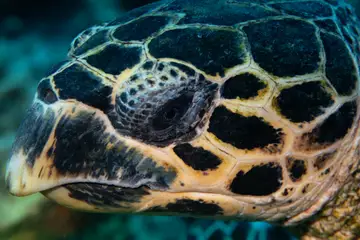
Hawksbill Sea Turtle
Photo: cello caruso-turiello · CC BY 4.0 · iNaturalist

Hawksbill Sea Turtle

Eretmochelys imbricata

Conservation
Endangered, Listed 6/02/1970 (TPWD fact sheet tx-tpwd-fs-seaturtle)
No confirmed photo of Kemp's Ridley Sea Turtle

Kemp's Ridley Sea Turtle

Lepidochelys kempii

Conservation
Endangered, Listed 12/02/1970 (TPWD fact sheet tx-tpwd-fs-ridley)
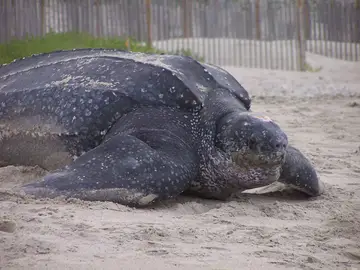
Leatherback Sea Turtle
Photo: Rabon David, U.S. Fish and Wildlife Service · Public domain · Wikimedia Commons

Leatherback Sea Turtle

Dermochelys coriacea

Size
Adults 5 to 6 feet long, 750 to 1,000 pounds (NOAA). Texas Parks and Wildlife cites weights up to 1,300 lb and shells up to 8 feet.
How to recognize it
  • The only sea turtle that lacks scales and a hard shell.
  • Front flippers proportionally longer than in other sea turtles; rear flippers paddle-shaped.
  • Usually a pink spot on top of the head that can identify individuals.
Conservation
Endangered, Listed 6/02/1970 (TPWD fact sheet tx-tpwd-fs-lethback)

Full Leatherback Sea Turtle guide

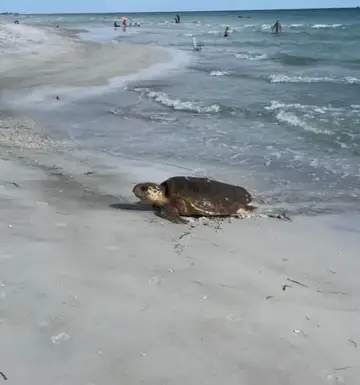
Loggerhead Sea Turtle
Photo: Kristiina Hurme · CC BY 4.0 · iNaturalist

Loggerhead Sea Turtle

Caretta caretta

Size
Adults 2.5 to 3.5 feet long and 200 to 350 pounds (NOAA). NCWRC gives 31 to 45 inches shell length and 170 to 350 pounds; SCDNR says adults can weigh as much as 300 pounds and reach up to four feet in shell length.
How to recognize it
  • Very large head with powerful jaws.
  • Slightly heart-shaped top shell.
  • Two pairs of scales (prefrontal scutes) between the eyes above the nostrils; two claws on each flipper.
Conservation
Threatened, Listed 7/28/1978 (TPWD fact sheet tx-tpwd-fs-logghead)

Full Loggerhead Sea Turtle guide

No confirmed photo of Mississippi Map Turtle

Mississippi Map Turtle

Graptemys kohni

No confirmed photo of Ouachita Map Turtle

Ouachita Map Turtle

Graptemys ouachitensis

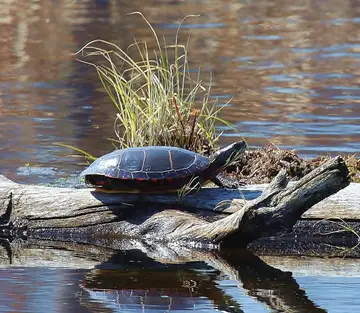
Painted Turtle
Photo: U. S. Fish and Wildlife Service - Northeast Region · Public domain · Wikimedia Commons

Painted Turtle

Chrysemys picta

Size
Small: adult shell usually 4 to 7 inches, up to about 10 inches; females are larger than males.
How to recognize it
  • Smooth, fairly flat shell with no keel and a smooth (not saw-toothed) rear edge
  • Red markings on the marginal shell plates
  • Yellow spot behind each eye and yellow stripes on the chin

Full Painted Turtle guide

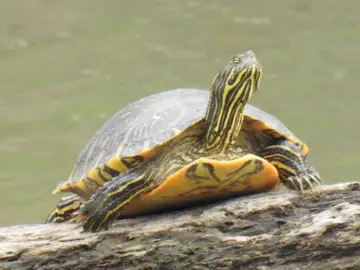
No confirmed photo of Pond Slider

Pond Slider

Trachemys scripta

3,956 records by month.
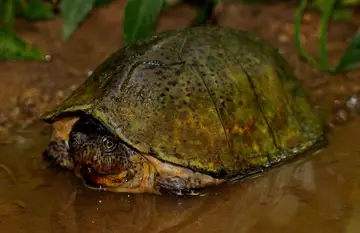
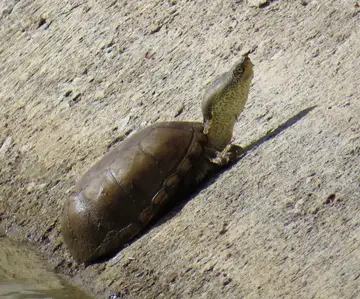
Razor-backed Musk Turtle
Photo: Peter Paplanus from St. Louis, Missouri · CC BY 2.0 · Wikimedia Commons

Razor-backed Musk Turtle

Sternotherus carinatus

No confirmed photo of Rio Grande Cooter

Rio Grande Cooter

Pseudemys gorzugi

River Cooter
Photo: Sam Kieschnick · CC BY 4.0 · iNaturalist

River Cooter

Pseudemys concinna

293 records by month.
No confirmed photo of Rough-footed Mud Turtle

Rough-footed Mud Turtle

Kinosternon hirtipes

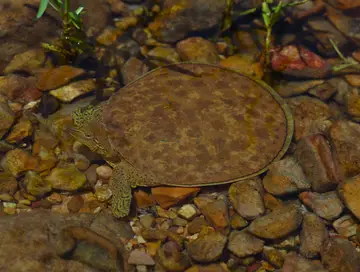
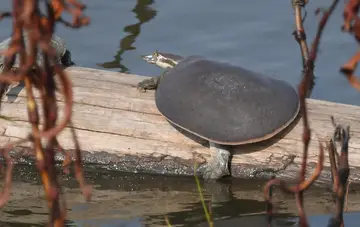
Smooth Softshell
Photo: Chrissy McClarren and Andy Reago · CC0 1.0 · iNaturalist

Smooth Softshell

Apalone mutica

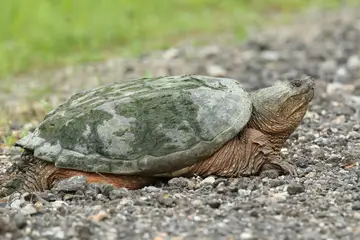
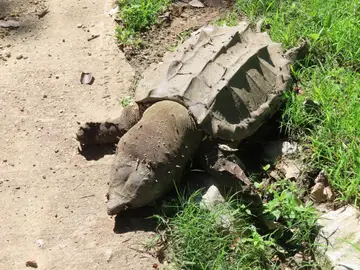
Snapping Turtle
Photo: Cephas · CC BY-SA 4.0 · Wikimedia Commons · resized

Snapping Turtle

Chelydra serpentina

Size
Upper shell usually 8 to 14 inches, occasionally to nearly 20; usually 10 to 35 lb, occasionally to 75 lb in the wild.
How to recognize it
  • Large head, long tail
  • Saw-toothed scales on the long tail
  • Small, cross-shaped lower shell
491 records by month.

Full Snapping Turtle guide

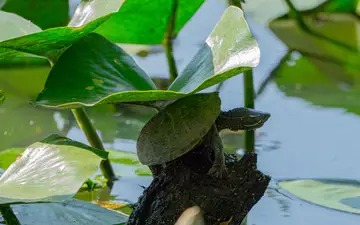
Stinkpot
Photo: Curtis Meyers · CC BY-SA 4.0 · iNaturalist · resized

Stinkpot

Sternotherus odoratus

92 records by month.
No confirmed photo of Texas Map Turtle

Texas Map Turtle

Graptemys versa

No confirmed photo of Texas River Cooter

Texas River Cooter

Pseudemys texana

No confirmed photo of Texas Tortoise

Texas Tortoise

Gopherus berlandieri

Conservation
This has resulted in its being listed in 1977 as a protected nongame (threatened) species (TPWD fact sheet tx-tpwd-fs-txtort)

Turtles people confuse

Loggerhead sea turtle or Leatherback sea turtle?

Loggerhead sea turtle
Photo: Kristiina Hurme · CC BY 4.0 · iNaturalist

Loggerhead sea turtle Not stated

Leatherback sea turtle
Photo: Rabon David, U.S. Fish and Wildlife Service · Public domain · Wikimedia Commons

Leatherback sea turtle Not stated

Adult leatherbacks differ from all other sea turtles, including the loggerhead, in their large size, spindle-shaped body and leathery shell without scales.

Snapping Turtle or Alligator Snapping Turtle?

Snapping Turtle
Photo: Cephas · CC BY-SA 4.0 · Wikimedia Commons · resized

Snapping Turtle Not stated

Alligator Snapping Turtle
Photo: Eric Schmidt · CC BY 4.0 · iNaturalist

Alligator Snapping Turtle Not stated

Tennessee (TWRA): the alligator snapping turtle has a longer snout with a hooked beak, extra marginal scutes (shell-edge plates) and more conspicuous ridges on the shell. Missouri (MDC): its upper shell has 3 prominent ridges, one along the center line and one on either side, and its large head ends in a sharp, strongly hooked beak. Texas (TPWD): the common snapping turtle has an oval-shaped head and a comparatively smooth, rounded shell; the alligator snapper has three distinct ridges, a triangular head and a fleshy lure in its mouth. Caution: young common snapping turtles also have three keels on the shell (MDC, NCWRC, CT DEEP), so ridges alone do not separate small turtles.

Eastern box turtle or Ornate box turtle?

Eastern box turtle
Photo: Summit Metro Parks · CC BY-SA 4.0 · iNaturalist · resized

Eastern box turtle Not stated

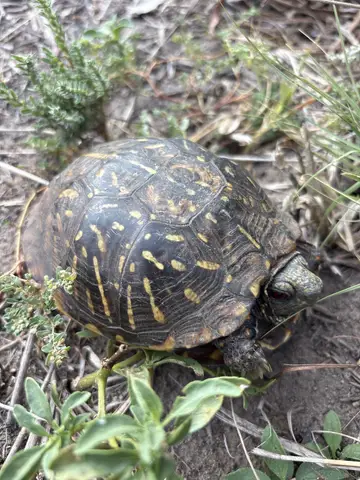
Ornate box turtle
Photo: Archer Silverman · CC BY 4.0 · iNaturalist

Ornate box turtle Not stated

The ornate box turtle usually has no ridge down the shell and has many yellow lines radiating from the center of each shell plate; it is more of a grassland species.

Photos show typical adults; individuals vary. Never get close to compare.

When turtles are active in Texas

Records of turtles in Texas peak in March to June and October. They show when people record turtles, not how many there are (about month bars).

7,377 records of turtles in Texas by month (GBIF, CC0 and CC BY records).

How to report

Aquatic invasive species: email [email protected] (TPWD). TPWD general phone: (512) 389-4800 or (800) 792-1112. Texas Parks and Wildlife Department

About this list

The species list comes from Turtles of Texas (Herps of Texas checklist, UT Austin) (Herps of Texas, Biodiversity Collections, Dept. of Integrative Biology, The University of Texas at Austin, 2020-04-23 (archive capture date; site says distributions based on Dixon 2013 and range extensions through Dec 2012)).

Venom labels come only from official sources and link to them; "Not stated" never means harmless. How labels work.

Sources

  1. Mission & Philosophy. Texas Parks and Wildlife Department. undated page; checked November 3, 2026.
  2. Herps of Texas: Turtles of Texas. Herps of Texas, Biodiversity Collections, Dept. of Integrative Biology, The University of Texas at Austin. 2020-04-23 (archive capture date; checked November 3, 2026.
  3. TPWD Wildlife Fact Sheet: Aquatic Invasive Species. Texas Parks and Wildlife Department. undated page; checked November 3, 2026.
    Quoted passages (1)
    “For information or to report sightings of aquatic invasive species, email [email protected].”
  4. GBIF.org occurrence records, human observations licensed CC0 1.0 or CC BY 4.0 only, accessed November 3, 2026. The datasets behind these counts are listed on our Sources page.