Leatherback sea turtle
Dermochelys coriacea · also called Leatherback turtle, Leatherback and Atlantic leatherback · Last checked November 3, 2026.
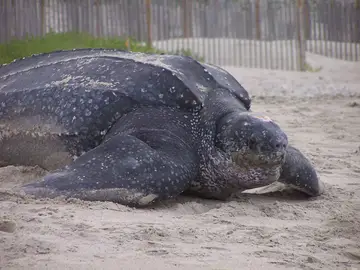

The leatherback is the largest turtle in the world: adults are 5 to 6 feet long and weigh 750 to 1,000 pounds. It is the only sea turtle without scales or a hard shell; instead it has tough, rubbery black skin with seven ridges along its back. It lives in the open ocean and visits US waters in the Atlantic, the Gulf and the Pacific. Most US nesting happens in Florida, Puerto Rico and the U.S. Virgin Islands. It is listed as endangered under the Endangered Species Act. None of the official sources we checked describe it as a danger to people; they focus on protecting it. NOAA Fisheries
On this page
Is the leatherback sea turtle dangerous?
How to identify a leatherback sea turtle
A photo or description can narrow it down, but cannot confirm what an animal is or that it is safe. Look from a distance and do not handle wild animals.
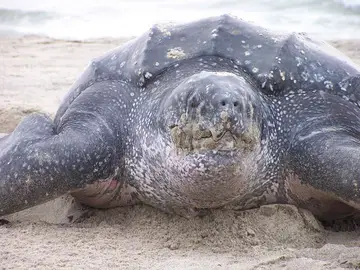

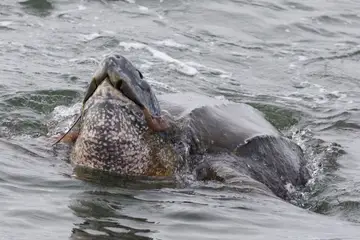
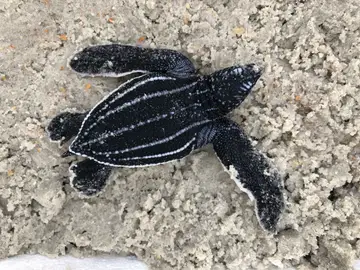
Size: Adults 5 to 6 feet long, 750 to 1,000 pounds (NOAA). Texas Parks and Wildlife cites weights up to 1,300 lb and shells up to 8 feet.
Colors: Mostly black, rubbery skin with pinkish-white underside; black skin with varying amounts of pale white spots. Pattern: Seven ridges run the length of the shell, which tapers to a blunt point.
Key features
- The only sea turtle that lacks scales and a hard shell. NOAA Fisheries
- Front flippers proportionally longer than in other sea turtles; rear flippers paddle-shaped. NOAA Fisheries
- Usually a pink spot on top of the head that can identify individuals. N.C. Wildlife Resources Commission
Animals mistaken for the leatherback sea turtle
Leatherback sea turtle or Other sea turtles (loggerhead, green, Kemp's ridley, hawksbill)?
Leatherback sea turtle
Other sea turtles (loggerhead, green, Kemp's ridley, hawksbill)
Adult leatherbacks differ from all other sea turtles in their large size, spindle-shaped body and leathery shell without scales. Texas Parks and Wildlife Department
Where the leatherback sea turtle lives
- Native or listed
- Nonnative or not established
- No official record in our data
- 1–9
- 10–99
- 100–999
- 1,000+
On our state guides
- Alabama turtles
- Alaska turtles
- California turtles
- Connecticut turtles
- Delaware turtles
- Florida turtles
- Georgia turtles
- Hawaii turtles
- Louisiana turtles
- Maine turtles
- Maryland turtles
- Massachusetts turtles
- Mississippi turtles
- New Jersey turtles
- New York turtles
- North Carolina turtles
- Oregon turtles
- Rhode Island turtles
- South Carolina turtles
- Texas turtles
- Virginia turtles
- Washington turtles
State boundaries: U.S. Census Bureau, cartographic boundary file cb_2024_us_state_20m.
When it is active
US and Caribbean nesting season runs March to July, with females nesting at night. Off North Carolina most are seen in spring and early summer while migrating north; South Carolina reports sea turtles in near-shore waters April through November.
US open-licence records peak in June to October.
Habitat and habits
Habitat: Mainly the open ocean; comes into coastal waters to breed or to follow jellyfish. Nests on tropical and subtropical beaches, preferring wide sandy beaches close to deep water.
Behavior: Highly migratory, some swimming over 10,000 miles a year; dives to about 4,000 feet and can stay down up to 85 minutes.
Diet: Soft-bodied open-ocean prey such as jellyfish and salps; tooth-like cusps and backward-pointing spines in the mouth and throat help hold them.
Young: Females nest every 2 to 4 years, several times a season at 8- to 12-day intervals, laying about 100 eggs per clutch; eggs incubate about two months.
Legal status and reporting
Federal: Endangered under the Endangered Species Act throughout its range; also CITES Appendix I. NOAA Fisheries
Protection: Protected species: in North Carolina it is federally and state-listed endangered, and it is illegal to kill, harm, collect, harass or sell them. N.C. Wildlife Resources Commission
Report: Report a stranded, injured, entangled or dead sea turtle to trained responders. NOAA lists: Southeast Sea Turtle Stranding and Salvage Network (844) SEA-TRTL (844-732-8785); Florida FWC (888) 404-FWCC (888-404-3922); Northeast hotline (866) 755-NOAA (866-755-6622); West Coast Region (866) 767-6114; Hawaii (888) 256-9840. NOAA Fisheries
Sources
- Leatherback Turtle (Species Directory). NOAA Fisheries. updated by NOAA Fisheries on 08/03/2026; checked November 3, 2026.
Quoted passages (6)
“They are the only species of sea turtle that lack scales and a hard shell.”
“Their front flippers are proportionally longer than in other sea turtles and their back flippers are paddle-shaped.”
“…a diet of soft-bodied open ocean prey such as jellyfish and salps”
“Leatherbacks are highly migratory, some swimming over 10,000 miles a year between nesting and foraging grounds. … can dive to depths of approximately 4,000 feet—deeper than any other turtle—and can stay down for up to 85 minutes.”
“Female leatherbacks return to nest every 2 to 4 years. Leatherbacks nest several times during a nesting season, typically at 8- to 12-day intervals and lay clutches of approximately 100 eggs. The eggs incubate approximately two months before leatherback hatchlings emerge from the nest.”
“The leatherback sea turtle is listed as endangered under the Endangered Species Act.”
- Leatherback Sea Turtle (NCWRC species page). N.C. Wildlife Resources Commission. undated page; checked November 3, 2026.
Quoted passages (2)
“Leatherbacks usually have a pronounced pink spot on the top of their heads, above their pineal gland.”
“It is a federally and state-listed endangered species. Because leatherback sea turtles are a protected species, it is illegal to kill, harm, collect, harass or sell them.”
- TPWD Wildlife Fact Sheet: Leatherback Sea Turtle (Dermochelys coriacea). Texas Parks and Wildlife Department. undated page; checked November 3, 2026.
Quoted passages (1)
“Adults can be distinguished from all other species of sea turtles by their large size, spindle-shaped bodies, and leathery, unscaled carapaces.”
- Report a Stranded or Injured Marine Animal. NOAA Fisheries. regional sections last updated 2024-04-30 to 2026-10-09; checked November 3, 2026.
- GBIF.org occurrence records, human observations licensed CC0 1.0 or CC BY 4.0 only, accessed November 3, 2026. The datasets behind these counts are listed on our Sources page.
- State boundaries: U.S. Census Bureau, cartographic boundary file cb_2024_us_state_20m.