Tennessee Wildlife Resources Agency: Wildlife Species in Tennessee … Currently, there are more than 325 species of fish, 89 mammals, 61 reptiles, 70 amphibians, and 340+ birds known to inhabit or migrate through Tennessee.
This page lists 16 turtles: all from Tennessee Wildlife Resources Agency's Reptiles » TURTLES.
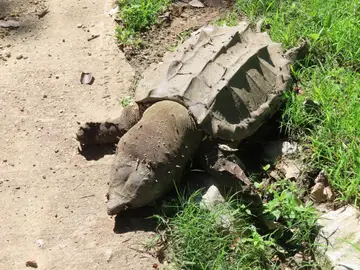
Usually 15 to 26 inches of shell and 35 to 150 pounds; males can reach 29 inches and 249 pounds, females about 22 inches and 62 pounds. Missouri records over 250 pounds.
How to recognize it
Three prominent ridges on the upper shell
Very large head with a sharp, strongly hooked beak
Extra row of scutes on each side of the shell
Where in Tennessee
Our largest turtle primarily occurs in the western third of the state with a few scattered records in central TN. Tennessee Wildlife Resources Agency
What the sources say
Habitat: Usually occurs in large and deep bodies of water such as lakes, large rivers, and deep sloughs; often among submerged logs or root snags. (Tennessee Wildlife Resources Agency)
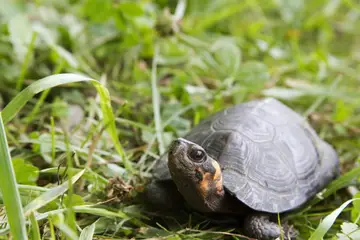
The Bog Turtle, which occurs in the extreme northeast corner of Tennessee, is Tennessee’s smallest and most threatened turtle. Formerly known as “Muhlenberg’s Turtle.” Tennessee Wildlife Resources Agency
What the sources say
Habitat: Prefers a specialized combination of open, shallow, wet areas with soft and muddy bottoms. Primarily in spaghnum bogs, wetlands, swamps, springs, and wet meadows; can occur up to 4000 feet. (Tennessee Wildlife Resources Agency)
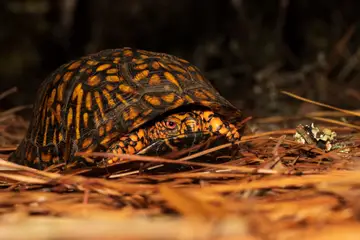
Range: This familiar, terrestrial turtle occurs across the entire state. Two subspecies are recognized in Tennessee: Eastern Box Turtle (T. c. carolina) and Three-toed Box Turtle (T. c. triunguis).
Habitat: Prefers moist, open forests often near water and floodplains. Occasionally found in pastures or burrowing beneath logs. (Tennessee Wildlife Resources Agency)
This semi-aquatic turtle occurs across Tennessee, except for the upper Cumberland and Tennessee River drainages … Tennessee Wildlife Resources Agency
What the sources say
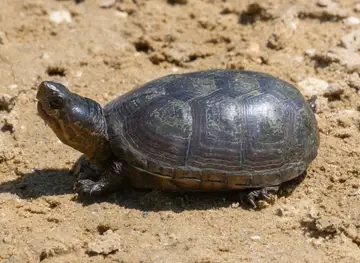
Range: This semi-aquatic turtle occurs across Tennessee, except for the upper Cumberland and Tennessee River drainages. Only one subspecies, Eastern Mud Turtle (K. s. subrubrum), is found in Tennessee; however the other 2 subspecies, Florida (K. s. steindachneri) and Mississippi Mud Turtle (K. s.hippocrepis), may hybridize with Eastern Mud Turtle along Mississippi River.
Habitat: Found in calm, shallow waters such as wetlands, ponds, ditches, and backwaters of rivers and streams. Prefers water with dense aquatic vegetation. (Tennessee Wildlife Resources Agency)
The Eastern Musk Turtle, also known as the “Stinkpot,” occurs from the Mississippi River to the Unaka Mountains; absent from many central and northeastern counties. Tennessee Wildlife Resources Agency
JFMAMJJASOND
31 records by month.What the sources say
Habitat: Prefers permanent water bodies with available shallow water and plentiful aquatic vegetation including rivers, streams, sloughs, and ditches. Also, found in temporary water pools, wetlands, and small ponds. (Tennessee Wildlife Resources Agency)
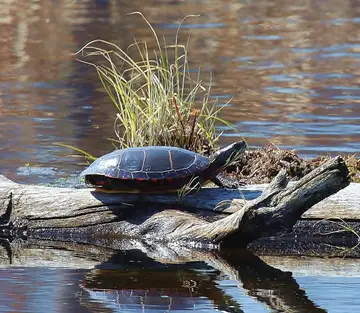
Photo: U. S. Fish and Wildlife Service - Northeast Region · Public domain · Wikimedia Commons
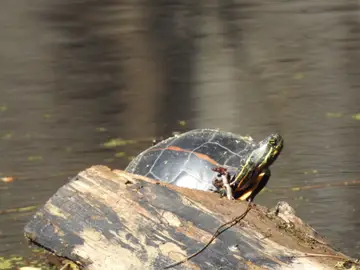
Small: adult shell usually 4 to 7 inches, up to about 10 inches; females are larger than males.
How to recognize it
Smooth, fairly flat shell with no keel and a smooth (not saw-toothed) rear edge
Red markings on the marginal shell plates
Yellow spot behind each eye and yellow stripes on the chin
Where in Tennessee
Two subspecies are recognized in TN: Eastern Painted Turtle (C. p. picta) and Midland Painted Turtle (C. p. marginata) … Tennessee Wildlife Resources Agency
JFMAMJJASOND
37 records by month.What the sources say
Range: Two subspecies are recognized in TN: Eastern Painted Turtle (C. p. picta) and Midland Painted Turtle (C. p. marginata). Eastern Painted occurs in the Blue Ridge Mountains, while Midland Painted occurs in the Tennessee River drainages.
Habitat: Prefers shallow bodies of water with soft, muddy bottoms and plentiful aquatic vegetation; examples include lakes, rivers, ponds, wetlands, ditches, oxbows, and reservoirs. (Tennessee Wildlife Resources Agency)
Two subspecies are recognized in TN: Mississippi Map Turtle (G. p. kohnii) and False Map Turtle (G. p. pseudogeographica) … Tennessee Wildlife Resources Agency
What the sources say
Range: Two subspecies are recognized in TN: Mississippi Map Turtle (G. p. kohnii) and False Map Turtle (G. p. pseudogeographica). False Map occurs in the Mississippi River in the northwestern corner of the state, while Mississippi Map Turtle occurs in the western section of the Tennessee River and the entire stretch of the Mississippi River in TN.
Habitat: Found in large rivers with slow currents and backwaters; also in lakes, ponds, sloughs, and oxbows. Prefers water with aquatic vegetation and numerous places to bask. (Tennessee Wildlife Resources Agency)
Habitat: Prefers larger bodies of water with aquatic vegetation such as lakes, rivers, sloughs, and large ponds. Commonly seen basking on fallen trees or logs. (Tennessee Wildlife Resources Agency)
Range: Found in the Mississippi, Tennessee, and Cumberland Rivers. One subspecies, Ouachita Map Turtle (G. o. ouachitensis), occurs in TN; formerly classified as a subspecies of the False Map Turtle (G. pseudogeographica pseudogeographica).
Habitat: Prefers large rivers and lakes with aquatic vegetation and plenty of basking sites. (Tennessee Wildlife Resources Agency)
No confirmed photo of Pond Slider
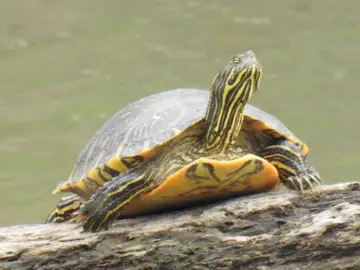
Pond Slider
Trachemys scripta
Where in Tennessee
Three subspecies are recognized in Tennessee: Red-eared Slider (T. s. elegans), Yellow-bellied Slider (T. s. scripta), and Cumberland Slider (T. s. troostii). Tennessee Wildlife Resources Agency
JFMAMJJASOND
567 records by month.What the sources say
Habitat: Prefers still waters such as ponds and lakes, but will also use slow-moving rivers, sloughs, and oxbow lakes. Aquatic vegetation, muddy bottoms, and abundant basking sites are important too. (Tennessee Wildlife Resources Agency)
Found in all major river systems across Tennessee. One subspecies, Eastern River Cooter (P. c. concinna), occurs in Tennessee. Tennessee Wildlife Resources Agency
JFMAMJJASOND
71 records by month.What the sources say
Habitat: Prefers large rivers and lakes, but frequently uses ponds, floodplain river pools, and wetlands. River Cooters are usually associated with water that has abundant aquatic vegetation and rocky bottoms. (Tennessee Wildlife Resources Agency)
Occurs in the northern parts of the state in the Tennessee and Cumberland River drainages, and the Reelfoot Lake area of the Mississippi River drainage … Tennessee Wildlife Resources Agency
What the sources say
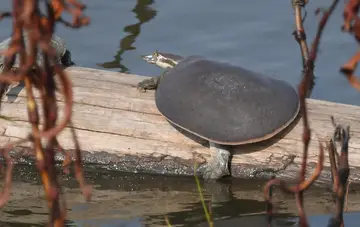
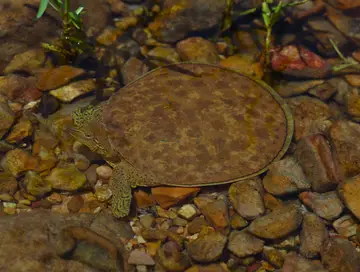
Range: Occurs in the northern parts of the state in the Tennessee and Cumberland River drainages, and the Reelfoot Lake area of the Mississippi River drainage. One subspecies, Midland Smooth Softshell (A. m. mutica), occurs in TN.
Habitat: Prefers large rivers with sandy or muddy bottoms; occasionally lakes. (Tennessee Wildlife Resources Agency)
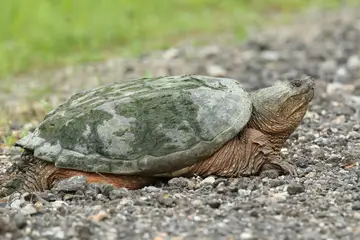
Upper shell usually 8 to 14 inches, occasionally to nearly 20; usually 10 to 35 lb, occasionally to 75 lb in the wild.
How to recognize it
Large head, long tail
Saw-toothed scales on the long tail
Small, cross-shaped lower shell
Where in Tennessee
Occurs across the state; only one subspecies, Eastern Snapping Turtle (C. s. serpentina), recognized in TN. Tennessee Wildlife Resources Agency
JFMAMJJASOND
123 records by month.What the sources say
Habitat: Typically found in any bodies of water including lakes, rivers, streams, wetlands, ponds, and vernal pools; but can be found on land as well. Snapping Turtles prefer muddy waters, or water with aquatic vegetation, for concealment purposes. Although not a habitat they use but for moving from one place to another, they are often seen crossing roads where they are frequently run over by cars. (Tennessee Wildlife Resources Agency)
Southern Painted Turtle was a subspecies of the Painted Turtle until recent genetic analysis indicated it was a distinct species … Tennessee Wildlife Resources Agency
What the sources say
Range: Southern Painted Turtle was a subspecies of the Painted Turtle until recent genetic analysis indicated it was a distinct species. It is thought that they occur mostly in the western Tennessee coastal plain based upon the preliminary morphological characteristics used in identification.
Habitat: Prefers shallow bodies of water with soft, muddy bottoms and plentiful aquatic vegetation; examples include lakes, rivers, ponds, wetlands, ditches, oxbows, and reservoirs. (Tennessee Wildlife Resources Agency)
Habitat: Found in large rivers and streams mostly, but also lakes, ponds, and marshes. Prefers clear, sandy or muddy bottomed rivers with a little vegetation. Basks on fallen trees, sandbars, or rock ledges. (Tennessee Wildlife Resources Agency)
Found east of the Tennessee River (western middle Tennessee portion) with the exception of the Cumberland River drainage … Tennessee Wildlife Resources Agency
What the sources say
Range: Found east of the Tennessee River (western middle Tennessee portion) with the exception of the Cumberland River drainage. The Stripe-necked Musk Turtle (S. m. peltifer) is the only subspecies of Loggerhead Musk Turtle that occurs in Tennessee.
Habitat: Occurs in creeks, springs, ponds, rivers, and wetlands. Commonly found around snags and fallen trees over a soft substrate. (Tennessee Wildlife Resources Agency)
Tennessee (TWRA): the alligator snapping turtle has a longer snout with a hooked beak, extra marginal scutes (shell-edge plates) and more conspicuous ridges on the shell. Missouri (MDC): its upper shell has 3 prominent ridges, one along the center line and one on either side, and its large head ends in a sharp, strongly hooked beak. Texas (TPWD): the common snapping turtle has an oval-shaped head and a comparatively smooth, rounded shell; the alligator snapper has three distinct ridges, a triangular head and a fleshy lure in its mouth. Caution: young common snapping turtles also have three keels on the shell (MDC, NCWRC, CT DEEP), so ridges alone do not separate small turtles. Tennessee Wildlife Resources Agency
Painted turtle or Southern painted turtle?
Photo: U. S. Fish and Wildlife Service - Northeast Region · Public domain · Wikimedia Commons
The southern painted turtle has a bold red, orange or yellow stripe down the middle of the shell and a plain yellow plastron; Tennessee says a genetic test is needed to be certain. Tennessee Wildlife Resources Agency
Photos show typical adults; individuals vary. Never get close to compare.
When turtles are active in Tennessee
Records of turtles in Tennessee peak in March and May to August. They show when people record turtles, not how many there are (about month bars).
JanFebMarAprMayJunJulAugSepOctNovDec
1,404 records of turtles in Tennessee by month (GBIF, CC0 and CC BY records).
How to report
TWRA "Report Wildlife Encounters, Incidents, or Illness" page (https://www.tn.gov/twra/wildlife/report-wildlife.html): bear conflicts (800) 831-1174; online forms for bear sightings, sick deer, and dead or sick birds. Rare birds: [email protected] (2013 checklist). Aquatic invasive species: TWRA directs people to its Invasive Fish Species page. Tennessee Wildlife Resources Agency
“Marginal scutes (plates) have prominent red coloration.”
“The sides of the head and chin have yellow striping and a noticeable yellow spot occurs behind each eye.”
“The carapace (upper shell) has a keel running down the center and is more pronounced in juveniles.”
“A small, high-domed turtle (4.5 to 6.0 inches in length) with highly variable colors and patterns.”
“Similar Species: Alligator Snapping Turtle has longer snout with hooked beak, extra marginal scutes, and more conspicuous ridges on the shell.”
“Southern Painted Turtle usually has a prominent red or orangish stripe running down the center of the back and a yellow plastron, but genetic analysis is required to positively distinguish from Painted Turtle.”
Wildlife Species in Tennessee. Tennessee Wildlife Resources Agency. archived copy, captured August 11, 2026; checked November 3, 2026.Quoted passages (1)
“Wildlife Species in Tennessee … Currently, there are more than 325 species of fish, 89 mammals, 61 reptiles, 70 amphibians, and 340+ birds known to inhabit or migrate through Tennessee.”