No official source we use states whether this animal is venomous. That does not mean it is harmless: do not handle it.
Size
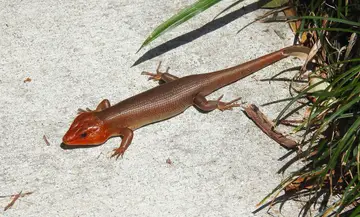
About 6.5 to 12.75 inches in total length. Oklahoma gives about 12 inches for large adults and SREL up to 13 inches. Males are larger than females.
How to recognize it
Large, wide head; breeding males have swollen orange-red jowls.
Smooth, glass-like scales, short legs and a stocky body.
Upper-lip scales separate it from five-lined skinks: Maryland, Tennessee and North Carolina count five labial scales between the nostril and the eye rather than four. Oklahoma and Missouri count differently, around 8 or 9 in the full lip row.
What the sources say
Habitat: This skink is essentially a woodland inhabitant. It is found only in several counties in the south- ern half of the state and is rare even there. Occasionally, broad-headed skinks can be observed high in the branches of dead trees. It has the distinction of being the most arbore- al of our four species of skinks. (Ohio Department of Natural Resources, Division of Wildlife)
Range: The lizards can now be found in several areas in Hamilton, Butler, and Clermont Counties and have established themselves in neighboring Kentucky and Indiana, with population densities of 1,500 per acre in good habitat.
Habitat: The lizards are pri- marily found along old rock walls, railroad tracks, refuse piles, or oc- casionally in rocky ravines. Because they have persisted for many years and survived through record-setting severe winters, they are considered permanent residents. (Ohio Department of Natural Resources, Division of Wildlife)
No official source we use states whether this animal is venomous. That does not mean it is harmless: do not handle it.
Size
5 to 8.5 inches
How to recognize it
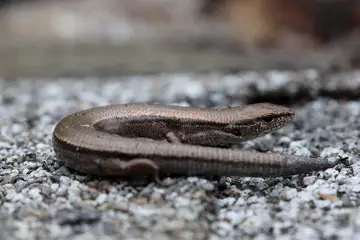
Smooth, shiny scales
Enlarged middle row of scales under the tail (separates it from the southeastern five-lined skink)
Tail breaks off easily and twitches to distract predators; it grows back shorter
JFMAMJJASOND
96 records by month.What the sources say
Habitat: Five-lined skinks occur throughout Ohio. They can often be located under the bark of decaying logs, in stumps, rock and log piles, and decaying plant material as well as abandoned farm buildings and roadside debris. Plestiodon fasciatus (Ohio Department of Natural Resources, Division of Wildlife)
No official source we use states whether this animal is venomous. That does not mean it is harmless: do not handle it.
Size
About 4 to 7.25 inches total length (SREL, Ohio DNR); Illinois gives up to about 19 cm (7.5 in).
How to recognize it
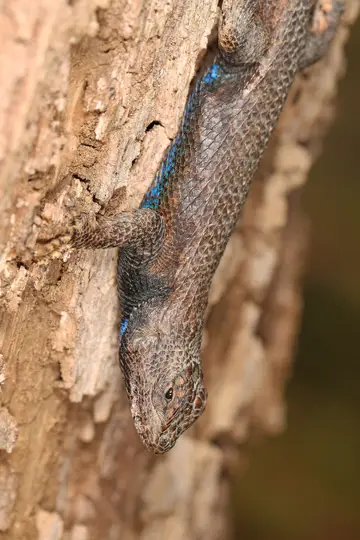
Rough, spiny, keeled scales: the only native lizard in North Carolina (and in Georgia and South Carolina) that looks rough or spiny
Often on fences, trees, logs, stumps, rocks and buildings; dashes up a tree and keeps to the far side when approached
What the sources say
Habitat: Although found in a variety of habitats, fence lizards seem to prefer the dry, wooded hillsides and rocky cliffs that characterize most of unglaciated Ohio. (Ohio Department of Natural Resources, Division of Wildlife)
No official source we use states whether this animal is venomous. That does not mean it is harmless: do not handle it.
What the sources say
Habitat: This very small skink is limited to the extreme southern part of the state where it seems to prefer open areas in or adjacent to woods. It may be found by turning over large stones and by sifting through fallen leaves. Although it is one of the least common lizards encoun- tered in Ohio, it may be abundant where it is found. (Ohio Department of Natural Resources, Division of Wildlife)
NCWRC: broadhead skinks reach a much larger size. ODWC: juveniles can be told apart by counting the upper lip scales (five-lined: seven, with two post-labials; broad-headed: nine, with no post-labials).
Photos show typical adults; individuals vary. Never get close to compare.
When lizards are active in Ohio
Records of lizards in Ohio peak in April to July. They show when people record lizards, not how many there are (about month bars).
JanFebMarAprMayJunJulAugSepOctNovDec
217 records of lizards in Ohio by month (GBIF, CC0 and CC BY records).
How to report
ODNR Division of Wildlife: 1-800-WILDLIFE (Wildlife headquarters and district offices are listed in the 2018 Reptiles of Ohio guide). An older undated ODNR brochure (Pub 115) asks people to report timber rattlesnake sightings by mail to the Division of Wildlife, 360 E. State Street, Athens, OH 45701; that address may be out of date. Ohio Department of Natural Resources, Division of Wildlife
What official sources say
Are there lizards in Ohio?
Yes. ODNR lists five lizards: Eastern Fence Lizard, Little Brown Skink, Common Five-lined Skink, Broad-headed Skink and the invasive Common Wall Lizard (Cincinnati area). The broad-headed skink is the largest. Ohio Department of Natural Resources, Division of Wildlife
“The broad-headed skink is the largest lizard in Ohio.”