States Wildlife

Ohio Turtles: Identification Guide With Pictures

Last checked November 3, 2026 against official sources.

On this page
  1. All 11 turtles
  2. When they are active
  3. About this list
  4. Sources

This page lists 11 turtles: all from Ohio Department of Natural Resources, Division of Wildlife's Reptiles of Ohio Field Guide.

All 11 turtles

From A to Z.

No confirmed photo of Blanding's Turtle

Blanding's Turtle

Emydoidea blandingii

Conservation
Ohio threatened
What the sources say

Habitat: Ohio’s Blanding’s turtles are limited primarily to the northern counties along Lake Erie, where they inhabit the marshy shorelines, inland streams, wet meadows, and swamp forests. Although essentially aquatic, the Blanding’s turtle often travels over- land as it moves among different wetlands throughout the year. (Ohio Department of Natural Resources, Division of Wildlife)

Eastern Musk Turtle
Photo: Curtis Meyers · CC BY-SA 4.0 · iNaturalist · resized

Eastern Musk Turtle

Sternotherus odoratus

41 records by month.
What the sources say

Habitat: Musk turtles seem to prefer deep, still water in lakes, ponds, and sluggish streams with muddy bottoms and an abundance of plant life. Like snapping turtles, musk turtles are strongly aquatic and are seldom observed out of water except to lay eggs, or occasionally during early spring to bask in the sun. (Ohio Department of Natural Resources, Division of Wildlife)

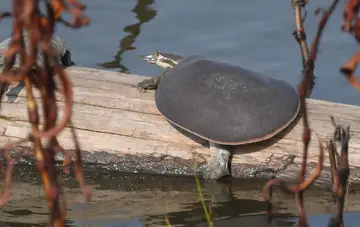
Eastern Spiny Softshell
Photo: Peter Paplanus · CC BY 2.0 · Wikimedia Commons

Eastern Spiny Softshell

Apalone spinifera spinifera

Conservation
common/game
What the sources say

Habitat: Although it can be found in lakes and smaller streams, the Eastern spiny softshell is essentially a river turtle. It prefers relatively shallow water with a sand or soft mud bottom. A common habit of the softshell is to settle on the bottom by rocking from side to side, while flipping sand and mud up onto its back, com- pletely burying itself.PHOTO BY: ©MATT JEPPSON (Ohio Department of Natural Resources, Division of Wildlife)

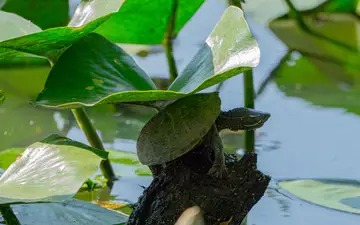
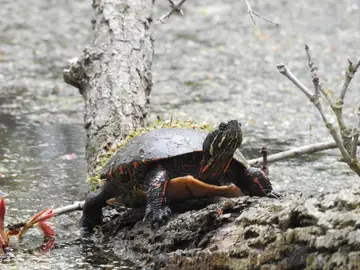
Midland Painted Turtle
Photo: sudomir · CC BY 4.0 · iNaturalist

Midland Painted Turtle

Chrysemys picta marginata

What the sources say

Habitat: They are particularly fond of basking and can be seen by the dozens on logs and along the banks of most bodies of water through the summer and even during warm winter days. With the coming of winter, midland painted turtles seek deep water and burrow into the mud or debris at the bottom. (Ohio Department of Natural Resources, Division of Wildlife)

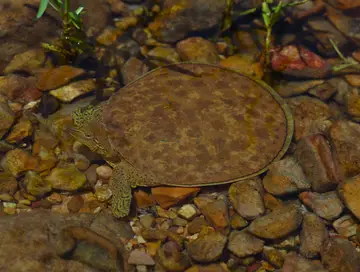
Midland Smooth Softshell
Photo: Chrissy McClarren and Andy Reago · CC0 1.0 · iNaturalist

Midland Smooth Softshell

Apalone mutica mutica

Conservation
common/game
What the sources say

Habitat: The midland smooth softshell is limited primarily to southern and southeastern Ohio where it inhabits the larger tributaries of the Ohio River, particularly the Scioto River. They are especially fond of shallow water areas along sandbars. Juvenile (Ohio Department of Natural Resources, Division of Wildlife)

No confirmed photo of Northern Map Turtle

Northern Map Turtle

Graptemys geographica

What the sources say

Habitat: Map turtles are extremely wary and show a marked preference for sizable bodies of deep water, such as large rivers and lakes, where they can dive to the safety of the depths. The broad, flat crushing surfaces of the powerful jaws are well suited for consuming snails, crayfish, and clams, which form the bulk of the diet. Map turtles may be active year-round. (Ohio Department of Natural Resources, Division of Wildlife)

No confirmed photo of Ouachita Map Turtle

Ouachita Map Turtle

Graptemys ouachitensis

Conservation
Ohio species of concern
What the sources say

Habitat: Previously thought to be limited to the lower reaches of the Scioto River, recent surveys reported the Ouachita map turtle in the Muskingum and Great Miami Rivers, indicating its distribution may be more widespread.PHOTO BY: ©SHUTTERSTOCK.COM (Ohio Department of Natural Resources, Division of Wildlife)

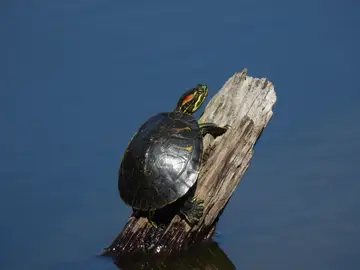
Red-eared Slider
Photo: ncb1221 · CC BY 4.0 · iNaturalist

Red-eared Slider

Trachemys scripta elegans

What the sources say

Habitat: Although these turtles are common in areas far south of Ohio, isolated communities have been discovered in some northern states. Whether released captives or remnants of an ancient popu- lation from a warmer age, they manage to hold their own. This turtle is also fond of basking and can be seen on logs and along the banks of many types of bodies of water through the summer.PHOTOS BY: ©NINA HARFMANN Red-ear detail (Ohio Department of Natural Resources, Division of Wildlife)

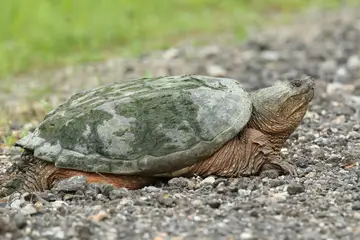
Snapping Turtle
Photo: Cephas · CC BY-SA 4.0 · Wikimedia Commons · resized

Snapping Turtle

Chelydra serpentina

Size
Upper shell usually 8 to 14 inches, occasionally to nearly 20; usually 10 to 35 lb, occasionally to 75 lb in the wild.
How to recognize it
  • Large head, long tail
  • Saw-toothed scales on the long tail
  • Small, cross-shaped lower shell
Conservation
common/game
517 records by month.
What the sources say

Habitat: Found in permanent bodies of water, as well as ephemeral wetlands and ditches. Snappers seldom bask in the sun except in early spring; therefore, though they are very abundant they are not seen as frequently as most other turtles. From May through June, females may be seen crossing roads in search of sites to lay their eggs. (Ohio Department of Natural Resources, Division of Wildlife)

Full Snapping Turtle guide

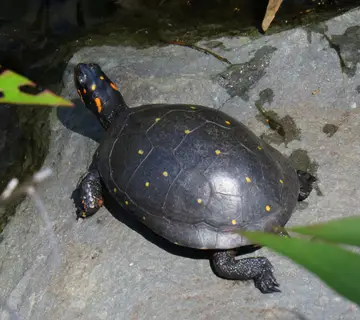
Spotted Turtle
Photo: Nick Block · CC BY 4.0 · iNaturalist

Spotted Turtle

Clemmys guttata

Conservation
Ohio threatened
What the sources say

Habitat: This handsome turtle shows a marked preference for the shallow, sluggish waters of wet prairies and meadows, fens, bogs, marshes, small streams, ditches, and pond edges, especially where vegetation is abundant. It occasion- ally wanders away from water and lives in wet woods. (Ohio Department of Natural Resources, Division of Wildlife)
Woodland Box Turtle
Photo: Summit Metro Parks · CC BY-SA 4.0 · iNaturalist · resized

Woodland Box Turtle

Terrapene carolina carolina

Conservation
Ohio species of concern
What the sources say

Habitat: Found in woodlands throughout Ohio, the box turtle is our most terrestrial turtle. During the heat of summer, this docile animal spends the day hidden beneath rotting logs, decaying leaves, and other plant debris, ven- turing out only during early morn- ing or evening. A sudden shower after a dry spell will usually bring out box turtles in large numbers.PHOTO BY: ©NINA HARFMANN (Ohio Department of Natural Resources, Division of Wildlife)
When turtles are active in Ohio

Records of turtles in Ohio peak in April to June. They show when people record turtles, not how many there are (about month bars).

2,827 records of turtles in Ohio by month (GBIF, CC0 and CC BY records).

About this list

The species list comes from Reptiles of Ohio Field Guide (ODNR Division of Wildlife Publication 5354) (Ohio Department of Natural Resources, Division of Wildlife, Publication 5354 (0118), "Publication date: 2/18"; retrieved 2026-11-03).

Venom labels come only from official sources and link to them; "Not stated" never means harmless. How labels work.

Sources

  1. Reptiles of Ohio Field Guide (Publication 5354). Ohio Department of Natural Resources, Division of Wildlife. PUBLICATION 5354; checked November 3, 2026.
  2. GBIF.org occurrence records, human observations licensed CC0 1.0 or CC BY 4.0 only, accessed November 3, 2026. The datasets behind these counts are listed on our Sources page.