States Wildlife

Delaware Lizards: Identification Guide With Pictures

Last checked November 3, 2026 against official sources.

On this page
  1. All 5 lizards
  2. Lookalikes
  3. When they are active
  4. How to report
  5. About this list
  6. Sources

This page lists 5 lizards: 2 from DNREC's Amphibians and Reptiles SGCN table + USFWS Bombay Hook NWR Amphibians and Reptiles and 3 named in other official sources. 1 is nonnative.

All 5 lizards

From A to Z.

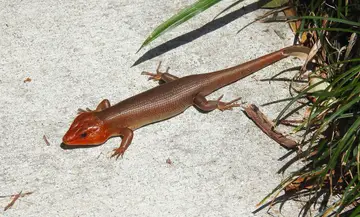
Broad-headed Skink
Photo: Laura Gaudette · CC BY 4.0 · iNaturalist

Broad-headed Skink

Plestiodon laticeps

Not stated

Venom
No official source we use states whether this animal is venomous. That does not mean it is harmless: do not handle it.
Size
About 6.5 to 12.75 inches in total length. Oklahoma gives about 12 inches for large adults and SREL up to 13 inches. Males are larger than females.
How to recognize it
  • Large, wide head; breeding males have swollen orange-red jowls.
  • Smooth, glass-like scales, short legs and a stocky body.
  • Upper-lip scales separate it from five-lined skinks: Maryland, Tennessee and North Carolina count five labial scales between the nostril and the eye rather than four. Oklahoma and Missouri count differently, around 8 or 9 in the full lip row.

Full Broad-headed Skink guide

No confirmed photo of Five-lined Skink

Five-lined Skink

Eumeces fasciatus

Not stated

Venom
No official source we use states whether this animal is venomous. That does not mean it is harmless: do not handle it.
Size
5 to 8.5 inches
How to recognize it
  • Smooth, shiny scales
  • Enlarged middle row of scales under the tail (separates it from the southeastern five-lined skink)
  • Tail breaks off easily and twitches to distract predators; it grows back shorter
Where in Delaware
Recorded at Bombay Hook NWR US Fish and Wildlife Service
251 records by month.
What the sources say

Habitat: Cut-over woodlands with rotting stumps and logs (US Fish and Wildlife Service)

Full Five-lined Skink guide

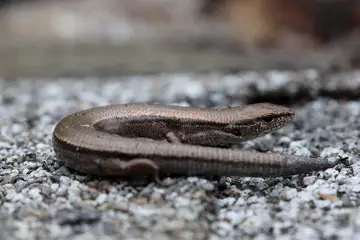
Little Brown Skink
Photo: Rstanton13 · CC BY-SA 4.0 · Wikimedia Commons · resized

Little Brown Skink

Scincella lateralis

Not stated

Venom
No official source we use states whether this animal is venomous. That does not mean it is harmless: do not handle it.
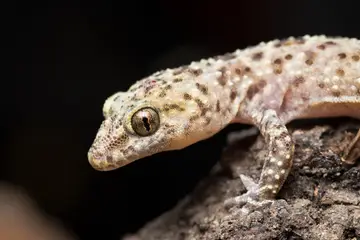
Mediterranean Gecko
Photo: Konstantinos Kalaentzis · CC BY-SA 4.0 · Wikimedia Commons · resized

Mediterranean Gecko

Not stated Nonnative

Venom
No official source we use states whether this animal is venomous. That does not mean it is harmless: do not handle it.
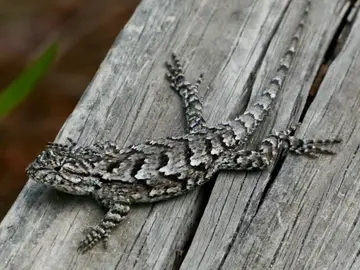
Northern Fence Lizard
Photo: John Matthew Erickson · CC BY 4.0 · iNaturalist

Northern Fence Lizard

Sceloporus undulatus hyacinthinus

Not stated

Venom
No official source we use states whether this animal is venomous. That does not mean it is harmless: do not handle it.
Size
About 4 to 7.25 inches total length (SREL, Ohio DNR); Illinois gives up to about 19 cm (7.5 in).
How to recognize it
  • Rough, spiny, keeled scales: the only native lizard in North Carolina (and in Georgia and South Carolina) that looks rough or spiny
  • Often on fences, trees, logs, stumps, rocks and buildings; dashes up a tree and keeps to the far side when approached
Where in Delaware
Recorded at Bombay Hook NWR US Fish and Wildlife Service
66 records by month.
What the sources say

Habitat: Rotting logs and open woodlands (US Fish and Wildlife Service)

Full Northern Fence Lizard guide

Lizards people confuse

Broad-headed skink or Common five-lined skink?

Broad-headed skink
Photo: Laura Gaudette · CC BY 4.0 · iNaturalist

Broad-headed skink Not stated

No confirmed photo of Common five-lined skink

Common five-lined skink Not stated

Young and females are very similar. Missouri: five-lined skinks do not grow as large, to only 5 to 8.75 inches. Illinois: the only reliable way to tell them apart is by counting lip scales, which usually requires a hand lens.

Photos show typical adults; individuals vary. Never get close to compare.

When lizards are active in Delaware

Records of lizards in Delaware peak in April to June and August. They show when people record lizards, not how many there are (about month bars).

323 records of lizards in Delaware by month (GBIF, CC0 and CC BY records).

How to report

Invasive aquatic species: report to the DNREC Division of Fish and Wildlife by phone, email or the online Invasive Fish Tracker. Invasive terrestrial species: Wildlife Section, 302-739-9912. Sick or dead wildlife (five or more at one place): 302-735-3600 ext. 2. Wildlife damage biologist: 302-735-8683. DNREC

About this list

The species list comes from Amphibians and Reptiles SGCN table (2025-2035 DEWAP) + USFWS Bombay Hook NWR Amphibians and Reptiles (Delaware Department of Natural Resources and Environmental Control (DNREC), DEWAP page modified 2025-12-16). 3 more entries come from other official sources named on each card.

Venom labels come only from official sources and link to them; "Not stated" never means harmless. How labels work.

"Nonnative" and "Invasive" follow the wording of the source list. See invasive species in Delaware.

Sources

  1. Delaware's Endangered Species. Delaware Department of Natural Resources and Environmental Control (DNREC). datePublished 2020-05-15, dateModified 2025-04-28; checked November 3, 2026.
  2. Amphibians and Reptiles (2025-2035 Delaware Wildlife Action Plan). Delaware Department of Natural Resources and Environmental Control (DNREC). datePublished 2025-09-09, dateModified 2025-12-16; checked November 3, 2026.
  3. Bombay Hook National Wildlife Refuge: Amphibians and Reptiles. U.S. Fish and Wildlife Service. archived copy, captured July 20, 2026; checked November 3, 2026.
  4. Gone Herpin' - DNREC Catalogs Delaware's Reptiles and Amphibians (Outdoor Delaware). Delaware Department of Natural Resources and Environmental Control (DNREC). published 2020-09-30, modified 2025-07-08; checked November 3, 2026.
  5. Invasive Aquatic Species. Delaware Department of Natural Resources and Environmental Control (DNREC). published 2020-02-11, modified 2025-02-03; checked November 3, 2026.
    Quoted passages (1)
    “It is also important to keep an eye out for invasive terrestrial species. They should be reported to the Wildlife Section, at 302-739-9912.”
  6. GBIF.org occurrence records, human observations licensed CC0 1.0 or CC BY 4.0 only, accessed November 3, 2026. The datasets behind these counts are listed on our Sources page.