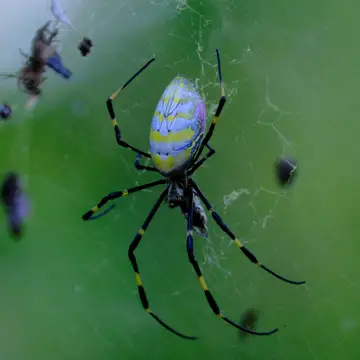
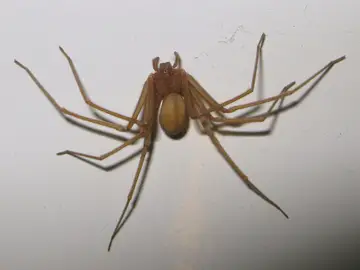
This page lists 7 spiders.
5 are venomous by official accounts. 2 are nonnative.
Not every species: no complete official list of Georgia spiders exists, so this page covers the ones state and Extension sources name. How lists are built.
Which spiders can hurt you
Official sources single out these spiders in Georgia, in their own words:
Venomous. “While spiders are beneficial in that they feed on various insects, there are at least two species in Georgia that are dangerous to humans. One is the black widow, which is very common throughout the state.” University of Georgia Cooperative Extension
Venomous (UGA Extension). “Georgia has three species of widow spiders: southern black, northern black and brown. … One notion about widow spiders is true: They are venomous.” University of Georgia CAES Field Report
All 7 spiders
Venomous species first, then A to Z. Do not handle them.
“While spiders are beneficial in that they feed on various insects, there are at least two species in Georgia that are dangerous to humans …” University of Georgia Cooperative Extension
Venom: “One notion about widow spiders is true: They are venomous.” (University of Georgia CAES Field Report)
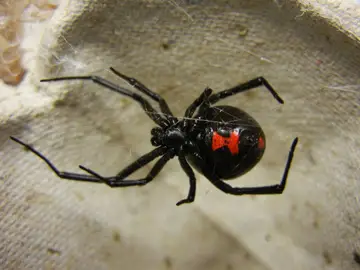
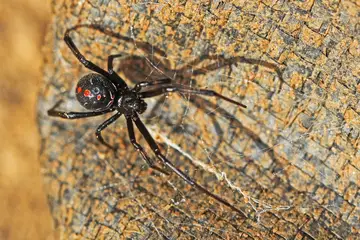
Habitat: This spider makes an irregular web in piles of trash and lumber, around rock borders, and in cracks and crevices around the foundations of homes. (University of Georgia Cooperative Extension)
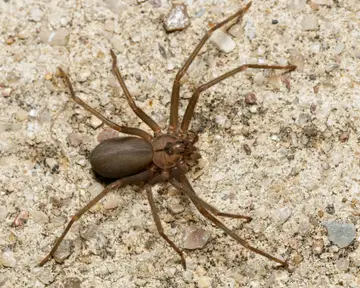
Body about 7 to 12 mm (about 3/8 inch); females average about 9 mm and males about 8 mm. UC IPM says a recluse body is not more than 3/8 inch long.
How to recognize it
Six equal-sized eyes in three pairs. UC IPM calls this the most definitive feature, since most spiders have eight eyes.
The violin mark alone is not a reliable way to identify it
UC IPM's five-point check: six eyes in pairs, evenly colored finely haired abdomen, no spines on the legs, evenly colored legs, body no more than 3/8 inch
Venom: “Brown recluse spider bites, on the other hand, cause tissue damage by salivary secretions in their venom and antibiotics have no effect on salivary secretions.” (UGA College of Agricultural and Environmental Sciences)
Range: North Georgia; source: "we document the spider's presence in 31 (19.5%) of Georgia's 159 counties, with almost all being found in the northern portion"; "collected almost exclusively north of the Fall Line"; "extremely rare in Georgia"
Habitat: Undisturbed areas inside buildings (e.g., under the basement steps, in unused clothing) or outside under rocks, piles of tires, under houses or under loose tree bark (Journal of Medical Entomology; hosted by UGA Department of Entomology)
Venom: “One notion about widow spiders is true: They are venomous.” (University of Georgia CAES Field Report)
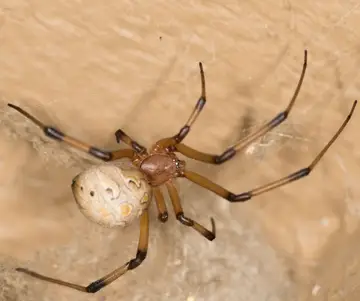
Habitat: "Outside, brown widows prefer woodpiles, tires, empty containers and eaves. Indoors, the spider prefers protected places like under furniture and in shoes." (University of Georgia CAES Field Report)
“The brown recluse is not a common Georgia spider and has limited distribution in the state.”
Are there black widows in Georgia?
Yes. UGA Extension says the black widow is very common throughout the state and is one of at least two spiders in Georgia dangerous to humans. University of Georgia Cooperative Extension
“One is the black widow, which is very common throughout the state.”
About this list
Venom labels come only from official sources and link to them; "Not stated" never means harmless. How labels work.
“While spiders are beneficial in that they feed on various insects, there are at least two species in Georgia that are dangerous to humans. One is the black widow, which is very common throughout the state.”
“The other species is the brown recluse, which is extremely rare in Georgia.”
“Reduce spiders by removing piles of wood and trash close to inhabited areas.”
“One is the black widow, which is very common throughout the state.”
Widow spiders: Why gardeners wear work gloves. University of Georgia CAES Field Report (UGA Cooperative Extension). published 2008-02-21; checked November 3, 2026.Quoted passages (2)
“One notion about widow spiders is true: They are venomous.”
“Georgia has three species of widow spiders: southern black, northern black and brown. … One notion about widow spiders is true: They are venomous.”
“The brown recluse is not a common Georgia spider and has limited distribution in the state.”
Brown recluse spider isn't typically a Southerner. UGA College of Agricultural and Environmental Sciences (CAES Field Report/newswire). February 19, 2009; checked November 3, 2026.Quoted passages (1)
“Brown recluse spider bites, on the other hand, cause tissue damage by salivary secretions in their venom and antibiotics have no effect on salivary secretions.”
“Eggs hatch during April and May. The spiders spend the summer growing and begin to mature in August and September (Figure 4). There is just one generation per year.”