Wood Turtle
Glyptemys insculpta · also called Redleg turtle and Sculptured turtle · Last checked November 3, 2026.
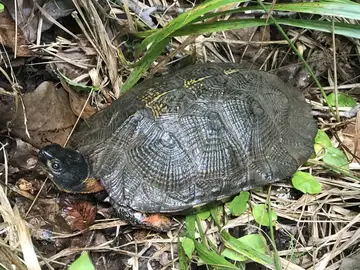
The wood turtle is a medium-sized freshwater turtle, about 5.5 to 8 inches long, with a rough, carved-looking brown shell and orange or reddish skin on the neck and legs. It lives along clear streams and nearby woods and fields in the Northeast, the mid-Atlantic and the Great Lakes states. Michigan DNR says turtles are harmless to humans, although, like any wild animal, they may bite to protect themselves. It is a protected or listed species in many states, and USFWS lists its federal status as under review. MassWildlife
On this page
Is the wood turtle dangerous?
Michigan DNR, about turtles in general: harmless to humans, although like any wild animal they may bite to protect themselves. Michigan Department of Natural Resources
“Turtles are harmless to humans, although like any wild animal, they may bite to protect themselves.”
Bites and stings: Michigan DNR (all turtles): may bite to protect themselves. MassWildlife: males chase and bite each other in the mating season.
How to identify a wood turtle
A photo or description can narrow it down, but cannot confirm what an animal is or that it is safe. Look from a distance and do not handle wild animals.
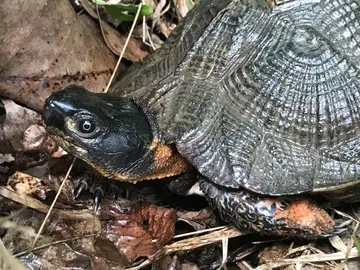
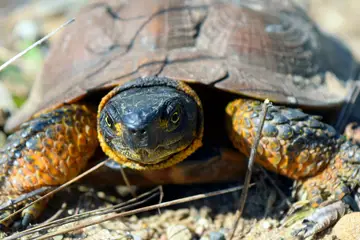

Size: 14-20 cm (5.5-8 in) MassWildlife
Colors: Shell brown, tan or grayish-brown; orange on the legs and neck; in Massachusetts the forelegs are rich orange-red; underside of chin and legs bright yellow, orange or red. Pattern: Each shell plate rises in a pyramid of grooves and ridges (carved, 'woodworked' look); lower shell cream to yellow with dark patches at the outer rear corner of each plate.
Key features
- Lower shell has no hinge Pennsylvania Fish and Boat Commission
- Combination of brown shell, orange front limbs and a lower shell solidly fused to the upper shell MassWildlife
- Males: concave lower shell, long thick tail, broader head MassWildlife
Young
Hatchlings have a dull, broad, low shell, a tail almost as long as the shell, and no orange on the neck and legs.
Animals mistaken for the wood turtle
Wood Turtle or Eastern Box Turtle?
Wood Turtle
Eastern Box Turtle Terrapene carolina
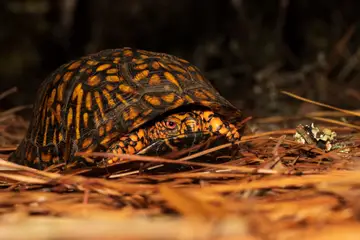
Box turtles are smaller and have a hinged lower shell that closes completely. MassWildlife
Wood Turtle or Blanding's Turtle?
Wood Turtle
Blanding's Turtle Emydoidea blandingii
Young Blanding's turtles can look sculpted, but have a bright yellow throat and no orange forelimbs. MassWildlife
Wood Turtle or Bog Turtle?
Wood Turtle
Bog Turtle Glyptemys muhlenbergii
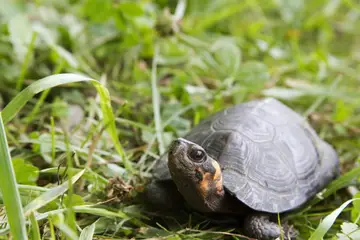

Bog turtles have a distinctive orange blotch on the side of the head. MassWildlife says they are exceedingly rare and, in Massachusetts, found only in Berkshire County. MassWildlife
Where the wood turtle lives
- Native or listed
- Nonnative or not established
- No official record in our data
- 1–9
- 10–99
- 100–999
- 1,000+
On our state guides
- Connecticut turtles
- Delaware turtles
- Iowa turtles
- Maine turtles
- Maryland turtles
- Michigan turtles
- Minnesota turtles
- New Hampshire turtles
- New Jersey turtles
- New York turtles
- Pennsylvania turtles
- Rhode Island turtles
- Vermont turtles
- Virginia turtles
- West Virginia turtles
- Wisconsin turtles
State boundaries: U.S. Census Bureau, cartographic boundary file cb_2024_us_state_20m.
When it is active
Active season April to October; overwinters in flowing rivers and streams. New Jersey: active late March or early April through October, mostly morning and late afternoon/evening. MassWildlife
US open-licence records peak in April to June.
Habitat and habits
Habitat: Small to mid-sized perennial streams with a current, and nearby riparian clearings, wetlands, forests and fields; seldom far from cool, clear streams. MassWildlife
Behavior: 'Worm stomping': alternately stomps its front feet to make vibrations that bring earthworms to the surface.
Diet: Opportunistic omnivore eating plant and animal food on land or in water; Iowa DNR lists berries, dandelions, insects, earthworms, mollusks and carrion.
Young: Massachusetts: nesting mainly in June, one clutch a year averaging 7 eggs, hatchlings emerge August-September; adults can live more than 50 years and take more than a decade to mature.
Legal status and reporting
Federal: USFWS ECOS lists the wood turtle as 'Under Review' (not listed under the Endangered Species Act). ECOS
Protection: State-listed in many states (e.g. threatened in MI, MN, NJ and WI; special concern in MA, ME, PA and VT). Massachusetts: keeping wood turtles as pets is illegal and any handling requires a permit from MassWildlife. MassWildlife
Report: Massachusetts: report sightings with photos to MassWildlife's Heritage Hub. Maine: submit observations to the Maine Amphibian & Reptile Atlas Project. Michigan: report turtle sightings to MIHerpAtlas.org. MassWildlife
Questions about the wood turtle
Wood turtle
A medium-sized freshwater turtle (5.5 to 8 inches) with a rough, sculpted brown shell and orange on the legs and neck, found near clear streams from New England and the mid-Atlantic to the Great Lakes and eastern Minnesota. It is listed as threatened or of special concern in many states, and USFWS lists it as under review.
Sources
- Wood turtle. MassWildlife (Massachusetts Division of Fisheries and Wildlife). archived copy, captured September 2, 2025; checked November 3, 2026.
Quoted passages (14)
“The wood turtle is a medium-sized freshwater turtle (14–20 cm; 5.5–8 in) recognized by orange coloration on the legs and neck.”
“The wood turtle is distinctive in its combination of a typically brown shell, orange front limbs, and plastron fused solidly to the carapace by a bony ‘bridge.’”
“Males have an oval, concave shape to their plastron, a thick and long tail, and a broader and more robust head than females.”
“Hatchlings have a dull-colored shell that is broad and low, a tail that is almost as long as their carapace, and neck and legs that lack orange coloration.”
“Wood turtles are strongly associated with small- to mid-sized perennial streams, often with a noticeable current.”
“Wood turtles are opportunistic omnivores; they feed readily on both plant and animal material found on land or in the water.”
“The wood turtle occasionally exhibits a remarkable feeding behavior referred to as ‘worm stomping,’ in which they will stomp on the ground, alternating their front feet to create vibrations in the ground that mimic rainfall.”
“During the active season from April to October, wood turtles are usually encountered within a few hundred meters of the stream banks.”
“Nesting in Massachusetts occurs over a four-week period, primarily in June. … Female wood turtles lay one clutch a year … Clutch size in Massachusetts averages 7 eggs. Hatchling emergence occurs from August through September. The life span of the adult wood turtle exceeds 50 years”
“Any handling of wood turtles will require a permit from MassWildlife.”
“Sightings should be reported to MassWildlife’s Heritage Hub with photo documentation.”
“Eastern box turtles are smaller than wood turtles and have a hinged plastron that allows them to completely enclose their limbs and head when threatened.”
“…while young Blanding’s turtles can have a shell that appears ‘sculpted,’ their throat is bright yellow and they lack the typical orange forelimb coloration of the wood turtle.”
“…bog turtles are exceedingly rare and only found in Berkshire County, and they have a distinctive orange ‘blotch’ on the side of the head.”
- Turtles (Michigan DNR species page). Michigan Department of Natural Resources. archived copy, captured April 13, 2026; checked November 3, 2026.
Quoted passages (1)
“Turtles are harmless to humans, although like any wild animal, they may bite to protect themselves.”
- USFWS ECOS species report: Scientific Name like 'Glyptemys%' (ESA listing status). U.S. Fish and Wildlife Service (ECOS). database queried November 3, 2026; checked November 3, 2026.
Quoted passages (1)
“Wood turtle … Glyptemys insculpta”
- Turtles (species accounts). Pennsylvania Fish and Boat Commission. undated page; checked November 3, 2026.
Quoted passages (1)
“The plastron is hingeless and can aid in distinguishing this turtle from the box and Blanding's turtles”
- Minnesota Rules 6134.0200 Animal Species (endangered, threatened, special concern). Minnesota Office of the Revisor of Statutes (rules of the Minnesota DNR). Published Electronically: October 8, 2013; checked November 3, 2026.
- GBIF.org occurrence records, human observations licensed CC0 1.0 or CC BY 4.0 only, accessed November 3, 2026. The datasets behind these counts are listed on our Sources page.
- State boundaries: U.S. Census Bureau, cartographic boundary file cb_2024_us_state_20m.