This page lists 5 spiders: 3 from Clemson Cooperative Extension, Home & Garden Information Center's Widow Spiders in South Carolina and Brown Widow Spiders, plus CDC/NIOSH Venomous Spiders at Work; no SC checklist exists and 2 named in other official sources.
3 are venomous by official accounts. 1 is nonnative.
Not every species: no complete official list of South Carolina spiders exists, so this page covers the ones state and Extension sources name. How lists are built.
Which spiders can hurt you
Official sources single out these spiders in South Carolina, in their own words:
Adult female body about 8-12 mm (0.3-0.5 in); UC IPM gives about 3/8 in (10 mm), smaller than a mature western black widow. Clemson (2003) gives 1 to 1 1/2 in with legs extended. Males are tiny, 2-5 mm.
How to recognize it
Spiky egg sac (covered in silk points, like a pollen grain or sandspur; about 10 mm per LSU AgCenter, 1/2 in per Clemson 2003) is diagnostic even without the spider
Venom: “All three types of widow spiders have venom that is toxic to people.” (Clemson Cooperative Extension, Home & Garden Information Center)
Habitat: Usually is found outdoors under stones, logs, or other dark, protected areas in and around buildings (Clemson Cooperative Extension, Home & Garden Information Center)
No confirmed photo of Coyle's Purseweb Spider
Coyle's Purseweb Spider
Sphodros coylei
Not stated
Venom
No official source we use states whether this animal is venomous. That does not mean it is harmless: do not handle it.
Conservation
SC SWAP priority species (2015 list)
No confirmed photo of Wolf spiders (group)
Wolf spiders (group)
Not stated
Venom
No official source we use states whether this animal is venomous. That does not mean it is harmless: do not handle it.
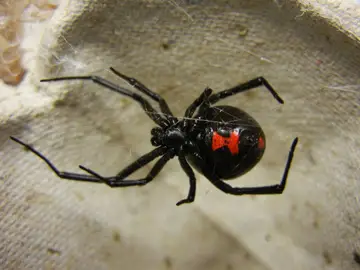
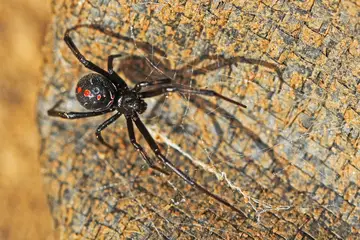
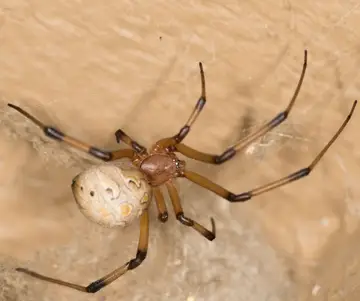
Adult female black widows are usually shiny black with red markings; very dark brown widows are flat black. The brown widow hourglass is usually orange to yellow-orange, but do not rely on color alone: UF/IFAS shows a brown widow with a red hourglass, Clemson says usually orange or red-orange, and black widow markings vary (northern black widows have two red spots; a western black widow's red can be almost imperceptible or absent). Brown widow egg sacs are spiky; Clemson (2003) and UF/IFAS Sarasota describe black widow sacs as smooth, and Clemson (2026) says the southern black widow's sac has a single small point.
Photos show typical adults; individuals vary. Never get close to compare.
When spiders are active in South Carolina
Records of spiders in South Carolina peak in June to October. They show when people record spiders, not how many there are (about month bars).
JanFebMarAprMayJunJulAugSepOctNovDec
2,145 records of spiders in South Carolina by month (GBIF, CC0 and CC BY records).
If you are bitten or stung
Call 911 or Poison Help at 1-800-222-1222 right away. Poison Help connects you to your local poison center, any time of day.
What official sources say
Are there black widows in South Carolina?
Yes. Three widow spiders occur: southern black widow (Latrodectus mactans, statewide), northern black widow (L. variolus, mainly Piedmont and Upstate) and the non-native brown widow (L. geometricus, statewide, densest on the coast). Clemson Cooperative Extension, Home & Garden Information Center
“There are three species of widow spiders in South Carolina: the southern black widow (Latrodectus mactans), the northern black widow (L. variolus), and the brown widow (L. geometricus).”
Are there brown recluse spiders in South Carolina?
CDC says only that the species is venomous and lives in the midwestern and southern US. CDC/NIOSH
Reptiles and Amphibians of SC. South Carolina Department of Natural Resources. page footer 2020; checked November 3, 2026.
Widow Spiders in South Carolina (HGIC 2518). Clemson Cooperative Extension, Home & Garden Information Center. Published Sep 17, 2026; checked November 3, 2026.Quoted passages (3)
“All three types of widow spiders have venom that is toxic to people.”
“All three types of widow spiders have venom that is toxic to people. … The bite from a brown widow spider is much less severe to people.”
“There are three species of widow spiders in South Carolina: the southern black widow (Latrodectus mactans), the northern black widow (L. variolus), and the brown widow (L. geometricus).”
Venomous Spiders at Work. CDC/NIOSH. page dated Sept. 28, 2026; checked November 3, 2026.Quoted passages (2)
“The venom is a neurotoxin that produces pain at the bite area and then spreads to the chest, abdomen, or the entire body.”
“In the midwestern and southern United States.”
Brown Widow Spiders (HGIC 2474). Clemson University Cooperative Extension, Home & Garden Information Center. Published Apr 6, 2003; checked November 3, 2026.
Wolf Spiders (HGIC 2450). Clemson University Cooperative Extension, Home & Garden Information Center. Published May 2, 2001; checked November 3, 2026.