Southern toad
Anaxyrus terrestris · also called Bufo terrestris and Bufo (Anaxyrus) terrestris · Last checked November 3, 2026.
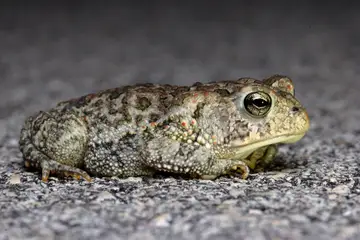

The southern toad is a native, medium-sized warty toad of the Southeast, averaging 1.6 to 2.9 inches long and reaching about 3.5 to 4 inches, brown, gray, reddish or blackish, best known by the tall ridges (cranial crests) on its head that end in knobs, giving it a "horned" look. It lives on sandy soils below the Fall Line from southeastern Virginia through the Carolinas and Georgia to Florida and west to eastern Louisiana, including yards, fields and pine woods, and is most active at night in the warmer months. It releases a toxic skin secretion from the glands behind its eyes, which Alabama's wildlife agency says can sometimes irritate human mucous membranes. In Florida it can be confused with the invasive cane toad, which is far larger and dangerous to pets; UF/IFAS says the southern toad's small oval glands are no danger to pets. University of Georgia Savannah River Ecology Laboratory
On this page
Is the southern toad dangerous?
Alabama Department of Conservation and Natural Resources: toads do not give people warts, but the southern toad's bufotoxin can, in some cases, irritate human mucous membranes. Outdoor Alabama
“However, the bufotoxin secreted from the parotoid glands can, in some cases, cause some irritation to human mucous membranes.”
No official source we use states whether this animal is venomous. That does not mean it is harmless: do not handle it.
If someone is bitten or stung, call 911 or Poison Help at 1-800-222-1222.
How to identify a southern toad
A photo or description can narrow it down, but cannot confirm what an animal is or that it is safe. Look from a distance and do not handle wild animals.
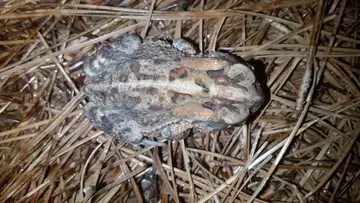
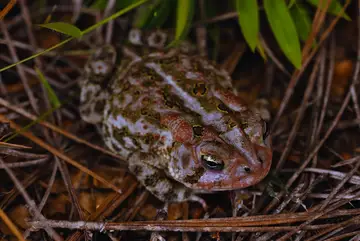

Size: Usually 1.6 to 2.9 inches (SREL), with official ranges up to 3.5 inches (Virginia DWR) or 4 inches (Alabama); island populations can reach 4.4 inches. FWC: maximum of about 3 to 4 inches. Females are larger than males. University of Georgia Savannah River Ecology Laboratory
Colors: brown, gray, reddish, blackish and tan. Pattern: dark blotches with warts; light stripe down back (sometimes); warty.
Key features
- High ridges (cranial crests) on the head that end in raised knobs in front of the glands behind the eyes, giving a "horned" look. NCWRC: this is the easiest way to tell it from American and Fowler's toads. University of Georgia Savannah River Ecology Laboratory
- Large, elongated (Alabama: kidney-shaped) parotoid glands behind the eyes; UF/IFAS describes them as small and oval compared with the cane toad's large triangular glands. University of Georgia Savannah River Ecology Laboratory
- A faint light stripe may run down the middle of the back. University of Georgia Savannah River Ecology Laboratory
- Males are smaller than females and have dark throats (SREL: in breeding season). N.C. Wildlife Resources Commission
- Call: a shrill, high-pitched trill of 2 to 8 seconds (Virginia DWR: 5 to 10), higher than the American toad's. University of Georgia Savannah River Ecology Laboratory
Young
Tadpoles are small and blackish and turn into toadlets in about 4 to 8 weeks. The head crests are not obvious in southern toads smaller than about 1 inch, and in Florida toadlets of the different toads, including the cane toad, are very hard to tell apart.
Animals mistaken for the southern toad
Southern toad or Cane toad?
Southern toad
Cane toad Rhinella marina
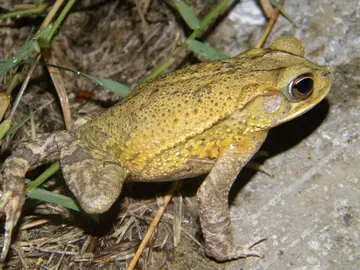

Adult cane toads are much bigger (6 to 9 inches, FWC; 3 to 6 and up to 9, UF/IFAS); southern toads reach only about 3 to 4 inches. Southern toads have clear ridges or 'horns' above the eyes and a small oval gland behind each eye; cane toads have no crests and a large, triangular gland that tapers back to a point. Young cane toads are raisin-sized and hard to tell from native toadlets. FWC
Invasive in Florida and highly toxic: FWC says its secretions can sicken or kill pets that bite it and may irritate skin or burn the eyes of people.
Southern toad or Oak toad?
Southern toad
Oak toad Anaxyrus quercicus
The oak toad is tiny (never over 1.5 inches, UF/IFAS) with a bold light stripe from snout down the back and indistinct head crests; NCWRC notes young southern toads are often mistaken for oak toads. UF/IFAS Extension
Native; UF/IFAS: small oval poison glands, no danger to pets.
Southern toad or Fowler's toad?
Southern toad
Fowler's toad Anaxyrus fowleri
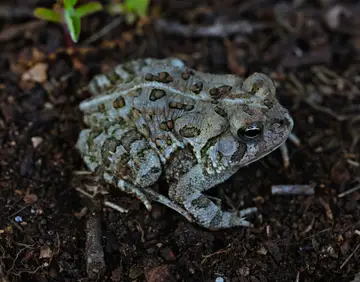

Fowler's toad has smaller cranial ridges than the southern toad; the southern toad's crests end in large knobs. They may hybridize where ranges overlap. University of Georgia Savannah River Ecology Laboratory
Southern toad or American toad?
Southern toad
American toad Anaxyrus americanus
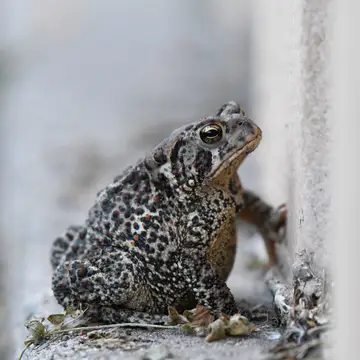

The southern toad is most easily told by the large knobs on its pronounced head crests; its trill is shorter and higher-pitched than the American toad's. They may hybridize where ranges overlap. N.C. Wildlife Resources Commission
Where the southern toad lives
- Native or listed
- Nonnative or not established
- No official record in our data
- 1–9
- 10–99
- 100–999
- 1,000+
On our state guides
- Alabama frogs and toads
- Florida frogs and toads
- Louisiana frogs and toads
- Mississippi frogs and toads
- North Carolina frogs and toads
- South Carolina frogs and toads
- Virginia frogs and toads
State boundaries: U.S. Census Bureau, cartographic boundary file cb_2024_us_state_20m.
When it is active
Mostly nocturnal: seen and heard through the warmer months, spending days in burrows and foraging and mating at night. In winter it stays inactive (torpor) in burrows about a foot deep. Outdoor Alabama
US open-licence records peak in April to August.
Habitat and habits
Habitat: A wide range of land habitats on sandy soils, including pine woodlands, coastal scrub, hammocks, farm fields and residential areas; also marshes and swamps. Often seen on roads. Needs shallow standing water to breed. University of Georgia Savannah River Ecology Laboratory
Behavior: Hides by day under logs, leaf litter or in burrows; when threatened it can puff up its body. Predators include hognose and water snakes. Its activity area may span a mile.
Diet: Adults eat small invertebrates such as beetles, ants, cockroaches, crickets and snails, caught with a fast, sticky tongue; tadpoles eat algae, plants and detritus.
Young: Breeds February to October depending on latitude (Alabama and Virginia: March to September), peaking with warm spring rains, in shallow wetlands, ditches and even tire ruts. Females lay 2,500 to 4,000 eggs in long jelly strings that hatch in 2 to 4 days; tadpoles transform in 30 to 55 days. Mature at 2 to 3 years; lives at least 10 years.
Legal status and reporting
Protection: SREL: widespread and common, not legally protected in its range. North Carolina: nongame species with no open season; collecting is limited without a license. Louisiana lists it as a Species of Greatest Conservation Need (S3). University of Georgia Savannah River Ecology Laboratory
Invasive status: Native, not invasive; in Florida it declines where invasive cane toads arrive. University of Georgia Savannah River Ecology Laboratory
Questions about the southern toad
Cane toad vs southern toad
Size and head shape. Adult cane toads are 6 to 9 inches; southern toads only about 3 to 4. Southern toads have ridges or 'horns' above the eyes and a small oval gland behind each eye; cane toads have no crests and a large triangular gland. Cane toads are highly toxic and can kill pets; UF/IFAS says southern toad glands are no danger to pets. Toadlets of both are very hard to tell apart, and FWC asks people to be sure a toad is not a native southern toad before removing it.
Southern toad
A native toad of the Southeast, averaging 1.6 to 2.9 inches and reaching about 3.5 to 4, brown to gray, reddish or blackish, with knobbed head crests. It lives from southeastern Virginia to Florida and eastern Louisiana, mostly on sandy soils, and is active at night in warm months. Its skin secretion can irritate human mucous membranes, according to Alabama's wildlife agency.
Sources
- Southern Toad (Bufo [Anaxyrus] terrestris). University of Georgia Savannah River Ecology Laboratory (linked by SCDNR as its species information). undated page; checked November 3, 2026.
Quoted passages (10)
“A medium-sized toad averaging 41–75 mm (1.6–2.9 in) in length, though insular populations may reach 113 mm (4.4 in).”
“Distinctive high cranial crests terminate in prominent knobs projecting upward in front of the parotoids, giving the species a ‘horned’ appearance.”
“Parotoid glands are large and elongated, positioned behind the eyes.”
“A faint mid-dorsal stripe may be present.”
“A shrill, high-pitched trill lasting 2–8 seconds at ~75 notes per second. Higher in pitch than the call of the American Toad.”
“Occupies a wide range of terrestrial habitats associated with sandy soils, including pine woodlands, coastal scrub, hammocks, agricultural fields, and residential areas. Requires shallow standing water for breeding.”
“Predators include snakes (particularly hognose and water snakes), turtles, giant water bugs, and wading birds.”
“Breeding occurs from February to October, depending on latitude, but peaks in spring with warm, rainy weather.”
“Declines have been noted in areas of Florida where invasive Cane Toads (Rhinella marina) compete with or prey upon them.”
“It is widespread and common. It is not legally protected within its range and is adaptable to suburban and agricultural landscapes.”
- Southern Toad (Species profile). Virginia Department of Wildlife Resources. updated January 22, 2024; checked November 3, 2026.
- Southern Toad. Alabama Department of Conservation and Natural Resources (Outdoor Alabama). undated page; checked November 3, 2026.
Quoted passages (3)
“However, the bufotoxin secreted from the parotoid glands can, in some cases, cause some irritation to human mucous membranes.”
“…the southern toad will eat small invertebrates, such as beetles, ants, cockroaches, crickets, snails, and anything else that they can swallow.”
“During the warmer months the southern toads spend much of their time seeking refuge in their burrows during the day while foraging and mating at night.”
- WEC387 The Cane or "Bufo" Toad (Rhinella marina) in Florida. UF/IFAS Extension (EDIS). Original July 2017; checked November 3, 2026.
Quoted passages (1)
“Never larger than 1.5 inches—Florida's smallest toad”
- Cane Toad (species profile). Florida Fish and Wildlife Conservation Commission (FWC). archived copy, captured October 13, 2026; checked November 3, 2026. Archived copy.
Quoted passages (1)
“Southern toads will have well defined cranial crests which look like ridges or horns above their eyes and a small, oval shaped gland visible behind their eyes. Cane toads do not have crests above their eyes and possess a larger, triangular shaped gland behind their eye.”
- Southern Toad (NCWRC species page). N.C. Wildlife Resources Commission. undated page; checked November 3, 2026.
Quoted passages (3)
“Males are smaller than females and have dark throats.”
“Eggs hatch in about a week or less. The small, blackish tadpoles transform in about 4 to 8 weeks.”
“The southern toad's call is a long trill resembling that of American toads but usually shorter in duration and slightly higher in pitch.”
- Fowler’s Toad (Bufo [Anaxyrus] fowleri). University of Georgia Savannah River Ecology Laboratory (linked by SCDNR as its species information). undated page; checked November 3, 2026.
Quoted passages (1)
“Cranial ridges are smaller than the Southern Toad (A. terrestris).”
- GBIF.org occurrence records, human observations licensed CC0 1.0 or CC BY 4.0 only, accessed November 3, 2026. The datasets behind these counts are listed on our Sources page.
- State boundaries: U.S. Census Bureau, cartographic boundary file cb_2024_us_state_20m.